

Who Goes There? Deluxe Edition, designed by Jon Gilmour and published by Certifiable Studios, doesn’t so much invite you into a game as it quietly locks the door behind you and waits to see how long it takes before trust breaks down entirely.
From the outset, it presents itself as a cooperative survival experience — but it doesn’t take long before that label starts to feel more like a suggestion than a promise. Based on the novella that inspired The Thing, Who Goes There? is a quietly seductive exercise in mistrust.
Imagine, for a moment, a wooden cabin in the heart of Yorkshire. Four friends sit around a large oak table, moving pieces across a board, collecting cards, rolling dice. Working together… on the surface. For a time, the cooperation is genuine. We are all there to survive. But quickly, suspicion creeps in. At first, it’s a possibility — there might be a Thing among us. Then, slowly but surely, it becomes a certainty. That’s when Who Goes There? reveals its true quality.
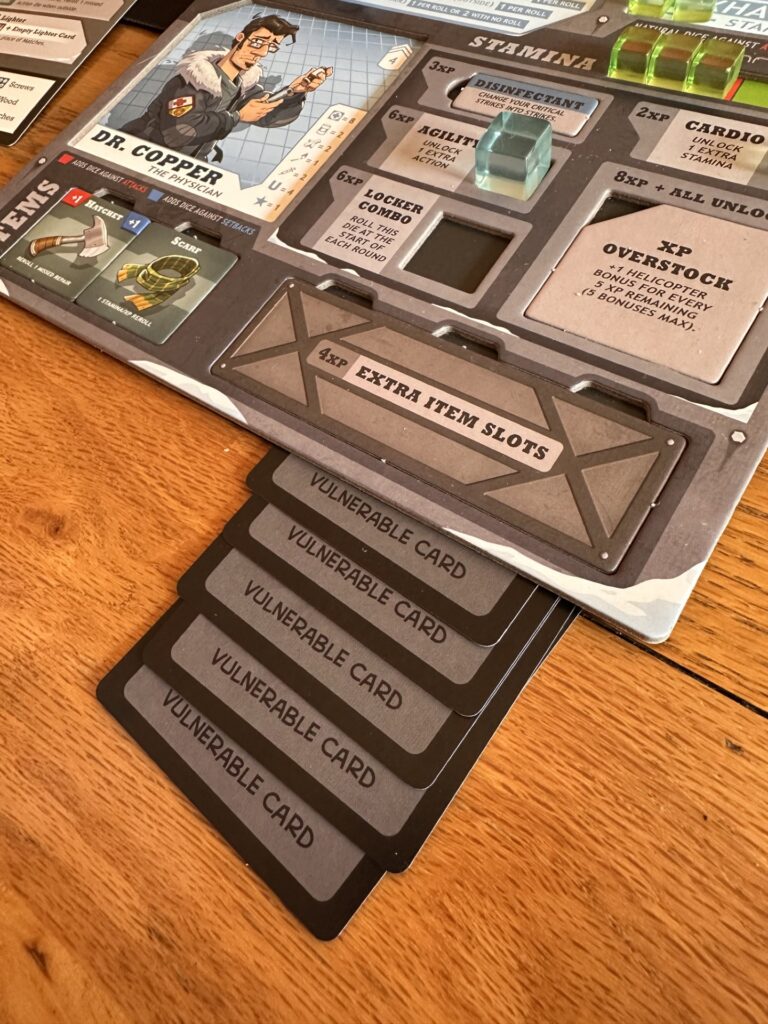
The game’s greatest strength is that sense of gradual erosion. In many hidden traitor games such as Battlestar Galactica or Dead of Winter, you begin knowing there is a betrayer. Trust is therefore always conditional. Who Goes There?, however, seeps into you. Certain actions — failing events or attacks — force players to draw from a pool of twelve Vulnerable cards. Eleven are harmless. One is not. Draw the blood-stained card, and from that moment on, you are the Host.
What’s particularly clever is that your objective doesn’t change. Everyone—infected or not—is still trying to escape and reach civilisation. Unlike other betrayal games where a traitor’s behaviour can give them away, here the deception is far subtler. You are all working toward the same visible goal, which makes suspicion feel uncomfortable rather than obvious.
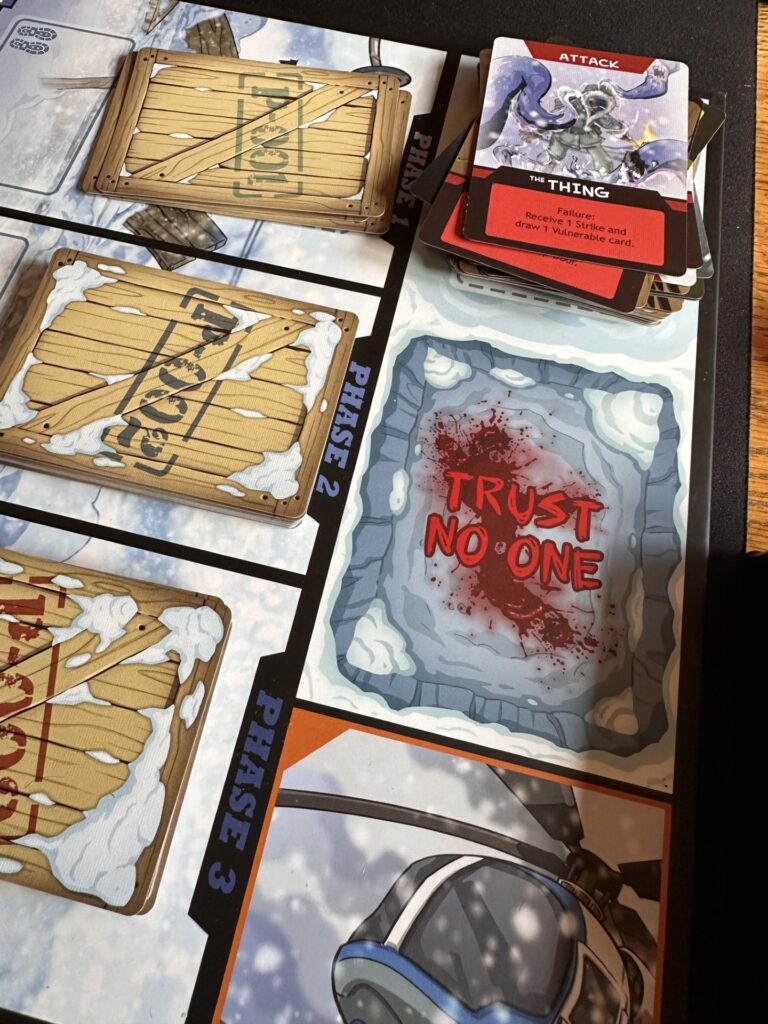
The board itself is divided into two key areas: inside and outside. Indoors, players search the Storage and Workshop decks, gathering items, consumables, and resources for crafting. Outside, things become more dangerous—and more rewarding. Three exploration decks unlock across the game’s three tiers, offering greater experience and opportunities, but also increasing risk. Searching the Phase Deck can grant helicopter bonuses (essential for victory), but may also trigger a Thing attack. Fail, and you’ll be drawing from that increasingly ominous Vulnerable deck.
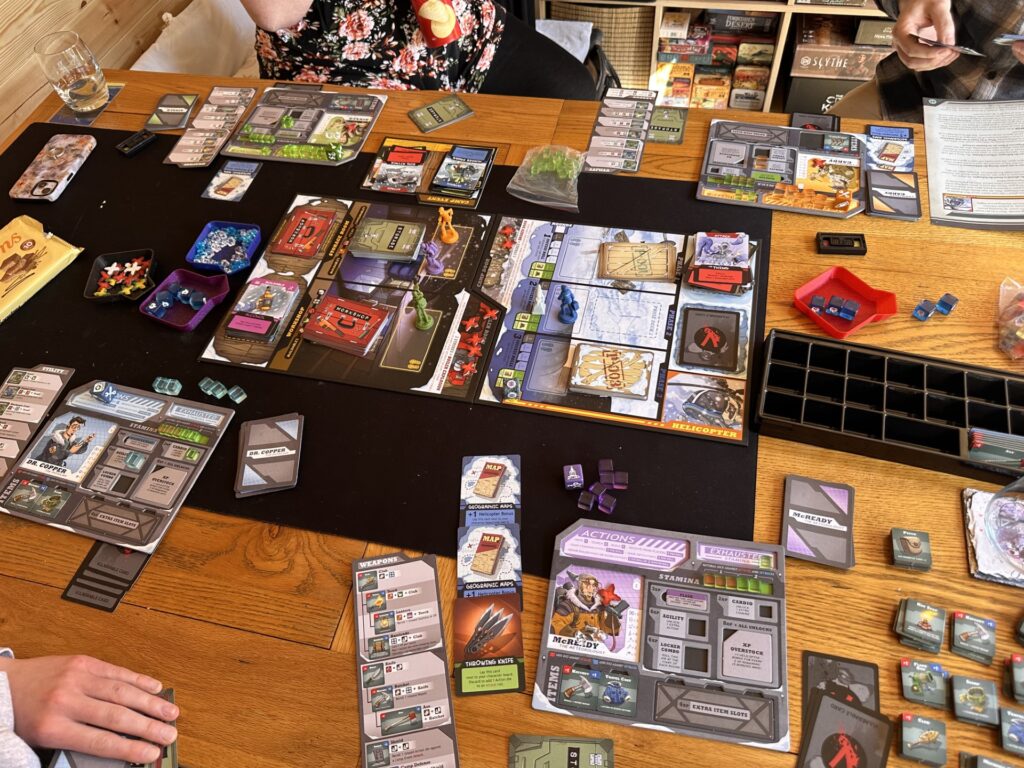
Staying outside brings faster progression—but at a cost. Stamina drops quickly, reducing your dice pool and making success less likely. It’s a constant balancing act between risk and survival, ambition and caution.
As our own game unfolded, the tension became palpable. I had three Vulnerable cards. My friend to the right—playing as Garry—also had three, and held the power of deciding who would board the helicopter. Kinner had one. Dr. Copper had five. Statistically, suspicion fell heavily on Copper — though inconveniently, he was the only one with a testing kit. Were we right to doubt him? Or were the numbers misleading us? Things were not helped by the use of the testing kit, and the other player selected, Kinner, was the other player we didn’t trust. So of course, there came a case of “no no no, you are the thing” that confirmed a slither, but left a chasm in us, thirsting for the truth.
Each round is broken into phases, including eating and sleeping. During the eating phase, players must consume food or take wounds — three wounds, and you’re out. Given that many failed tests also deal damage, survival is always precarious. The sleeping phase, however, is where things become truly uncomfortable.
Players must share a space—and this is where the “clicker” comes in. It’s one of the game’s most inspired physical components. Instead of simply showing allegiance cards, players use a hidden slider device to conceal or reveal their status. When you share a space (or trade), you exchange clickers, allowing another player to see your condition—unless you successfully resist it. Of course, if the person you’re interacting with is infected, you may not like what you discover… or what happens next.
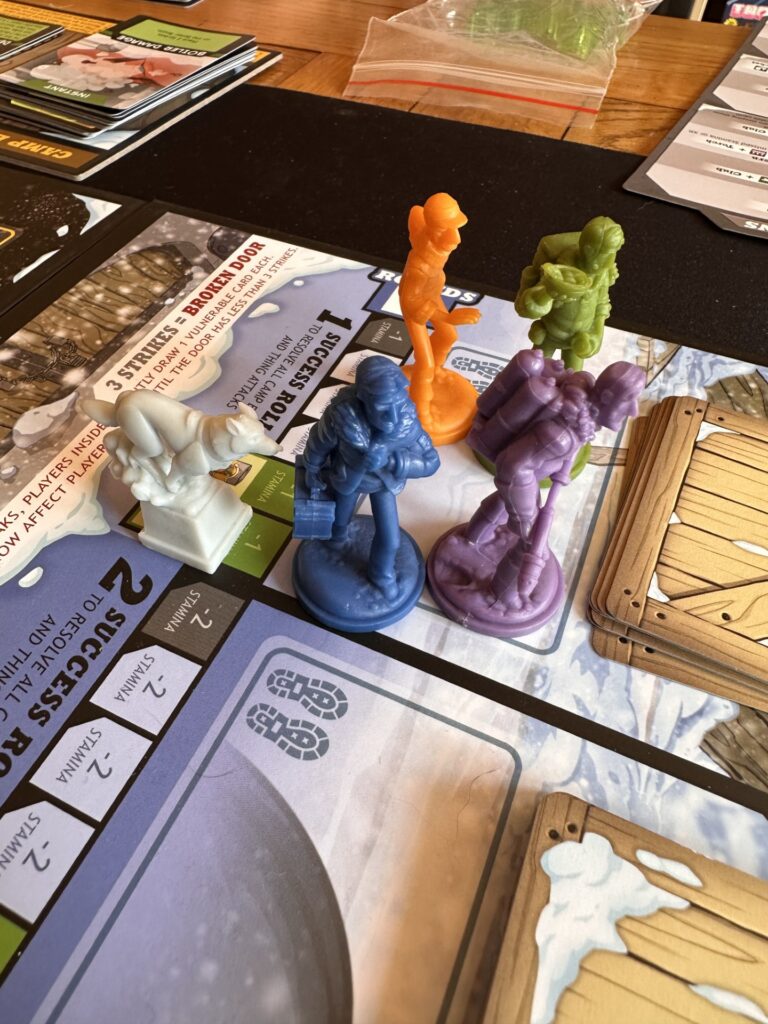
If you survive long enough, the endgame arrives: The helicopter. The leader chooses who boards, and multiple outcomes are possible. Everyone on board is infected? Not enough biomass to survive. Too few helicopter bonuses? The survivors are lost in the wilderness. Success requires both trust and preparation — two things the game has spent hours systematically dismantling.
In our case, we made our choice. Dr. Copper and Kinner were left behind. The rest of us boarded, convinced we had made the right call. Two humans escaping to warn civilisation of what remained in the snow.
Or so we thought.
Who Goes There? is a remarkable production. The Deluxe Edition is lavish — arguably excessive — but undeniably impressive. The miniatures are detailed, the artwork sharp and evocative, reminiscent of titles like Dredge or Deep Regrets, with a bold, unsettling edge that perfectly captures the theme. Much like bringing a flamethrower to Antarctica, it’s not strictly necessary — but it certainly enhances the experience.
This is not a light game. Expect roughly an hour per player, factoring in discussion, suspicion, and the slow paralysis of decision-making under pressure. I wouldn’t say all players take a long time to decide what to do, but you know who you are. However, there is one aspect that remains difficult to overlook: Player elimination.
Early in our game, two players—including myself—were dangerously close to being knocked out. Had that happened, it would have left someone sitting idle for hours while the game continued. For a game of this length, that’s a significant flaw. While it didn’t ultimately affect our session, the risk alone feels poorly mitigated.
In the end, none of us died. The humans won. And, of course, the player with a single Vulnerable card — the least suspicious of all — had been the Host, sorry for doubting you for so long Copper, but then again, you did get turned in the end, so I was pre-emptively correct.
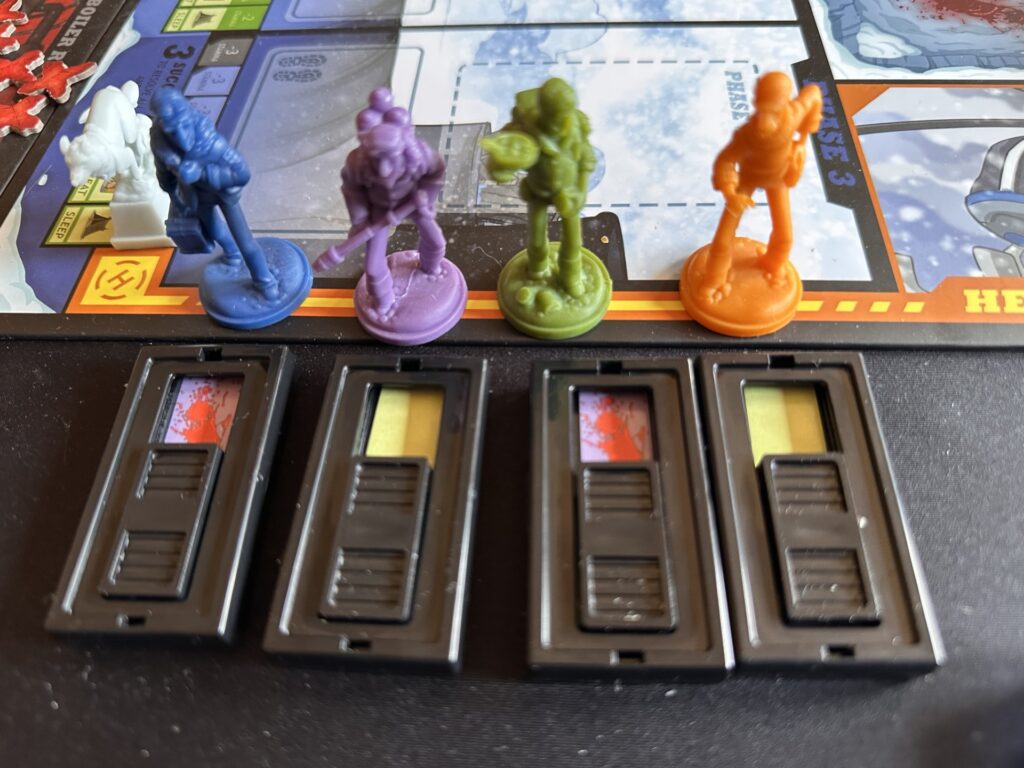
Our time with Who Goes There? was tense, nerve-wracking, and thoroughly absorbing. And when it was over, we stepped away from the table, left the cabin, and went for dinner.
Although perhaps holding our knives just a little closer than before.
You can find out more about Who Goes There? on the Kickstarter page for its second edition.
