

I love the idea of illuminated manuscripts. That fascination has only grown thanks to my other half, who knows far more than I do about the period they were created in. In 2023, those of us tempted by a good videogame were treated to the excellent Pentiment, more recently we had Scriptorium, and now Inkwell has arrived on the tabletop. Needless to say, I was rather excited to get it to the table.
Designed by Jasper Beatrix, Lewis Graye and Joey Palluconi and published by DVC Games, Inkwell had already won me over before I even opened the box. It comes in a compact package that looks and feels like an illuminated manuscript itself, making it one of those games you immediately want to pick up. The closest comparison in both style and accessibility is probably Azul. Over the years, Azul has become one of those gateway games that seems to live on every board gamer’s shelf, and for good reason. But maybe its time to put those tiles down and pick up your ink and page as Inkwell has entered the abbey and I think its here to stay.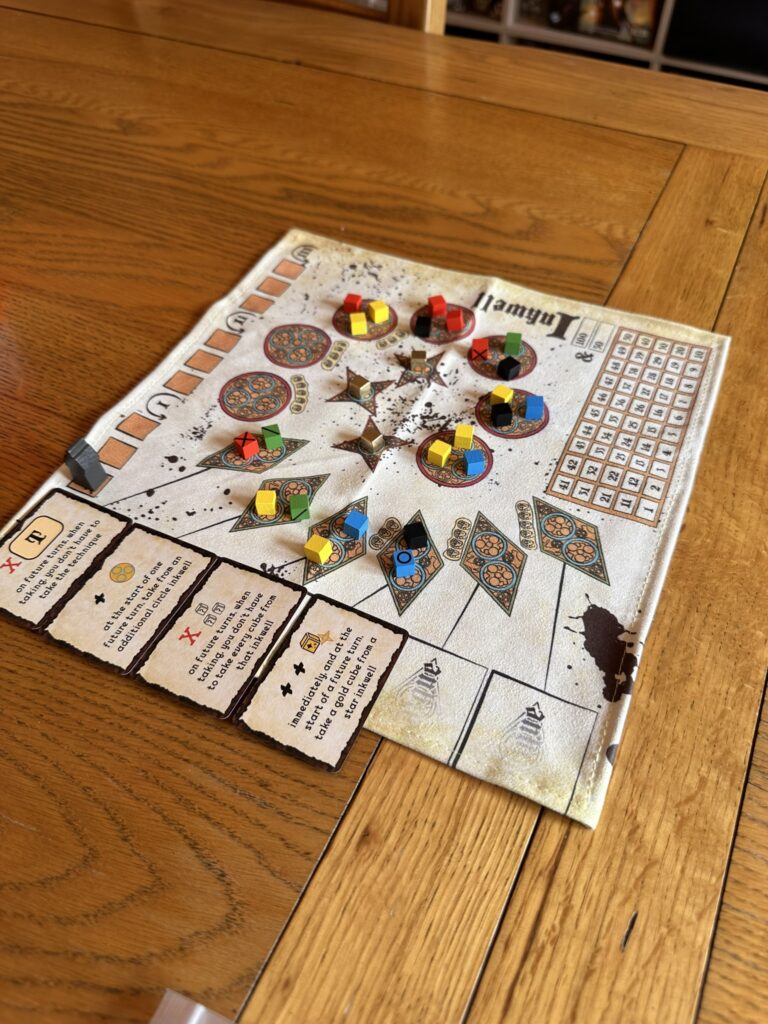
Inkwell shares that same welcoming design philosophy that made Azul such a hit. If you have played Azul, you’ll pick it up in minutes. If you haven’t, you’ll still be up and running in no time. That’s part of its charm.
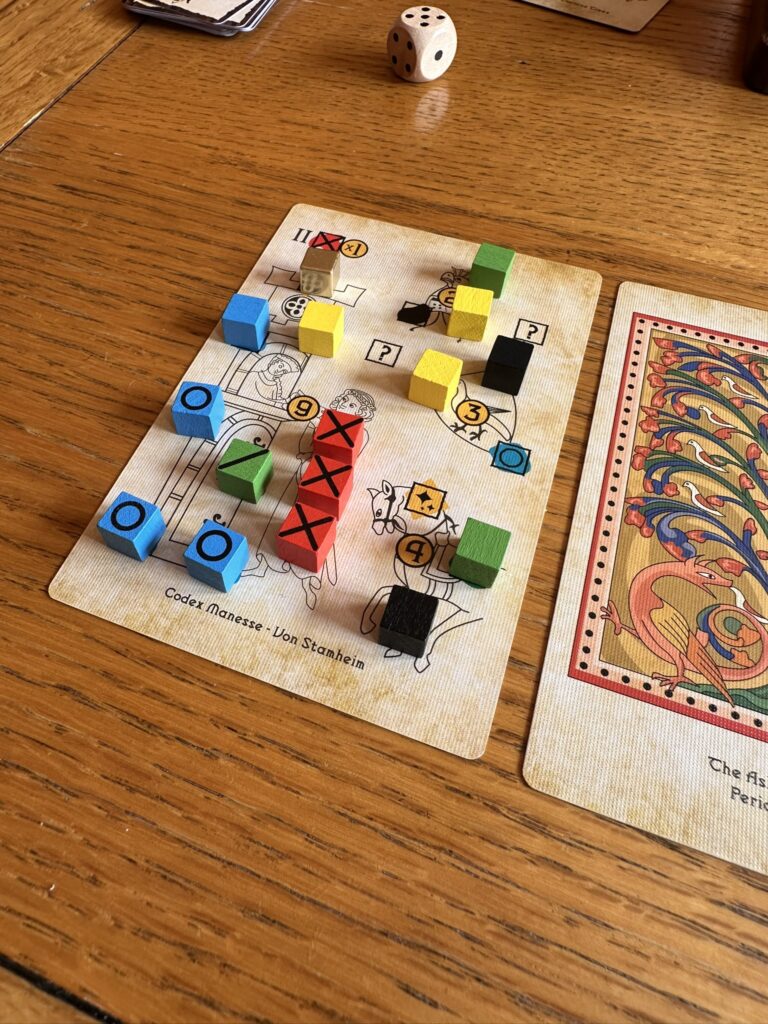
You play as a monk tasked with creating beautiful illuminated manuscripts. Each player starts with a manuscript page made up of coloured squares grouped into scoring sections, all wrapped around gorgeous medieval illustrations that perfectly fit the theme (on the back of each card is also a really nice piece of illuminated artwork). In the middle of the table sits a faux leather play mat that is, I have to say, delightfully tactile. Each of us at least once would touch it and comment how good it is.
At its centre sit the coveted gold (wild) cubes, surrounded by groups of coloured cubes and the Technique cards that add a little extra strategy to proceedings.
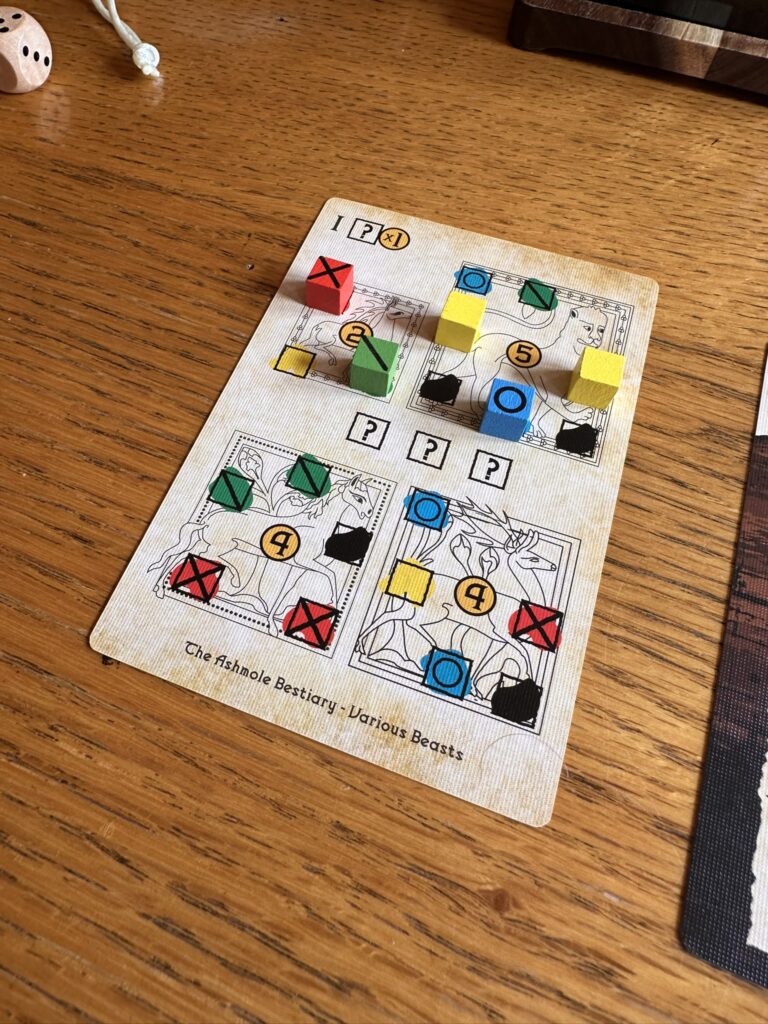
On your turn, you choose a group of cubes and take every cube from that section. The catch is that you must be able to place every cube you’ve taken onto your manuscript. If you can’t, you simply can’t choose that group. Stars in the middle contain a single gold cube each. Circles contain three cubes, and then diamonds only two cubes, but each diamond also has a Technique card attached. Taking cubes linked to a Technique card grants you a special ability, ranging from collecting additional wild cubes to bending the placement rules in your favour. They’re simple little powers, but they add just enough variety to stop the game feeling repetitive.
As cubes disappear from the table, everything eventually refills and the dreaded Abbot advances. I love this little mechanic. While you’re happily illuminating your masterpiece, the Abbot is quietly wandering past, reminding you that deadlines existed long before we entered the modern hell that is Microsoft Teams.
Each time the Abbot progresses, the pressure mounts until you’re forced to move on to your next manuscript page. You begin on Page I before progressing to Pages II and III, each becoming slightly more demanding without introducing unnecessary new rules. It’s a lovely way of increasing the challenge without overwhelming players, and it keeps the game flowing at a brisk pace.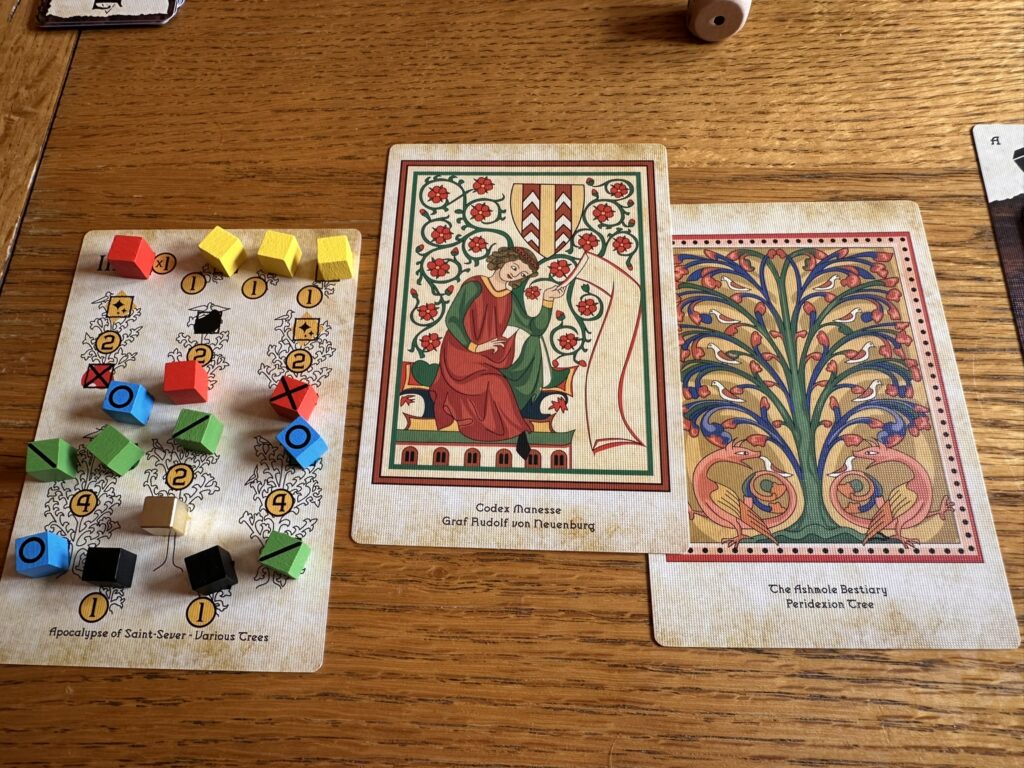
Completed sections score as you move between pages, while unfinished work sadly remains unfinished. Apparently medieval monks didn’t believe in “I’ll finish it tomorrow.” Bonus scoring for particular colours and the occasional wild space also mean there’s always something to aim for, even when the cubes don’t quite fall your way.
We played with four players and, including teaching the rules, finished in just under 45 minutes. Now that we know the game, I can comfortably see it taking around half an hour. That is, assuming you don’t have your own version of my friend Alastair. I love the man dearly, but his turns have been known to span entire historical periods. Had he been around in an actual scriptorium, the printing press might have arrived before he finished his first manuscript.
I only have two tiny gripes, and neither would come remotely close to affecting my recommendation.
The first is the cube bag. It’s just a little too small. Once all of the cubes are inside, they’re packed so tightly together that giving the bag a good shake doesn’t randomise them as well as I’d like. It’s hardly game-breaking, but a slightly larger bag would have been appreciated.
The second is the Technique cards. In your first game, these are probably the biggest rules hurdle (and it’s not a high hurdle). While every card has a more detailed explanation available through a QR code in the rulebook, it did strike me as a slightly odd omission not to include those explanations in print. Yes, most of us will have a phone nearby, but Inkwell feels like such a wonderfully portable game that relying on internet access, however briefly, seems unnecessary. Perhaps adding a couple more pages would have pushed production costs too high, but it’s one of the few moments where the game’s otherwise elegant presentation stumbles.
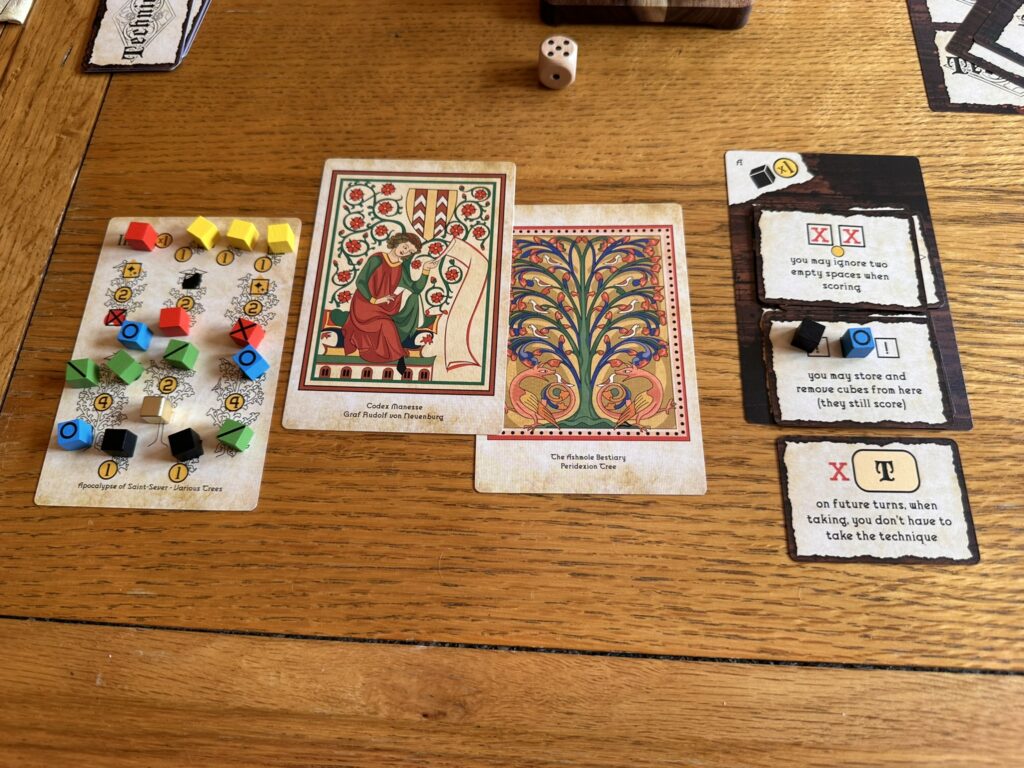
Accessibility is another area where Inkwell deserves praise. As someone who is colour-blind, I’m always pleased when designers take it into consideration and act on it in a way that works. Inkwell gives each cube colour its own unique stripe pattern, making them easy to distinguish regardless of colour vision. It’s a thoughtful touch that deserves recognition. Some other games that do this do not do it well enough (Fate of the Fellowship springs to mind) but Inkwell nailed it for me and I did not once struggle.
Inkwell is one of those rare games that feels equally at home with seasoned hobby gamers and complete newcomers. The rules are approachable, the production is gorgeous, and every game leaves you wanting to turn another page. Better still, it comes at a price that doesn’t make your wallet immediately seek refuge in a monastery.
For me, Inkwell is a must buy game and I think its quality is strong enough to replace Azul on my shelf, and hopefully yours. It’s compact enough to take anywhere, quick enough to get to the table on a weeknight, and satisfying enough that the inevitable question at the end is, “Shall we play again?” Just don’t be surprised if someone puts on a medieval playlist halfway through. It turns out funky lute music pairs remarkably well with manuscript illumination.
You can find out more about Inkwell on the DVC Games website.

Inkwell sounds absolutely beautiful, especially with the illuminated manuscript theme and those medieval illustrations. The comparison to Azul definitely caught my attention.