

This is only the second game to cross my table from developer and publisher DVC Games, but if this is the standard they’re aiming for, I sincerely hope they keep it up. Following the phenomenal Inkwell, DVC Games have returned to publish Pacts, designed by Ben Brin. Pacts is a two-player duel that is steeped in Celtic mythology. If you do not do confrontation games, I won’t waste your time, don’t get this game. But if you do, keep reading, because I think you may have found your next favourite two-player game.
I started setting up Pacts on its faux leather map of Ireland. It’s compact enough to fit comfortably on most coffee tables and travels well. Every component you get out of the book (besides the non decorated cubes) has Celtic symbolism. If you have ever had the pleasure of reading The Call by Peadar O Guilin, I think Pacts will fill you with the same kind of imagery. If you haven’t read it, it’s worth a go.
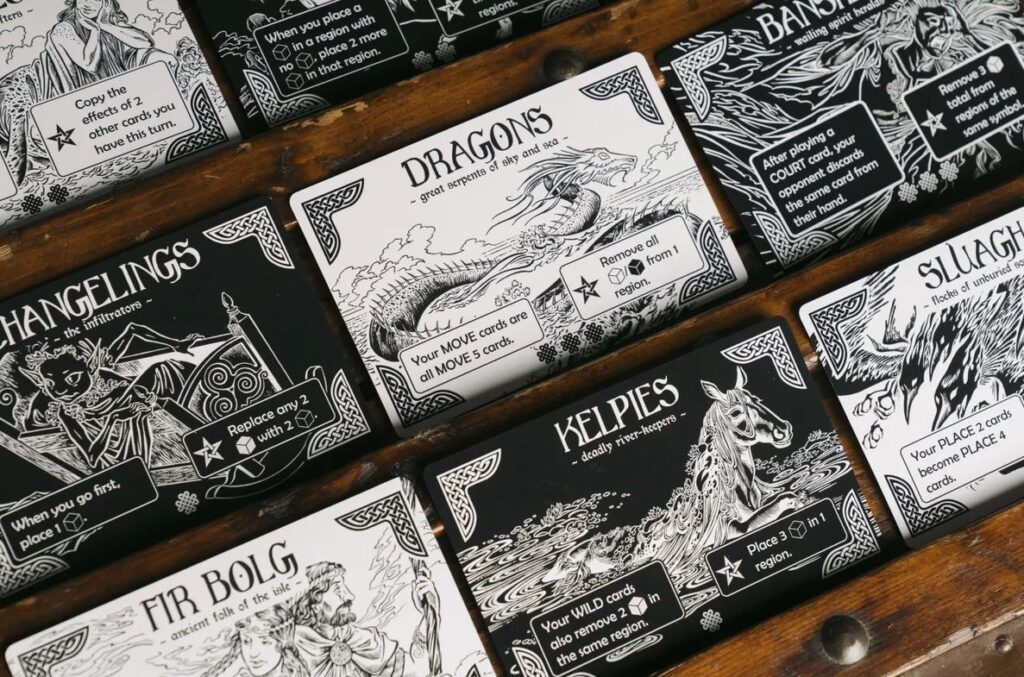
At first, Pacts looks pretty straightforward. You get your map, a small deck of cards and some faction cards that have some simple, but very well done artwork on. One of which made me think of the horse scene from Neverending Story. You know the one.
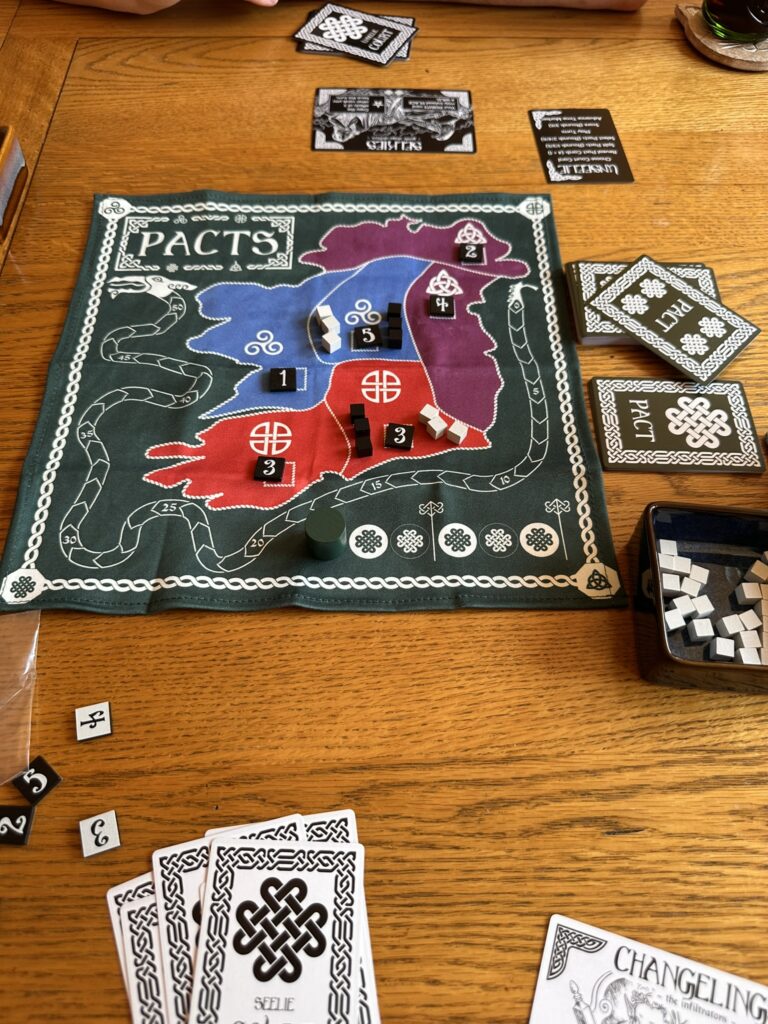
Pacts is played over six rounds, and it’s one of the rare games that the play time is apt. Even on a first play. You choose to play as either the Seelie who are the blessed fae in Irish myth, or the Unseelie who are of course the chaotic and dark forces, the kinds of things my aunty Maeve would tell me tales of when I was a child. There is no game difference between the two factions though, each character you can play as is double sided, so there is no benefit to one side over the other.
Your objective in Pacts is to take control of the different regions of Ireland. You do this simply by having the most cubes in that region. Each region has a different point value. After three rounds, you score the regions, and flip the point value tokens so each region value shifts.
On your turn, you select one of seven cards from your personal deck and put it face down. Then comes the most interesting mechanic to Pacts. One player picks four cards from the lower power deck and one card from the more powerful deck. And then you put them into two piles, and include in one of those piles, the 2nd player token. This mechanic was inspired and it’s not one I have seen before (please do comment if there are other games that do this kind of thing so I can check them out). If you are the splitting player, the other player gets to choose which pile of cards they want. So you cannot make one pile clearly stronger, because your opponent will just choose that. The key is to balance the piles as best you can, whilst making it so that you know the other player will choose a pile that’s good for them, but not as good as the pile you are left with. For me, the faction I was playing as got to place an extra cube for free if I was first player, so I always tried to manipulate the cards to mean that my opponent would think that the pile with the 2nd player token was the best.
Once you have selected your piles, you reveal your factions card you chose for that round and whoever is 1st player, takes their turn. The cards you can get will either add a token (or two) of yours in a territory matching its colour. There are six territories, in three sets of two colours. Play a token in any territory colour. Move a number of your tokens from one territory to an adjoining territory. There are also Ability cards which activate your faction specific ability. In my opening game it turned two of my opponents cubes into mine. There is also a point card that just grants three points.
You take your turn, using or discarding each card, and then the second player does the same. Until the end of the third round, and you score each territory.
Pacts continues along this path until the sixth round when you do it again and declare a victor. So yes, it sounds like there is not a lot of gameplay variety, but considering the game can play in twenty minutes quite easily, it does not feel stale at all. There was an element of me that thought the closest game to Pacts is Smallworld, only it’s not filled with anywhere near the complexity.
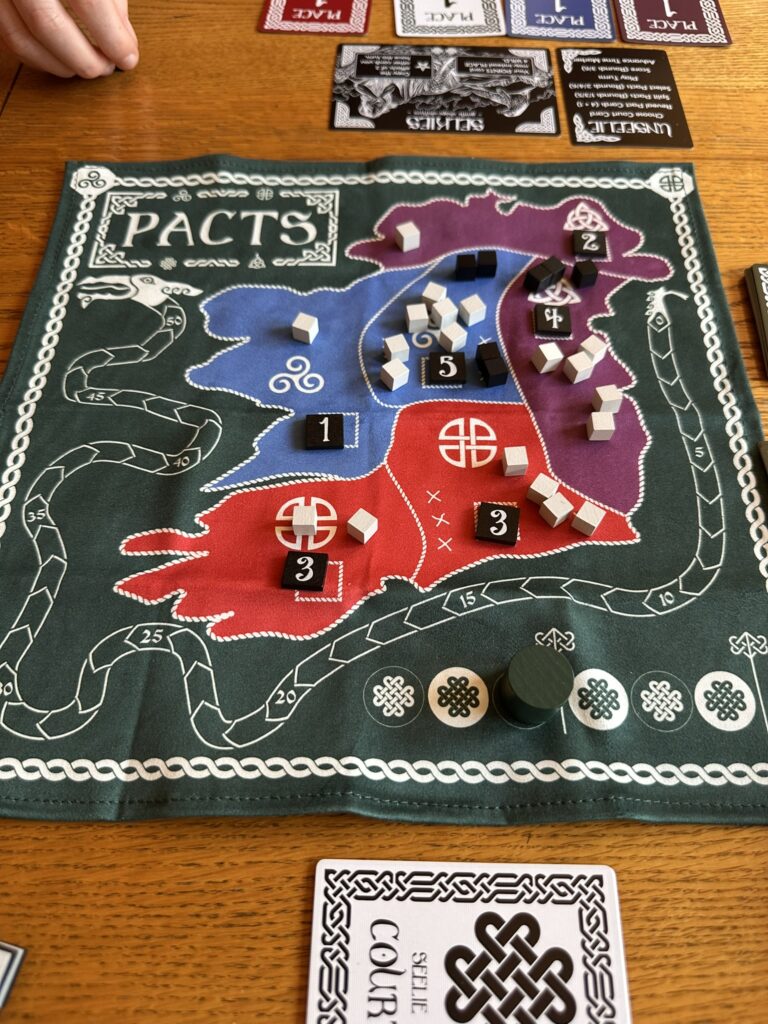
Now, I have some things that I do feel might concern some players. For starters, in our first few games, it certainly felt as though taking the lead after the first scoring round gave a significant advantage. Whether that’s an issue that disappears with experience or a genuine balance concern, I’m not quite ready to say. One way I would maybe like to have balanced it is if you win a territory, you lose a cube or two from it. This would mean your opponent has a chance to upset the second round a bit more. The move cards that you get can also only be used on your cubes, I would have liked to see if making it so you could move other players tokens would have influenced playing strategies. The only other gameplay tweak we considered, but also think might be horrible, would be to score every round and only flip the scoring tokens after round three. So whilst I do believe that Pacts strength is that a loss might be taken as a “best of three?”, in my house, it was hard to get my partner to play again. But she generally doesn’t enjoy direct confrontation games.
Pacts is a big game in a very small box and it is proof that elegant design can easily be better than a big flashy game with unnecessary complexity. If you enjoy direct confrontation games, Pacts is incredibly easy to recommend. It is simple to pick up, and the theme, whilst not overly strong, still gives it a wonderful setting we don’t often get to see in games. I just don’t know if your ability to trust anyone putting piles into two “equal” piles will survive playing Pacts. Or as my aunty Maeve might say “Go n-éirí leat”
You can find out more about Pacts on the DVC Games website.
