

It was October 2024 when I first played Saltfjord, and I only managed to get my hands on it because a friend brought it back from Essen Spiel that year. Somehow, this incredible game remained elusive in the UK for well over a year, but copies are finally beginning to creep into local game retailers. The question is; does Saltfjord still live up to my expectations so long after I felt the initial pang of excitement? Let’s find out!
Saltfjord is a spiritual successor to the rather controversial Santa Maria — sharing the core idea of drafting dice to activate rows and columns on your personal board and taking the benefits. Thankfully, Saltfjord is also a much broader, more ambitious design that doesn’t fall back on the grim and overtrodden theme of colonial exploitation.
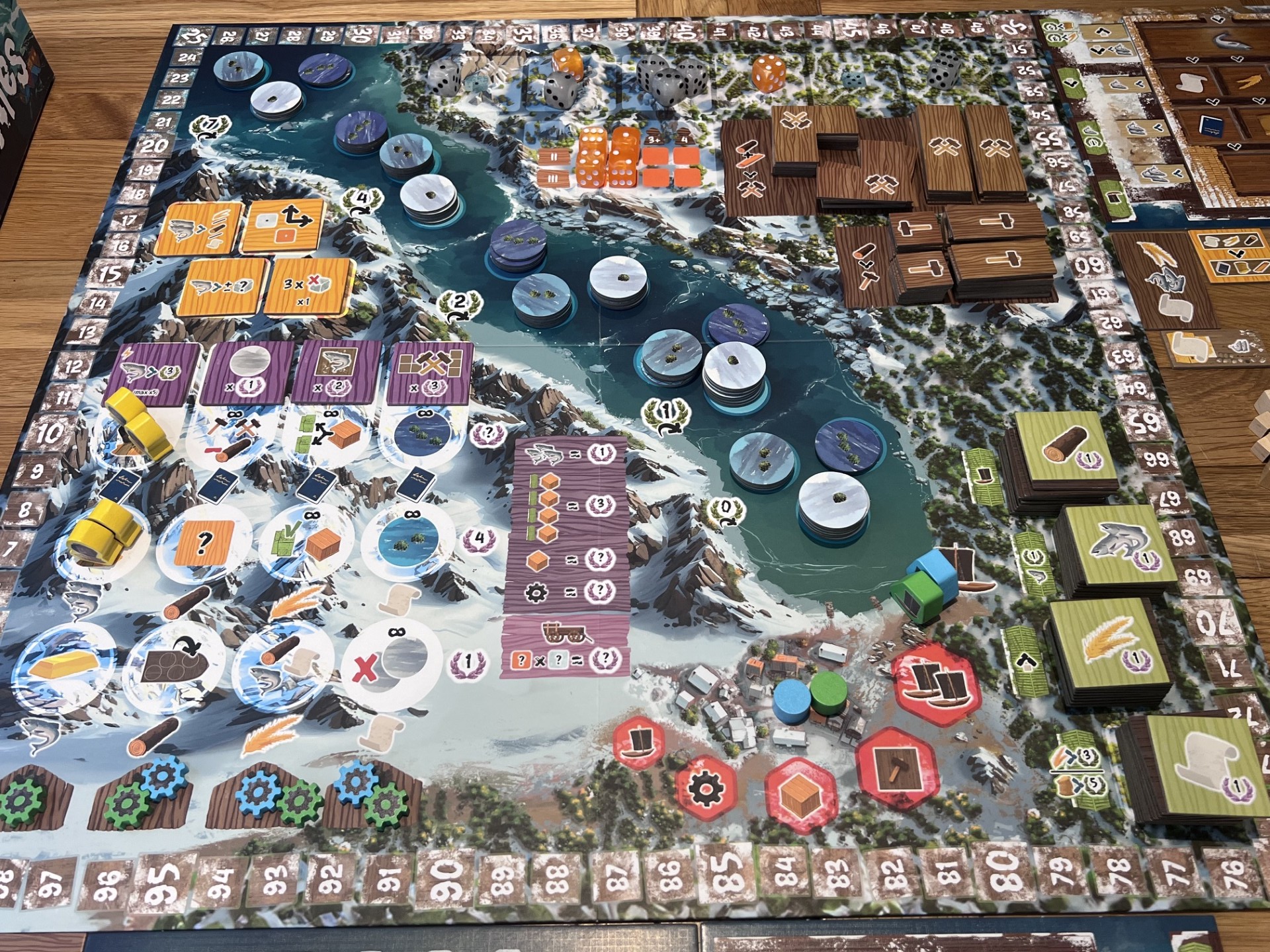
The result is a medium‑weight strategy game that blends engine‑building, spatial planning, and long‑term optimisation into a cohesive whole, set against the much less challenging backdrop of a 19th‑century Norwegian fishing village. Saltfjord is a game about shaping a community’s future through careful development, but it’s also a game about timing, dice drafting and just the right mix of luck and judgement.
The heart of Saltfjord is the 6×6 grid on each player’s board. When you draft a die, you activate either a row or a column depending on its colour — white dice trigger columns, orange dice trigger rows — and every building or feature in that line fires in sequence. This creates a satisfying sense of escalation: early turns are fast and quite modest, but as you add new stuff to your board, each die becomes a miniature engine.
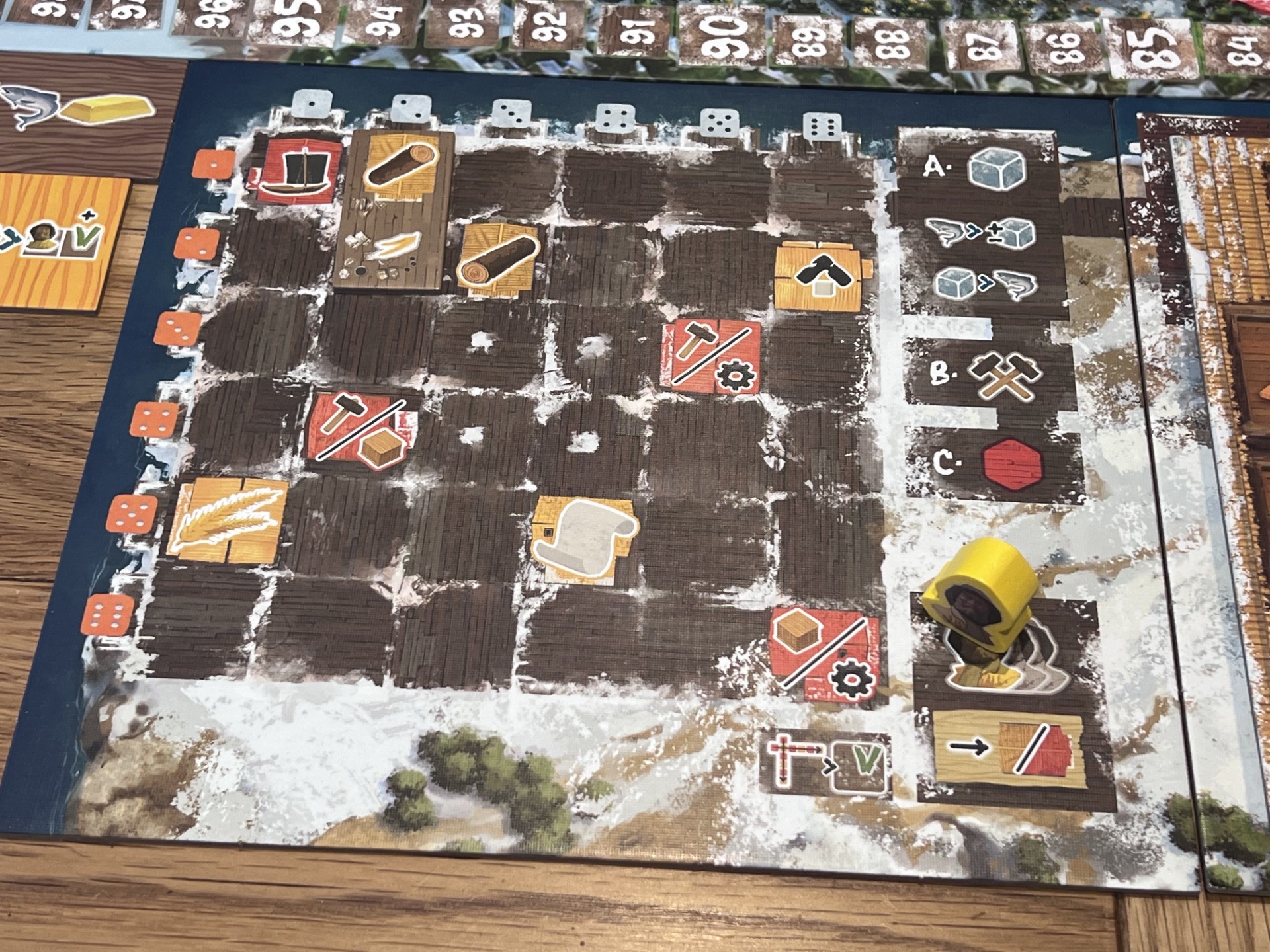
The decision space grows organically and keeps downtime to a relative minimum because players generally recall what each row or column will give them as it expands. The Saltfjord puzzle becomes one of shaping your grid so that future activations cascade in the most efficient way, or perhaps even around a specific idea like supporting fishing, generating build resources or whatever. It’s a system that rewards foresight without ever punishing experimentation, and it gives the game a rhythm that feels both deliberate and dynamic. You can always do better but you’ll never feel like you’ve wasted your turn.
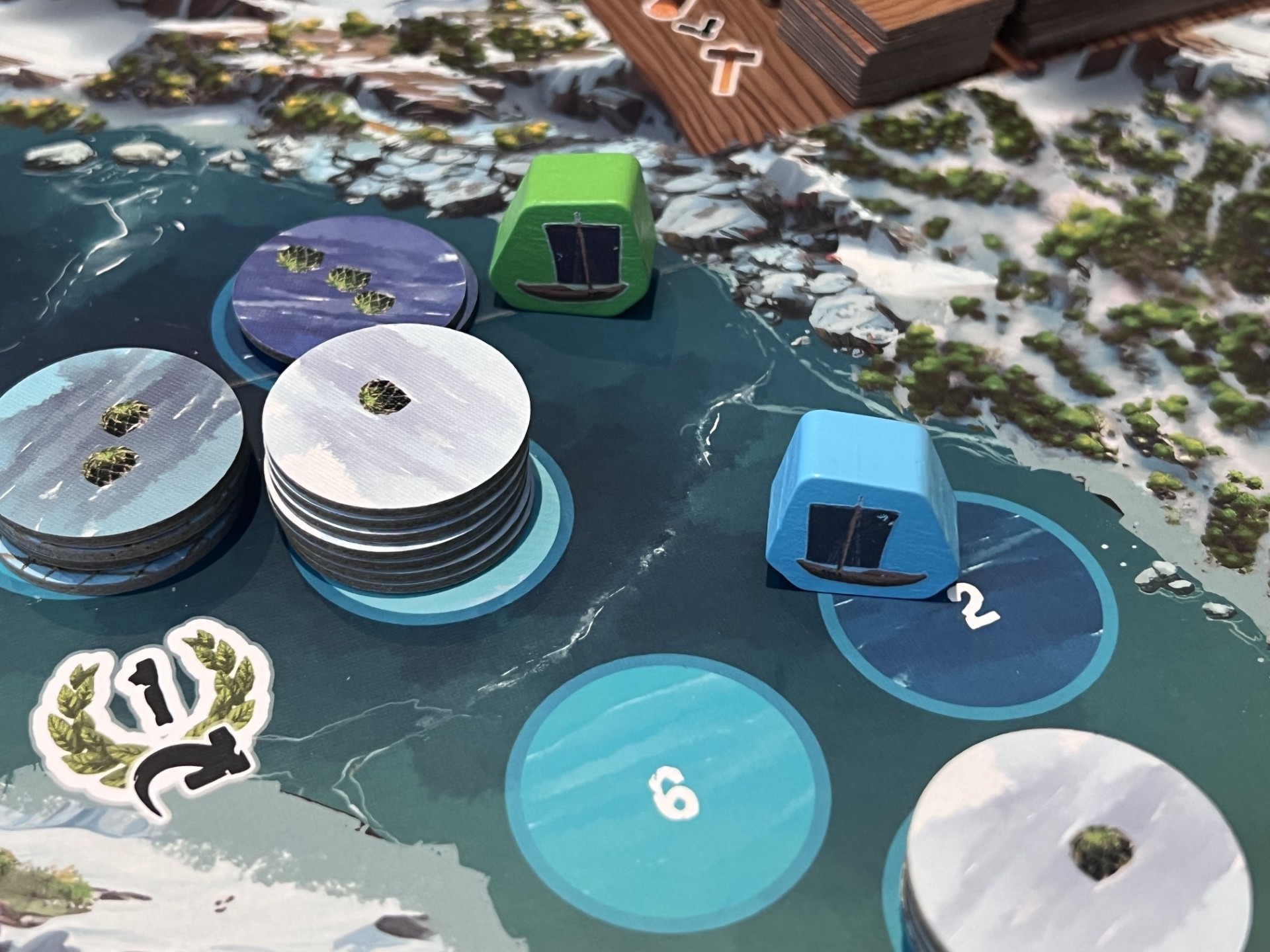
What elevates Saltfjord beyond a simple dice‑activation puzzle is the breadth of actions those buildings enable. Fishing is a major pillar: sending your boat out to sea to collect fish, crates, and bonuses is both thematic and mechanically rewarding, whilst both luck and the tools to mitigate it add a bit of welcome randomisation.
Trade orders offer another path, letting players package resources into crates for points and long‑term benefits. Technology tracks provide upgrades that reinforce specific strategies, whether that’s improving your boat, enhancing your income, or unlocking new efficiencies such as construction discounts.
And then there’s construction itself, which simply involves adding new buildings and features to your grid, either small ones that slot into the grid itself or larger ones that sit outside it but provide powerful effects. Each of these systems feeds into the others, creating a web of incentives that encourages players to specialise without locking them into rigid paths. To go back to that growing complexity that I mentioned earlier, I don’t think Saltfjord would work if all of this was in play from the start. The only way a player can process all the options and possible outcomes is by iteratively working through them and taking an active role in the decisions that build each personal board.
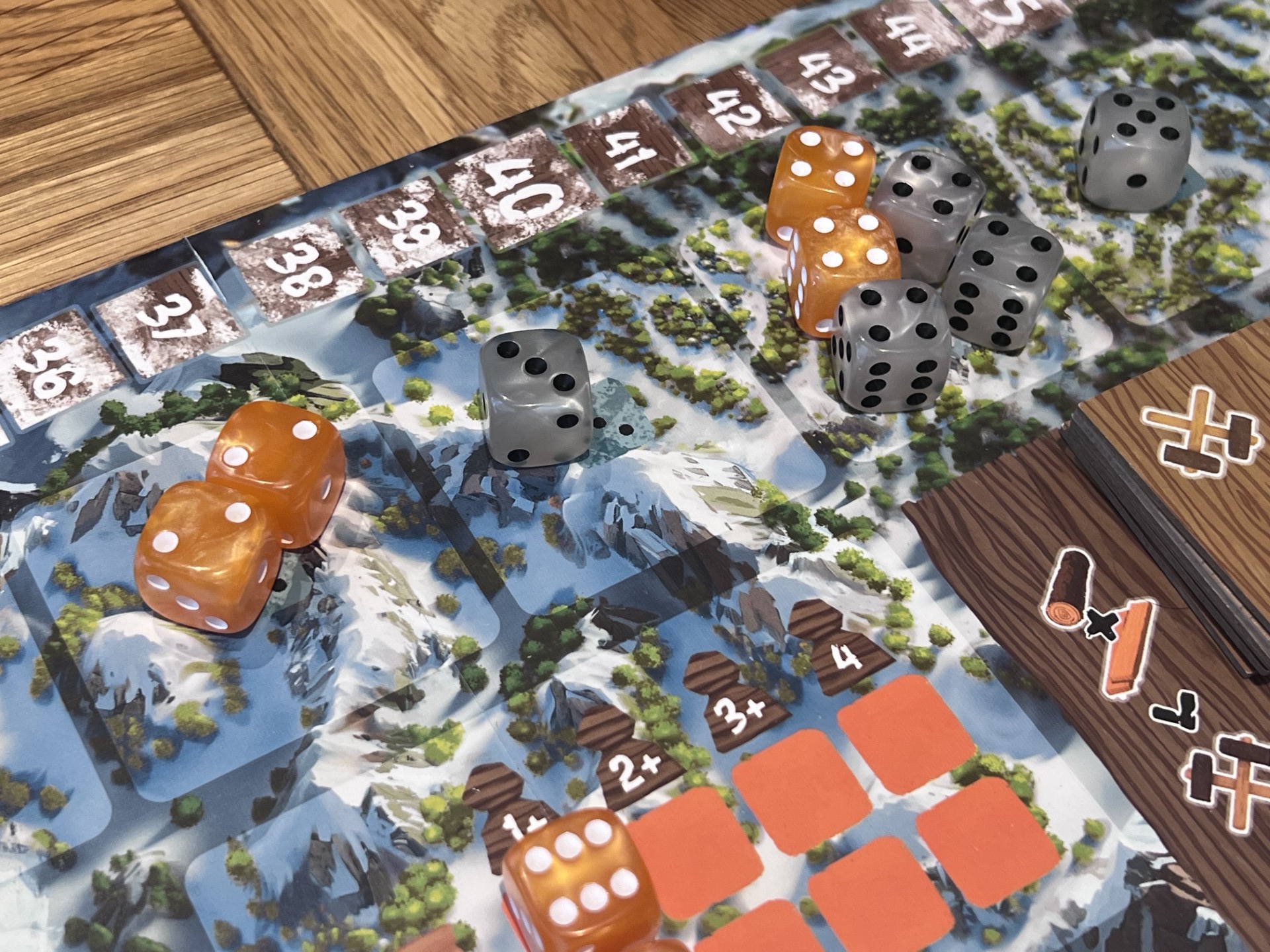
One of the most compelling aspects of Saltfjord is how it handles the luck based features that I’ve already nodded to. Dice drafting always carries the risk of variance, but here the shared pool and the flexibility of the grid mitigate randomness. You’re rarely stuck with a useless die; instead, you’re forced to adapt your plan to the evolving draft and as with so many games, turn order really matters here. In Saltfjord, the game becomes less and less about hoping for the right number and more about sequencing your turns so that any die can be turned into progress. This makes the drafting phase interactive and tense without ever feeling unfair or frustrating like it does in games such as Civolution for example.
The game’s pacing is also well judged. Saltfjord plays over three rounds, each with its own arc of expansion, optimisation, and payoff. The end‑of‑round tavern actions add a nice, clever and rewarding twist, giving players a final burst of agency after they’ve passed. These actions can be powerful — extra resources, upgrades, or bonuses — and because they’re taken in a worker‑placement style, there’s a race to secure the best ones. It’s a small touch, but it adds a bit of something to the round structure and gives players something meaningful to consider even after their main actions are done.
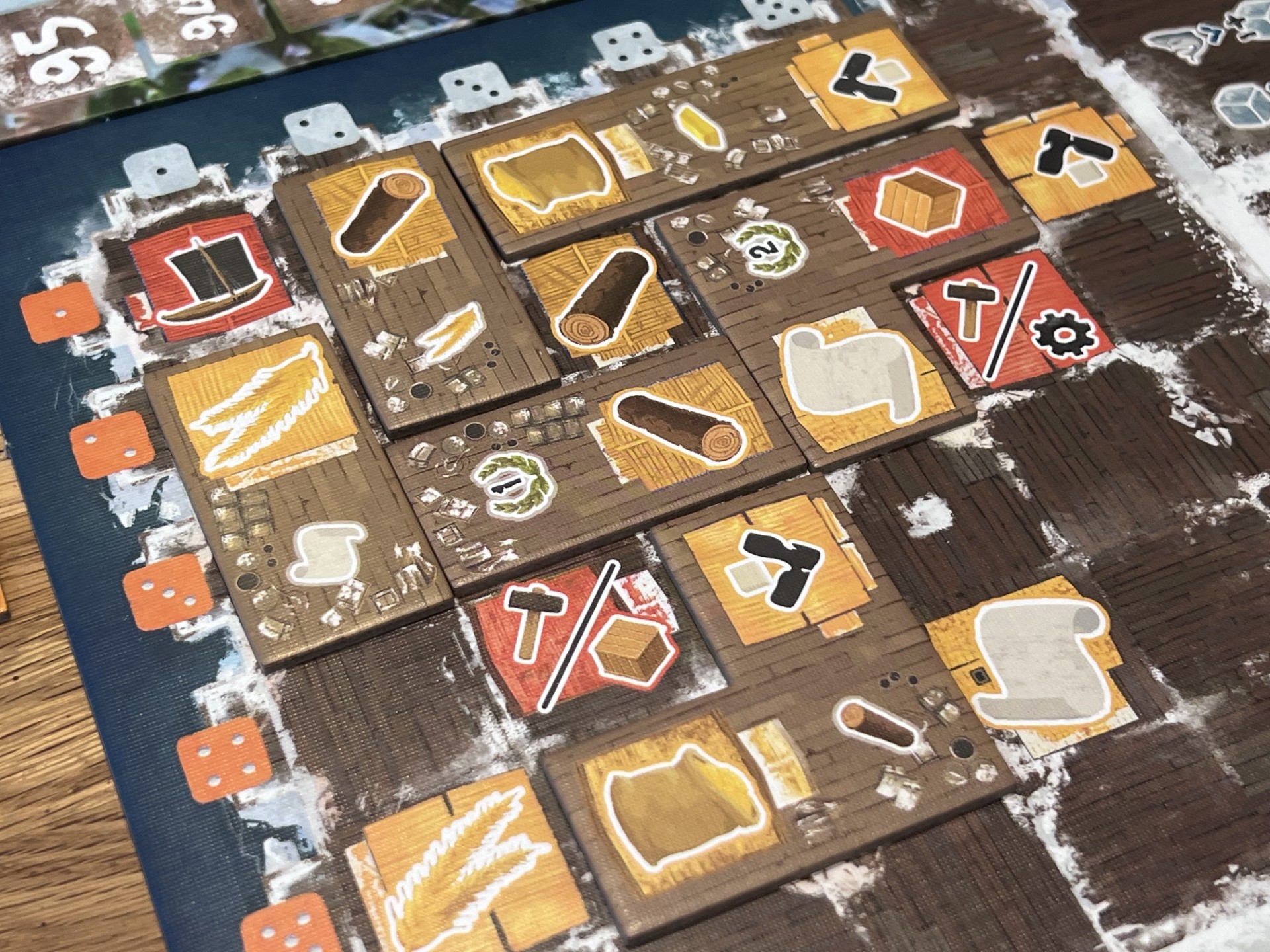
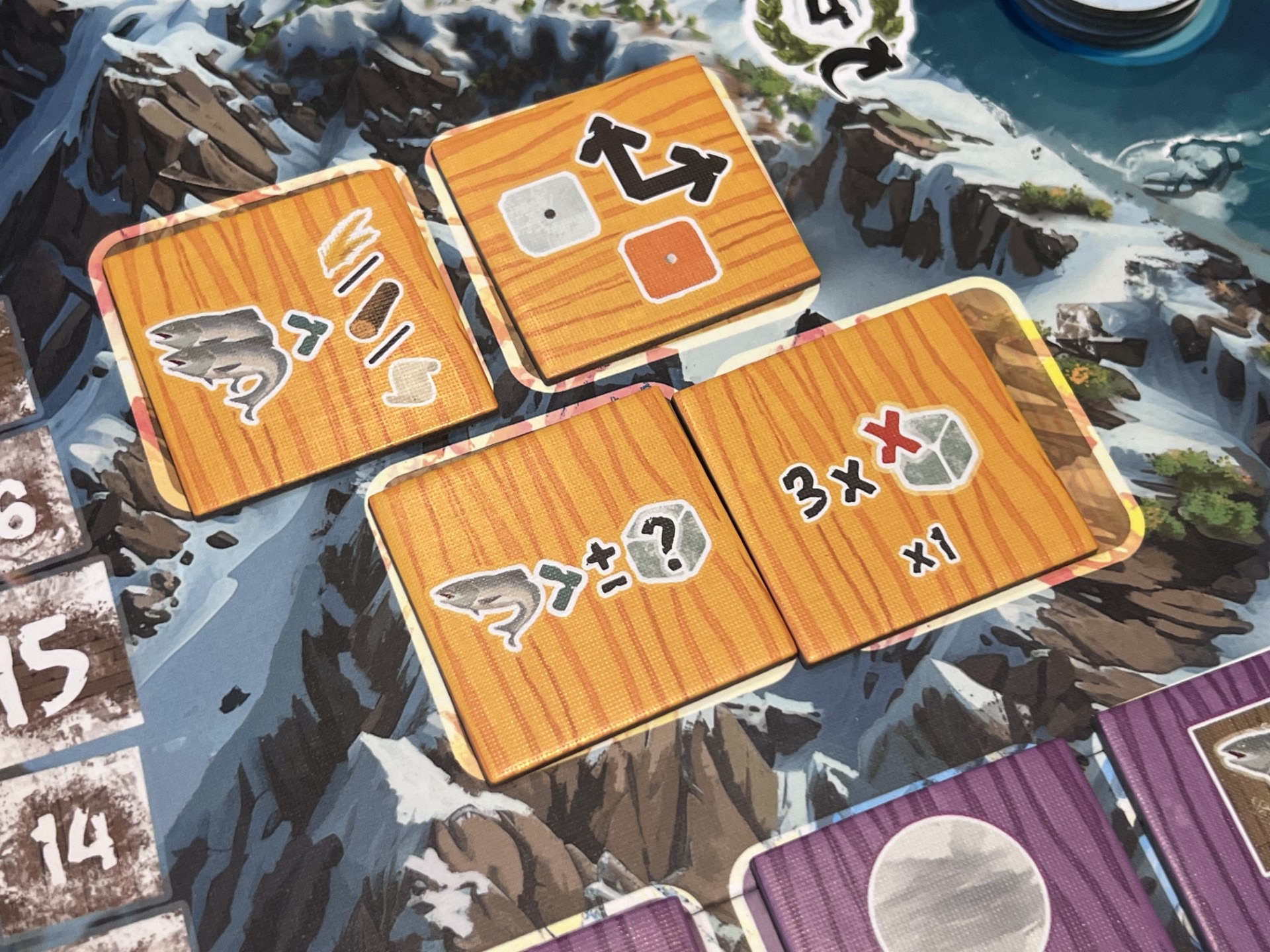
Replayability is one of Saltfjord’s strongest qualities. Variable setup elements — including special abilities, end‑game scoring tiles, and the mix of available buildings — ensure that each game pushes players toward different strategies. Some plays become boat‑heavy, others reward deep investment in technology, and others hinge on clever manipulation of trade orders. The grid itself is a blank canvas at the beginning that changes every time you play, and the way you fill it determines the shape of your entire game.
Thematically, Saltfjord is grounded in its superb artwork. The setting — a coastal village adapting to change at the turn of the century — is reflected in the mechanics and every single component reinforces this. Fishing feels like an essential strategy, whilst trade feels aspirational, and the slow march of technological progress is both necessary and exciting. The artwork reinforces this tone, with clean iconography that stands out against the muted, painterly and yet still colourful aesthetic.
If there’s one thing that we struggled with, it’s that for all its slow build up, Saltfjord can still end up a little thinky. The grid system, the sequencing of actions, and the long‑term planning required can lead to analysis paralysis, especially at higher player counts or with younger players. These days I love games (like this) where the actual rules are relatively simple but the decisions carry weight (also seen here), but in Saltfjord I found that some players reach a sort of “maximum capacity” where they were fine with four, five or six interlinked things happening on their turn, but once the game breached this hidden internal RAM buffer, they just melt down and have to restart their turn 2-3 times.
Despite this health warning, Saltfjord is a smart, elegant evolution of the dice‑drafting engine‑builder that leaves the shackles of the game that inspired it long forgotten on the bottom of the ocean. Saltfjord offers meaningful choices, satisfying progression, and a thematic grounding that enhances rather than distracts. It’s a game that rewards planning but still leaves room for tactical pivots, and it’s one that feels richer with each play. For fans of Santa Maria and Coimbra, it’s an easy recommendation — a thoughtful, well‑crafted euro that is not just similar to these games, but also much better than them in almost every way.
You can find Saltfjord on Amazon.
