

With a flash of steel, you manoeuvre towards the enemy swordsman, your two daggers falling first thanks to the Combination attack that combines movement with a downward slash. The opponent isn’t out of the game yet, though, and raises their two-hander. In Crimson Capes, this doesn’t always mean you should react…
You see, just as you have access to four characters, each with four “Disciplines” of special moves, enemies have options too. You see a raised sword and your instinct is to block, but the enemy feints, now ready to follow-up with a horizontal slash. Do you have time to do a Combination attack to dodge backwards? Do you have the Charge to use your Discipline to bring out an automatic deflect? Do you roll forwards, evading the swing but losing the opportunity to counter, and placing you with your back to them?
These split-second, moment-to-moment decisions are what make Crimson Capes so engaging and entertaining. But, without any stats or traditional levelling system, is the game too shallow to stand up to other “Soulslike Metroidvanias” we’ve come to know?
A Skill-Based Combat System Obsessed with Unique Animations
First of all, it’s worth clarifying what is and isn’t souls-y about this game. I wouldn’t normally be one to bring up the term, but the developers went and shoved it in their own description so now I have to explain what parts of “Soulslike” they actually include, because it’s surprisingly little…
In Crimson Capes you explore a beautifully rendered pixel fantasy world, with 3D rotoscoped animations. Mechanically, though, you won’t be levelling up and investing in stats. Hell, you won’t even be finding new weapons and gear in the Souls way. Instead, all these elements are closer to a Metroidvania in style. Your armour and gear aren’t statistical changes but instead carry unique effects. Things like covering enemies in spider web when they attack you, or increasing the damage of running attacks.
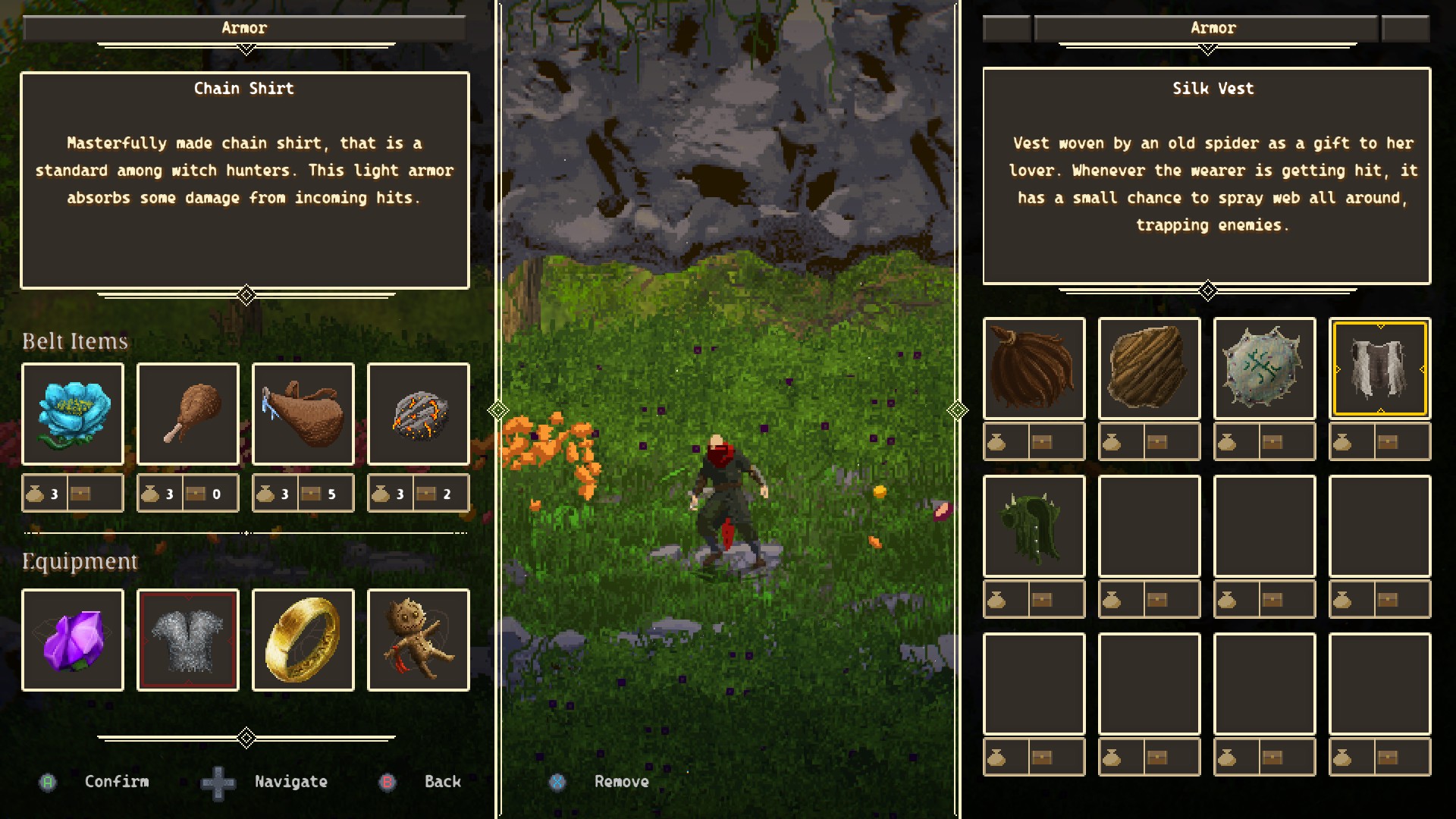
Gaining exp and levelling up provides access to Combination Attacks and Discipline Attacks, but not raw “stats” like Strength, Dexterity etc. This streamlined system makes the entire experience pretty far detached from Souls games, and I think that’s for the best. In a Souls game you are never quite sure how much of a victory was because of your stat investment and weapon damage numbers, and how much was your actual moment-to-moment input.
In Crimson Capes, you’re not objectively stronger in terms of damage-per-hit or life total at the end of the game than you are at the start. Instead, your progression and power increases come in the form of situational upgrades that you, as a player, have to know when to use to actually get anything out of them.
Build variety without the crunchy RPG maths
To give you an impression of how diverse the combat is despite the lack of stats and traditional levelling, here’s the ways you can change your playstyle:
Characters
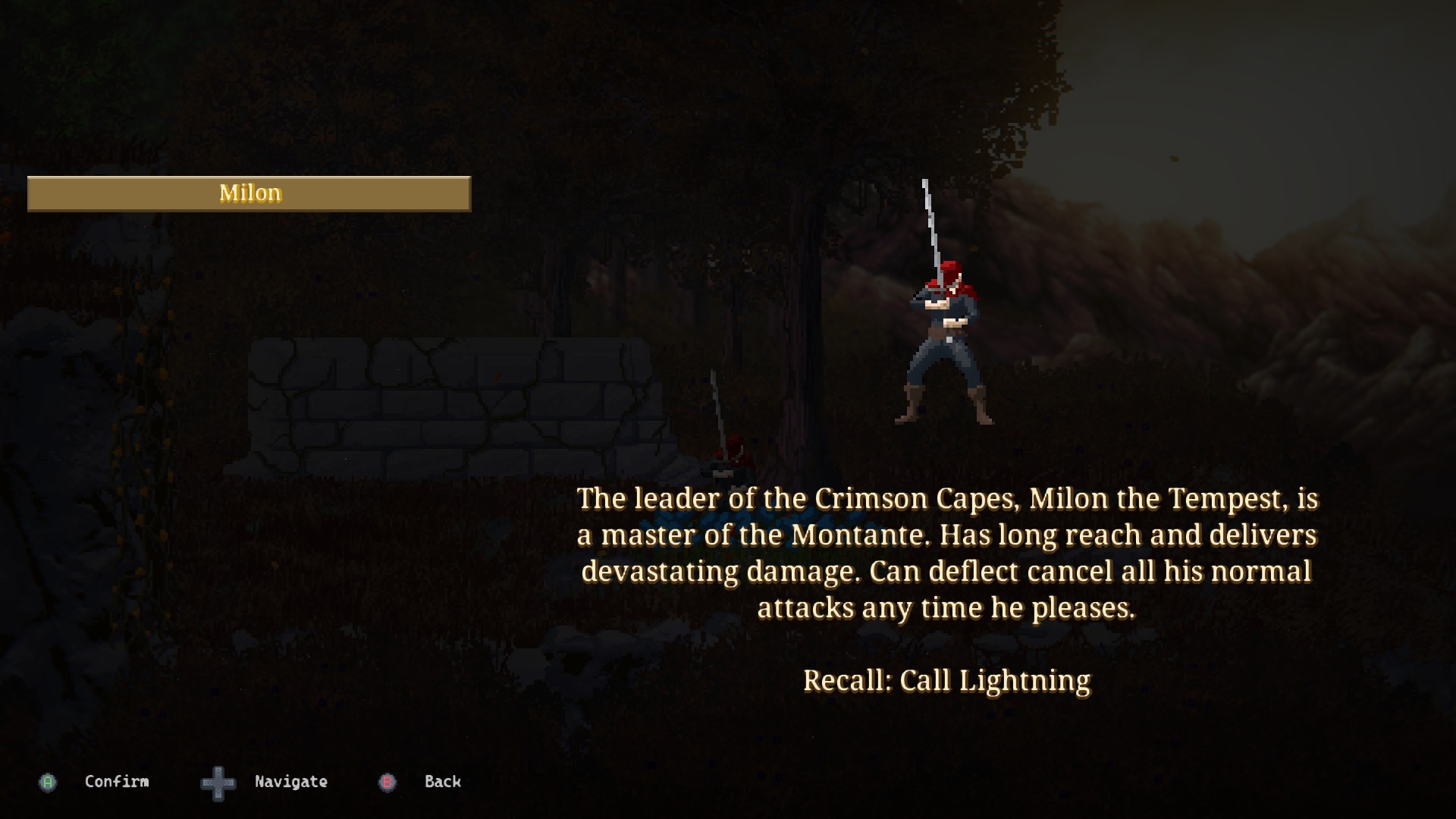
There are 4 playable characters, who once unlocked can be freely switched to and from at bonfires sorry sites of grace sorry benches sorry blue flower patches. You aren’t forced to use one of each character for each main Mage boss, and can instead mix-and-match. Each character has their own weapon, with unique light and heavy attack strings as well as Combination Attacks. Each character has 4 unique Disciplines and one set of 3 unique passives.
Combination Attacks
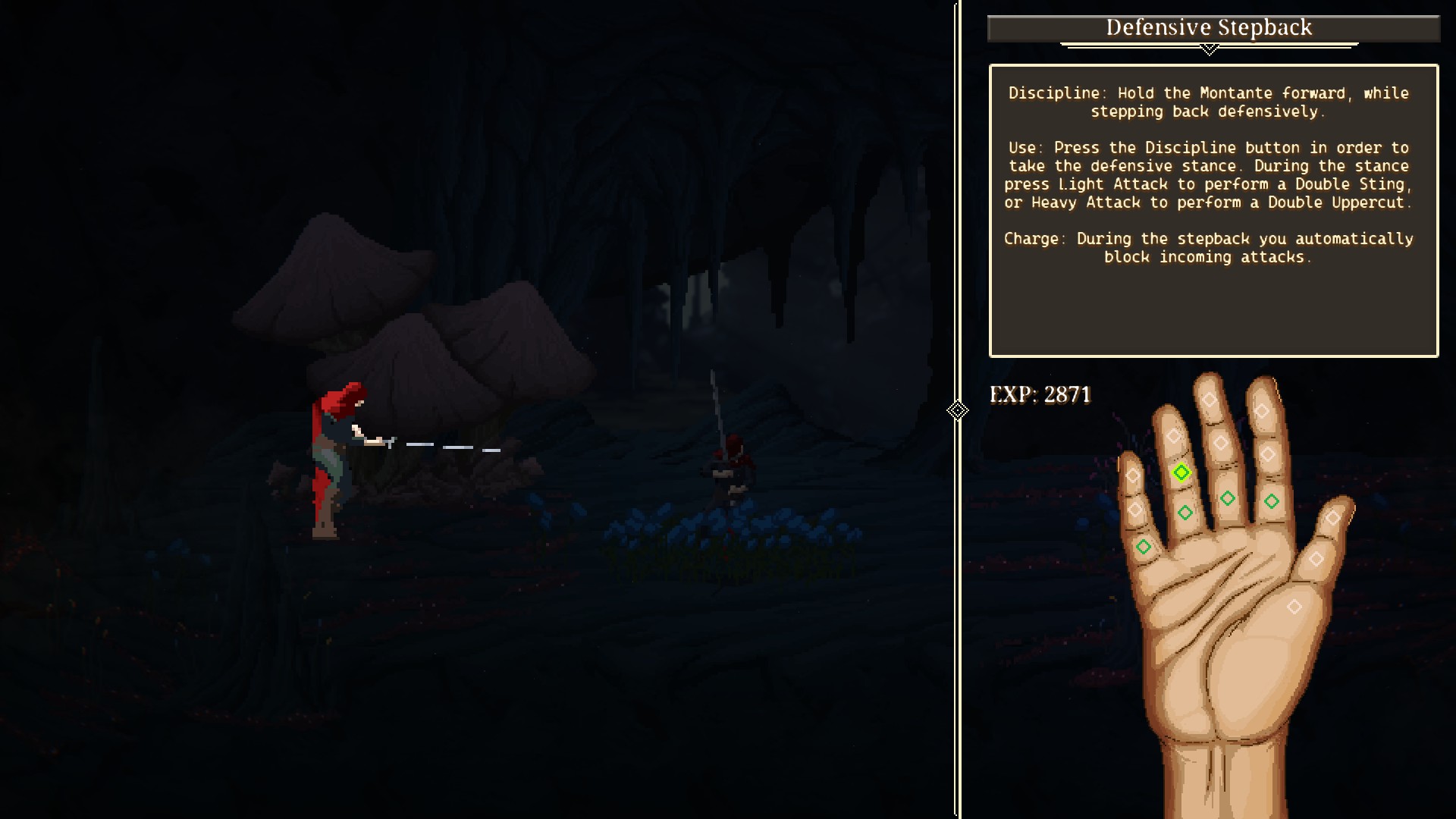
The first new moves you unlock are Combination Attacks. These are performed by holding Up or Down while using a light or heavy attack. In general, every character has an interrupt on R1+Up, a stamina drain on R1+Down, a long-range attack on R2+Down and a status or damage attack on R2+Up. This means new characters are easier to switch to as your basic Combinations are the same. However, the fact that these moves are all uniquely animated and have their own movement and hitbox rules makes some character’s Combination Attacks play vastly differently to another’s.
Disciplines
Disciplines are stances that provide an R1 and R2 special attack. Each character has 4 Discipline options, each with those two attacks. This means you’ve got 32 individual Discipline Attacks to experiment with. One example (And my favourite) is the “Backflip” discipline for the dagger-wielder. This discipline performs a Backflip that can pass over enemy attacks, and can be followed with a spin back towards the enemy to hit them in the back. Other examples are an automatic-deflect stance and a stance that imbues your sword with fire. Finding moves that fit your timing and combat needs is very rewarding, as the more tools you have in your arsenal the easier you can “solve” difficult attack strings from bosses.
Gear
Gear provides unique effects in the form of your Gem, Armour and 2 Fetish slots. At one point I had a maximum defence build with an effect making me take less damage at high life, and an effect letting me take less damage at low life! Other times I had the gem that provides Bleed to light attacks and the fetish that makes bleed-inducing attacks deal more stagger damage.
In my ten-and-a-half hour playthrough I discovered around 6 gems, 10 armours and 15+ fetishes, and hadn’t even tried all the Disciplines as I wanted to invest in the ones that sounded like my style. Multiple playthroughs could well extend the game time beyond that ball-park.
It’s in this way the lack of RPG mechanics actually makes the build variety even higher, not lower. Not having to manage requirements and scaling leaves you free to include whatever aspects you like with no penalty. You can play the dagger-wielder without investing into any bleed abilities and you can play the two-hander focusing on light dodge attacks. It’s all about recognising what specific challenge an enemy is giving you, and finding your own way to solve that.
Inconsistent UI in an otherwise carefully-constructed game
Some enemies, such as The Thing That Lives Beneath Providence, don’t have stamina bars. This might make you think they can’t be staggered, but actually it just protects them from being killed with a finisher. If you hit enough heavy attacks and parries, you can stagger most enemies. This bit of misleading UI led to a few hours of wondering how I was meant to face certain bosses, but upon realising their stamina bar was just “hidden” rather than non-existent I quickly came around.
There’s also the issue of the final boss breaking the rules that the game has followed right up until that point. I personally don’t understand when a game makes the final fight a gimmick rather than a test of everything you’ve learnt so far. Instead of using all the tools at your disposal from throughout the game, you’re essentially locked into one strategy. However, even with a lacklustre ending, the ten hour journey to get there is absolutely fantastic.
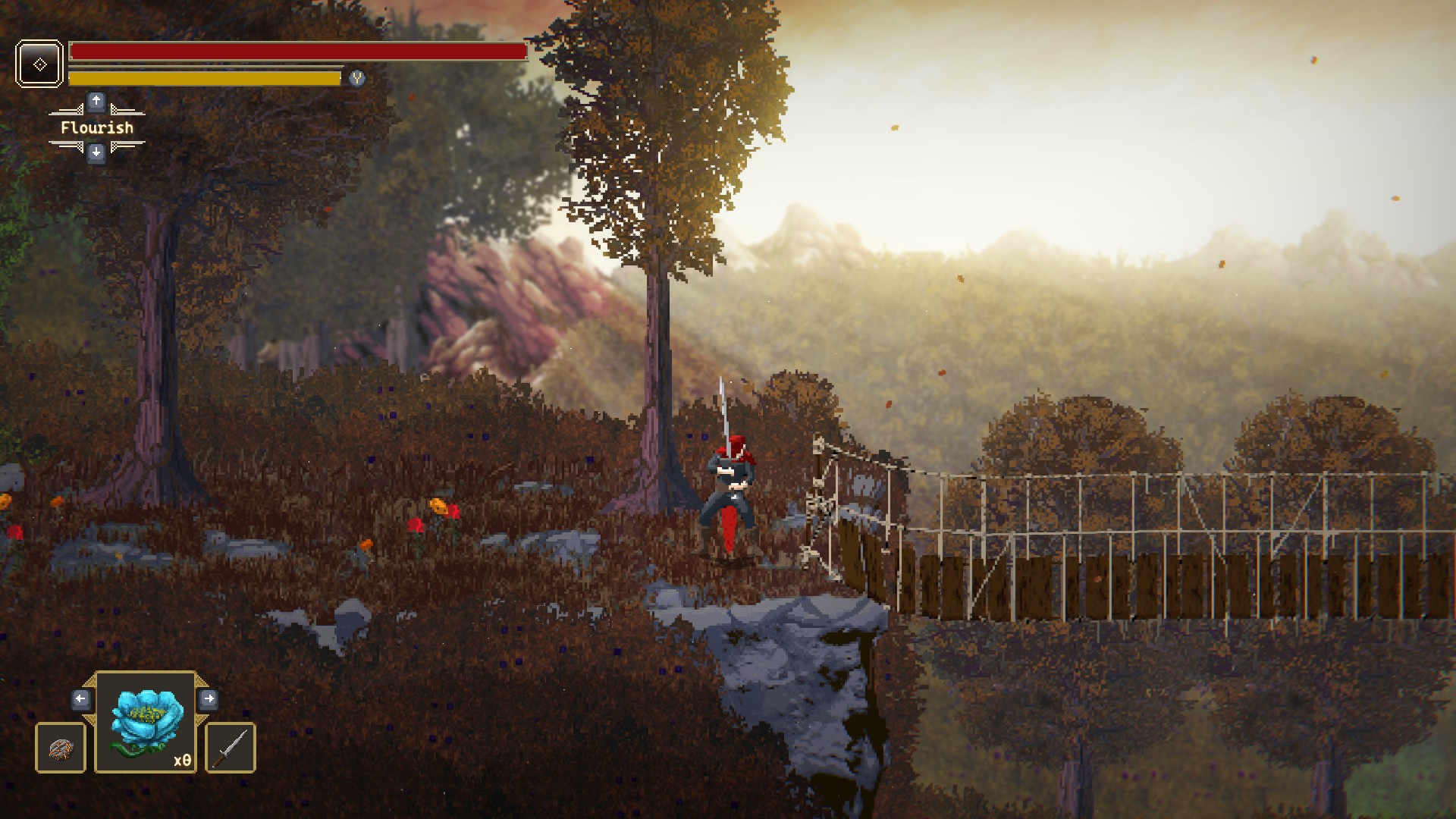
Fortunately, the developer at Poor Locke is very transparent about improvements, and has taken the inconsistency of the stamina HUD on board. They even chatted about the ending and have said more content is planned to be released for free following Crimson Cape’s release. With at least 5 or 6 Disciplines I never even tried, I’m certainly excited to jump back in and face the game in a new way, with the new content providing the perfect motivation.
Strength lies in the hand
Crimson Cape’s unique take on movement, feints and power-scaling make for a short, tight experience that showcases how the RPG-ification of genres doesn’t always result in more depth. By stripping away stats and encumbrance and even traditional stamina consumption (Instead focusing on Combat Flow) Crimson Capes provides a fresh challenge for even seasoned Souls and Metroidvania veterans. Paradoxically, that simplicity also makes the game approachable for a new player, who might come to expect such vivid and specific animations from other games in the genre!
Crimson Capes is available now on Steam
