

The Last Gas Station is a cosy management game with mysterious, conspiracy-ridden undertones for that perfect balance of creepy and cute. Unfortunately, the charming and immersive world doesn’t house a substantial videogame and the whole concept feels more like an idle game with extra steps rather than a complete experience. For every way the game pulls you in, there’s two more ways it fails to hold you.
The vibes are immaculate and bespoke
It’s easy to get sucked into the world of The Last Gas Station. Expansive background views and plenty of foreground details ensure the entire screen is brimming with character, and that’s before even looking at your character! The Tanooki-adjacent being you play is detailed, animated well in all situations and has facial expression changes for little things like sprinting too long.
All this lovely artwork is supplemented by a simple but charming soundtrack which progresses through motifs as the day passes. There’s no in-game clock, so you mainly know if it’s morning, afternoon, evening or night by the music (and, of course, the location of the sun). This gives a refreshing vibe to every day, making the day-to-day shopkeeping fly by a little quicker and with substantially more joy than if one track played the entire time.
The world is more than just art and music, though. The characters you meet explain different “Legends”, which range from a bottomless lake to UFO sightings to straight up Bigfoot. There’s a fair few to discover, and they each add a new and mystical element to the landscape as well as having their own dedicated items to stock or decorate your store with.
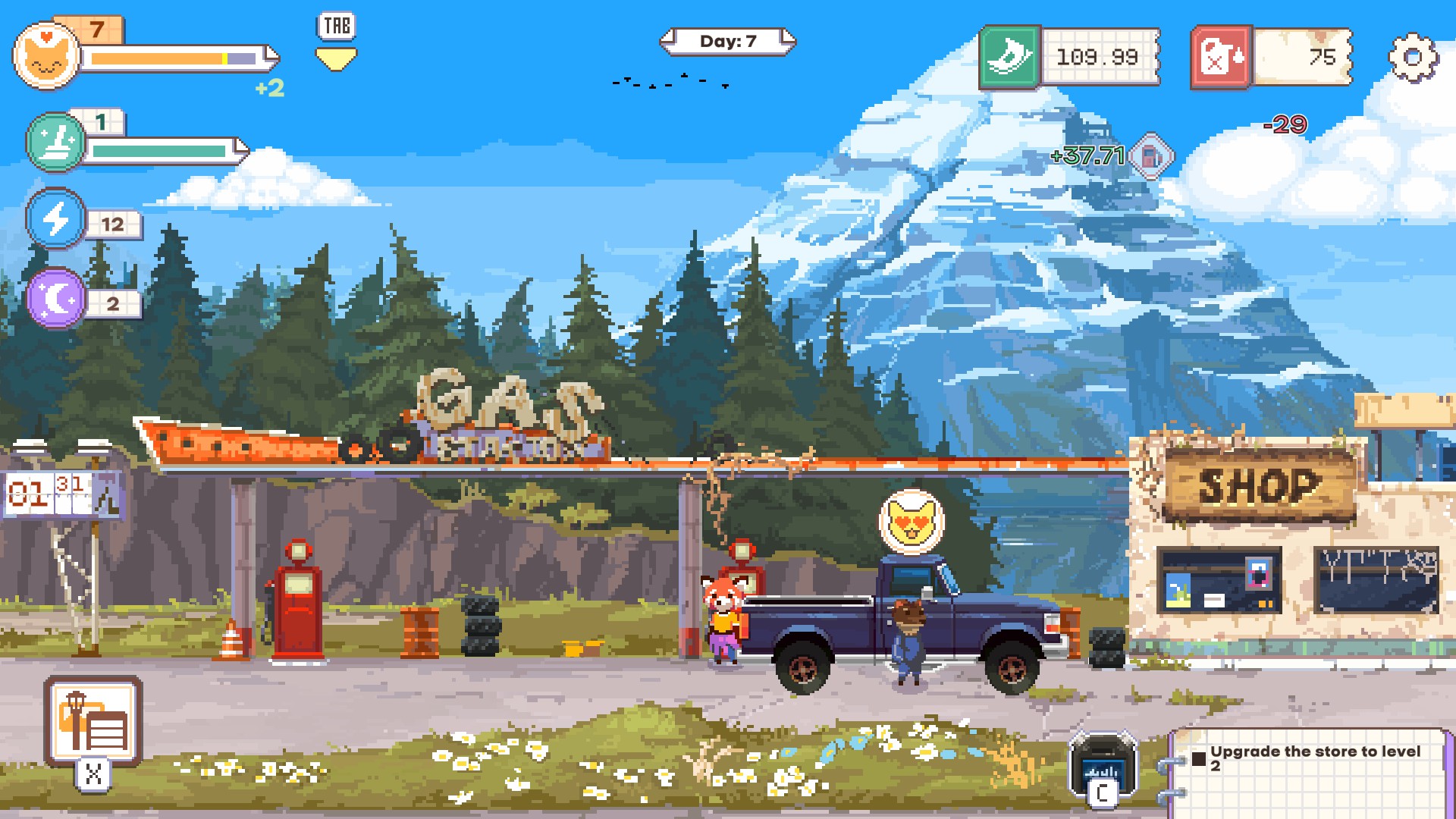
When once the shift to night-time was just a reason to go to bed, now you start noticing eyes in the cave by the lake, or strange constellations in the sky above the mountains…
We exist in this world but have no way to interact with it
This is where The Last Gas Station flounders. It sets up such a brilliant world, with wonderful characters and unsettling rumours…then makes you do the same minigame 100 times. I understand shop management games are inherently built around repeating menial tasks, and it’s not the entire genre that I am against. What The Last Gas Station fails to do is capture the feelings of progress and player choice that make those games actually fun to play.
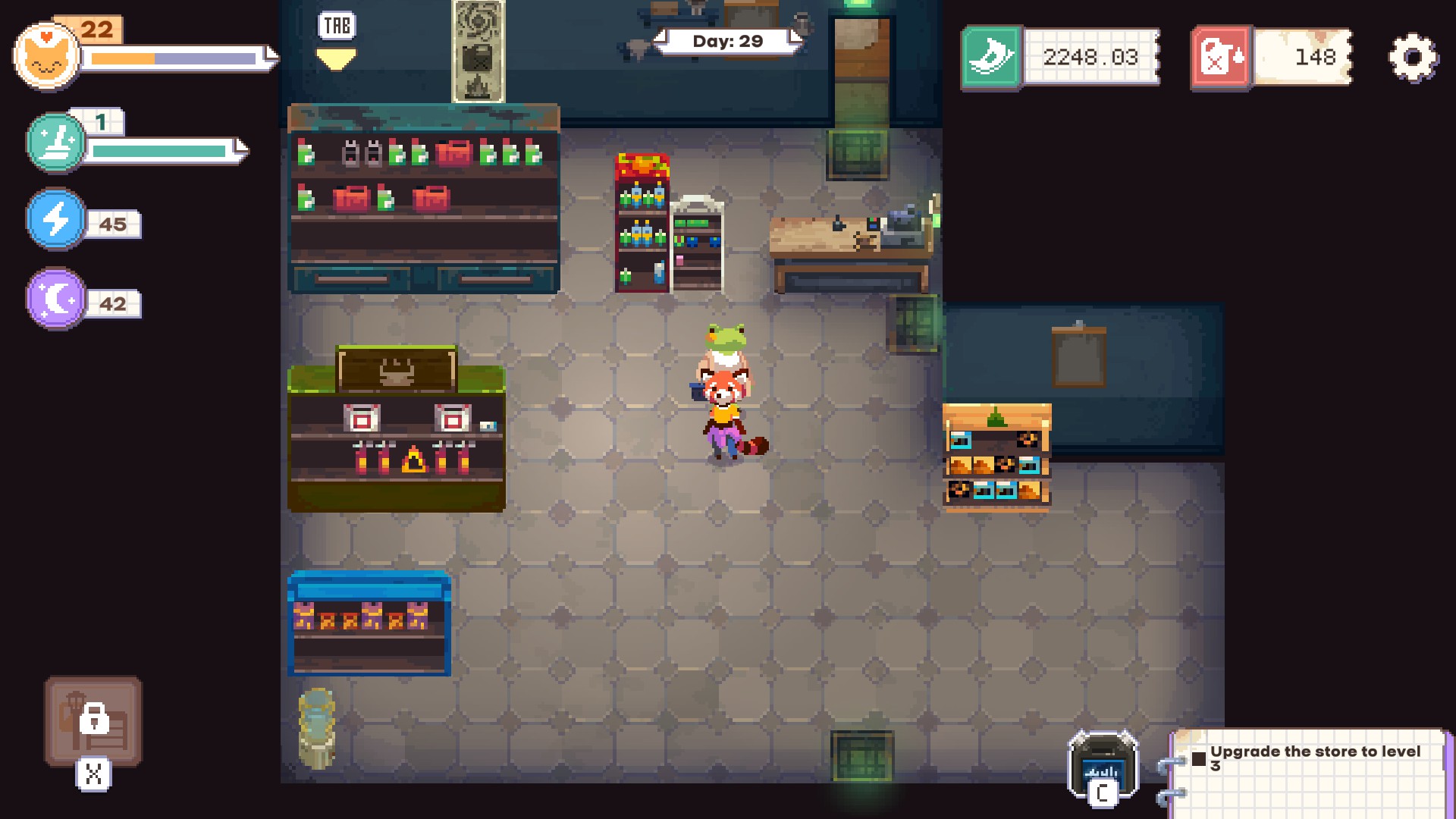
The core issue, which hit me like a tonne of bricks one night when buying upgrades for the shop, is that The Last Gas Station presents all the wrong things as primary objectives to the player. Your main objectives, which are permanently plastered on your HUD at all times, are focused around upgrading your gas station. This might sound logical, but here’s what I realised:
All the best management games have you either choose your own goals and present the game systems as a sandbox, or they present goals that are distant, generic or unrelated to any single specific upgrade. For example, when you are told to reach Shop Level 2 in TCG Shop Simulator you can make the money for that however you see fit, and there’s the background secondary gameplay of opening packs up yourself. On the way to that goal you’ll likely upgrade your shelving, buy licences for more products and invest in some tables. All of those choices are made by you, though. They aren’t items to tick off on a list.
The Last Gas Station having “Buy Lvl. 2 Upgrades” be your primary mission takes the joy out of discovering and saving for those upgrades. The game has the Legends system, it’d make much more sense to have the mission be “Get a legend to level 5” and, as a player, we’d seek out upgrades to make that goal attainable. Without that driving force, all the upgrades in the game transform from exciting options to tedious required breakpoints.
The Last Gas Station forces players to buy almost every available upgrade explicitly, not through presenting a goal that the player can choose to reach via those upgrades. It drains any sense of agency and control, and I never felt my gas station was actually mine.
The objectives are the main culprit, but player agency is snubbed constantly in so many ways:
- Main objectives require buying almost every upgrade, making your choice over them irrelevant
- Prices for fuel change daily, but it’s always better to fuel a car than to not. You’ll consistently get enough visitors that your silo runs out, and that means you have to buy new fuel at the daily cost regardless. It’s only once you get the 1000L fuel tank that buying low to sell high can make any noticeable difference, and by that point it’s hard to care anymore
- Managing shop inventory is abysmal. You can’t specify storage locations, and can’t see price data when storing or placing items. Again, the idea you could buy a load of stock up when it’s cheap and sell it off when it spikes is Management Game 101, but The Last Gas Station doesn’t have the infrastructure to let you do that. It is always objectively best to just buy low and auto-populate shelves
- Managing shop prices is even worse. That is to say, there is no price management. You don’t get to choose to risk running a low margin or a high one, you just buy things and put them on a shelf and hope you turn a good profit
All of these elements add up to a game that can’t really react to a player any differently, no matter how they play. There’s data presented and buttons to click, but absolutely 0 meaningful player choices to make.
Needing to order more fuel and make sure you have enough in the pumps for customers would be another interesting economic balancing act, but once again the game doesn’t really capitalise on the idea mechanically. You simply order more fuel when you get low and it arrives within 20 seconds. There’s no ordering for the next day and having to disappoint customers. Without consequences for poor management, is it really a management game?
Minigames don’t need to be innovative, but they at least need to be varied
This brings us to the final nail in the coffin: The minigames. To begin with, you have just one, which is simply refuelling cars but holding space and shift, then hitting Q when it’s done. What I want to say next is that speeding up the needle runs the risk of over-shooting the mark or spilling fuel but no, the gauge stops dead when press Q regardless, so you’ll never miss the required space even at full speed.
After hours of hoping the grinding all led somewhere, I unlocked and upgraded a new branch of the gas station: the auto-shop. This lets you service customer vehicles, rather than just refuel them. Finally, some new minigames to alleviate the grind!
To change oil you hold a button until the right time…
To inflate tires you hold a button until the right time…
No Simon Says minigame? No symbol-matching? Minigames don’t need to be the most innovative or deep, but in a ~6+ hour game they do need to at the very least be varied.
The core issue with these mechanics is that they don’t justify themselves.
Why let me speed up the needle if there is 0 risk? Just make the needle go that fast by default.
Why show me stock market fluctuations if I can’t manage my inventory and separate stock easily? Just let me buy what I fancy for Legend ranks and don’t even tell me the stock market change.
Why focus so much on grinding for currency when the player has barely any input over much profit they even make? Let the story and Legends progression drive me, with the money-making progression being my tool for that goal.
If all these systems were as deep as a Management game needs, the game would be great. If these systems were removed, the game would be great. As it stands, it’s stuck doing a half-job at being half-good.
A wonderful concept that needs a gameplay design overhaul
I wish The Last Gas Station was either simple and short enough that I’d finished it in my 6 hours, or that it actually delivered on the management gameplay aspect of its vision. If the new minigames with the auto-shop were actually different to the refuelling that would have kept me going another couple of hours, but I just couldn’t face any more time in the game.
I love the world, I adore the art, the vision is sound. Unfortunately it’s just been executed so poorly, with objectives that make progression completely devoid of any player agency, removing all that lovely worldbuilding by having absolutely 0 game feel.
