
Rowdy Partners is the niche trick-taking game that your four-player game night needs

Rowdy Partners, from designers Jason Hager, Darren Reckner and Capstone Games, is a team‑based trick‑taking game that takes the familiar structure of playing cards into tricks and wraps it in a gloriously over‑the‑top Mexican wrestling theme. It’s loud, colourful, and not at all like what we’ve come to expect from Capstone — who typically publish much heavier-seeming games like Terra Mystica, Age of Innovation and many more. With that said, underneath the showmanship there’s a surprisingly sharp system about tempo, information, and managing risk with your partner.
Rowdy Partners works both as a physical card game and as a digital implementation, and the fact that it’s currently in public beta on Board Game Arena (as well as available in retail form) makes it very easy to explore in depth. About ten of my playthroughs took place with the physical game, whilst I managed about four or five additional asymmetric games online. Given how quick Rowdy Partners plays, it could be played online during a lunch break, or as a slightly longer filler during your face to face game night.
Rowdy Partners is played over a series of rounds, each made up of eight tricks. You’re not just trying to win tricks for points in the traditional sense; instead, you and your partner are trying to drain the opposing team’s health and ultimately pin one of their wrestlers. Each team controls a pair of wrestlers who tag in and out of the ring, and the cards you play represent strikes, counters, and signature moves that push the momentum of the match back and forth. It’s a clever twist on trick‑taking because the lowest card wins the trick here, but a winning card only deals damage equal to its value — so a one will likely win, but will need to be modified with tokens to do more than a single damage.
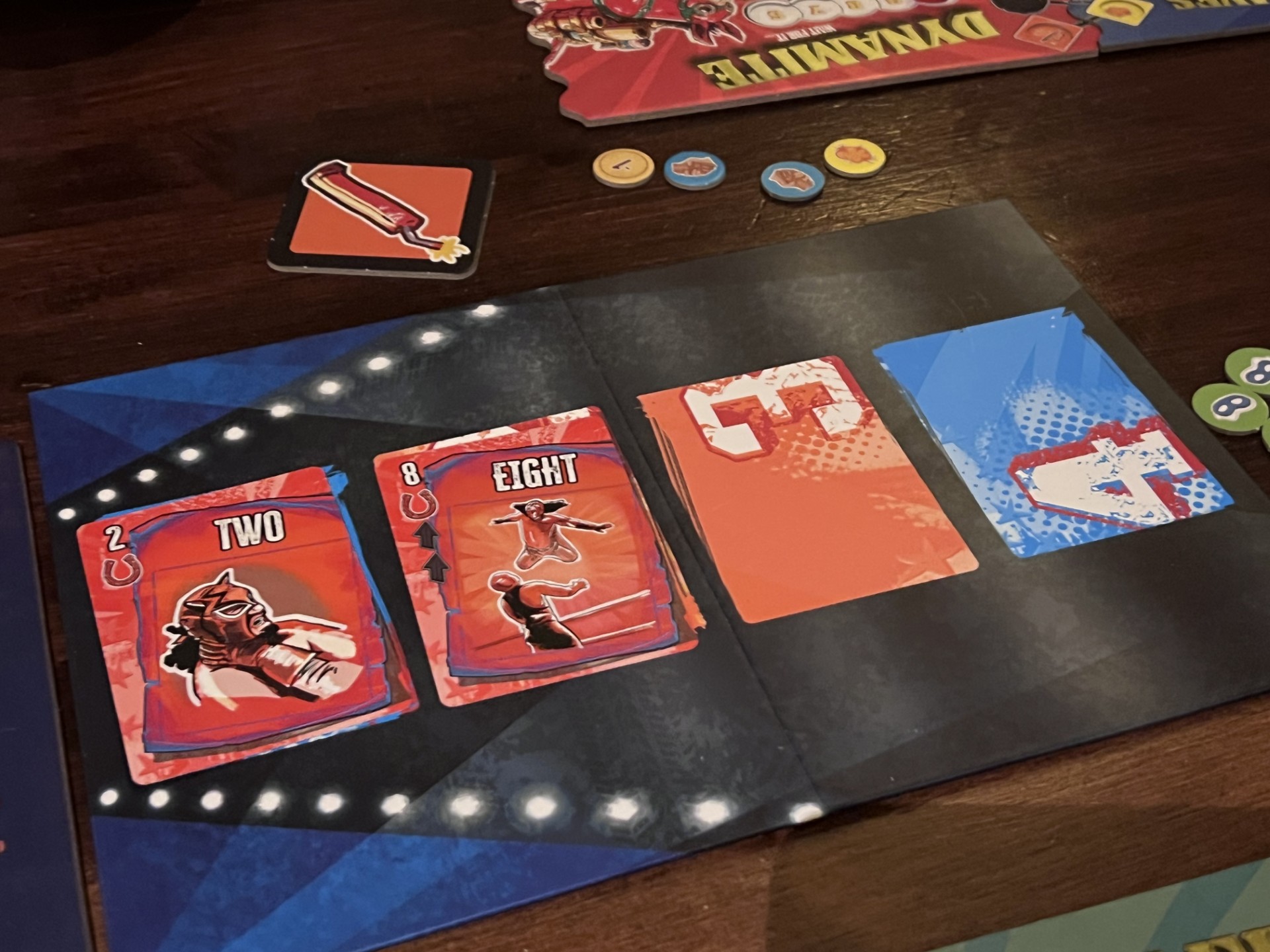
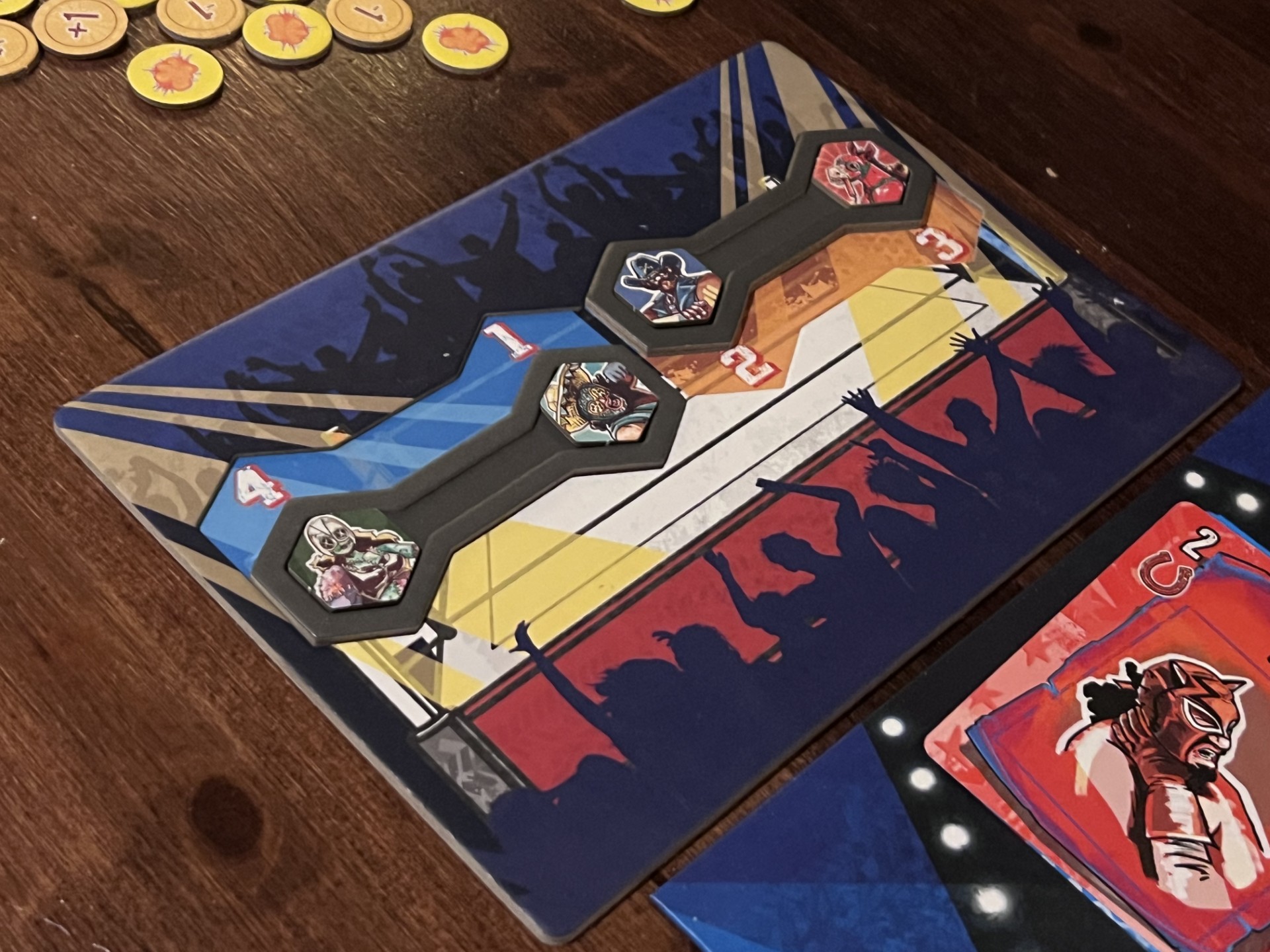
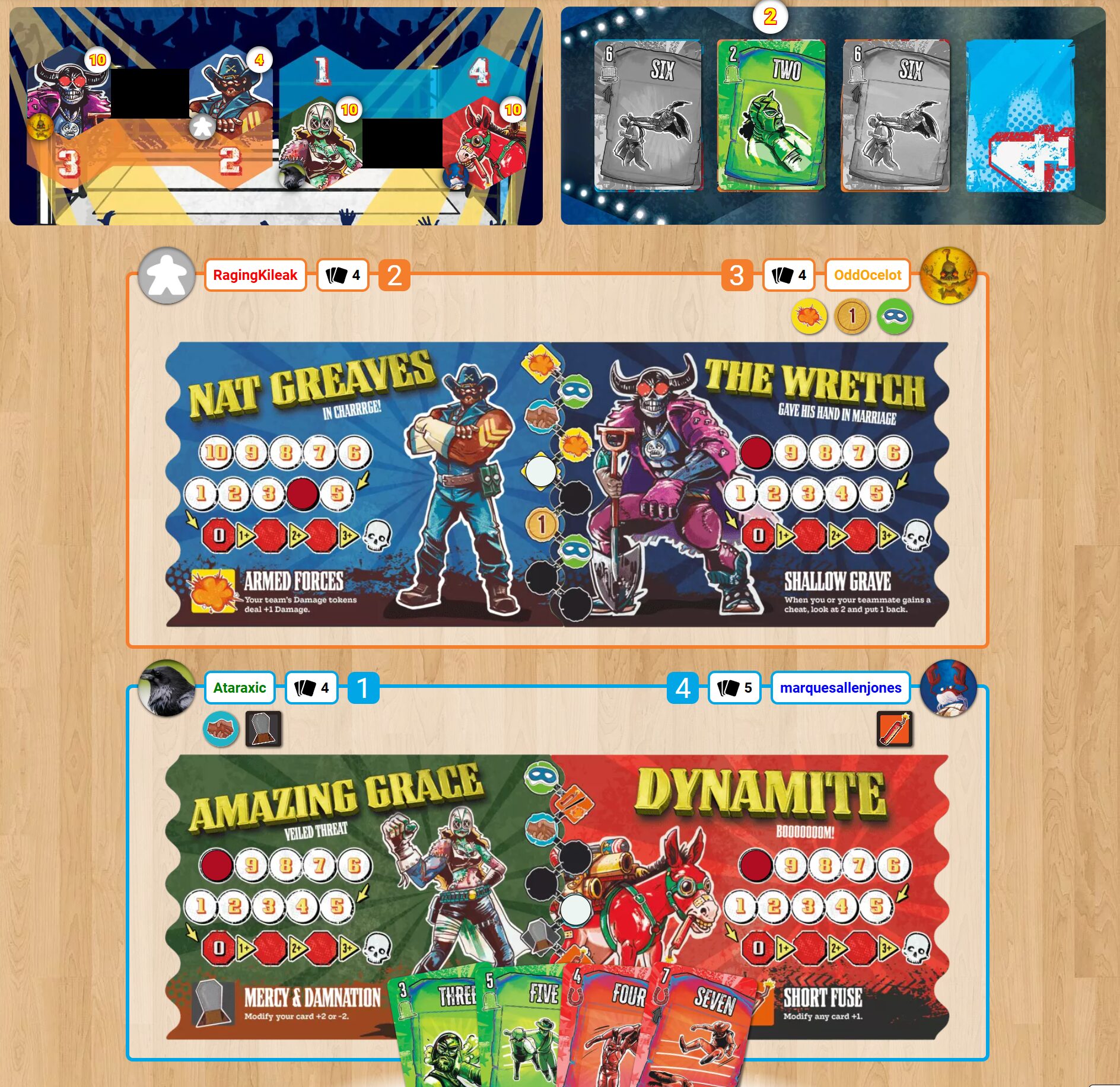
The basic flow is straightforward. Players are dealt their hand of eight cards, the player in first position (as indicated on a handy little board) leads, and everyone else must follow suit if they can. As I mentioned, the lowest card wins the trick, but each wrestler has a special ability that might change things — one wrestler causes his team’s damage tokens to do two damage, so if one of these onto a “one” card, then suddenly a card that would deal a single damage is now dealing three. Other characters get unique tokens that modify their card value or suit.
These tokens are important for several reasons — some of which (like damage) — are straightforward. On other occasions, they have a more subtle use. Most characters must play their tokens when their own card is played, but Dynamite (who seems to be an actual donkey in a luchador outfit) can use her Dynamite ability. This seems odd at first as it increases the value of a card by plus one, but when you read the rules a second time, you realise that it can be played on any card at any time, so there’s potential to play it either on an opposing card to make it easier to beat, or to play it on an allied card to deal more damage (assuming it wins the trick).
Another key rule in Rowdy Partners is that of countering. A counter occurs whenever a second card of the same value is played into the trick. So as an example, if someone leads with a blue two, and then the next player follows with a blue three that has a minus one token on it, then both cards are eliminated leaving the third player (who is always partner to the second player in the trick) to lead with a new suit and value of their choice. As you’d expect, there’s no open communication between team mates, and guessing what your partner has in hand is just as important as working out what your opponents might do.
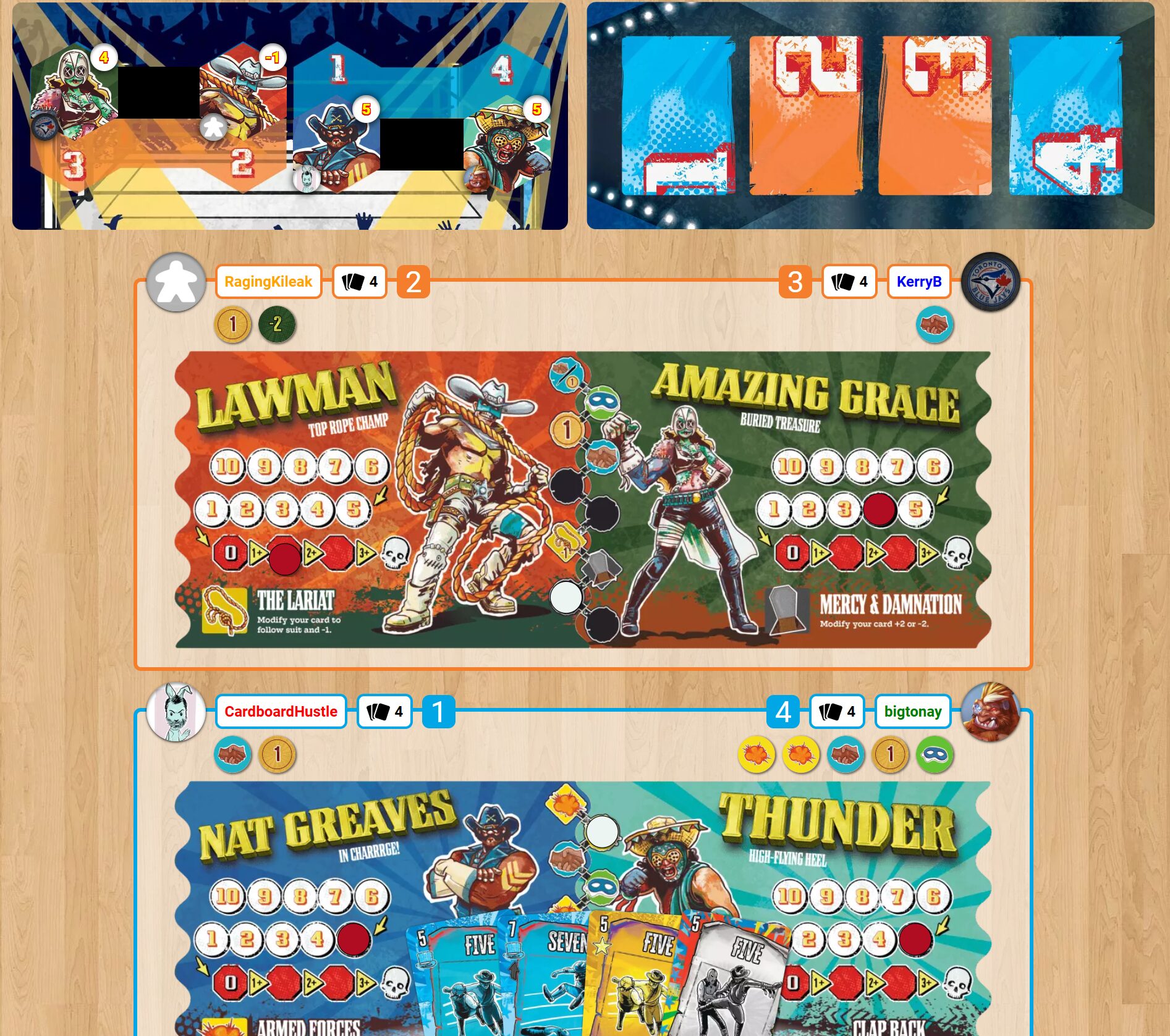
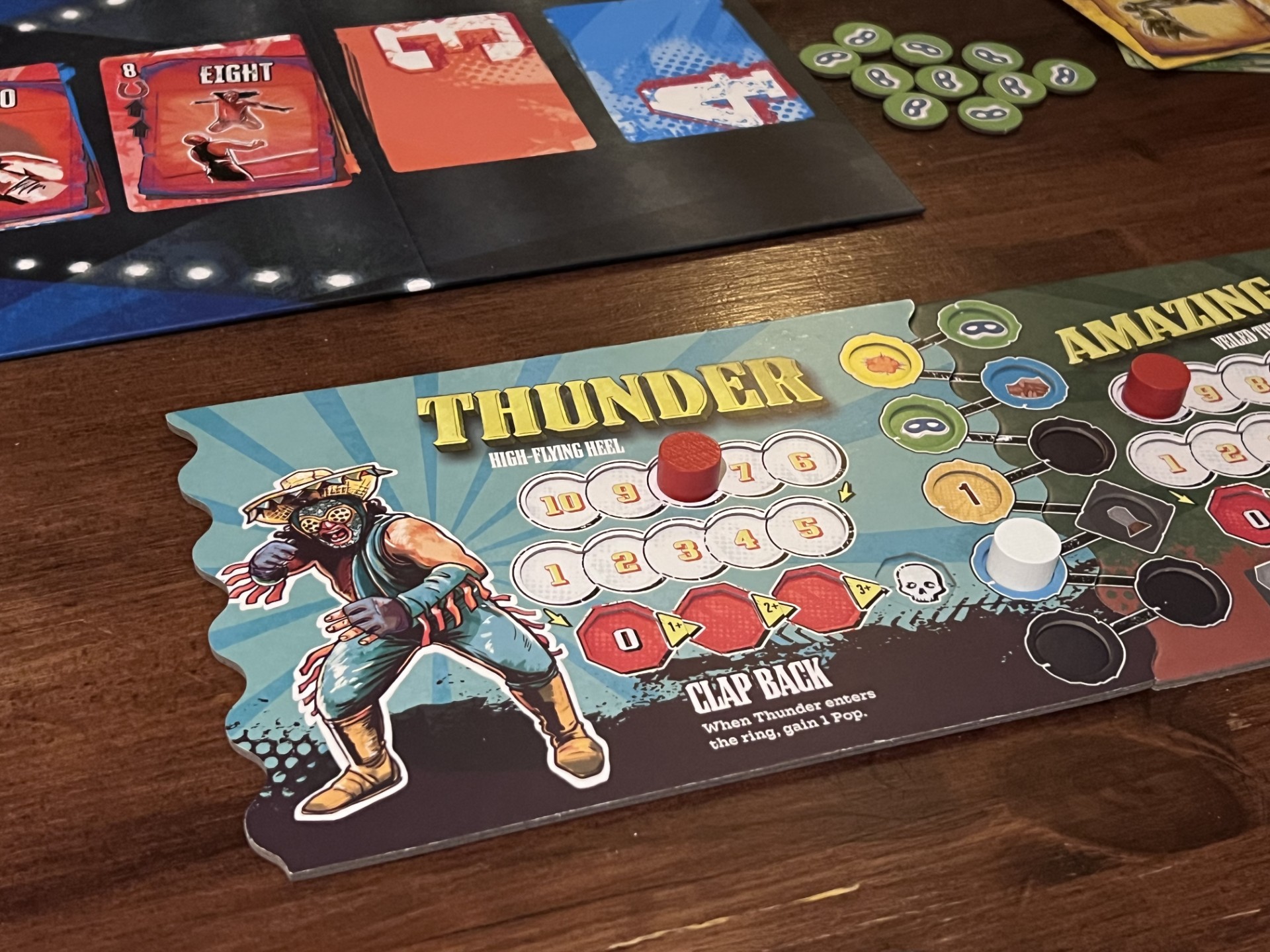
Health is the central resource in Rowdy Neighbours, but it’s not the only resource. Each wrestler has a health track, and as a team loses tricks, the health of the in-ring wrestler ticks down until they enter the “pin zone.” From here, there are three steps until that wrestler is pinned — and cleverly these must be dealt with one trick at a time with ascending difficulty. You can’t just strongarm a player from five health down to zero — their health bar will stop at three, then two, then one. The final space requires a trick of damage three to be won, so chipping away with ones won’t do it either.
The other resource in Rowdy Partners is popularity. Each wrestler comes with their own dual-layer board and when a partnership is formed, those boards are slotted together. Where the boards join, the popularity track zig-zags up the board and features tokens on each side. As popularity is gained (usually from playing high numbered cards like sevens and eights) so too are the tokens — and these include +1/-1 modifier coins, +1 damage, tag tokens that allow the in-ring wrestler to switch and cheat tokens that do various things but remain hidden from opponents until used.
A big part of the fun in Rowdy Partners is the synergies between wrestlers and the narratives that emerge at table level. Combined with the gameplay, Rowdy Neighbours actually feels a lot like a wrestling match: Early tricks might be about probing and positioning, mid‑round exchanges about setting up damage, and late tricks about either closing out a pin or desperately trying to stave one off. Because the players work in teams (mainly), there’s a fantastic feel to how each game plays out.
What makes Rowdy Partners interesting from a systems perspective is how it uses imperfect information and partnership play. You can’t openly coordinate with your partner, but you can signal through your choices: leading a particular suit, burning a high card for popularity, or choosing when to trigger a swap all communicate something about your hand and your intentions. Good teams learn to read each other, to anticipate when their partner is setting up a signature move or trying to protect a weakened wrestler. That makes the game feel very different at novice and more experienced levels of play. With new players, it’s chaotic and funny; with experienced teams, things can actually get quite tense.
The physical production from Capstone is thematic and generally brilliant: bold art, expressive wrestler characters, and a presentation that sells the idea of a dusty Mexican town where grudges are settled in the ring. It’s easy to teach — the core trick‑taking skeleton is familiar to anyone who has played traditional card games — but the layered effects and health system give it more depth than a casual glance might suggest. It sits in that nice middle ground where you can play it as a light, “beer and pretzels” experience or dig into it as a more serious closing game for your evening.
The Board Game Arena implementation, currently in public beta, has proven invaluable in helping me learn some of the rules timing, and it’s also a game that works well in asymmetric timing mode. BGA makes Rowdy Partners accessible to a much wider audience and, crucially, handles all the bookkeeping: health tracking, popularity generation and card or token timing and suits. That means you can focus entirely on the temp and tactics rather than worrying about missing a trigger. For a game that lives and dies on the sequencing of plays and the interaction of abilities, having a clean digital rules arbiter is a real advantage. It also makes it easy to play repeatedly, experiment with different wrestlers and approaches, and get a feel for how the game scales at different player counts.
On that note, one thing I really want to comment on is how well Rowdy Partners is set up for two, three and four player games. Most of what I’ve said so far assumes four players, which in fairness does feel like Rowdy Partners’ natural home. That said, the game also includes a completely different set of character boards representing “Headliners” and their “Managers.” If you want to play two player then you simply choose a combo of one Headliner and one Manager, set your health to 20 (instead of ten) and set up a dummy hand on the table for each player’s manager (which will be controlled by the Headliner player alongside their own proper hand.) For anyone who has played games like 7 Wonders Duel, this setup will be immediately familiar.
I’m calling this out as a specific comment because I think the designers probably tried to work out how to use the standard wrestlers to do something that worked for two players, and I would assume were not happy with it. To add what is essentially a completely different set of (quite expensive to produce) components to accommodate a different player count is the kind of commitment that you only get from a quality publisher like Capstone Games, and I’ve enjoyed Rowdy Partners at both two and four. I’m yet to try it at three, but it works as a hybrid of the other modes, with one player controlling a wrestler and a dummy hand whilst the other two players work as a team.
From a design standpoint, Rowdy Partners succeeds because it respects both halves of its identity. As a wrestling game, it captures the ebb, flow and general razzmatazz of sports entertainment, especially at four players: desperate tags, big finishers, daring comebacks and sudden reversals are all here. Meanwhile as a trick‑taking game, it offers enough structure and nuance to reward careful play, hand management, and partnership intuition. It’s not just a gimmick pasted onto a standard card game; the theme and mechanisms are tightly interwoven.
If you enjoy partnership trick‑taking games and you like the idea of that structure being pushed into a more kinetic, thematic space, Rowdy Partners is a very compelling design. The physical edition delivers a satisfying table presence, while the Board Game Arena implementation gives you a low‑friction way to explore the system in depth. It’s chaotic — rowdy even —but it’s also smart — and that combination makes it stand out in a crowded field of modern card games.
You can find out more about Rowdy Partners on the Capstone Games website.
