

Big Walk is the third game from House House. the Australian based game developer known for a certain game involving a certain goose.
Seeming to be a combination of their first two games (however minimal): The multiplayer aspect of Push me Pull you, and the puzzle solving aspect of Untitled Goose Game; the colourful and minimal texture of their games seems to be a common theme for them, except – in this case – it seems that the employees making the map didn’t get the memo. It remains in my opinion that, whether intentional or not, Big Walk’s map creates the perfect opportunity for a phenomenal game and fantastic educational moments.
Big Walk starts its first challenge right off the bat: Friends. It requires more than one person but is best enjoyed with 4+ people. However, it does tweak and accommodate two or three players. The opening starts you in a room that feels reminiscent of an early development classroom, with entire spaces dedicated to each aspect of the controls. But what makes it special is that it doesn’t force you to interact with it. In fact, the whole game feels so large and looks so spectacular that the walls of the map never feel like an oppressive cage that asks you to solve the puzzle to progress.
Instead, Big Walk rewards the curiosity to explore each space completely; rewarding you with helpful items, or the pleasant spaces that it lets you enjoy together. Most of the spaces have no goal or purpose other than what you can make of it. This is where I think the first gem of this lies, the childlike play it allows you to engage with.
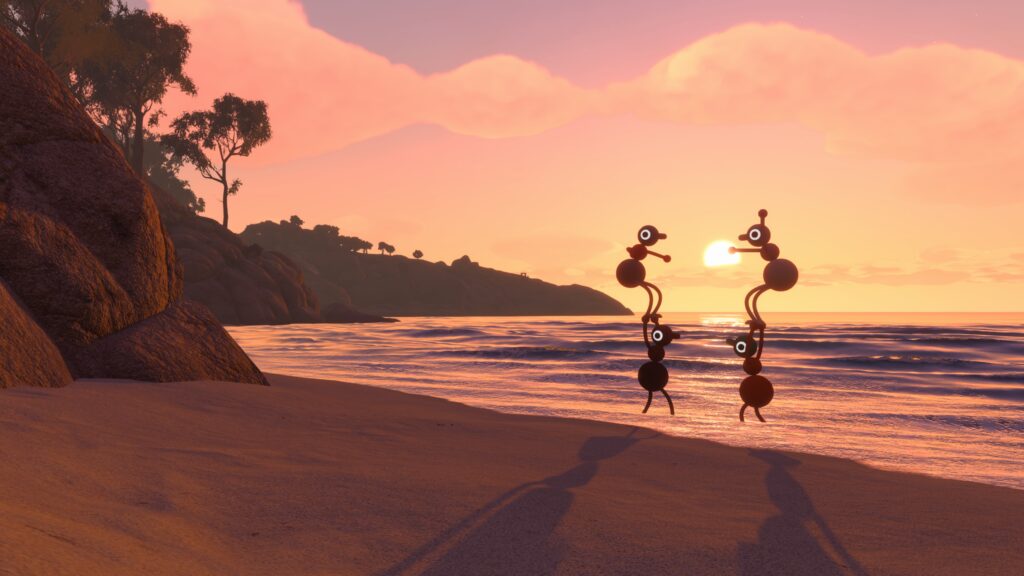
Up until this point you are surrounded by complete shapes, bright colours and very simple designed characters only to be slapped in the face with the greatest map design I’ve ever seen. A highly detailed textured island, complete with foliage, trees, rivers, a day night cycle and very accurate looking waves. When I entered this space for the first time, I was in awe of the contrast it had created. I promise you, I felt parts of my brain activate that I haven’t felt in years. By this point I hadn’t completed anything in this game, but I was enthralled. A collection of balls that we could grab and hold illuminated our way to the first structure in this space.
There I was ready for the first challenge, preparing myself for anything; a game of charades, a simple code breaker, riddles? But we arrived and there were three things: a paintbrush, a mirror, and a colour palette. The catch? To customize yourself, somebody else must paint you. Then the true idea of this game came to me. To get the most out of Big Walk you’ll have to interact and engage with each other. I don’t mean ‘talk’ to your fellow players, I mean truly engage with them, talk, converse, laugh, debate. The full monty. If I had any question at this point, it was more than likely “how far will it take this idea?”.
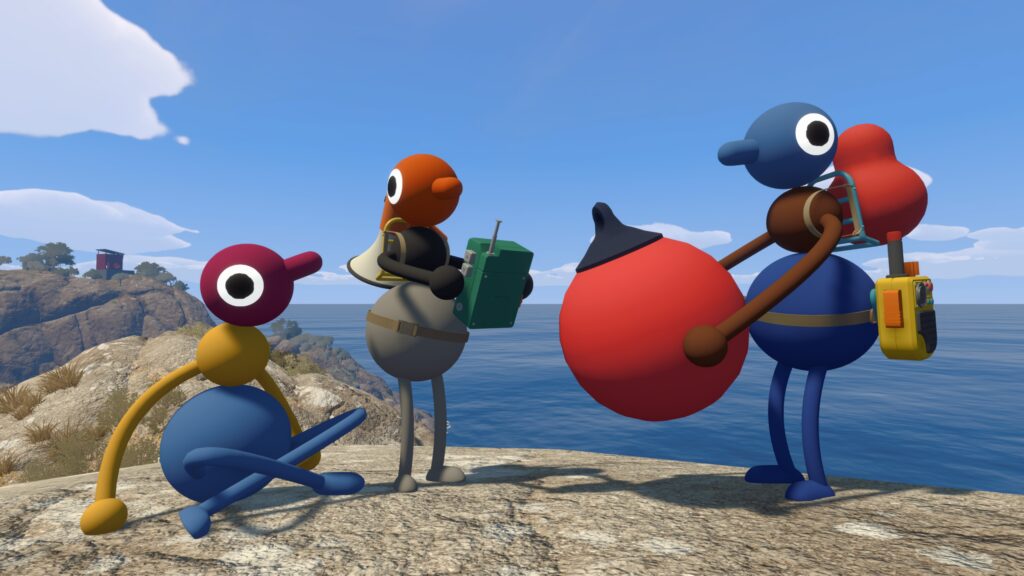
As a quick sidebar, the customization is a three-part colour system of head, body and legs. Cobalt went Yellow, Yellow, Blue. Looking like a minion of sorts. Loosper chose a Red, White, Black. Opting for a Feathers McGraw look. (That damn chicken). I decided White, Light Blue, White. Attempting a Smurf look. This information isn’t important, I just wanted to share.
The large spaces between each challenge. The remarkably designed map. The use for proximity chat and limited communication options. Big Walk remains a manifestation of the phrase “it’s not the destination, it’s the journey”.
My playthrough was a series of small stints with my friends who I shall refer to as Cobalt and Loosper. Cobalt likes to take it easy, enjoys the vibe first and foremost. Loosper is the kinda guy who enjoys completing a puzzle taking the path of least resistance. But, there was a point in our second session playing where I chose to hang back from the group. And as their voices slowly quieted and then disappeared, I was left with myself in this forest alone by the coast with nothing but me and the sounds.
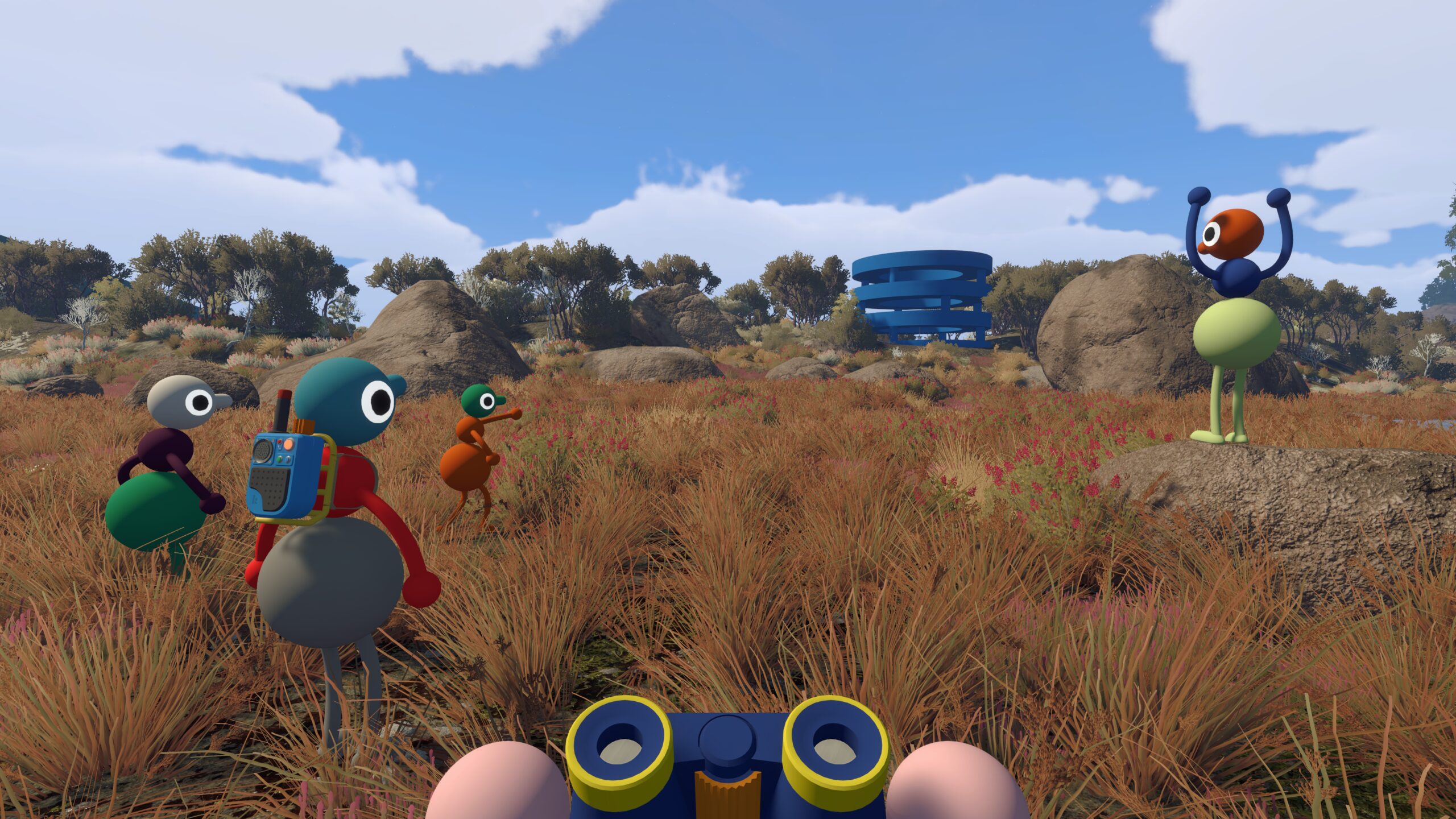
I felt the lack of walls at this moment. No timer counting down. No life counter. No enemies. What did the game want from me? It offered me no prompt to the next objective. I realised that there’s no punishment for taking the scenic route. I seized the moment. I had my little walk. Took in the views, explored on my own. I can’t remember the last time I had a moment like that in this dopamine-filled, retention-driven, attention-demanding game industry. I promised myself to have moments like that where I could from that point on. Not going off on my own necessarily but maybe sitting for a little while after a challenge or taking in each space a little bit longer than usual. It is already a big walk, what’s the harm in making it just a little bit bigger?
One of the core concepts is communication, with a lot of the challenges around the map changing the way to communicate. Whether without sight or sound or voice, separate rooms or patience, each challenge will ask something different of you to obtain the idols necessary to move onto the next area.
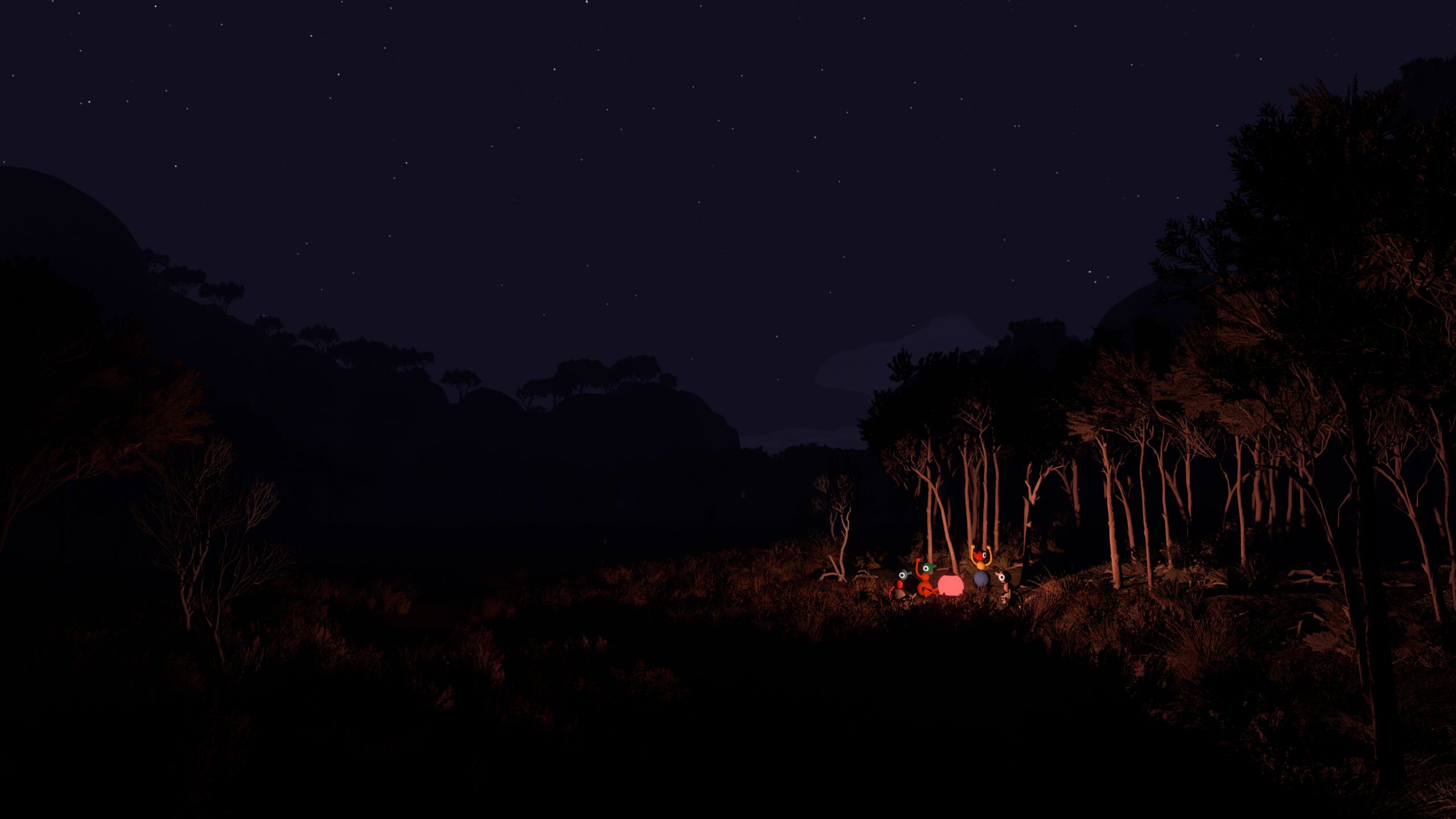
Some of these challenges are spectacular with some true gems in the crowd (my favourite being a room that gives you nothing but a nice room and a timer). These restrictions highlight each aspect of communication, meaning any flaws will reveal themselves eventually. The most apparent one to me was politeness.
Now maybe it’s because my friends and I are comfortable enough that we don’t immediately think to say our pleases and thank you. But during a room that asked us to place teapots in abstract locations to indicate which buttons to push, with no communication… The frustration in that room was clear and, admittedly, we had to stop and have a moderately heated conversation about what was going on. Whether that was “intended” or not your guess is as good as mine.
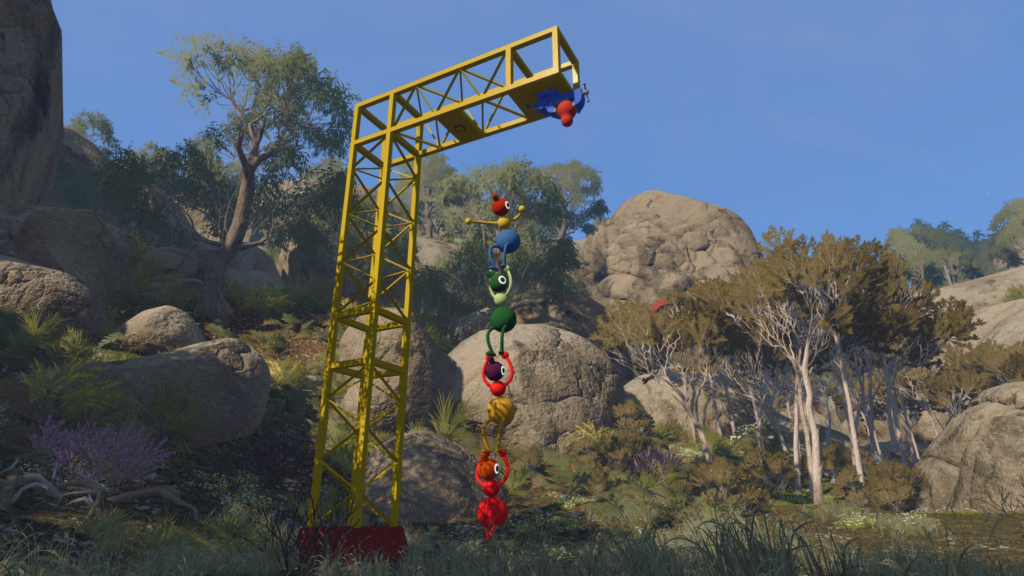
In the many rooms that, at one point or another, ask you to wait for your fellow players without knowing what’s going on, I can only imagine how that went for people who didn’t have the patience to wait around. You will need to trust your companions to do what they need to do, and you must have the patience to let them work it out on their own.
It’s not just a big walk because it’s large, it’s a big walk because you’re not the only one there. It really shows the importance of encouraging words. People can respond in all types of ways to the social aspect and it’s heavy here. It won’t force you to converse with anyone and even offers a text option that still works within proximity, so you have options. I know plenty of people who would much rather remove themselves from unsavoury social situations than navigate them, meaning that the encouraging words are essential for maintaining any dialogue within the game. Big Walk will test your communication skills. You will need to articulate. You will need to be descriptive. Most importantly you will need to listen.
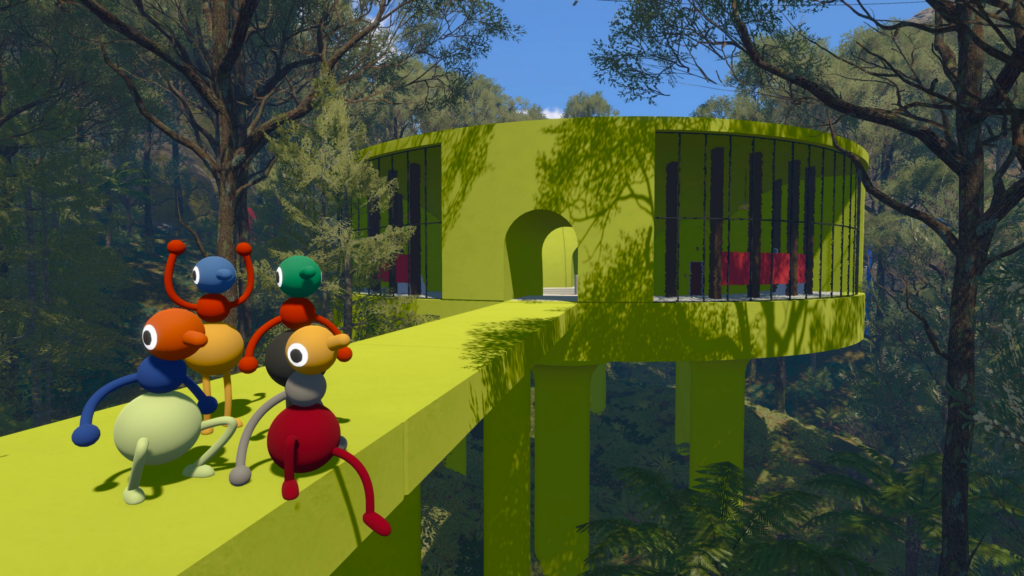
I’ve always had a longstanding belief that games can sometimes only be as good as its worst player. This is the case especially when they rely on the players adding aspects to the game. Board games, sandboxes, survival and TTRPG’s are all examples of games that can be ruined, if not completely, by bad characters. Whether that’s someone killing your dogs in Minecraft, refusing to plant the Defuser in Siege, refusing to pay someone in Monopoly and the plethora of ways that an individual can ruin a DnD game.
Unfortunately, or fortunately depending on how you view it, individuals like that cannot play Big Walk, but that’s not saying that it’ll be impossible for them. They’re just as capable to spend their money, load the game, grab some people and complete the challenges, but I don’t believe they’ll be able to enjoy the breadth of what it has to offer. It would be a more challenging game than it would need to be. It would run the risk of being an unpleasant experience for everyone involved. I really started to wonder what kind of experience these kinds of players would have. Would they be able to enjoy sitting on the beaches waiting for the sun to rise, just for the sake of it? How would the puzzles that take patience go? How do they treat players in puzzles with limited communication? Why would they continue to play a game that acts like sandpaper on their personality?
I see too many hurdles for people who would mess around in a way that their fellow walkers wouldn’t enjoy. And I find this an awful shame as these are the people who have the most to gain from this experience. I honestly believe that there are people who have and will learn from this, have a real genuine moment and walk out of this game with a little something that helps them grow. I’m not saying that it will change anyone like that. There are multiple ways that they could walk out of this closer to those that they walked in with, but that kind of growth often takes the individual to recognise and have the courage to face that and change. It doesn’t guarantee that change, but it gives them the opportunity to.
Now I’m going to be getting into a little bit of spoiler territory here for the last bit of the game so if you wish to experience that yourself, and I highly recommend that you do, Feel free to skip this paragraph and come back if you’re interested with what I have to say about it.
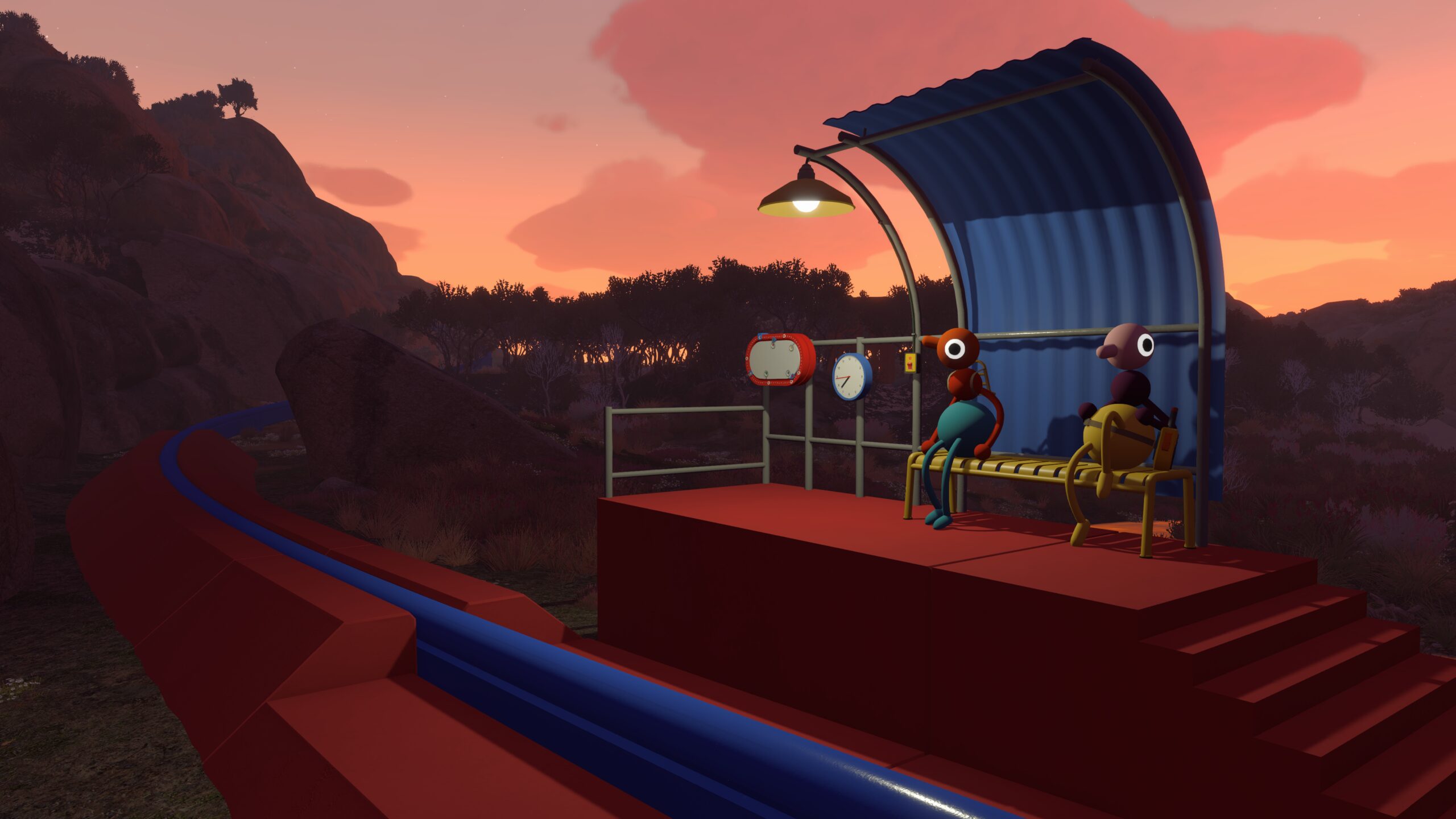
Now after Loosper, Cobalt and I had completed enough of the game to finish it we found ourselves making our way to an oppressive orb looming on the horizon. Making our way towards the entrance on the large wall blocking the path towards it, something strange began to happen. The characteristic colours that we added to each other at the start, began to slowly change until we all were the same shade of green, then purple, then blue. We now looked the exact same, only distinguishable by the equipment on our backs. My ears were full of this deep hum vibrating my headphones and I was unable to hear my fellow walkers. Pushing three buttons in tandem seemed to deactivate the source of this effect. Not thinking much of it, we progressed. And with there being such a large space between us and the orb, Cobalt and I chose to take this game literally and began our slow walk to the orb full of remissing, detours, discussing our favourite moments the whole nine yards. Loosper was eager to see what the orb was about, however he reluctantly decided to stay at our pace.
We kept the pace slow, taking in the moment, assuming that it would lead to the end of our journey. The orb was taking up more of the screen and that low hum began going again as the colours of our body’s blurred again. I couldn’t hear anyone, but there was music pleasantly gracing my ears. Then there was a turnstile removing our equipment…
I talked about how Big Walk was testing each aspect of our communication skills. At this moment you could argue that it was training us for these final puzzles – because these next puzzles we would have to do would be done without discussion, without identification, without planning.
They were the most enjoyable part of the game.
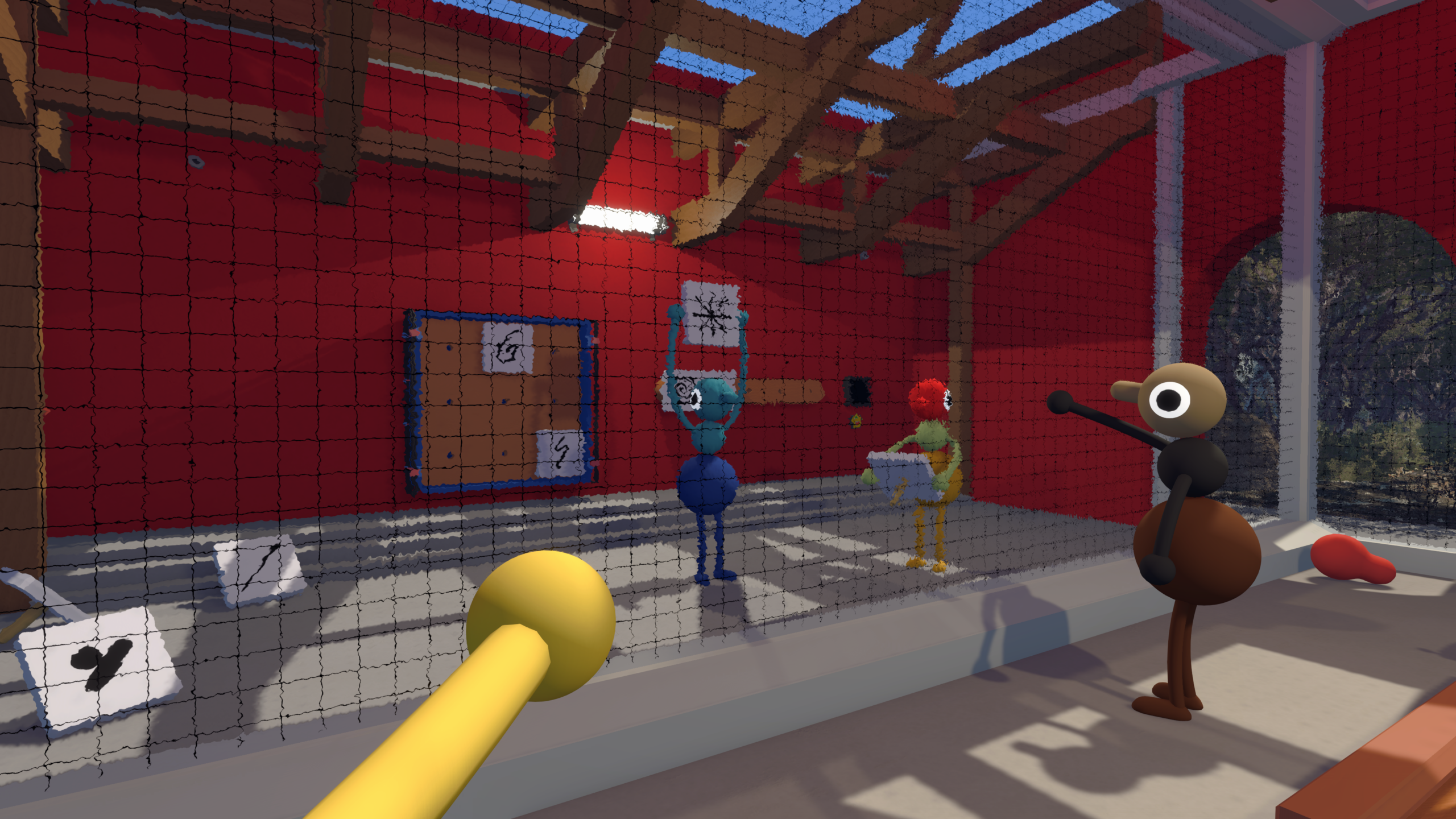
It felt as if all the puzzle pieces of the game had fallen into place within us. Some puzzles had a slow start but did indeed get done, while others felt natural to complete. But the true highlight of all of these was one puzzle that required communication in three parts. The confusion was immediate but after stopping for a second and each of us giving a few points to one item we all arrived at the same page. A smile coupled with involuntary glee found me a few times in these moments, and after completing the orb we were able to talk to each other again/ We all realised how wonderful and special that was.
We progressed to the credits, a lovely lounge area with a projector showing all the people who walked so this game could… well walk. I applaud you all. We spent the moment truly appreciating every name on the text scroll. With fun delight and the game testers bundled in their groups. We moved on at the end of the game. Now I shan’t spoil that, but I will say emotions were felt.
Big Walk gave me a sense of enjoyment that I have never felt before. And I believe that’s because it leaves space for you to bring something with you, each of you. Many games try to let you put yourself within a game, attempting to immerse you in the experience. This one accomplishes that in spades. Not for what it puts in but for what it leaves out. Safe to say that there’s lessons that developers and gamers can learn from this game, gamers most of all. Making this the most unique and unarguably the most recommended game for me this year, if it’s even fair to call it a game.
If you found yourself in disbelief about how I speak about the game, that’s okay. At the end of the day that’s what it is: A game. But why can’t it be more important? Why must it remain as insignificant as that. Maybe it’s worth slowing down. Maybe it’s worth a new view. Maybe it’s worth taking a Big Walk.
Big Walk is available now for PC, Nintendo Switch and PlayStation.
