

Magic: The Gathering released all the way back in 1993, and remains one of the most popular trading card games to this day. The interesting thing about MTG though, is that one of the most popular ways to play isn’t the “original” method.
Plenty of card games have multiple formats, but in my experience, Magic is one of the few games where I see more people seeing a variant (and actually see the publisher acknowledging and supporting the variant) as much as I do with Commander. Just because it’s a popular variant doesn’t mean you know how to play it though, and as we start to produce more Magic content here at B3, especially Commander themed features, we wanted to give you a basic guide on how it works.
Now, this guide is going to assume you know how to play Magic. If you don’t then I’d highly recommend downloading the free app Magic Arena. It’s the best free way to play Magic digitally in my opinion, and whilst you can’t play Commander there yet, it has a robust tutorial and is an excellent way to learn Standard, and to get used to the ways cards interact. I often use it as a way to sample card interactions before committing to buying physical cards.
With those ground rules set, let me tell you about my favourite way to play Magic.
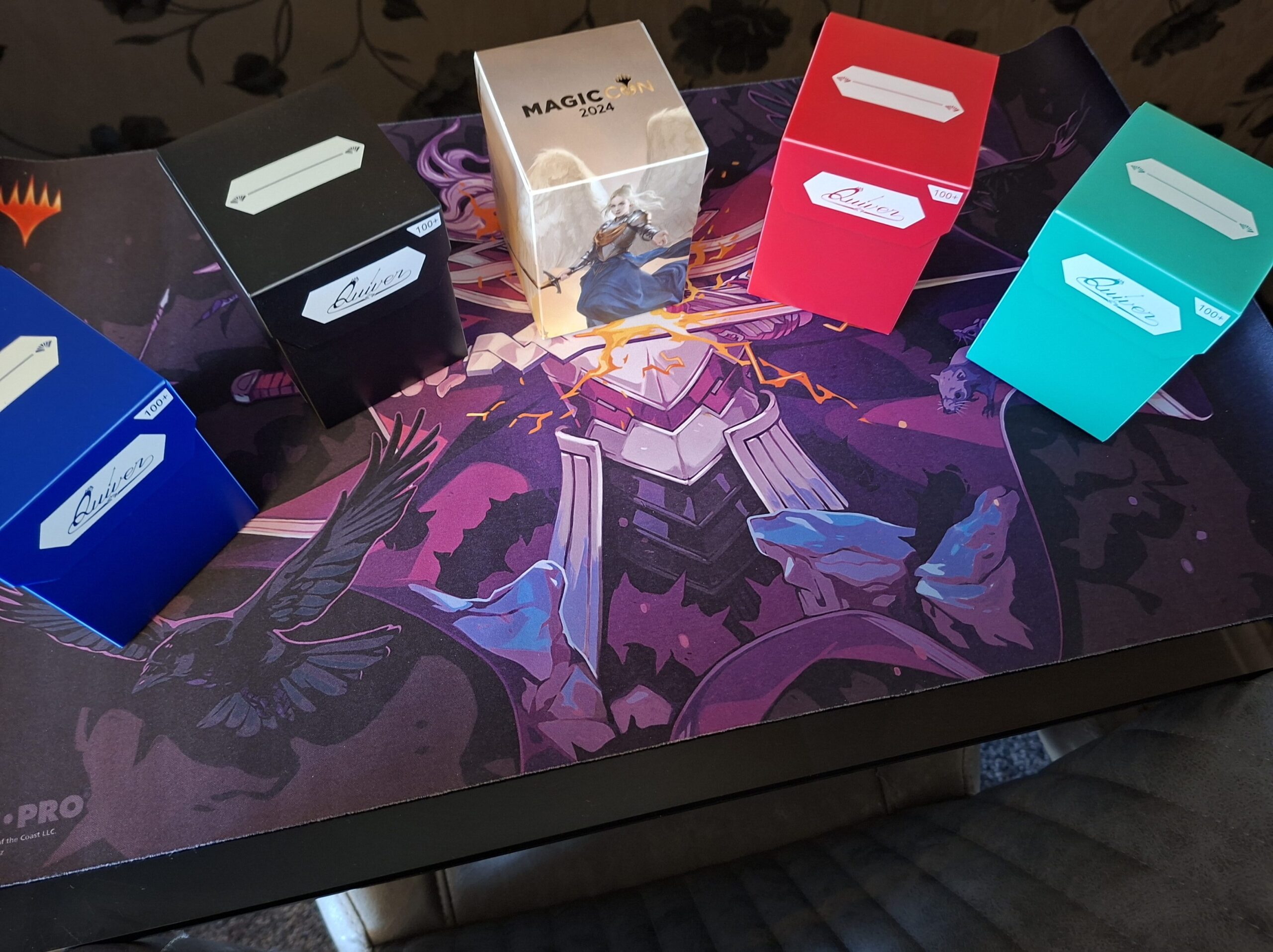
The Basics
Right, you’ve played a few games of Standard, you know how mana works, you know how to fight one opponent, now how about three?
That’s right, Commander is a “multiplayer” format. Whilst theoretically it works with anywhere from three to six players (anything more gets very unwieldy), the standard amount of players is four.
So, four players, 40 life, and a 100 card deck each (Your first Mulligan is also free). The simplest way to win the game is to reduce every other player’s life total to zero. Much like with Standard, you do that with your deck of lands and spells, but there’s some difference in how you build your deck, and that starts with the titular Commander.
The Commander
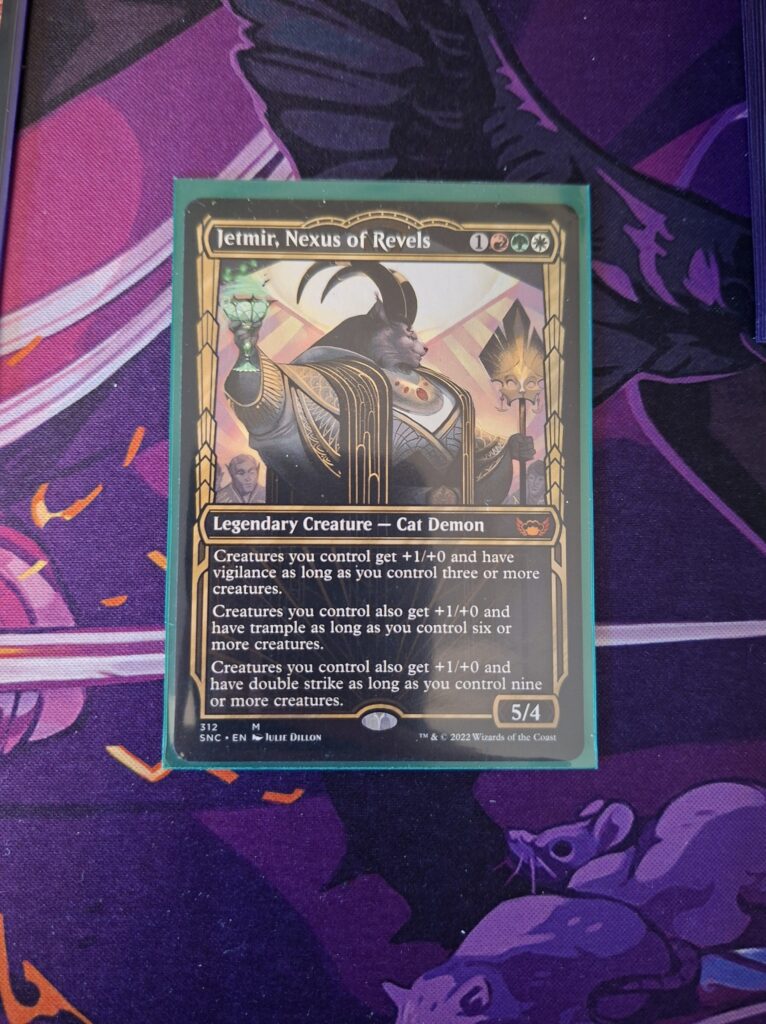
Your Commander is the heart of your deck, one* creature** (usually, bear with me) that represents your game plan, shows what you want to do every game, and determines the cards you can put in your deck.
Typically a Commander is a single Legendary Creature, Spacecraft or Vehicle card. The exceptions to this statement are…
- Legendary Planeswalkers that say “[This card] can be your commander”
- If two cards have an ability called Partner (or its variants), you can use both cards as your commander.
- Spacecraft or Vehicles without power/toughness cannot be commanders.
The golden rule of “reading the card explains the card” kind of applies here. Legendary creature/spacecraft/vehicles that can punch an opponent in the face can be your commander. If it has special rules on top of that on the card, great.
Your Commander lives in the Command Zone. A completely separate area outside your library/deck. You can cast your Commander from the Command Zone as if it was in your hand. When a Commander would change zones (i.e. sent to the graveyard, exiled, returned to your hand), you can return it to your Command Zone instead. The card may be cast again from the Command Zone, but you must pay 2 generic mana more each time you cast from the Command Zone past the first.
Every card in Magic has a “colour identity”. This is the summation of colours that appear on the card. Your Commander’s identity is vital, because is determines the cards you can have in your deck. Speaking of…
The Deck
Your deck, referred to in game as your library, must follow these rules.
- It may only contain a single copy of any valid card (basic lands excluded)
- Including your Commander(s), it must have exactly 100 cards
- You can only include cards that match your Commander(s) colour identity.
Commander doesn’t “rotate”, meaning any card that has been published since the game began (unless it’s on the ban list, or from a silver-border set) is legal. This is the main reason a lot of people prefer Commander to Standard. If you build a deck once, unless you get very unlucky it’s usable as long as you want it to be.
So how should you build a deck? If you ask five different players, you’ll get five different answers, but the guidelines I personally tend to follow are…
- 35-38 lands – I normally run 38, I only drop down to 35 if it’s a very low cost deck
- 5-10 ramp/rocks – cards that get you more mana, so either let you play more lands during your turn, or can
- tap for mana themselves
- 5-10 removal/interaction – cards that can counter spells your opponents cast, or remove permanents off their board
- 3-5 draw engines – cards that let you reliably draw more cards
The rest are whatever is on theme for your deck. People often talk about Archtypes, or at least that’s how I refer to them. This is the thing your deck does, its focus, its theme. You can have more than one, but the more things you try to do, the less successful you can do them. A few examples would be…
- Tribal/Typal – A classic, it focuses on a specific creature or card type and bonuses from playing these. A good example would be a Krenko deck. Krenko cards generally make Goblin tokens based on the number of Goblins you have, and can quickly get out of control.
- Artistocrat – Decks that focus on effects based on sacrificing permenants
- Spell Slinger – Decks that want to play a ton of instants/sorceries
- Storm – A variant of Spell Slinger decks that focus on the Storm keyword, which benefit from casting a lot of spells in a single turn and topping it off with a Storm card
- “Go Wide” – Make as many creatures as possible and swing
- Voltron – Buff your Commander as much as possible and swing at your opponents with that
- Mill – Make your opponents “mill” their decks so they run out of cards
Your Commander will often inform your theme, and any card you pick for your “theme” cards should all work towards the same goal.
Winning
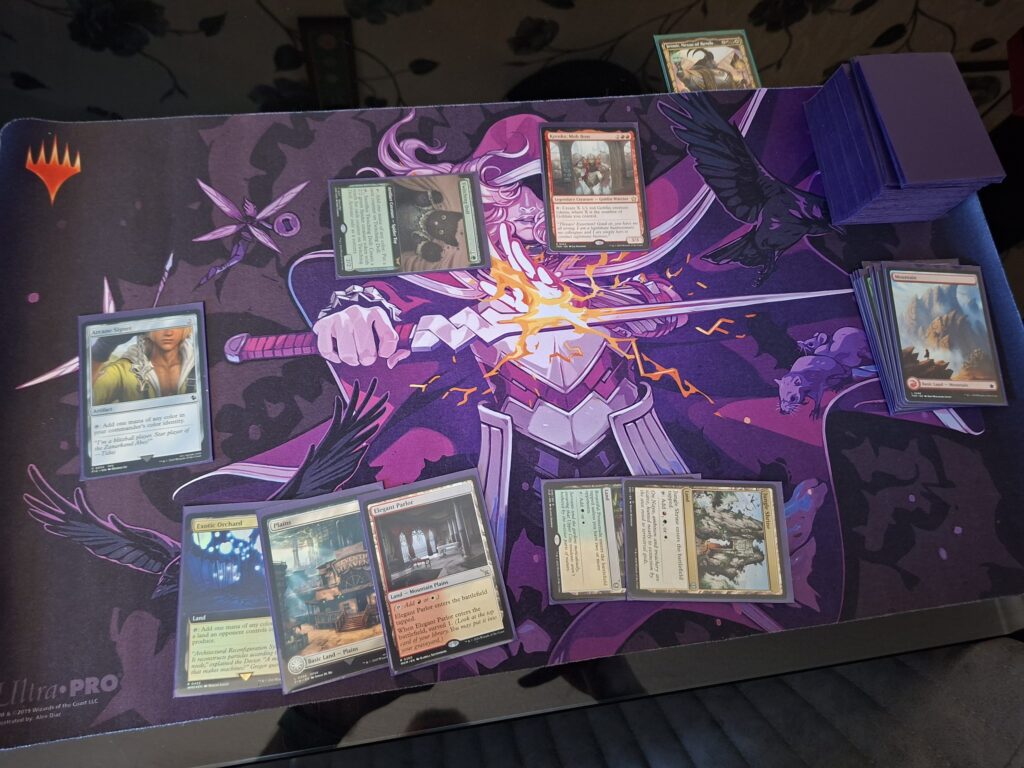
The standard Magic win conditions still apply. Get your opponents life to zero, give them ten poison counters, make them try and draw from an empty deck, or activate a card effect that wins you the game as rules text.
Commander itself has one additional win condition, and that’s Commander Damage. If your Commander deals combat damage to an opponent, you also track Commander Damage as well as the normal damage to their life total. If a player takes 21 or higher damage from a single Commander, they are eliminated.
- This damage doesn’t have to be in one hit, it’s tracked through the whole game
- It has to be combat damage, non-combat doesn’t count
- Partner commanders are tracked separately
Variants and Rule Zero
Commander is a flexible and ever changing game, and it’s important to communicate with the people you are playing with. Most people will play with the above set up, but there is a common phrase called Rule Zero.
Rule Zero means that if you want to do something outside of these general bounds (use a weird commander, mulligan until you get a good hand, etc.) then you can ask your play group beforehand to see if they’d be okay with it. Contrary to what some people might tell you, Commander is a casual game mode. The goal is to have fun.
If you ever go over four players, a lot of play groups will imagine the table as a circle, and you only have to defeat the two players opposite you. If you only play with three, you might start with 30 rather than 40 life. The key here is just to talk, establish the game before you start.