

Gunsen: The Battle for Toshi Ranbo is a streamlined and beautifully elegant engine‑building wargame that blends area control, tactical movement and escalating action power into a tense, highly interactive contest across the Legends of the Five Rings Rokugan setting. It’s cleaner than most games of its weight, easier to teach than its footprint suggests, and yet rich enough to keep you thinking from the first order card to until the final achievement is claimed. For me, this exceptional take on the Scythe model makes Gunsen the rarest of things — a strategy game that is both tense and approachable.
Gunsen feels like a game that has been designed with an opposing approach to the current design philosophy for this kind of game. Where others seem to add more and more “stuff,” often bringing wildly unbalanced and untested ideas to the table, Gunsen is a game that trims away anything that might be considered excess and focuses on tempo, positioning and the thrill of building an engine that becomes more powerful each and every time you activate it.
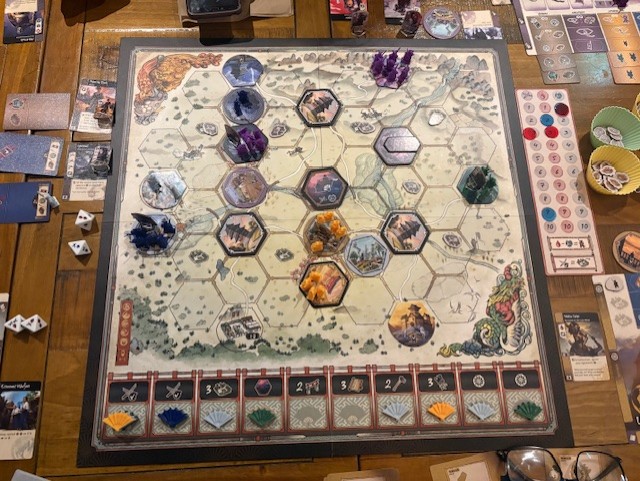
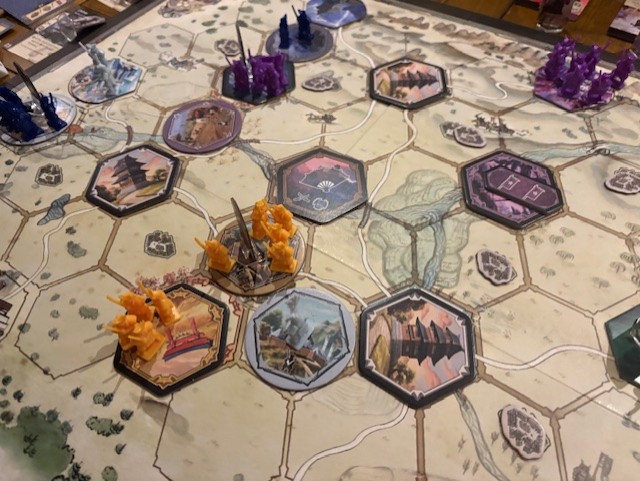
You take on the role of a daimyō from one of the seven Great Clans, each with its own heroes, buildings and clan‑specific cards. The board shows villages, shrines, watchtowers and the central fortress of Toshi Ranbo — the most coveted location in the game. Even on the very first turn, the map feels alive with possible opportunities, and the tension between expanding your influence and clashing with rivals is immediate. Unlike in Scythe, there are no rivers that need to be “crossed” before you can meet a foe, and the board is compact enough to make any move feel aggressive and impactful.
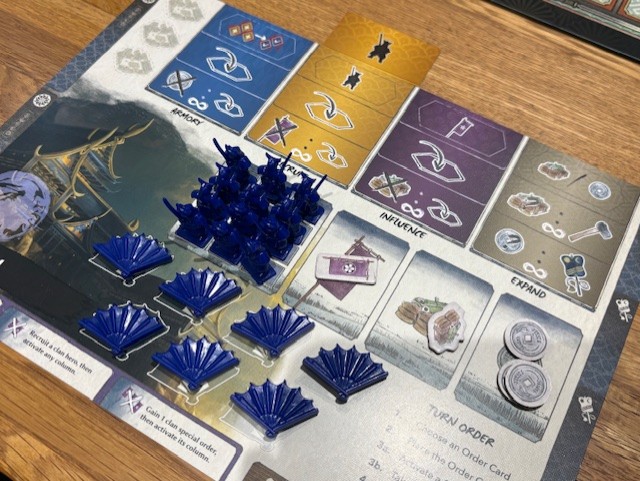
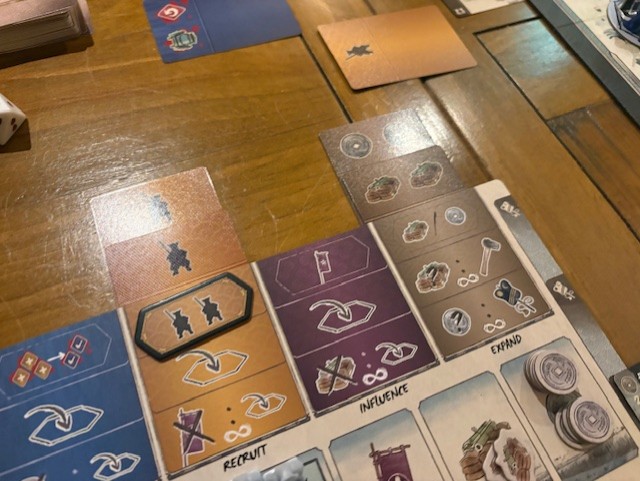
The core loop is beautifully simple. Each turn, you choose an Order Card from the shared row, then either place it in one of your clan board’s four columns or use it to trigger a Noble Action. Placing a card into a column activates that entire column from top to bottom — the new card, the older cards beneath it, and the printed actions on your player board.
Because cards stay in place permanently, each column gets stronger and stronger. Each column has a specific focus on recruitment, influence, armory, or expansion, but exactly once per game, one of the Noble Actions will allow you to place the “wrong” card into one column. The more you invest in a column, the more explosive it becomes and late game turns can deliver huge rewards. For me, this is a mega-clever system that rewards long‑term planning and makes every placement feel especially meaningful.
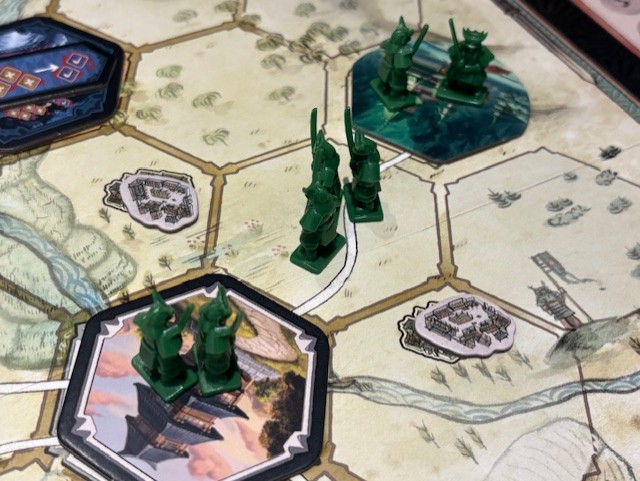
Movement and spatial awareness are also very important in Gunsen, and this is reflected by the presence of a move action printed on three of the four action columns. Every column grants a single movement as a “secondary” action, but you can spend additional resources to move further, with each column asking for a different resource to be spent. There is also a “fast” movement option via watchtowers — where a player can spend one influence to move a whole army between their fort and any friendly or unoccupied watchtower without spending an actual move action.
What this combination of factors means is that players who plan ahead and gather the appropriate resources can have huge turns, all of which can be played and feature zero randomness or hidden information. You could activate the yellow column to recruit four troops in your fort, then spend an influence to send them right up the board to an open watchtower, then use your one movement to step off that watchtower and (in this example) spend another influence to move them into an enemy occupied space triggering a battle out of nowhere. What’s important to note here is that this move is powerful, but it’s also completely predictable, as are several other possibilities. Working out what is best for you — and what is best for your opponents, is part of what makes Gunsen so clever.
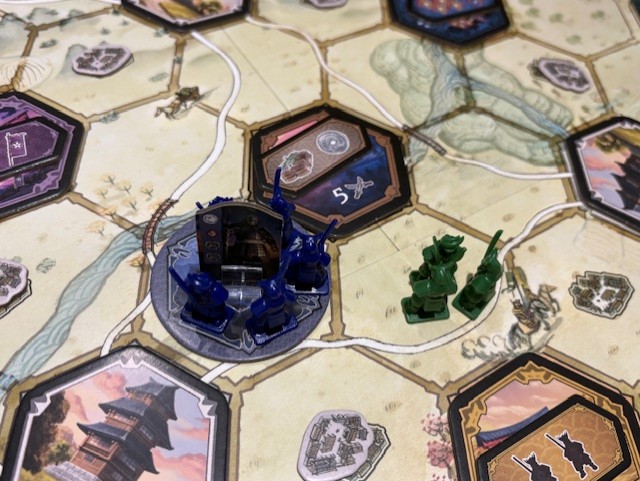
When two armies meet, all movement stops immediately and a battle is triggered. Battles are resolved through a mix of troop strength, hero abilities and dice. Both attacker and defender calculate their Force, Blood and Armour values, then roll up to six battle dice depending on their army’s capabilities. The dice add additional hits, blocks and bloodshed and here again Gunsen is very clever.
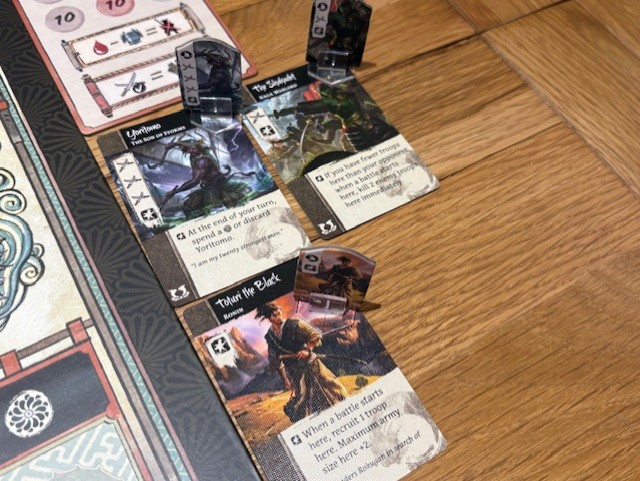
Rather than battles being resolved via an arbitrary dice roll, Gunsen uses a combination of factors across the physical position of troops on the map, the icons on order cards tucked into your player board, and the dice outcome. This might sound complicated in terms of how I’ll explain it, but trust me, it’s super intuitive. The baseline is simple — each troop contributes one Force, whilst heroes might add one or more depending on the circumstances and whatever their abilities are.
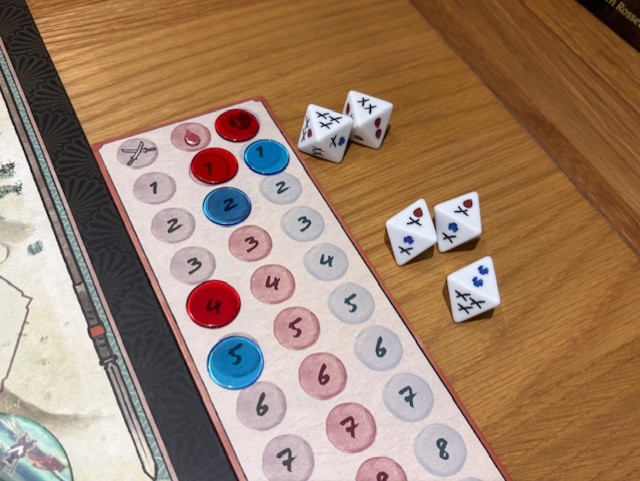
In addition to that, tucked order cards might add Force, Bloodshed (which removes enemy troops) or Armour (which cancels Bloodshed) into the mix. Next come the dice. Each player board shows that by default, a player will roll three dice and then choose two to commit to the battle. Order cards can add re-rolls, additional dice (to either roll or lock in) and there are even shrines on the board that can be controlled to increase the battle statistics in powerful ways.
To track this, Gunsen features a simple battle board with translucent coloured disks that slide down Force, Bloodshed and Armour tracks. What I really, really like about Gunsen is that there is enough randomness here to introduce uncertainty, but in almost every case, the higher quality army will win. A large army with no rerolls, low Armour and few dice will likely lose against a smaller one with several upgrades. It’s also possible to create dangerous combinations — for example by really buffing your bloodshed but keeping your armies small, making them costly to attack.
Whatever you choose to do, the battle board makes resolution really clear and the example in the rulebook helpfully walks through the process step by step, making it easy to grasp even for new players . Combat is quick, decisive and incredibly thematic, making it both a high point in Gunsen and also a high point across basically any game I could care to name. I’m not saying it’s the best battle system ever, but you know what, for a game of this speed and weight, it just might be.
The Noble Actions add another layer of depth, especially if you can’t see the perfect order card for what you want to do. These actions require the player to “burn” an order card to cover the Noble Action they wish to use, and then do whatever that Noble Action describes. One allows the player to take a second order card and then place it in any column, then activating that column, whilst the other two allow the player to recruit a hero or activate their clan’s special order. Each of these actions is powerful and game-breaking, with the mild asymmetry between the clans showing through with extra movement, brutality or economic might.
The Noble Actions feel like highlights — moments where you break tempo to seize an opportunity or rescue a faltering strategy. Heroes themselves are impactful but often positional, offering unique abilities that shape your approach to movement, battle or resource generation. They’re not usually overwhelming (unless their optimal condition is particularly hard to meet), but each one has to be taken seriously when accompanying an army.
In perhaps one of the greatest nods to Scythe, victory comes from earning seven achievements, which is probably where Gunsen’s pacing really shines. Achievements reward a wide range of playstyles and you can’t really ignore them. They include: winning battles, controlling shrines, building both of your clan buildings, using all three Noble Actions, buying tactics, collecting village tokens, completing clan goals and capturing or maintaining control of Toshi Ranbo (which is worth both one permanent point and a temporary one whilst you hold it.) General achievements are always visible and tracked with plastic fans, but each player will usually have two goal cards that are kept secret until their scoring conditions are met.
There’s a lot that I really appreciate about Gunsen as it is probably quite clear, but one thing that I liked in particular was how clean it feels even as the engines expand. The player boards are straightforward and well-laid out to start with, but even as you add cards and the actions stack up, it doesn’t seem to get any less straightforward to manage. The new orders don’t add complex combos or chains that require management, it’s just more of the icons that you already know, and an iterative increase in power level that drives the game to a satisfying conclusion.
As I always like to think of at least one or two limitations to a game even when I personally enjoy it, I’d say the main challenge for Gunsen is likely to be the confrontational element. Not everyone loves combat and confrontation in games and because there are two achievements for winning battles here, that means a “theoretical” minimum of four battles even in a two player game, assuming both players are playing optimally and haven’t cracked the code of a completely pacifist strategy. If that were the case, then I dare say Gunsen is already not the game for such people.
Even so, Gunsen: The Battle for Toshi Ranbo is one of the most confident strategy games I’ve played recently. It’s fast, tactical and hugely atmospheric with a fantastic, thematic mechanical back end. Every order card matters, every movement feels consequential, and every battle tells a really enjoyable story. If you enjoy area control with an engine‑building depth, clean rules and a strong sense of place, then I would be hard pushed not to recommend Gunsen. For me, its inclusion in the Game of the Year discussion for 2026 is potentially justified.
Gunsen: The Battle for Toshi Ranbo is available for purchase now, including from Amazon.
