

Aberration is a grim, tightly‑wound tower‑defence game that marries bag‑building, both scenario specific and randomised objectives, and escalating horror into a tense, highly-replayable puzzle that feels far more considered and characterful than its “tower defense” appearance initially suggests.
At first glance, Aberration looks like familiar territory, at least in terms of the tropes it uses. A corrupted force presses in on a village, shadowy figures advance along twisting paths and a handful of desperate heroes stand between the townsfolk and annihilation. It’s the kind of setup you’ve seen in videogames and tabletop before, but here it’s filtered through Ghostfire Gaming’s Grim Hollow lens: a world where the horror is both aesthetic and mechanical, creeping onto the map itself, into the heroes’ bodies and, if you let it, into your hapless village. Underneath the dark theme, the game is driven by a Quacks of Quedlinburg inspired bag‑building engine that feels surprisingly fresh and well-implemented here.
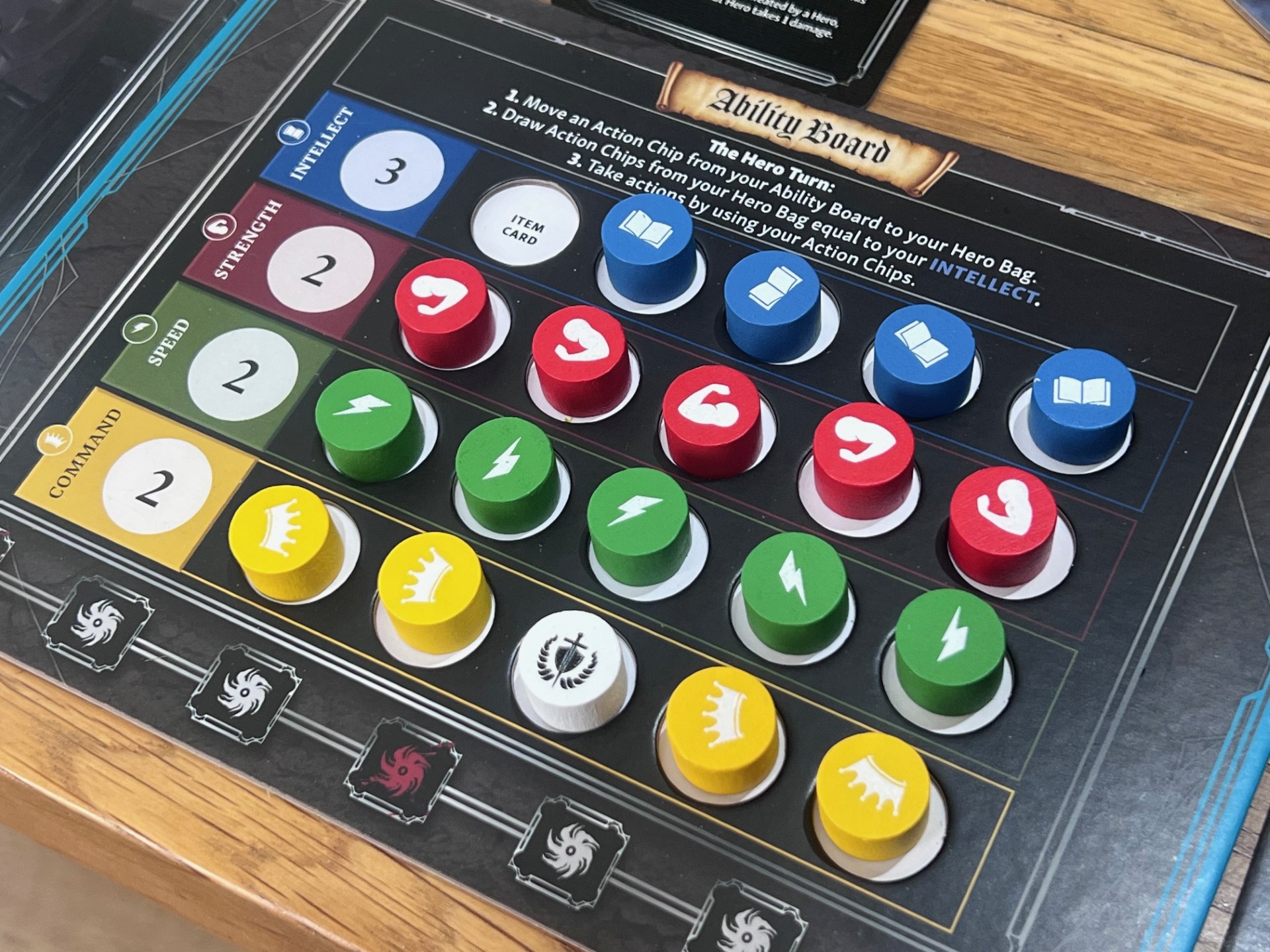
The core loop is simple and straightforward. Each round, the heroes act, then the enemies act. Before you even take your first turn, though, you’re making pretty meaningful decisions. You choose a character and a class (of which there are six of each to give 36 combinations) and that pairing defines your starting bag of disks, your stats, and your unique abilities. The character gives you a personal twist, the class defines your action profile, and together they push you toward a particular style of play. I felt this was a really clever way to create high variance without much of a rules overhead.
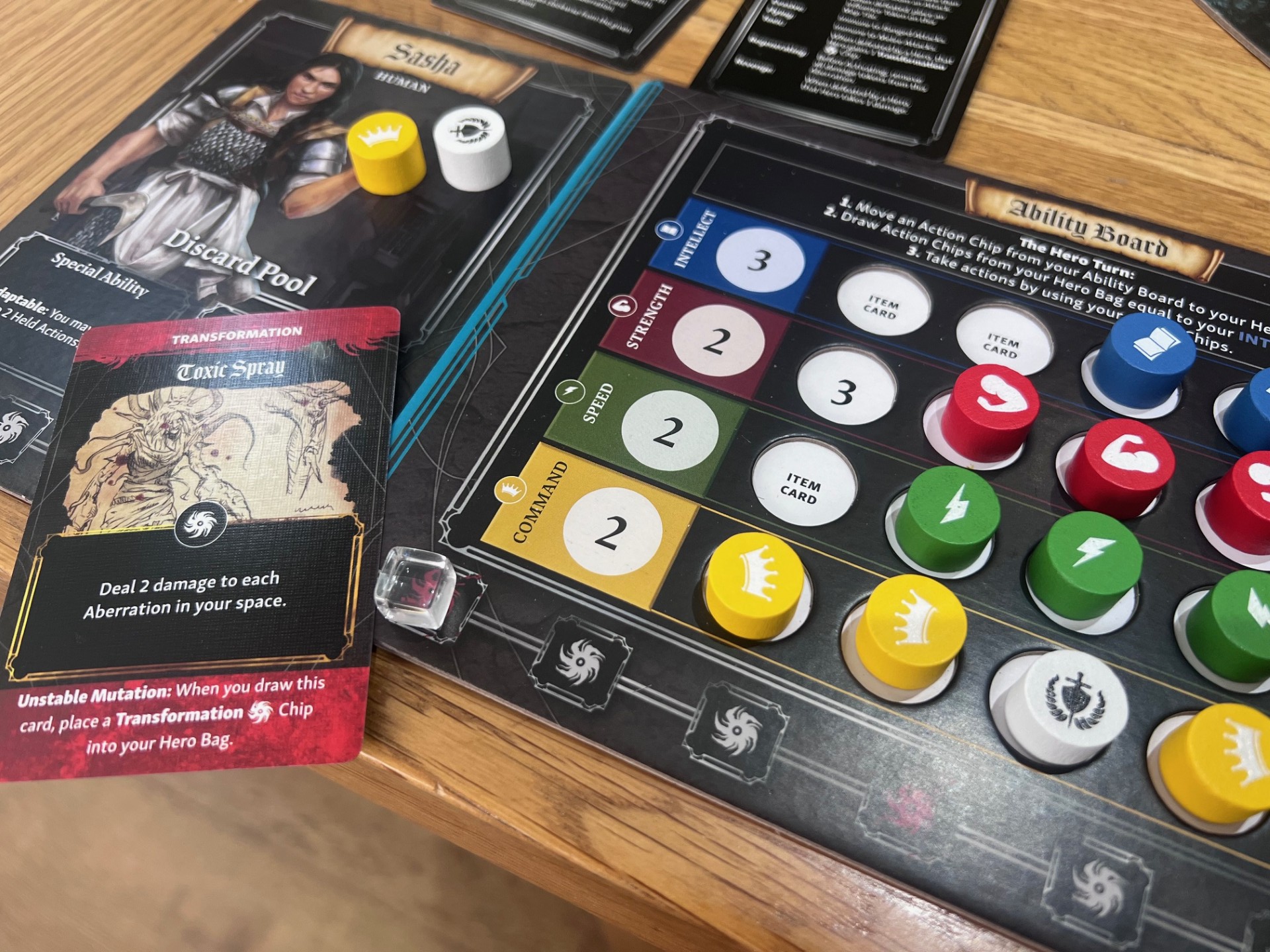
On each turn, you first add a disk to your bag (a small but important step that both specialises your build and advances your “level”) and then draw a number of disks equal to your Intellect stat. Each disk is an action, keyed to specific abilities on your class: attacks, movement, special manoeuvres, support effects and so on. There’s always a default action available that any disk can fuel — usually some mix of move and a light attack — which means even a “bad” draw doesn’t leave you stuck.
What this means is that if your character specialises in attacking with red disks, you want to add more of them to your bag to draw more (of course.) However, if you neglect your intellect (blue disks) then you won’t draw as many disks per turn and eventually the lack of action economy you have means that the game will eventually overrun you.
Essentially, the bag‑building here feels more like quite clever character sculpting than random churn. As you add disks, you’re not just increasing your options, you’re revealing higher stat thresholds and unlocking transformations. Damage isn’t purely punitive; every few points you suffer, you gain a mutation — a one‑off negative effect paired with a new action. It’s a very cool thematic touch suggesting that the heroes are literally being warped by the presence of the aberration, becoming more powerful and more monstrous as the game goes on. It also gives you another decision to make, as sometimes you want to take damage and get your mutation early to maximise access to the special power.
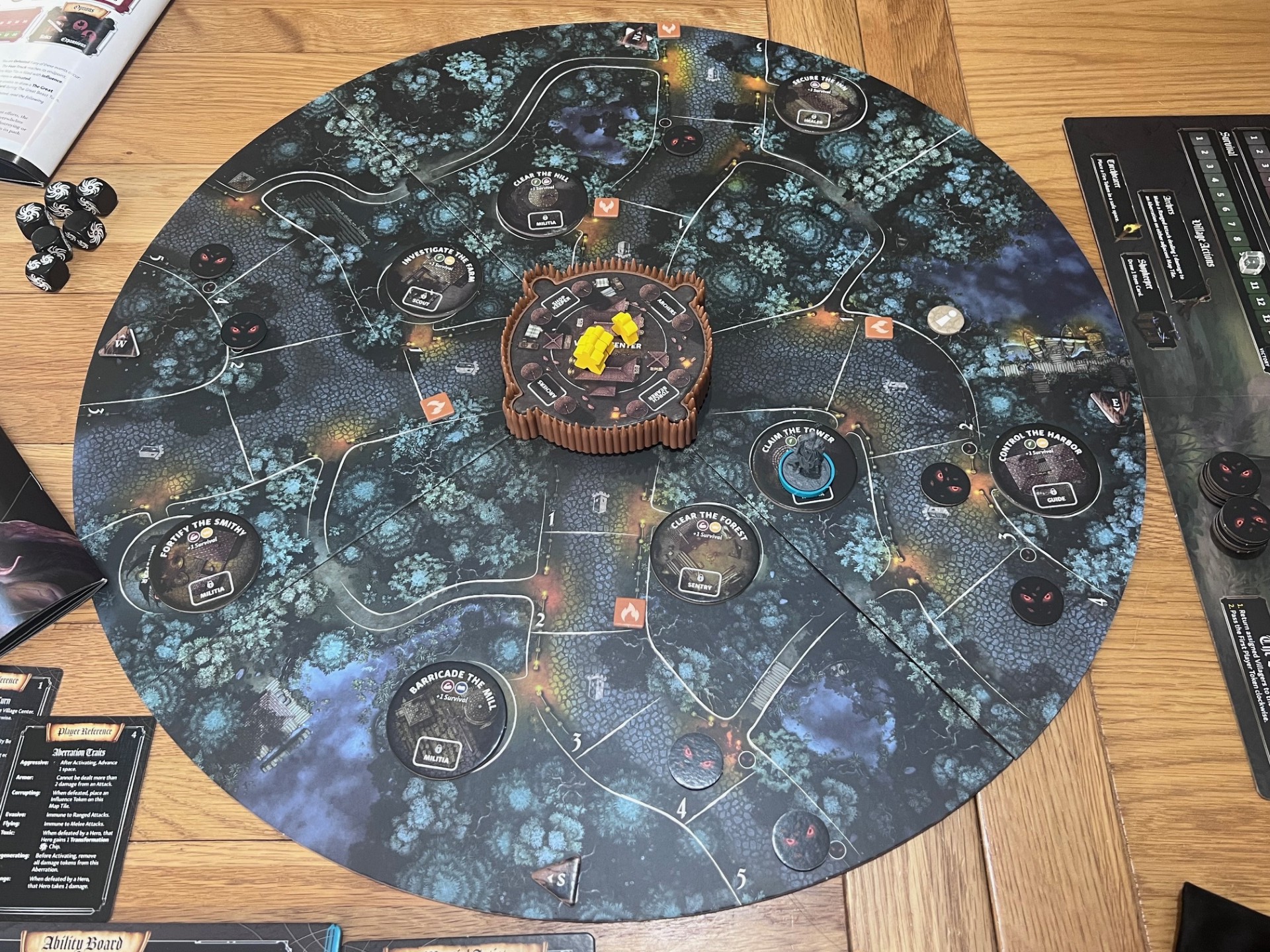
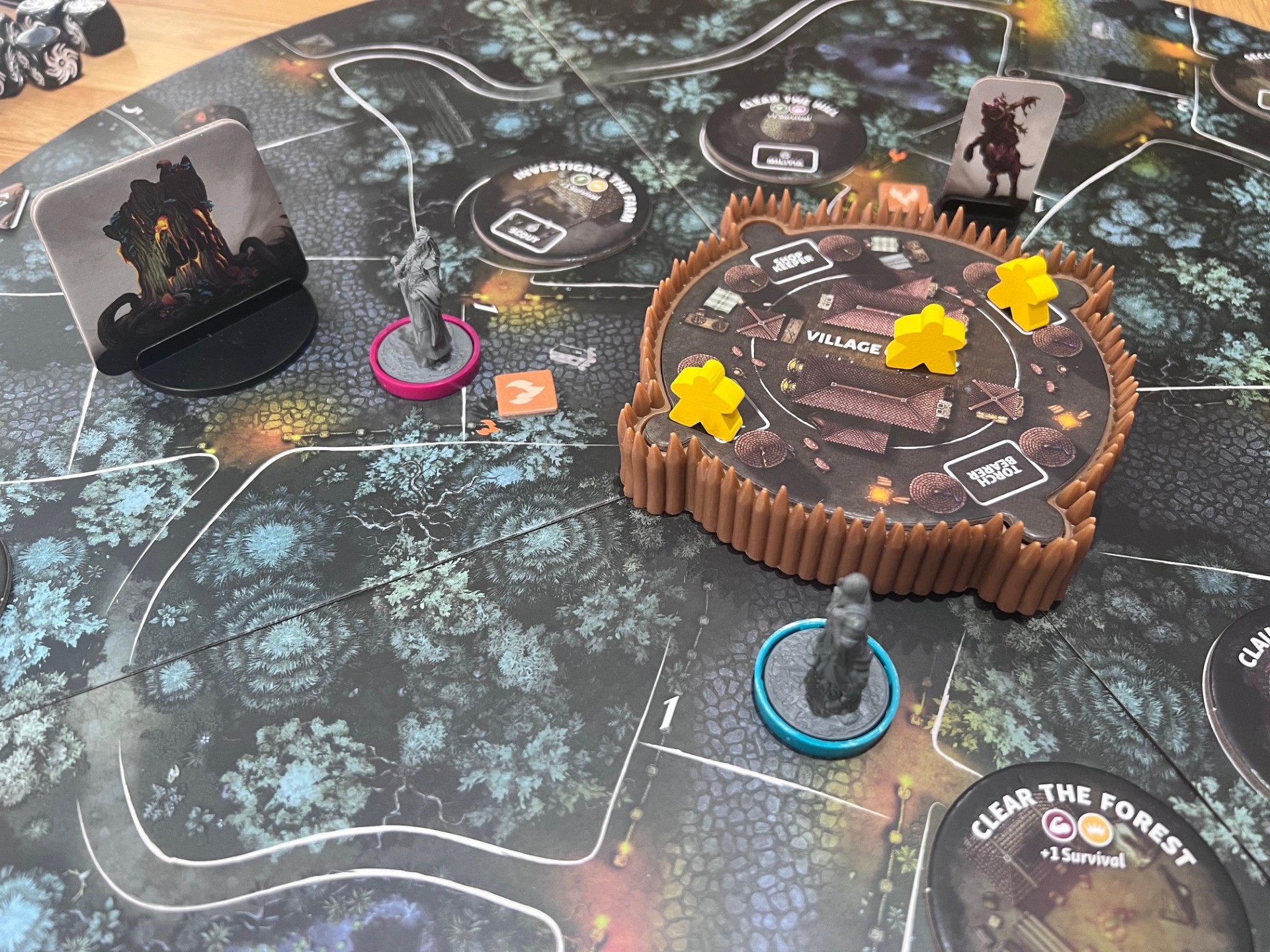
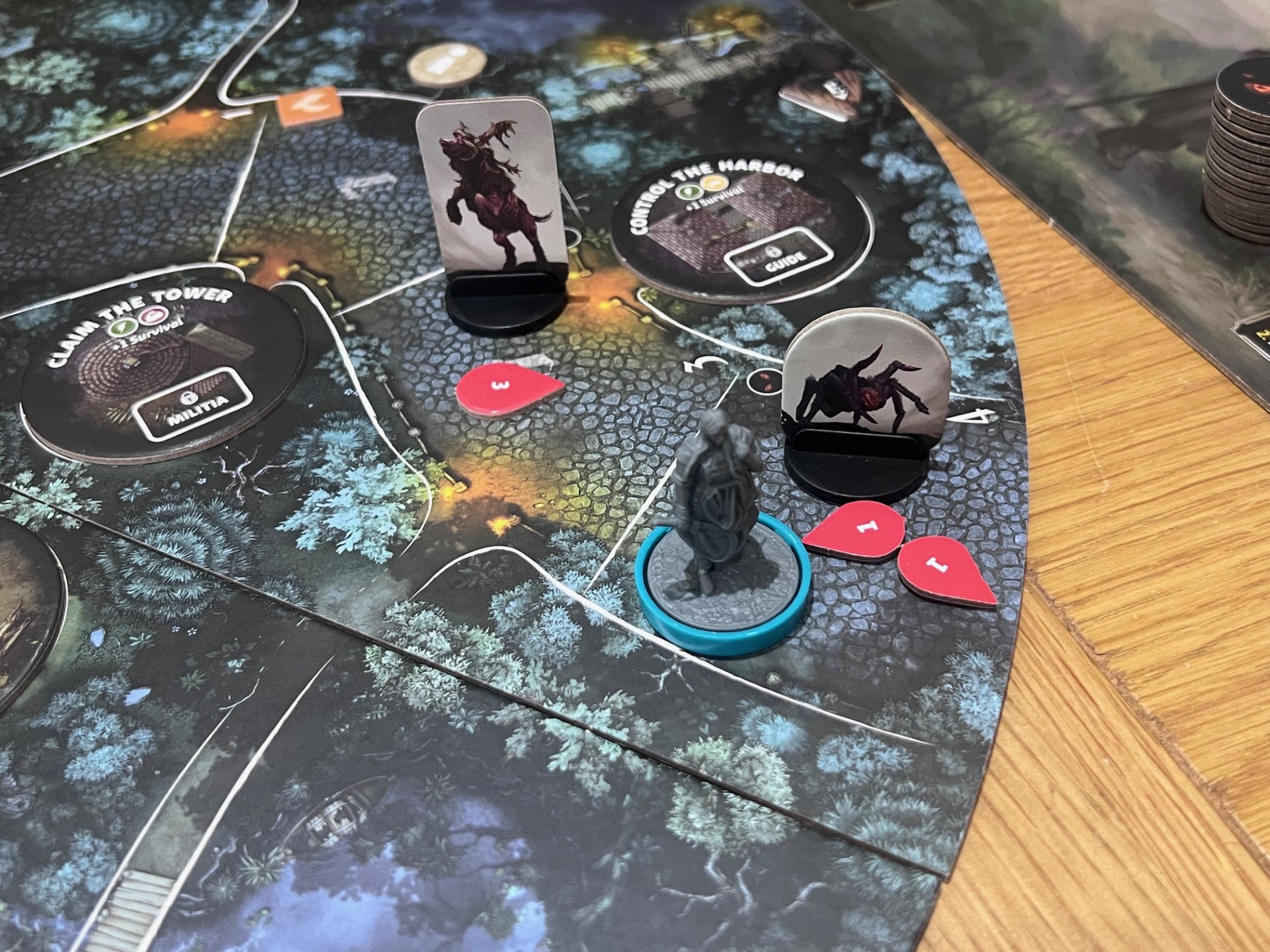
Opposite the heroes, the enemy turn is brisk and predictable. Enemies advance toward the village centre or attack if they share a space with a hero. Shadow tokens (numbered markers that stand in for unrevealed foes) slide along the paths, only flipping into “actual” enemies when they pass a fire or end in a hero’s space. The reveal moment is where the tower‑defence tension resides because whilst you’ve been tracking these shadows, guessing which is which, you won’t actually know how bad the threat is until you see it. Some shadows carry extra effects such as moving other shadows or additional activations, and as with all solo/cooperative games, random bad luck can have an impact.
“Influence” (meaning dark influence via the aberration) is one of the game’s nastiest ideas. Each scenario uses four map tiles, each numbered. When influence is placed, you mark off the highest‑numbered space on a tile, effectively deleting that space from the map. Monsters now spawn closer to town and the path is only ever a few spaces long in the first place. If a tile fills completely with influence, you lose outright. It’s a simple, clever and cruel mechanic and it’s quite thematic as the board itself decays whilst the aberration’s presence grows. In some games, you literally feel the noose tightening with every vanishing space.
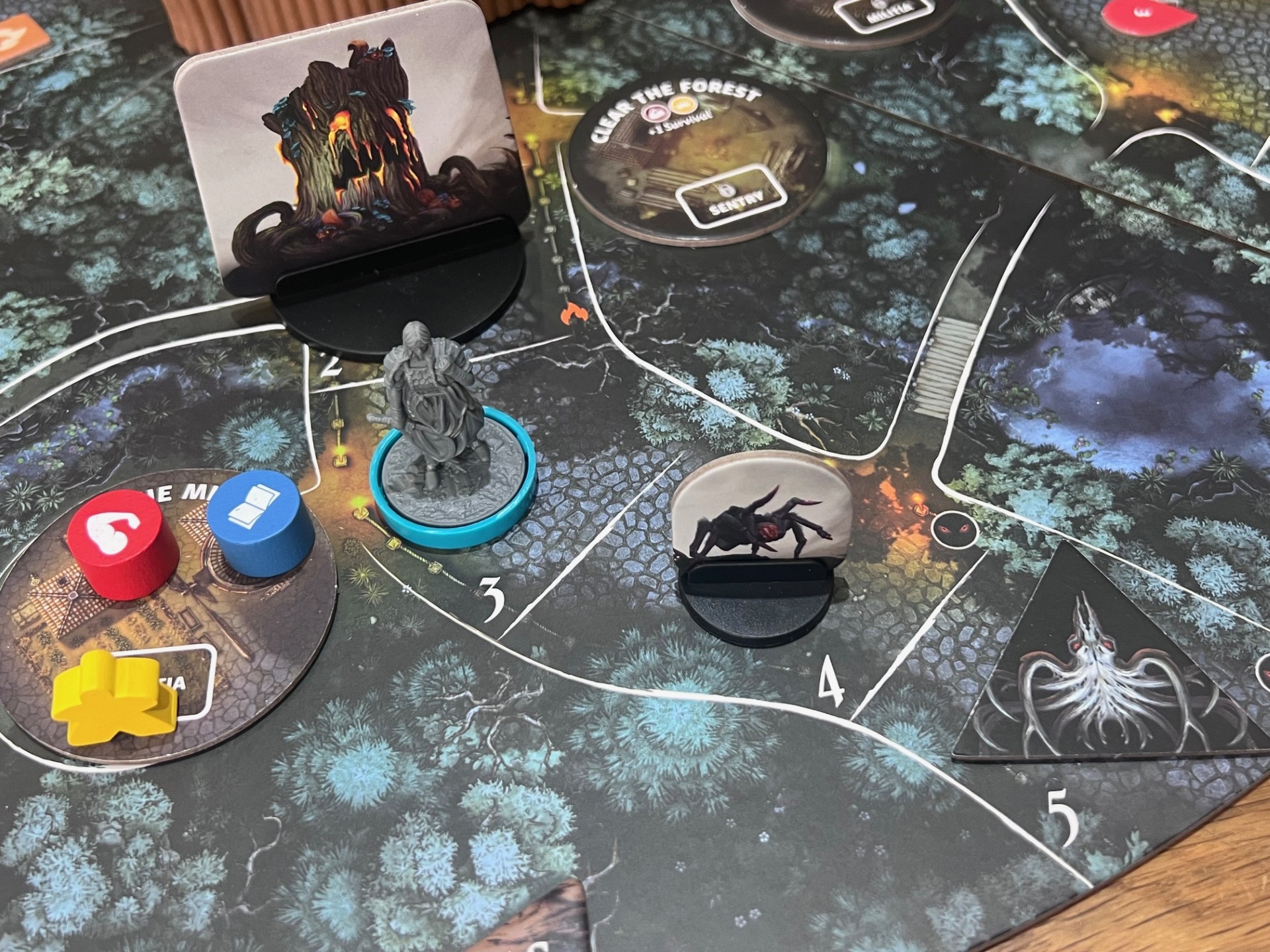
Win and loss conditions are layered but clear. To win, you need to hit a VP threshold by completing objectives and securing vantage points. Objectives are scenario‑specific tasks; you always have one active, and completing it scores VP and flips a new one. Vantage points are fixed spots on the map that, once claimed by spending the right disks with a hero in position, both score VP and unlock new villager actions. To lose, you can hit a fear threshold (primarily gained when enemies reach the village centre), fill a tile with influence, lose a hero, or run out of event cards. It’s a lot of ways to fail, but they all tie back to the same pressure points: keep the monsters out, keep the map intact, keep your heroes alive, and keep the scenario moving.
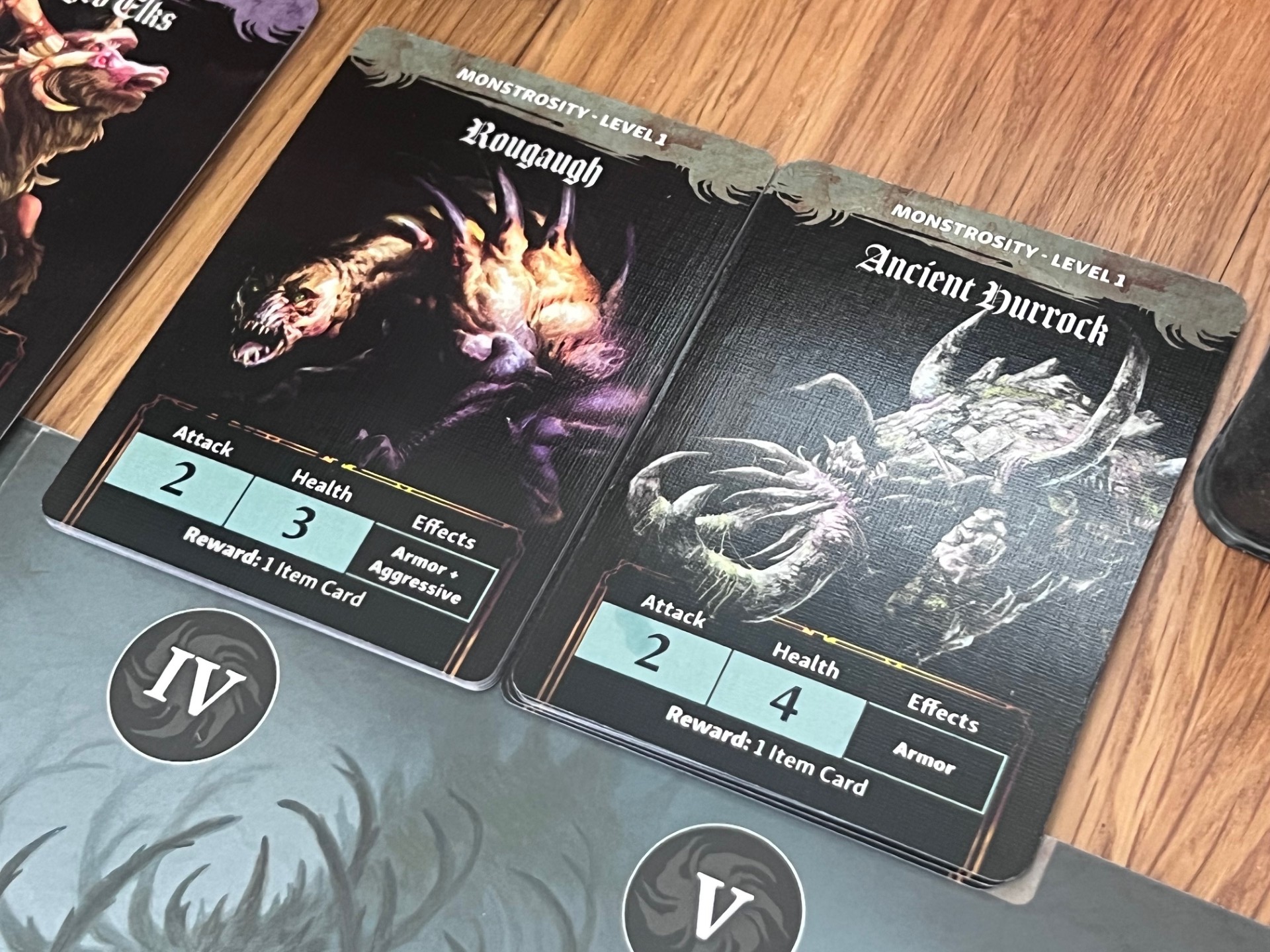
Events drive further randomness and inject pace into the game. At the end of each enemy turn, you flip an event card that powers up one of the enemies, switching it to a higher level and boosting health, attack, or both, often applying a small global effect and spawning more shadows. It’s a simple structure, but it keeps the threat curve rising in line with the power level of the player heroes. You never feel like you’ve “solved” a scenario because even when you’re ahead, the deck is sharpening its own claws and preparing something nasty.
Luck (or bad luck) is ever present here, but are handled with care. The bag draws are random, but the default actions and the way items and abilities offer rerolls or flat damage options mean you’re rarely at the mercy of a single bad pull. Enemy damage is predictable enough once you can see what you’re facing, for example. The swingiest element is the special effects on the backs of shadow tokens; a couple of influence drops at the wrong time can be brutal, especially early on. With repeated play, though, you learn to mitigate that risk — using items that reveal shadows without triggering their abilities, timing your reveals around fires and hero positions or similar. Aberration is not a eurogame in terms of decisions, but for a co‑op tower‑defence game, the luck factor feels well‑managed.
Solo play is supported properly with its own ruleset. True solo gives you an extra disk draw, an extra item, and a couple of free disk selections, but otherwise plays identically to multiplayer. Most cards scale cleanly, though a few classes reference “other heroes,” making them slightly weaker in pure solo. In practice, the difficulty curve feels fair, and while two‑handed play has more tactical richness (as it usually does in co‑ops), solo runs are satisfying and tense. I actually found Aberration to be simple enough that true solo and two-handed play were both viable and fun.
Replayability is strong. The thirty‑six character/class combinations alone give you a lot of room to explore different builds and approaches. On top of that, there are sixteen scenarios of varying length and complexity, each with its own enemy mix, map layout, and objective deck. Event decks are built from random pools, objectives cycle, vantage points change the way villagers can be commanded. When there’s been an opportunity to add variety, the designer has taken it, and I have a lot of time for that. I believe there is at least one expansion available as well, and possibly more to come.
What really sells Aberration for me is how coherently the theme and mechanics mesh. This isn’t just “generic fantasy meets tower defence” with little else to offer. The game genuinely feels like a desperate defence against an encroaching horror, but it uses clever systems to convey the theme through its mechanics. The shadow markers, the influence eating the map, the mutations on the heroes, the way villagers can be directed from vantage points — it all reinforces the idea of a village under siege by something wrong and bad things happen all the time. The Grim Hollow flavour gives it a distinct identity, but the game doesn’t lean on lore to do the heavy lifting because the mechanics are right there with it.
That said, Aberration is not perfect. Those early shadow flips can feel harsh until you’ve internalised the mitigation tools, and the loss conditions can stack in ways that punish missteps brutally. Some classes are clearly more comfortable in multi‑hero play than true solo, and if you’re looking for a pure, low‑variance puzzle, the presence of bag draws and shadow effects will always keep Aberration a step away from that.
As a horror‑themed, scenario‑driven tower‑defence game with real mechanical teeth, Aberration is impressive. It’s fast, tense, and surprisingly flexible, with a bag‑building core that gives you meaningful control over your hero’s arc and a map that literally rots under pressure. For me, that combination of grim atmosphere, sharp systems, and high replayability makes Aberration one of the more compelling co‑op tower‑defence designs I’ve seen in a while — and one I’d happily keep on the table as Ghostfire’s second‑edition and expansions roll in.
Aberration is available now, including from Amazon.
