

A competitive roguelike backpack builder? Turnbound certainly sounds unique.
A while ago, I took a look at Backpack Hero, which is one of a rather niche genre of games with a loose connection to the ever popular roguelite deckbuilder. Rather than building a deck though, you’d fill your backpack with equipment, positioning each object carefully to maximise synergy and win battles. Turnbound does something very similar, but without the backpack motif and adds a competitive element. It’s surprisingly addictive, but player feedback leaves a fair bit to be desired.
There’s a framing to what’s going on, but that story is minimal at best. You’re a lost or possibly trapped soul in a mysterious caravan in which a magic cat introduces you to a game board. The board will have you place tiles on it to strengthen a character that you temporarily inhabit before that board challenges another trapped soul from another world. If you win enough, you’ll get to go free. At least, that’s what I gleaned from the basic background you’re given. It’s all fluff really, as Turnbound is absolutely a gameplay driven game.
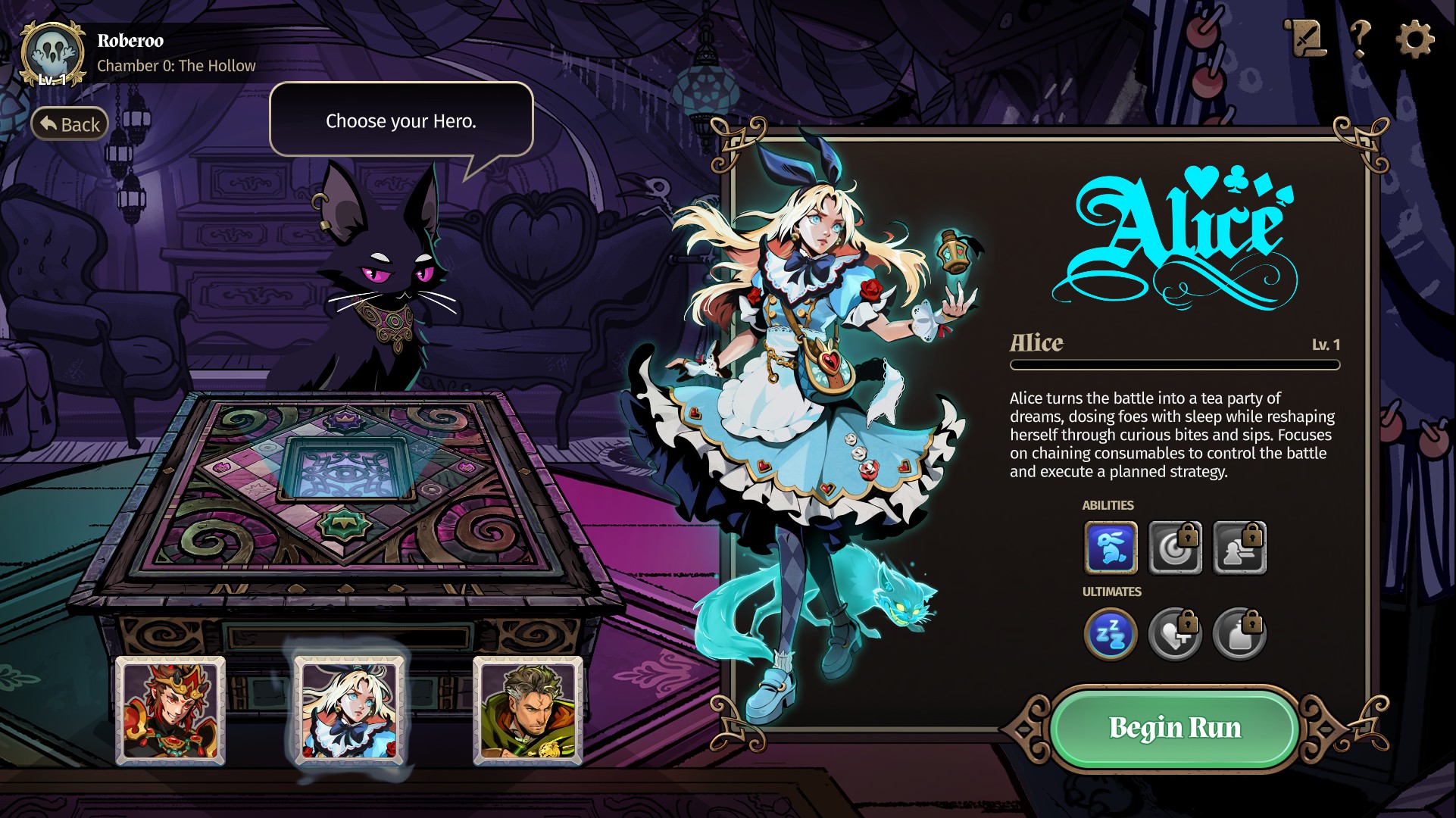
To begin a run, you pick one of three fictional characters consisting of Robin Hood, Sun Wukong, and Alice. Quite why these are the options I have no idea, but it’s probably something to do with copyright and publicly available figures. Each one has a different playstyle, with Sun being aggressive and trying to overwhelm his foes, Alice relies on putting tiles to sleep to take them out of action, whilst Robin tries to evade incoming damage and poison his enemy. They have their own special abilities and skills to use during a run, as well as unlockable ones as you level a character up.
The actual game has you placing tiles on a grid that will be used to attack your enemy with the goal of reducing the character themselves to zero health. At first you’ll have a few empty slots and a couple of items to place, but after a few rounds you’ll have access to a lot more space and equipment to tinker with. You’re free to alter your grid between rounds, so you aren’t locked into a setup once you’ve placed something. This is a good thing as the sheer volume of items that boost adjacent weapons or skills is unbelievable at times.
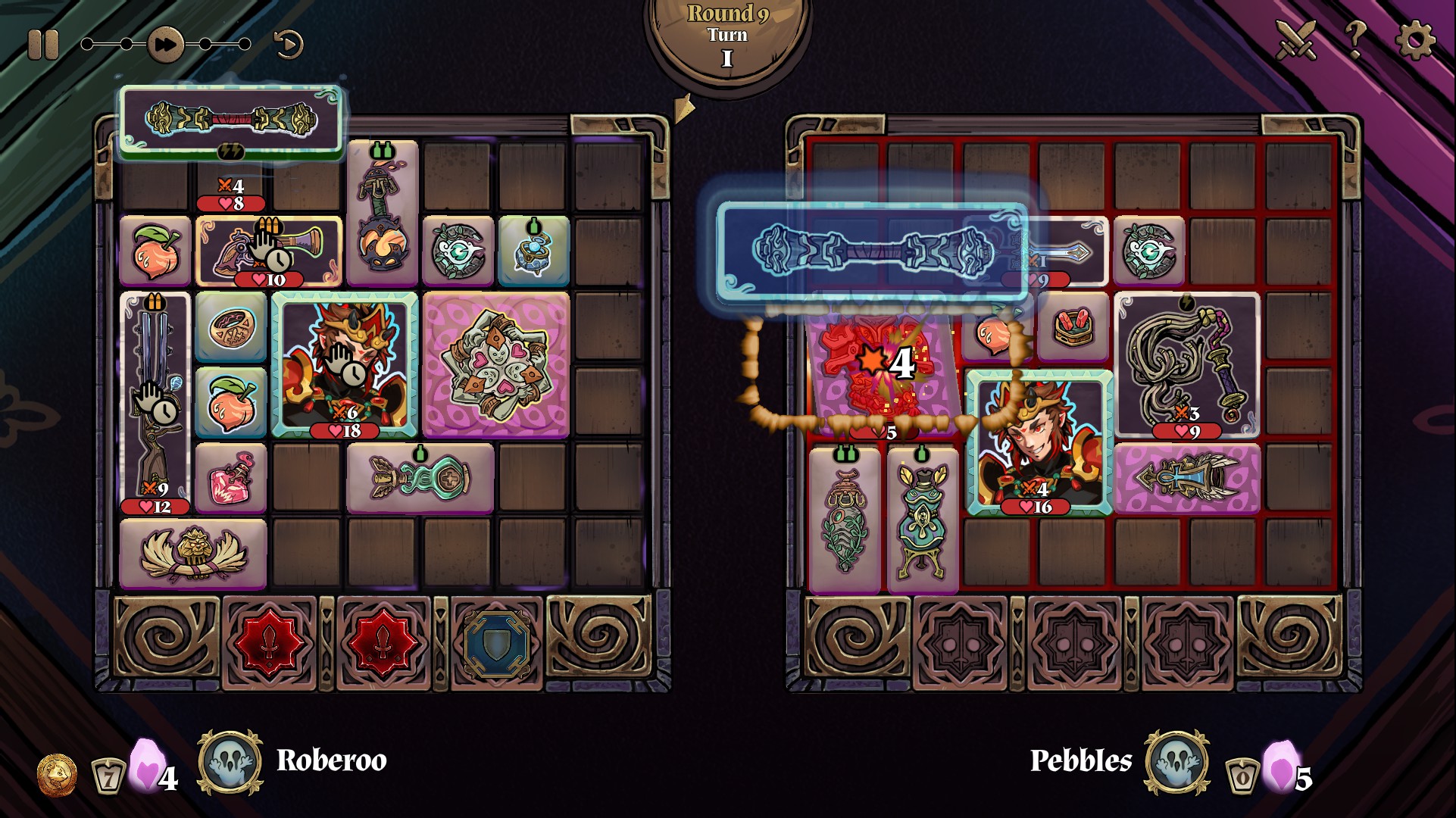
Win or lose a round, you’ll earn money that you then use to buy more tiles for your grid or to power up tiles that you already have. If you lose five rounds in your run, it’s game over and back to the start with possibly some newly unlocked items. If you win ten, then you win and move into a higher bracket to face stronger opponents.
You should be prepared to face some strong opponents early on though, as most enemies are other players’ grids who have succeeded before you. This asynchronous multiplayer that Turnbound employs is really neat, as you get to see all sorts of different setups from other players, giving you ideas on what could be effective builds for your future runs. On the downside, it means you can end up facing someone who demolishes you really quickly. Still, you never face a grid that isn’t suited to the round you’re currently on, so you shouldn’t expect to get wiped out too often.
The problem I came up against is that so many things happen at once in later rounds that it’s very hard to tell what is effective and what isn’t. Even turning the game speed down doesn’t help much as the number of abilities triggering at once becomes visual noise before too long. At some points I just gave up and let things play out in the hopes I’d win. There are a lot of key words to keep track of too. Taunt seems to be very effective, forcing enemy attacks to focus on a specific tile, but you also have thorns, poison, charge, destroy, ammo, and a slew of others that it can be a lot to take in a times, and it’s difficult to really narrow down a playstyle that works best. It doesn’t help that your weapons attack enemy tiles randomly, meaning sometimes you can see a way to win but the RNG decides that you don’t get to. I’d like an option to set priorities for your different weapons, and maybe this is a feature that will show up once the game leaves Early access.
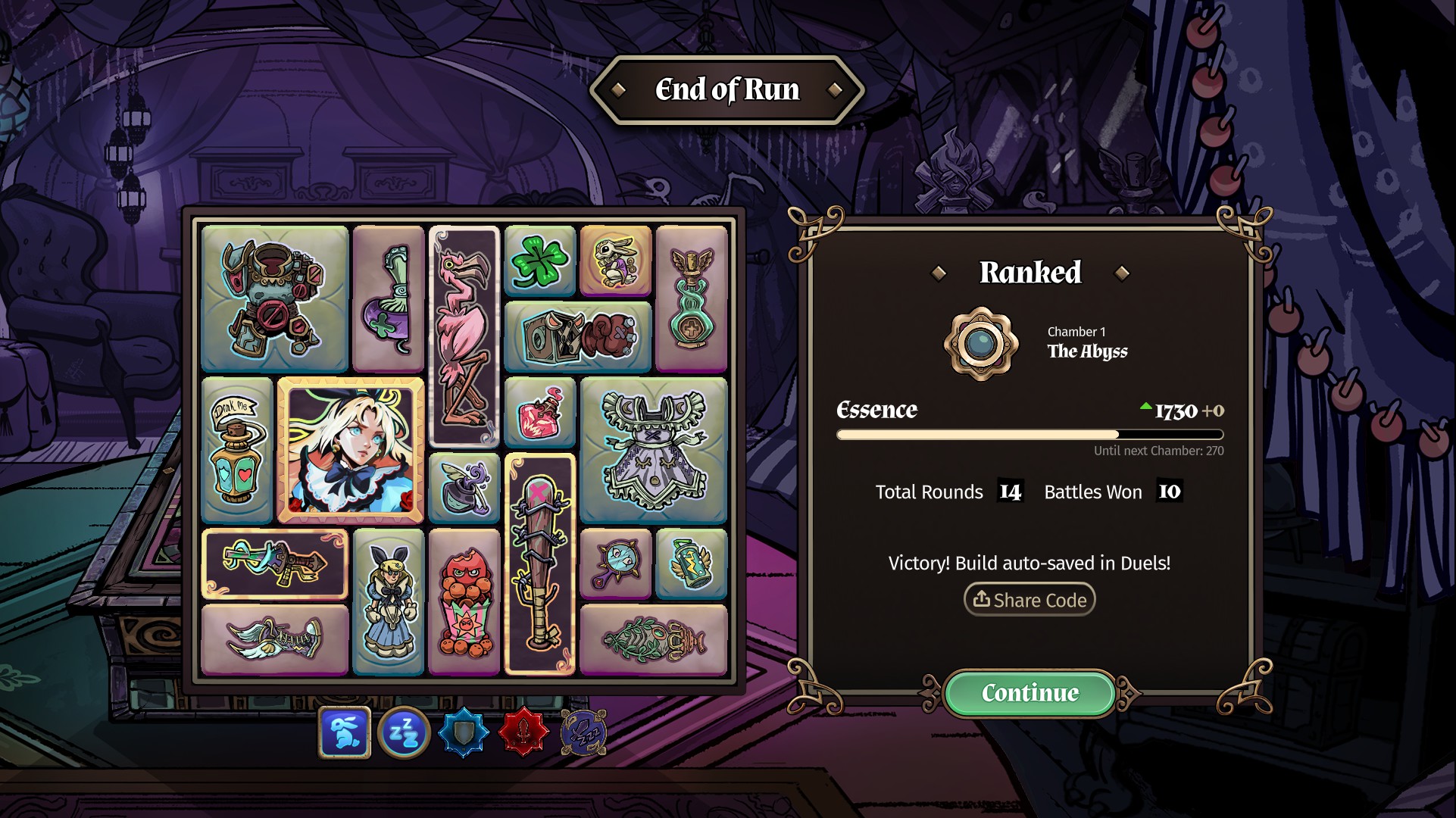
With those complaints out the way though, I will admit that I found Turnbound to be really quite addictive. The one-more-run mentality slipped in very easily, and I’ve been quite happy to try out a bunch of different builds just to see what happens even knowing I might not be able to keep track once the round starts. I’d like there to be more characters, though I appreciate balancing could be an issue there, but it’s still early days for Turnbound. The art style is certainly there, although simplistic in terms of animation. I’m hoping the full release does well, as there does seem to be a solid player base at the moment too, so there’s a good chance this game could have legs if it continues to develop the way it has done so far.
Turnbound is available now in Steam Early Access.
