

The Walking Dead: Streets of Survival is a grim, side‑scrolling beat ’em up that leans hard into the “All Out War” arc from the TV show, putting Rick, Daryl and Michonne front and centre as they carve their way through walkers and Saviors alike. Developed by Odaclick Game Studio, it’s a single‑player, level‑based brawler that feels immediately familiar if you’ve played Streets of Rage or similar games, but it layers in just enough progression and firearm‑focused combat to give it a slightly different flavour.
In The Walking Dead: Streets of Survival, missions are selected from a simple map following a brief tutorial and each missions drops you into locations like Alexandria, Hilltop and the Sanctuary for 20–30 minute stages that move mostly from left to right, with occasional backtracking for keycards, bombs or some random side objective. The structure is classic scrolling beat-em-up and The Walking Dead: Streets of Survival keeps it relatively simple.
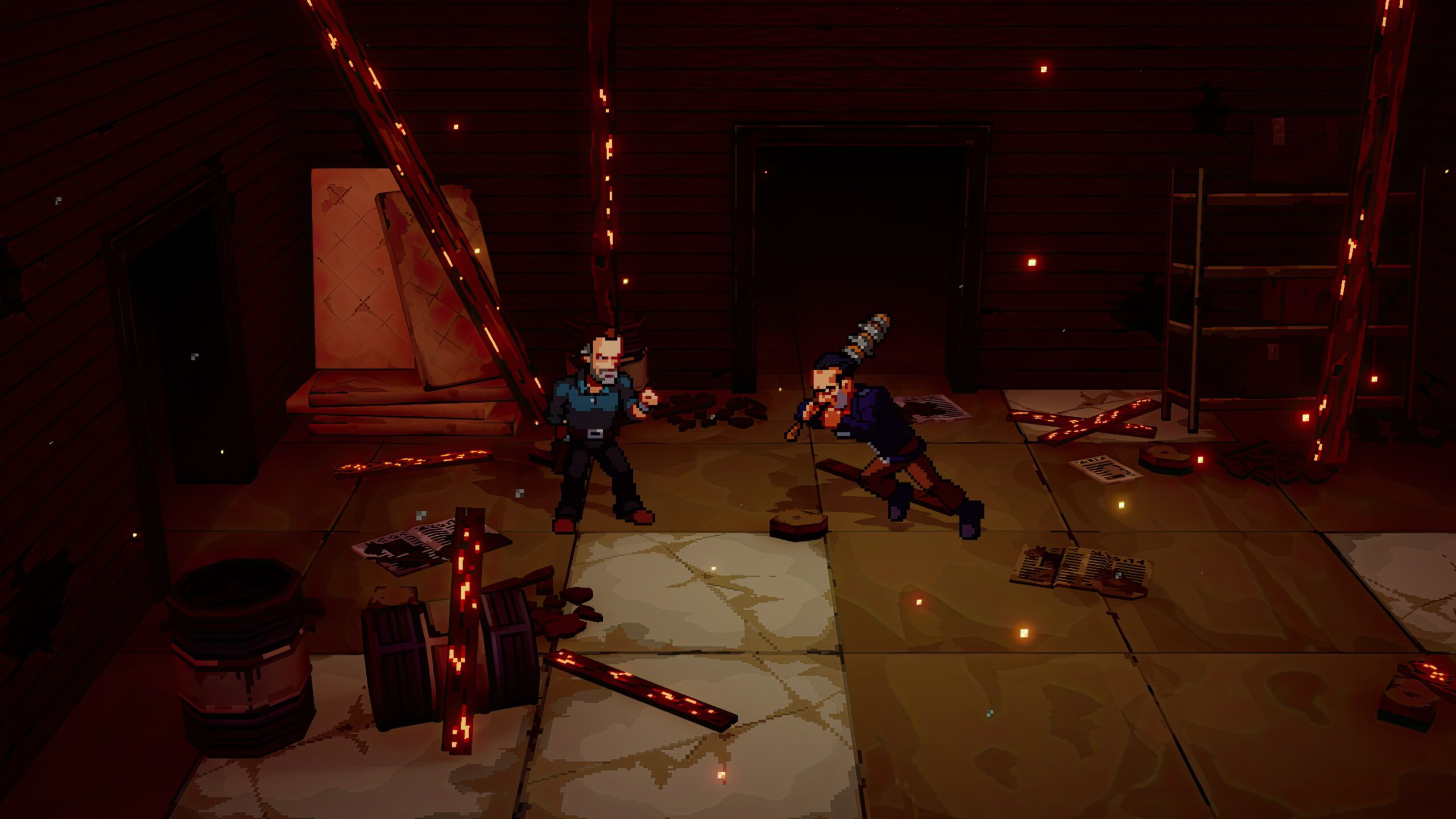
Combat is also straightforward and deliberate. Each character has light and strong attacks, plus a special move on cooldown, and the game’s move set is intentionally limited — there’s no jump or block, so you’re relying on rolls, kicks and careful positioning to stay alive. Rick fights with his magnum and a hatchet, Daryl with dual knives and his crossbow, and Michonne with her katana, which is both indestructible and easily the best melee weapon in the game.
As you progress, you’ll pick up temporary melee weapons like fire axes and pipes and a range of firearms including the powerful but quite restricted (ammo wise) shotgun. Regardless of how you set up for a fight, the emphasis is always on reading enemy compositions and managing crowds rather than executing complex combo strings or unloading a ton of bullets. Choice of characters and weapons does differentiate the gameplay, but not wildly so, and for me it came down to the simple fact that Michonne is clearly the best (starting) character.

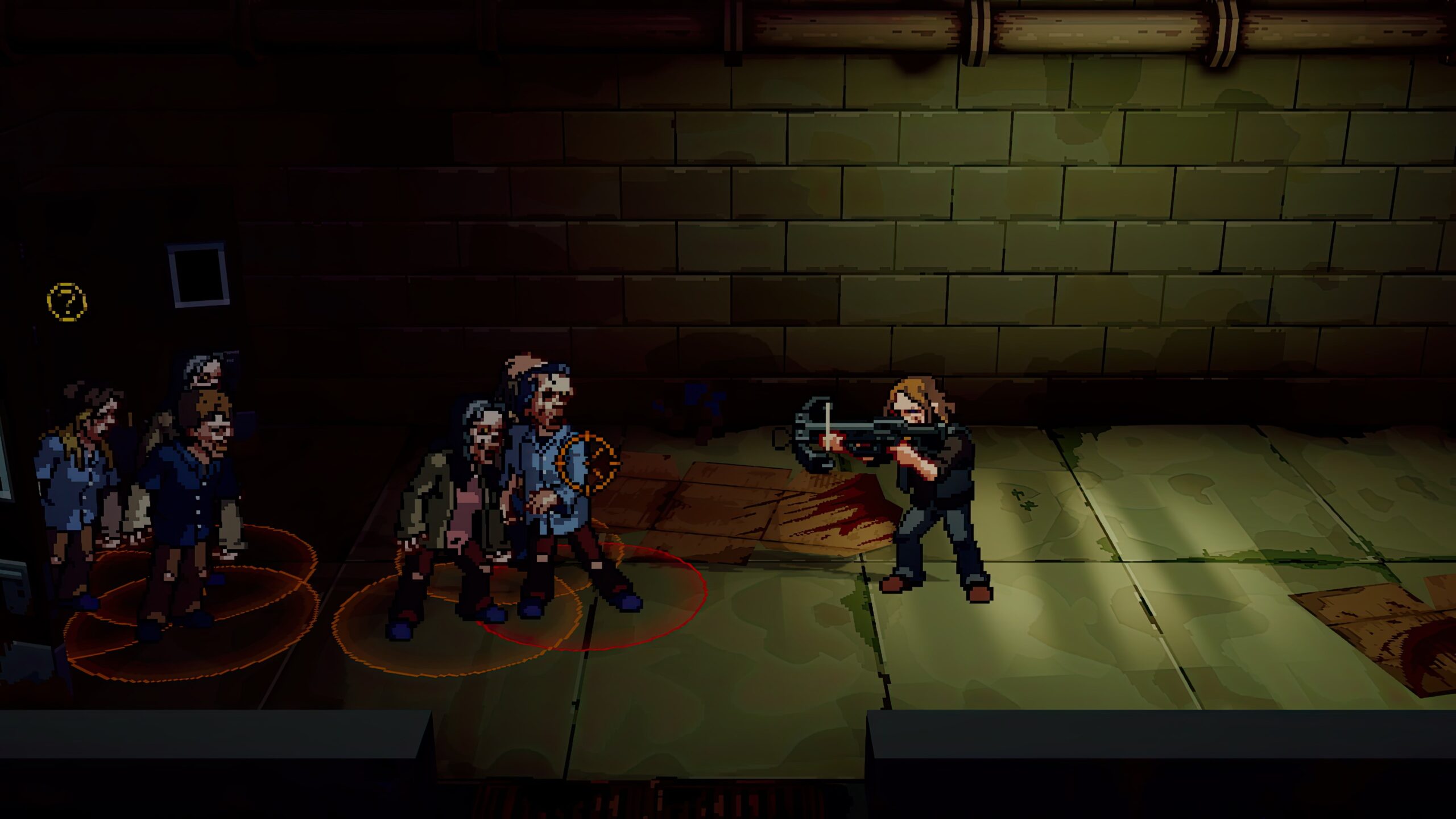
Firearms are what really set The Walking Dead: Streets of Survival apart from most side‑scrolling brawlers. Many Saviors carry guns, and Rick and Daryl start stages with ranged options that let you pop out from behind cover and engage in brief firefights. Ammo is limited and aiming is tied to a timing mechanic rather than pure twitch reflex, which adds a small layer of risk/reward to every shot.
You can crouch to sneak or hide behind cover, and vaulting over obstacles keeps the pace brisk even when the game asks you to move more cautiously. This means that you can engage ranged enemies safely even when you don’t have a gun, as long as you can time your movement correctly. When the gunplay does come, it gives the action a nice push‑and‑pull rhythm between melee scrapping and short, sharp exchanges of fire. On the other hand, when you’re out of bullets and being peppered from off‑screen enemies that you can’t see, it can feel messy and occasionally frustrating.
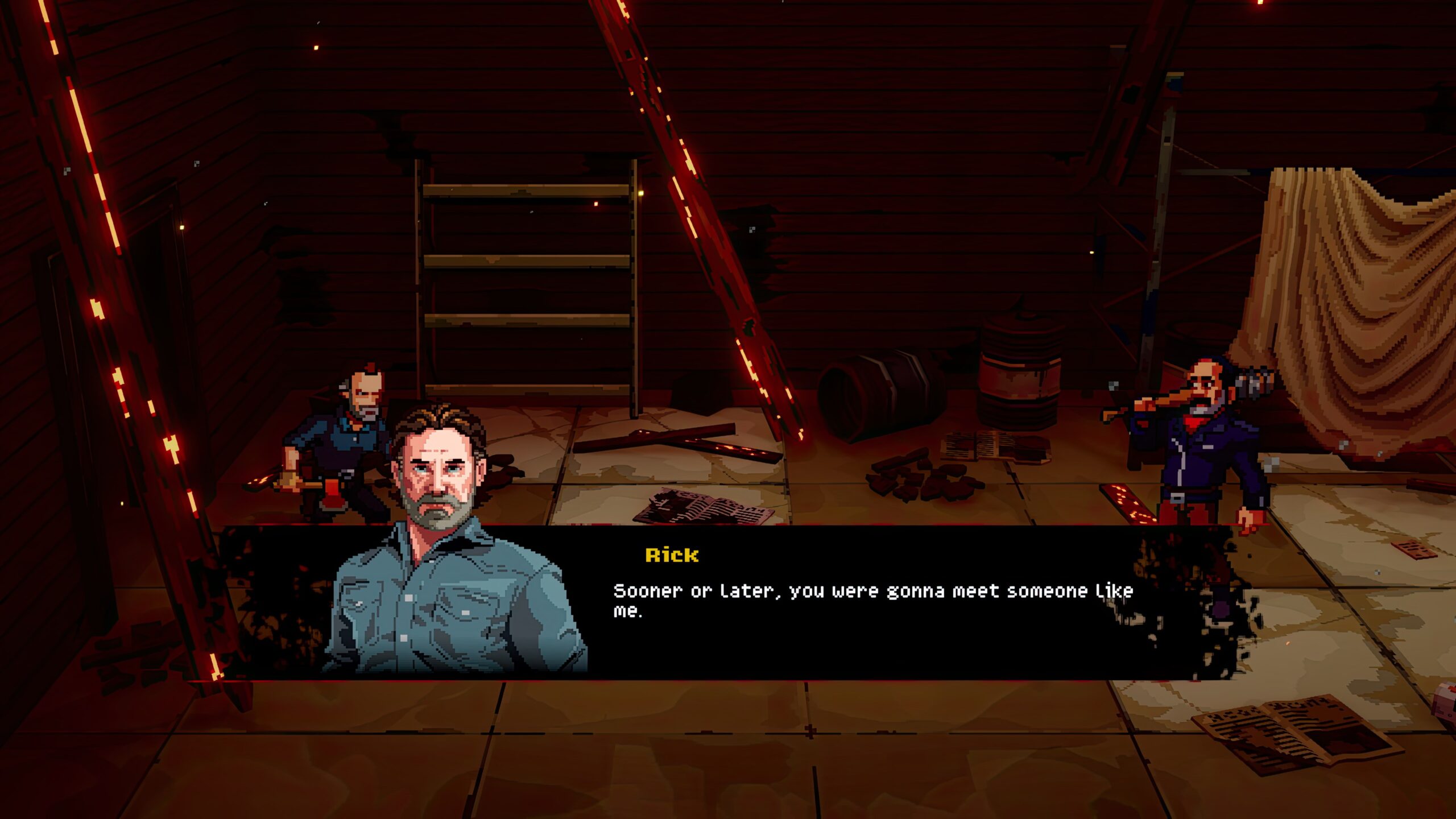
There’s a light RPG element that gives the campaign some welcome texture. As you clear missions, you earn points that feed into a modest skill tree for each character, improving health, damage, ammo capacity and other survivability tweaks. Weapons, lore items and “knowledge” pickups are tucked into containers and side rooms, offering a bit of optional scavenging without turning the game into an exploration‑heavy experience.
It’s not a deep system, but it does make replaying missions with different heroes feel worth it, especially if you find more depth to the different weapon setsups than I did. This also gives you a sense of incremental mastery as you tune each survivor to your preferred style. Minor spoiler here: once you’ve beaten the campaign, Negan unlocks as a playable character, bringing Lucille and a heavier, more brutal melee focus to the same set of missions, and for me it’s a choice between him and Michonne as the most interesting characters.
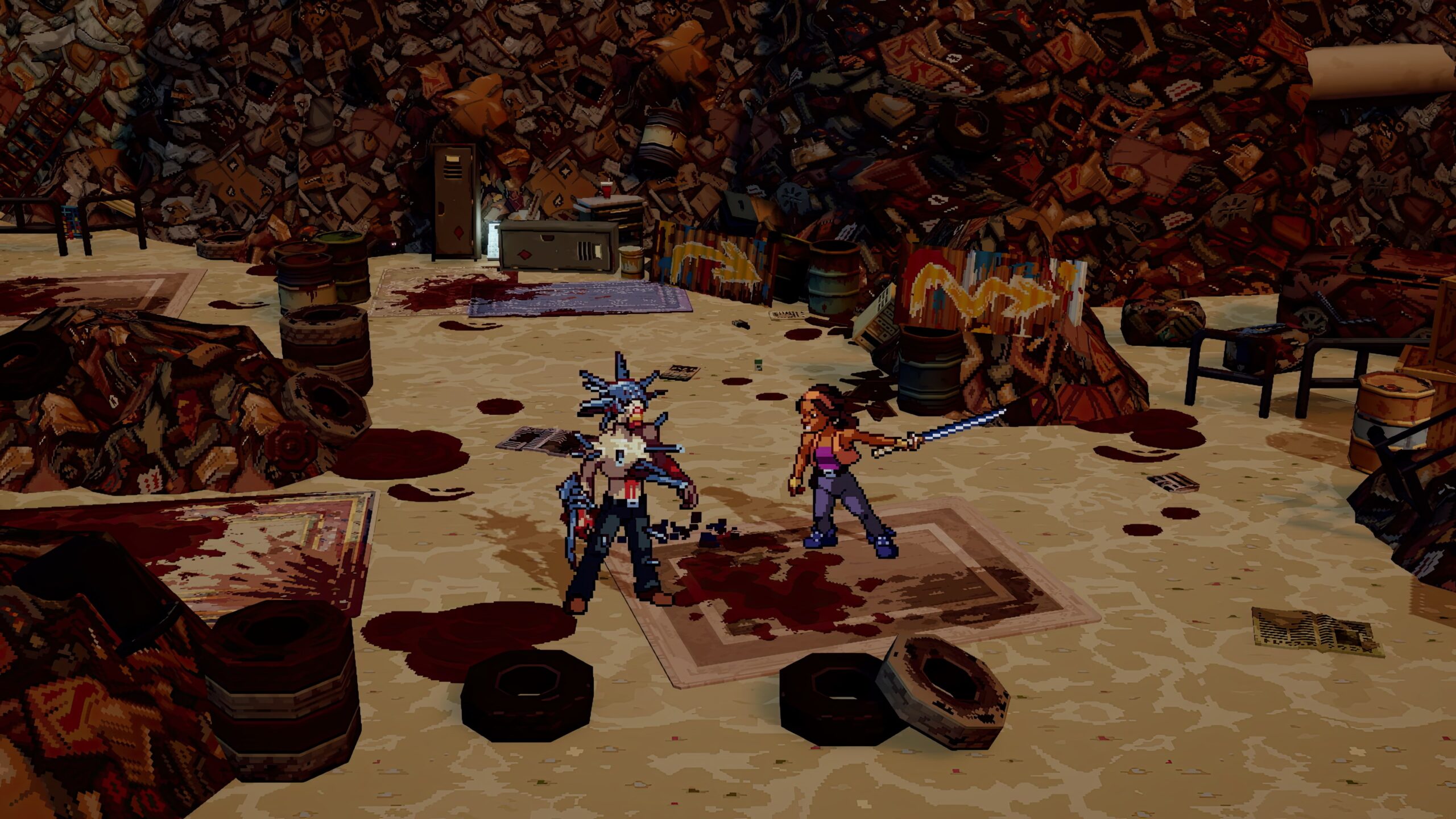
Visually, The Walking Dead: Streets of Survival uses pixel art characters against low‑poly backdrops to good effect. The tone is dark and grim, but the environments are readable and the key locations from the show are instantly recognisable. The presentation is more functional than flashy — combat lacks some of the audiovisual punch you might expect from the genre — but the art direction sells the bleakness of the setting and the constant presence of the horde. Cutscenes are mostly brief text‑driven interludes that frame each mission with just enough context, whilst voiceovers from the actual actors are used sparingly for the odd one-liner only.
Another area where The Walking Dead: Streets of Survival stumbles is in how rigid and repetitive its structure can feel. Most missions boil down to pushing through waves of walkers and Saviors, dealing with a few simple objectives, and finishing on a boss encounter. The limited move set and reliance on basic combos mean that, over longer sessions, fights can blur together, and the inability to finish off downed enemies or vary your approach much beyond weapon choice and positioning keeps the tactical ceiling fairly low. The campaign is also relatively short, and while the different protagonists and skill trees add some replay value, this isn’t a game you’ll be grinding for dozens of hours.
Even so, The Walking Dead: Streets of Survival does a decent job of delivering a focused, side‑scrolling interpretation of one of the show’s most iconic conflicts. It offers clear goals, modest but meaningful progression, and a campaign that can be seen through without excessive padding. If you’re a fan of The Walking Dead and like the idea of a grim, firearm‑infused beat ’em up where Rick, Daryl, Michonne (and eventually Negan) slug their way through the All Out War, this is a solid, if unspectacular, way to revisit that storyline.
The Walking Dead: Streets of Survival is available for Xbox, PC , Nintendo Switch and PS5.
