

Spokes, designed by Bert Hardeman and published by Radical 8 Games, is a smallish-box title that immediately grabs your attention with bright, neon artwork and the promise of fast, tight decisions, an elegant structure and a puzzle that reveals its depth only once you start engaging with it.
Radical 8 has built a reputation for compact, thinky games that punch above their weight, and Spokes fits neatly into that lineage. We loved Die of the Dead, for example, thanks to the clever use of dice as both a mechanical and aesthetic feature. Spokes is quite different, with simple efficiency and spatial movement puzzles combining within a single action each turn.
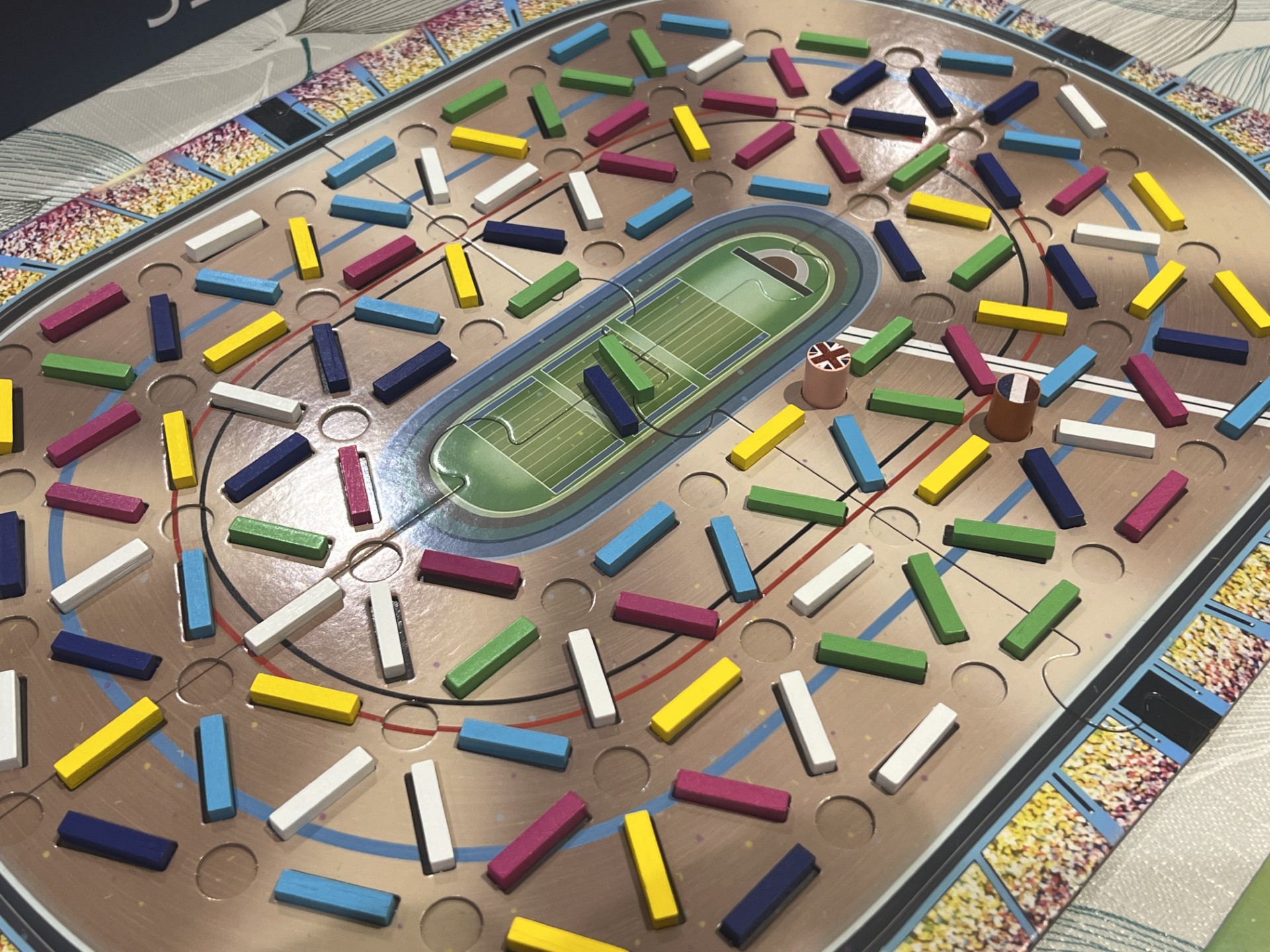
At its core, Spokes is all about manipulating the spokes of a wheel on your own player board to move your bike token around an oval velodrome. You do this by moving a cube on your board one to three spaces, jumping over spokes of six different colours until you choose to stop. When you do, you’ll pick up the spoke you just jumped over and place it onto the board, replacing an existing spoke piece of any colour.
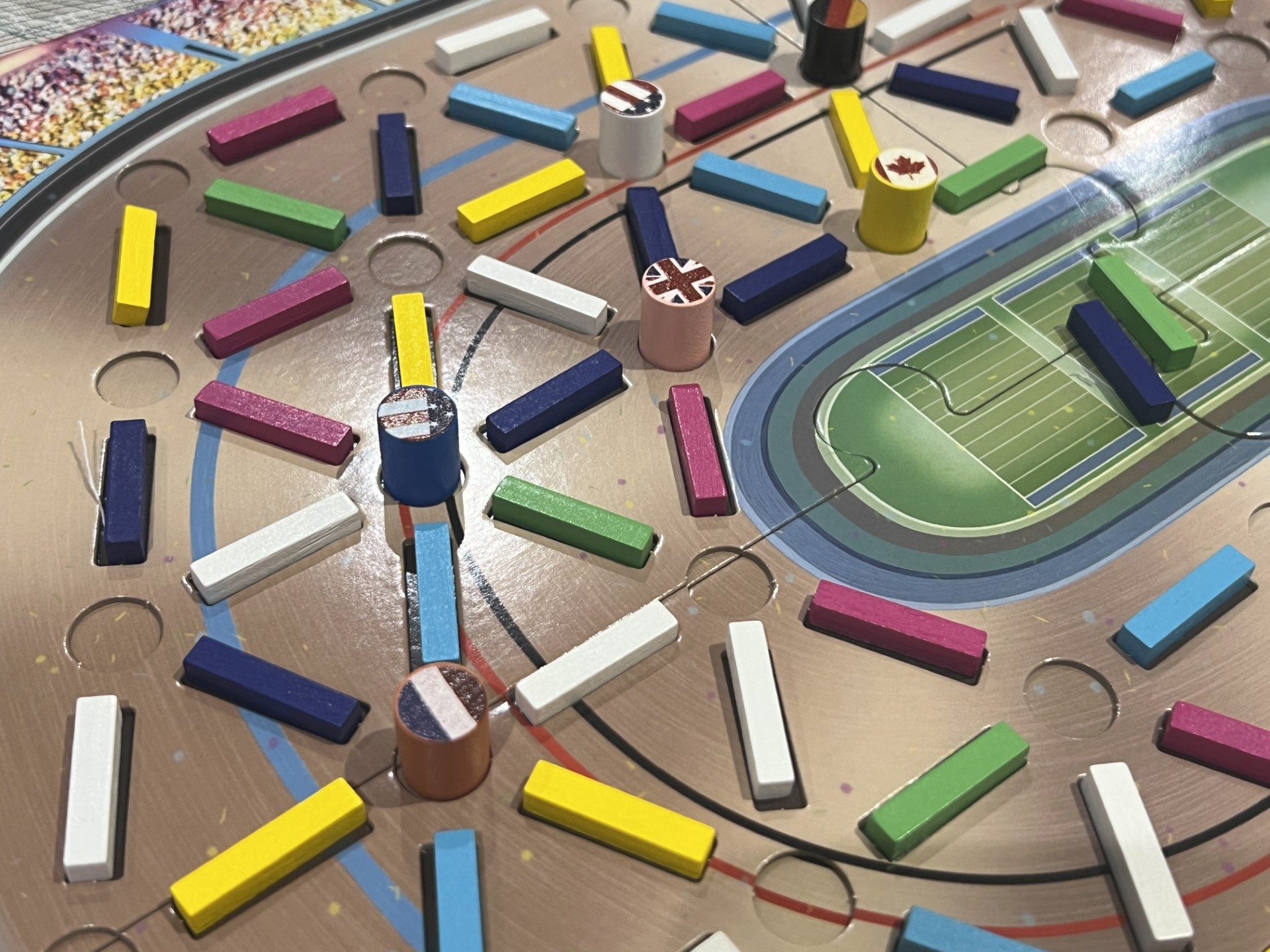
After you do this, your bike token must then move any number of spaces by following a path of single coloured spokes — which must include the one you just placed. As an example, if you can see two green spokes ahead of you, but there is an orange before them, you might move your cube two spaces on your board, pick up a green spoke, swap it with the orange and then move your bike forward three spaces (crossing all interconnected green spokes.)
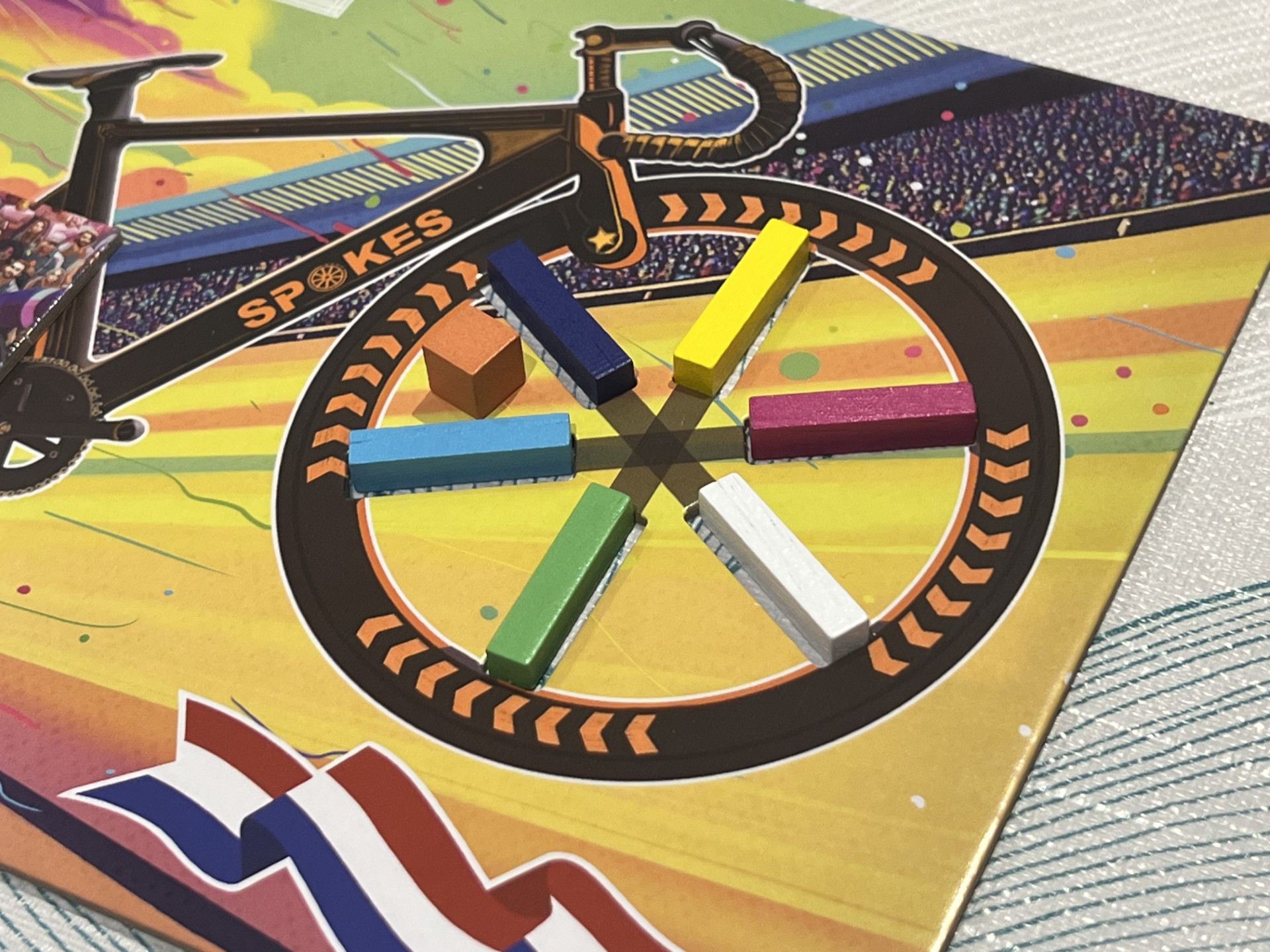
In terms of a physical action, this is very straightforward and takes literally seconds. On some occasions, a path is completely clear in front of you and either you do or do not have a spoke on your board to match. It’s super frustrating when you don’t, but a small part of the turn-by-turn tactical nuance in Spokes is that you may want to take a smaller turn on some occasions to set up a larger one next turn — which you’ll do by moving your cube more or fewer spaces as needed to set up the next move.
There are a few nuances. Players whos’ bike would end its turn on the same space as an opponent instead remain on the space before, but then flip a slipstream token which will allow them to use a single spoke of any colour in their run later (causing the slipstream token to flip back again). This bonus gives the players just enough game-breaking flexibility to make it feel powerful, but it doesn’t happen often enough to actually break the game or devalue the core design mechanics.
As I get older and as a dad of three children, I’m realising more and more how valuable my time is. I still love big, heavy games with lots of interlocking rules and combinations — but the truth is, I don’t have as much time to learn them as I used to. Games like Spokes are becoming more and more popular for me, because I can teach them quickly, play them to completion within 20-30 minutes and, crucially, still enjoy some important and clever decisions.
Production-wise, Radical 8 tends to favour bright, functional components that emphasise clarity over spectacle, and Spokes follows that philosophy. The bike wheel player boards are bright and visually striking without being cluttered, and the iconography is straightforward. The velodrome (presented as four jigsaw style interlocking pieces) is superb, with excellent colours and standout use of a dual-layer production method that means the spokes and bike tokens sit perfectly where they should.
As I hinted earlier, what makes Spokes interesting is how it positions itself within the broader landscape of modern abstract games. It’s not trying to be a sprawling strategy title or a thematic experience; it’s aiming for that elegant, minimalist space where a handful of rules generate a surprising amount of depth. Games like Azul, Reef, or Project L have shown how successful that formula can be, and Spokes explores similar territory but with a distinctive mechanical hook.
Spokes has the potential to be a quiet hit — the kind of game that doesn’t shout for attention but earns it through clever design and satisfying play. It’s the kind of game that you can pick up in a variety of settings — either with your kids just before bedtime or on a rainy Saturday morning, or with your gaming group when you’re waiting for people to arrive, or after the big games finish. Most notably, Spokes offers a clever design based on spatial awareness and planning, with just enough indirect interaction between players to give it some edge.
You can find out more about Spokes on its Kickstarter Page.
