
Escape from Project Riese is the serious refinement of the cooperative zombie shooter

Escape from Projekt Riese is a tense, narrative-driven solo/co-op campaign game from Raybox Games that blends tactical combat, horror, and historical fiction into a modular, campaign driven experience that builds on its predecessor, Escape from Stalingrad Z with refined mechanics, deeper storytelling, and the same smart, concise production.
Set in 1943 beneath the Owl Mountains of occupied Poland, Escape from Projekt Riese casts players as members of an Allied strike team infiltrating a secret Nazi facility plagued by a zombie outbreak. Your mission: rescue eccentric genius Dr. Hinzelmann and his resistance allies, uncover the horrors lurking in the base, and escape before the undead overwhelm you. It’s a cinematic setup, and the game delivers on it with a mix of tactical skirmishes, branching narratives, and modular scenario design.
Please note that this review and the images within are almost spoiler free. I have used a couple of pictures from early scenarios, but where possible I’ve tried to avoid showing anything that you wouldn’t see within an hour or so of starting the game.
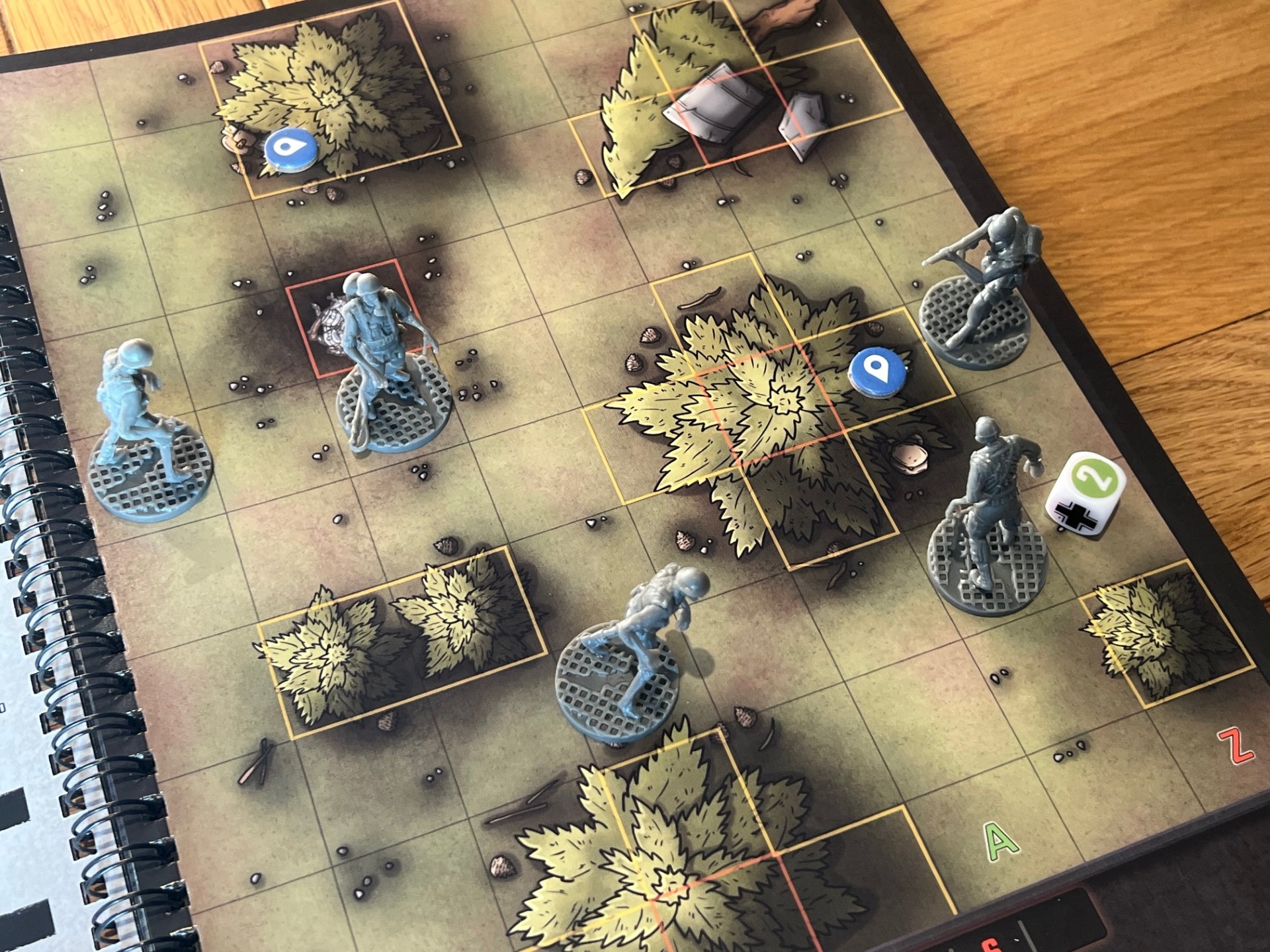
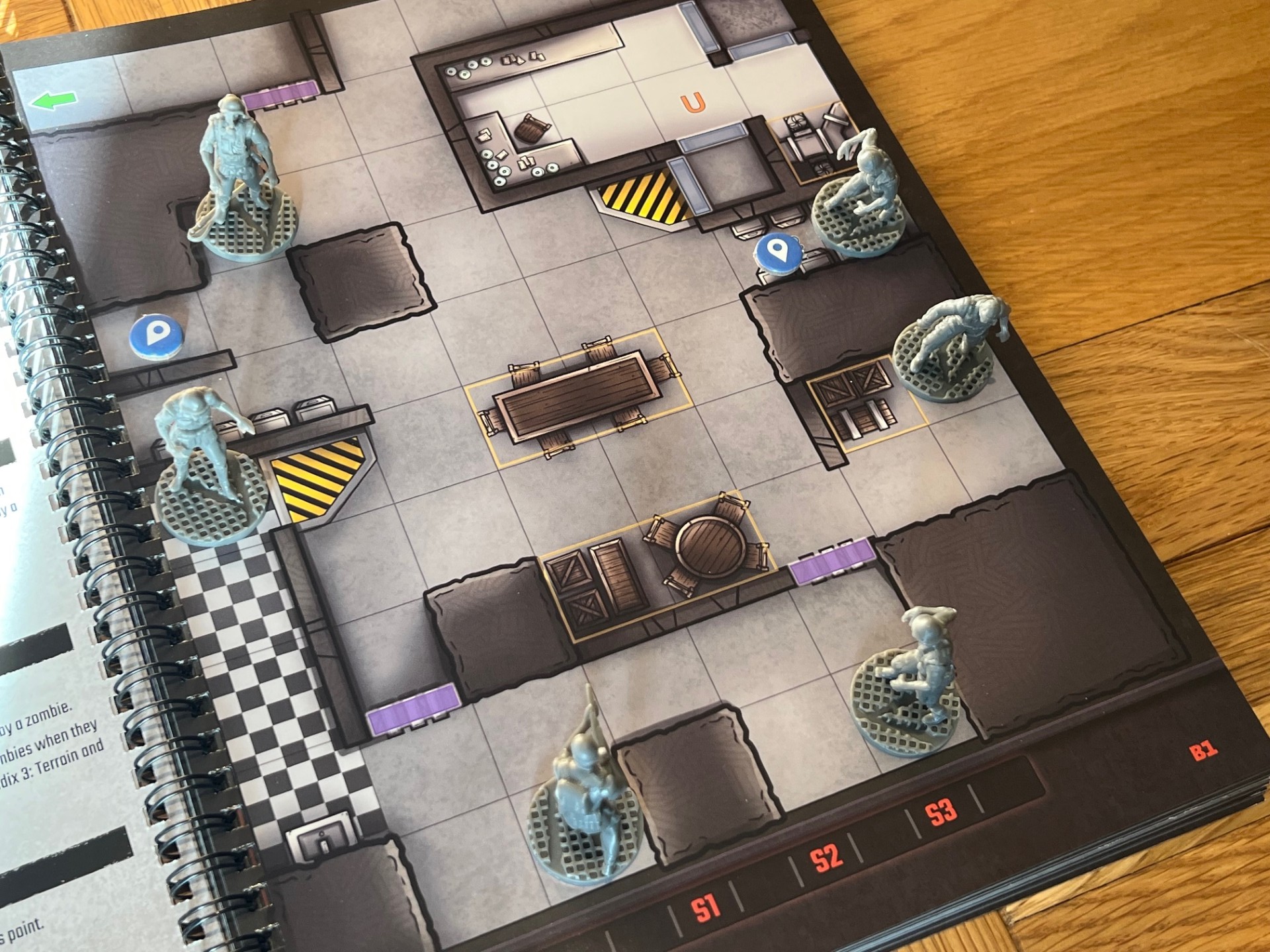
Gameplay unfolds across a series of linked scenarios, each played on maps presented as part of a ring-bound book that includes scenario specific rules, an illustrated map and any narrative. These maps are richly detailed — claustrophobic corridors, decaying laboratories, and occult chambers onto which you add cardboard doors and in this Deluxe Edition, plastic zombie and survivor models. The maps and miniatures serve well as both tactical terrain and narrative backdrop, with each scenario introducing new objectives, enemies, and environmental hazards, creating a sense of escalation and discovery.
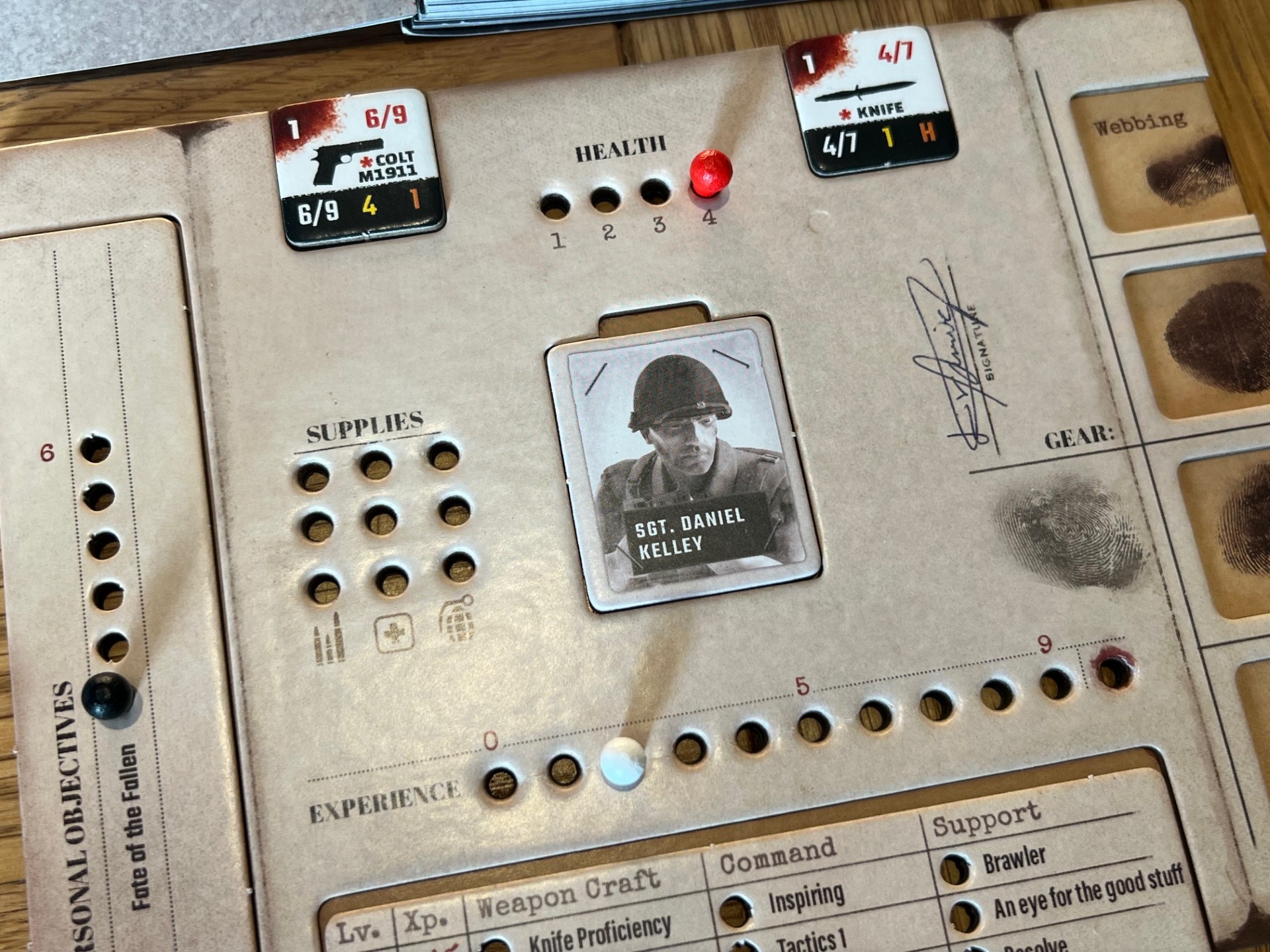
Combat is fast-paced and streamlined. As a solo or cooperative game for one to two, the players control one or two heroes, each with unique stats, abilities, and gear represented by a unique player board. Actions are largely straightforward and include the likes of moving — at either a run or a walk — searching or fighting. Fights are resolved using custom dice, with modifiers based on weapon type, range, and enemy traits, as well as whether you are standing, walking or running.
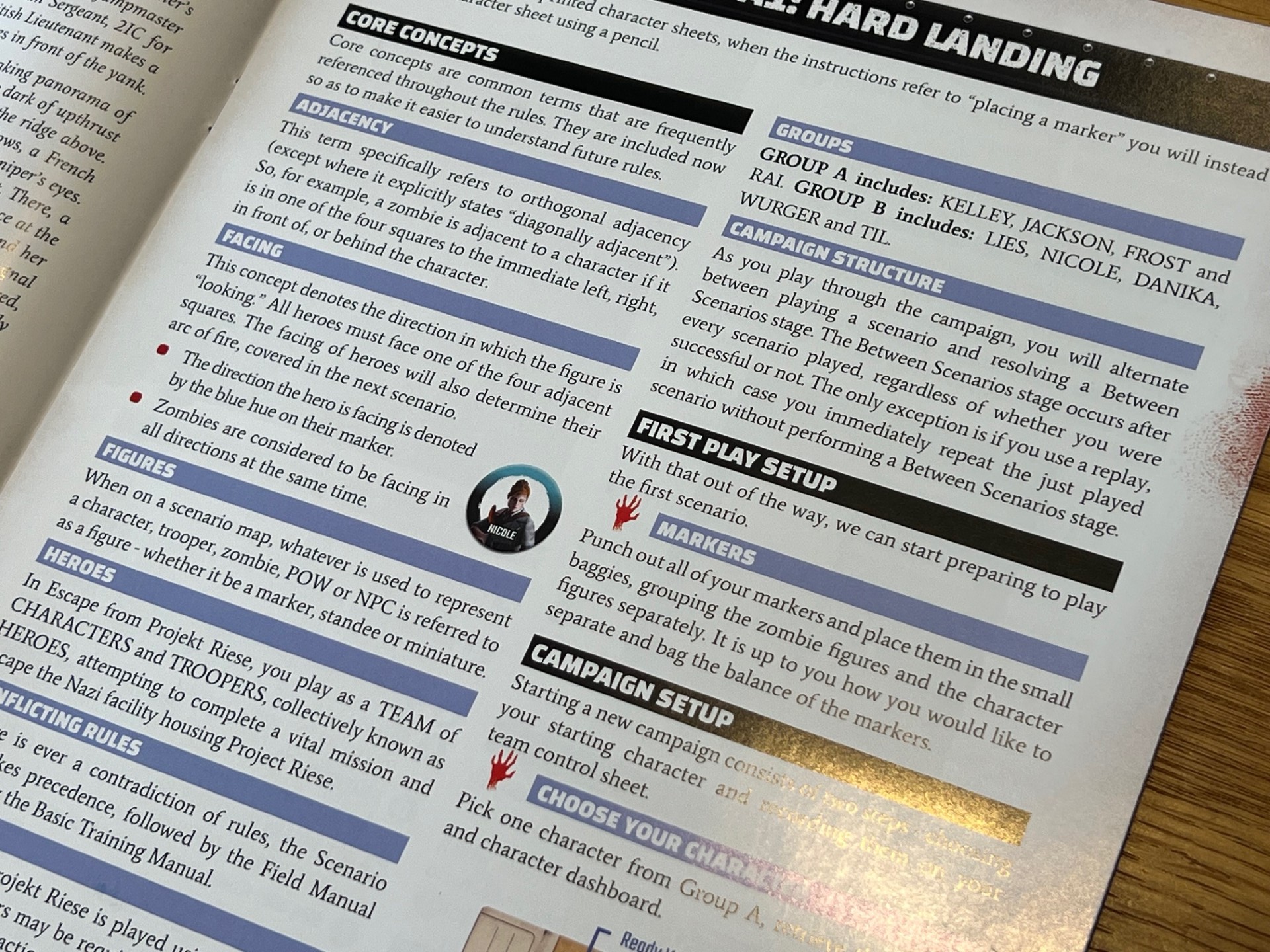
The system used by Escape from Projekt Riese rewards positioning and timing — player facing, flanking enemies, managing line of sight, and conserving key items are all critical. Enemies include standard zombies, more powerful variants (that I won’t spoil), and Nazi occultists, each with distinct behaviors and attack patterns. AI is handled via simple enough flowcharts and dice rolls, keeping turns brisk without sacrificing tension.
Whilst I am not likening Escape from Projekt Riese too directly to Zombicide, I was not surprised to see designer Marco Pecota enjoying Zombicide at a recent convention, and as I played Escape from Projekt Riese I often had the feeling of a smarter, more focussed and narrative-driven take on CMON’s popular game.
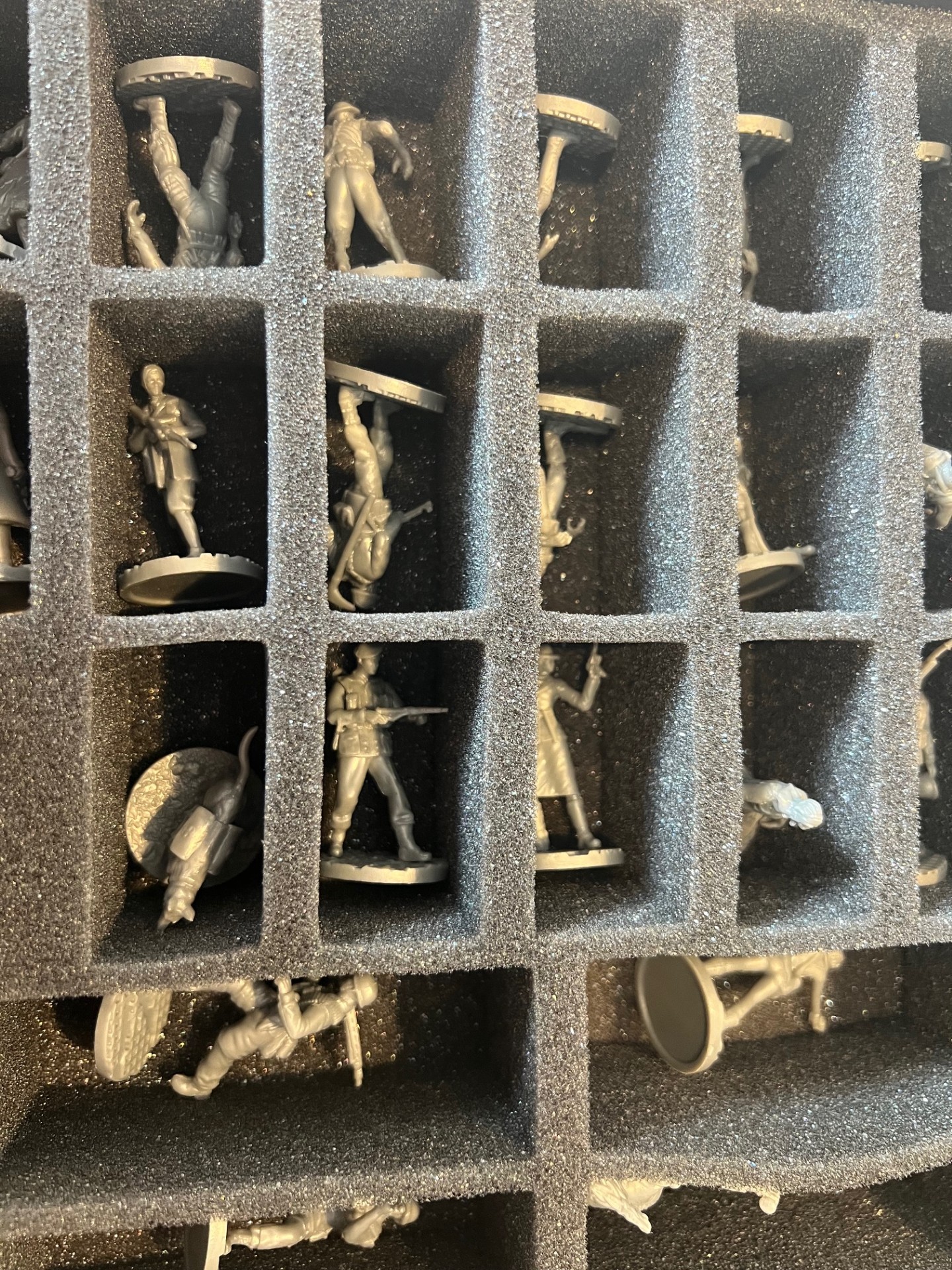
Where Zombicide is a dumb-but-fun dice chucker, Escape from Projekt Riese is considerably tighter, smarter and more complex. The scale is both broader thanks to the much higher number of scenarios, detailed narrative and additional complexity, and also smaller because scenarios take place on a small, focussed map and can be done in 30 minutes with ease.
One of the game’s standout features is its modular campaign structure. Scenarios move towards different conclusions, and player choices affect which missions unlock next. You might choose to explore a sealed wing of the facility, rescue a captured ally, or sabotage the facility power systems — each path offers different rewards and risks. This branching design adds replayability and encourages strategic planning beyond individual battles.
The campaign is underpinned by a light RPG system that carries over character progression and in many cases, items. Between missions, players can upgrade weapons, acquire new gear and improve stats. A strong story enhances this RPG feel, and the original Kickstarter claims that over a year of writing and development took place to bring it to life – a claim I can completely believe.
Production quality is high. The artwork — by Riccardo Federici, Nat Jones, and Julián Tunni — is gritty and atmospheric, with a graphic novel aesthetic that suits the horror theme. The map pages are detailed and atmospheric, and the character standees (should you choose to use them over miniatures) are detailed and thematic. The rulebook is well-organized with clear examples, but it’s also dense. I would suggest inexperienced players stick with it, because your first mission won’t require more than the first few pages, with the rest coming as scenarios and character builds get more complex.
Compared to Escape from Stalingrad Z, Projekt Riese introduces several refinements:
- Improved scenario variety, with more dynamic objectives and environmental interactions.
- Streamlined rules, especially around enemy AI and action resolution.
- Expanded narrative, including more character development and thematic depth.
- The possibility of multiplayer via an “Arena” mode expansion, which is not yet released
As mentioned before, the game supports solo and two-player cooperative play. Solo mode is probably the default mode here, with no need for rule tweaks or dummy players. Co-op mode allows for tactical coordination and shared decision-making, though some scenarios can feel slightly easier with two players due to simple action economy. If you’re a solo player and want to use two characters for simple variety if nothing else, you can do so with ease.
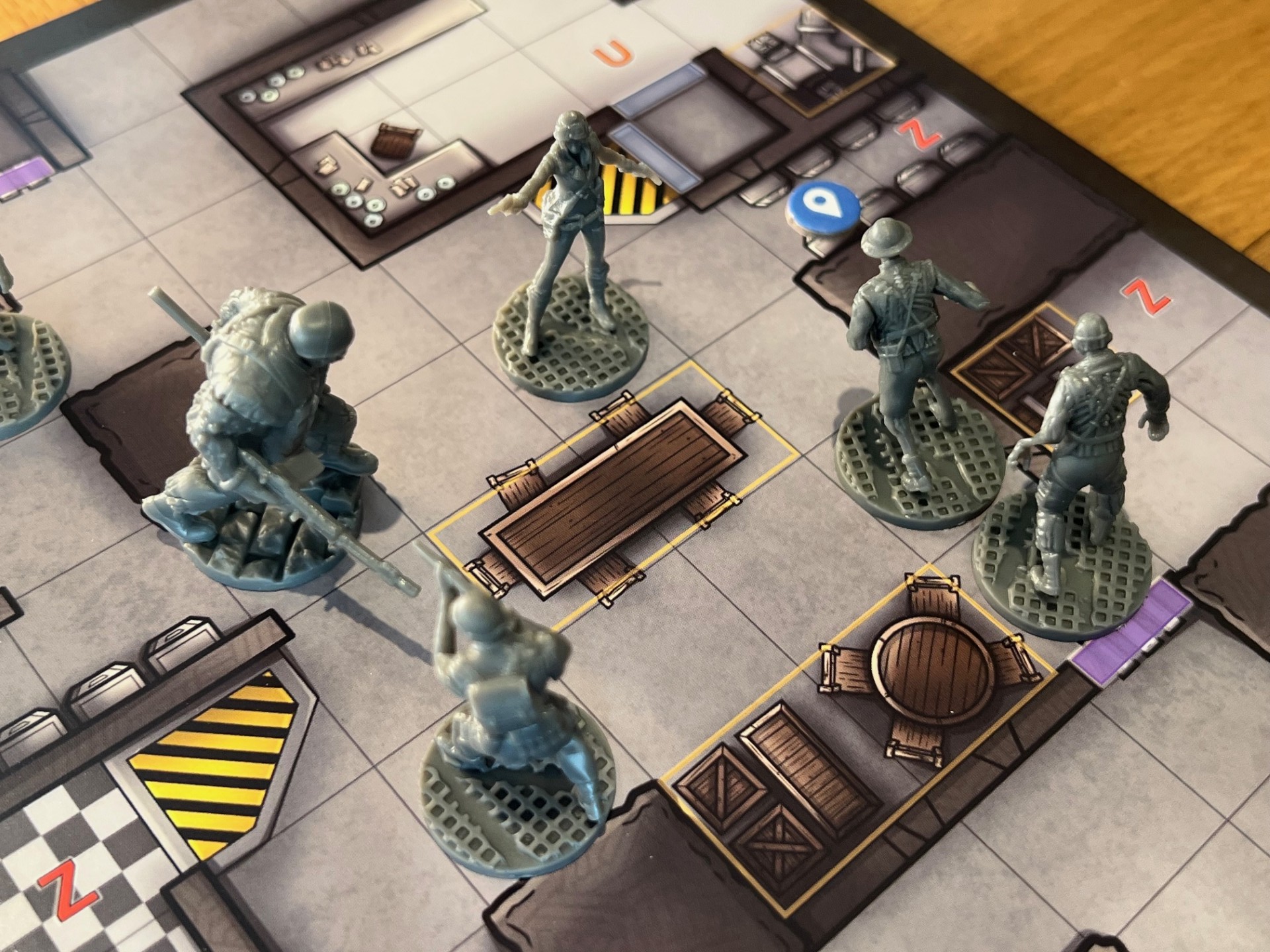
Escape from Projekt Riese has fantastic atmosphere, pacing, and design. I love the way that it blends pulp horror with tactical depth. With branching storylines and multiple characters (nine in the deluxe box) the replayability and thematic immersion remains high. Escape from Projekt Riese is rewarding for experienced gamers thanks to clever and layered systems, but not overwhelming for newcomers willing to learn.
Escape from Projekt Riese is a compelling blend of tactical combat, horror storytelling, and a simple RPG campaign. It builds on the strengths of its predecessor while carving out its own identity — darker, tighter, and more narratively ambitious. For fans of solo/co-op skirmish games with thematic depth and strategic challenge, it’s a standout title. What perhaps differentiates it for me, though, is the way it uses a more complex ruleset than games like Zombicide, but never reaches the heights of fiddliness that could put anyone off.
You can find out more about Escape from Projeckt Riese on its Kickstarter page.

Comments are closed.