

“Come on Reuben, it’s time to review another Roguelike, and good news! It doesn’t matter that we don’t feed you because this one is all about cooking up a storm!”. It’s no secret I play a lot of roguelikes, but I have the (un)fortunate ability to seemingly never be burnt-out on the genre. While Hungry Horrors didn’t fully satiate my appetite, it wasn’t simply because the game is a roguelike. Rather, Hungry Horrors actually fails to commit enough to the genre to truly stand out and ends up becoming a repetitive click-fest before too long.
Sometimes a game stands out through a unique mechanic or innovative genre-swap, but other times it’s through vibes and premise. Hungry Horrors sees you play as a ye olde Princess from the fairytales who is forced to learn to cook dishes from all across the British Isles to satiate various mythical, legendary and cryptid-esque monsters. It’s bizarre, and lays the foundation for the brilliantly quirky OST, animations and card-based gameplay.
So where does it all go wrong? The short answer is: it doesn’t. Hungry Horrors is a unique take on a saturated genre and does incredibly well at making its uniqueness shine. It could have done with more meat on its roguelike bones, but in general it’s an enjoyable experience that even non-roguelike fans might enjoy getting their teeth into.
Stargazy Pie isn’t in enough games, to be honest
For those of you who aren’t blessed with knowledge of British cuisine and culture, you might not be aware of such delights as Stargazy Pie, Slap Barm Pea Wets and Wiggan Kebabs. Alas, only the first makes its way into Hungry Horrors but one out of three isn’t bad. Stargazy Pie is a fish pie that has whole smoked or grilled herring peeking out of the crust, gazing at the stars. For featuring this classically unhinged dish Hungry Horrors already earnt my approval.
These dishes exist as cards, which you play to feed monsters until they are full. Once they’re satisfied they blip out of existence and your run continues. If you can’t tell what a dish is by the pixel art and name (which, when you see names like “Tatws Pum Munud”, I don’t blame you) then you can read up on lore in the game menu. Each dish has a lore page which tells you the basic recipe and some history of the meal, as well as its point of origin within the British Isles.
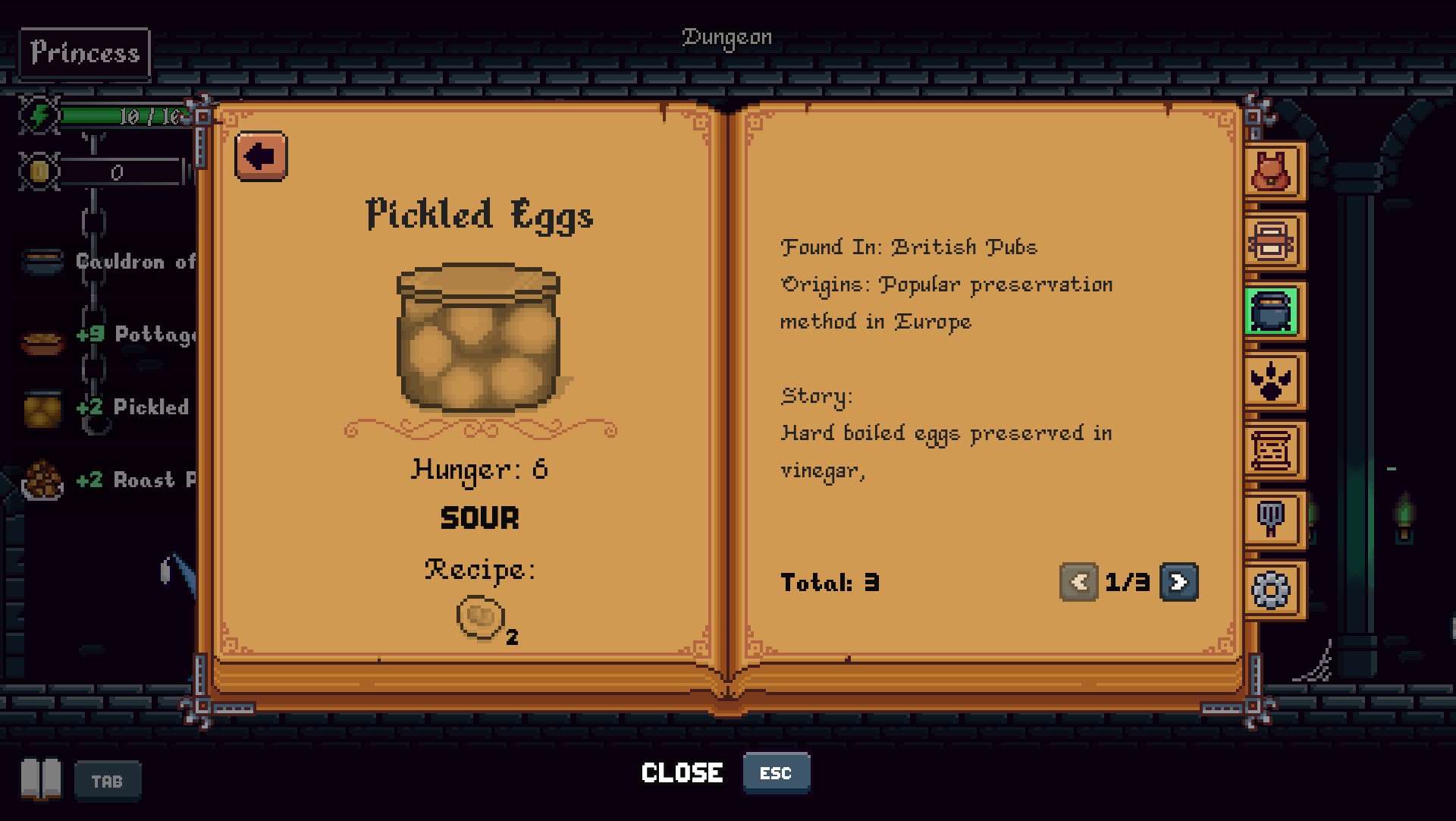
The monsters themselves have similar entries, with descriptions of their original folklore and where the stories might have originated. It’s all wonderfully full of soul and passion, and it’s nice to see British food and folklore alike be celebrated in an industry that usually prefers eastern Yokai or northern Norse cultures for their projects.
Card-chaining gameplay without enough bite
While the range of dishes and horrors provide a brilliant backdrop, the moment-to-moment gameplay can’t quite follow through for a roguelike veteran. As you complete areas you can then start from them or even repeat them in future runs. This means you’re largely in charge of how long a run goes on, and there’s nothing stopping you grinding up seasonings and cookware in early levels to gain an advantage for the later stages.
Meta-progression sees you unlock new recipes so you can start new runs with different dishes already cooked, which adds an element of deck-building and strategy to the start of each run. However, after that point you’ll be cycling the same few dishes and strategies ad infinitum unless a monster reveals they hate something you need for your deck to work. In that case, you just come back another run with a near-identical strat but with a different dish.
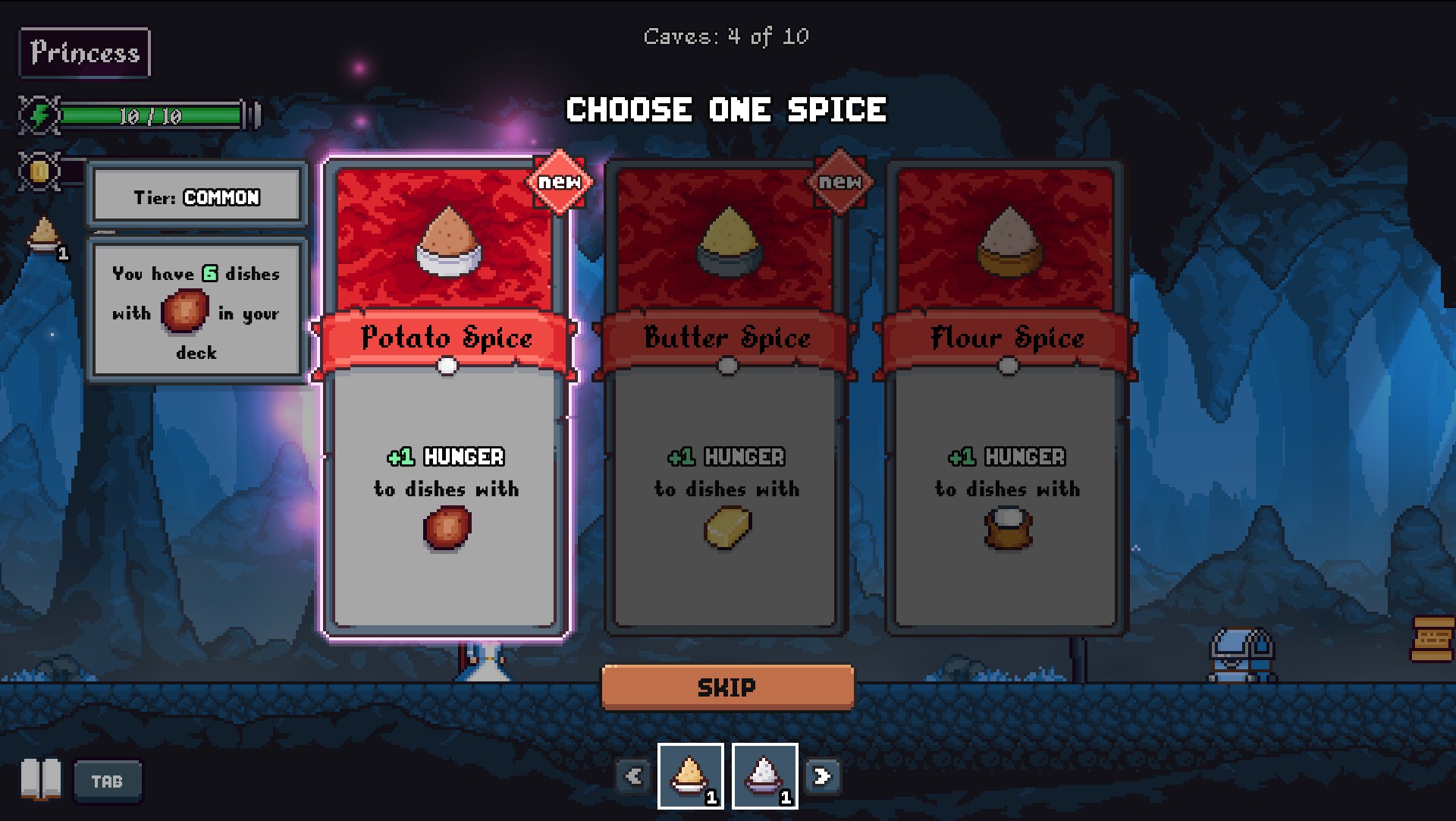
The core loop involves playing dishes which are either Sour, Salty, Sweet, Bitter or Savoury. These then trigger a new craving in the monster for one of the other tastes. You don’t want an inventory full of food that makes the monster crave Sweet, but then no Sweet to actually give them afterwards! So you make sure there’s a Sweet, but that Sweet might trigger a Salty craving so then you need to include Salty. That Salty then triggers another craving and so on. You can build powerful loops, for example endlessly going between Cullen Skin (Sweet -> Sour) and Tatws Pum Munud (Sour -> Sweet).
Horrors have unique loves, likes, dislikes and hates which can throw your strategy into disarray or make your deck easily deal with certain beasts. Knowing that an early game monster has a Love for Yorkshire Puddings, for example, can make you whisk through that stage with ease and quickly earn its rewards, helping make runs shorter in the long-term.
If a monster Hates your meal they will remove all the craving bonuses you earned so far, which can kill a run if you are in a late-game area at the time. Fortunately, these preferences never change. Once you know a boss hates a certain meal it is marked on that card, and you know in future to not feed them it. This means a big part of the meta-progression is not actually related to objective stat or recipe increases, but simply trial-and-error over learning which meals to bring for each biome.
Hungry Horrors doesn’t do anything offensively wrong, but might not hold interest
This loop of feeding and cooking, creating cycles of flavours and triggering additional effects makes for a solid foundation, but the game never feels like it fully capitalises on that foundation. Before long I was cycling the same cards into the same combos to beat the same hunger meter as always, and the enemy’s intentions or behaviours stopped really mattering if my deck did what it was meant to.
Wonderful music and beautiful artwork of rarely-seen British dishes and creatures kept me playing Hungry Horrors even when the card-based gameplay had become a little monotone, making the experience as a whole perfectly palatable. If you’re looking for an intense Slay the Spire experience this isn’t it, but for every way that the gameplay is lacking the art, lore and passion for British culture makes up for it.
Hungry Horrors is available now on PC
