

“There’s coffee in that nebula.” Few lines capture the spirit of Star Trek: Voyager quite like that one, and it’s a fitting starting point for Star Trek: Voyager – Across the Unknown, a strategy game that puts you in command of the legendary USS Voyager as it attempts the long and dangerous journey home across the Delta Quadrant. Developed by Gamexcite and published by Daedalic Entertainment, the game blends exploration, ship management and narrative decision-making into a formula that will feel instantly familiar to fans of XCOM: Enemy Unknown.
Two things in life bring me deep and abiding joy: Star Trek and XCOM. So when Star Trek: Voyager – Across the Unknown was first announced, my interest was immediately piqued. A strategy game where I can guide Voyager’s crew through the Delta Quadrant, make decisions that shape the fate of the ship, and rebuild the interior of the vessel as I go? Sign me up. I’ll grab the nearest shuttlecraft and pilot it straight into danger.
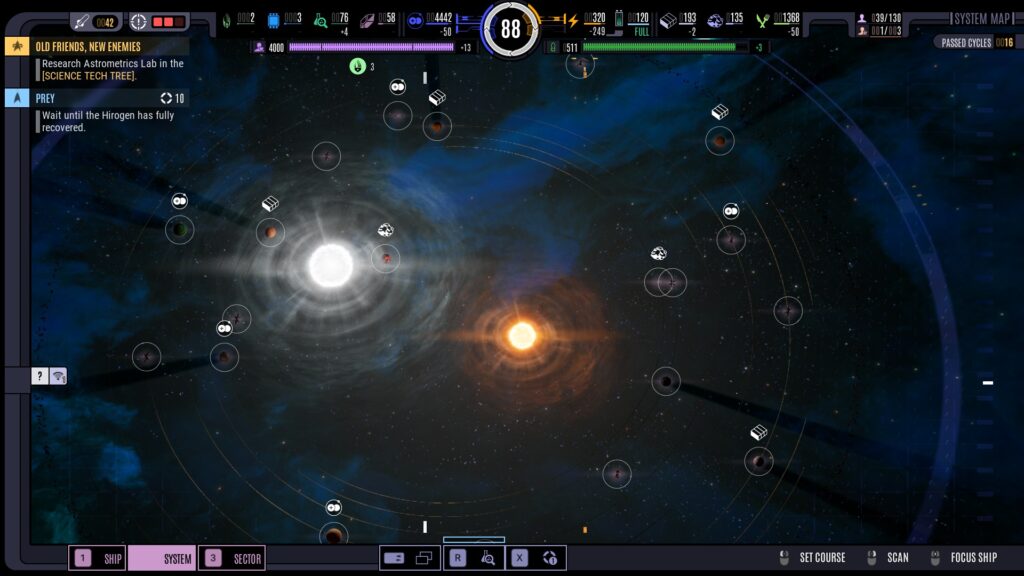
Gameplay revolves around four main activities: exploration, ship management, away missions and combat. Exploration forms the heart of the experience. The Delta Quadrant is divided into sectors, each containing multiple star systems filled with points of interest. These might be planets, abandoned ships, mysterious stations or something far stranger. Scanning these locations reveals potential rewards such as fuel, food, construction materials or even new crew members. Story missions are marked clearly on the map with a gold Starfleet delta, while optional side missions appear in blue.
Completing story objectives usually leads to a choice: Push forward into the next sector or remain behind to gather more resources. Staying longer allows you to strengthen Voyager, but it comes at a cost. Crew morale gradually drops the longer you linger in a region, encouraging you to keep moving. Most of the time it feels fair about how long it gives you in each sector, although it can occasionally be a little ruthless. In one playthrough I lost the Doctor’s mobile emitter simply because a story mission forced me out of the sector before I could finish a side quest. Sometimes the Delta Quadrant simply refuses to cooperate.
Managing the ship itself is where the XCOM inspiration becomes most obvious. Much like expanding your base in XCOM: Enemy Unknown, Voyager must be rebuilt piece by piece. Sections of the ship need to be cleared, powered and converted into new rooms that help sustain the crew and keep the mission alive. Space is incredibly limited, which leads to some difficult decisions. Do you build proper crew quarters that maintain morale but house fewer people, or emergency bunks that pack in more crew at the cost of comfort? Should a deck contain more cargo storage so you can carry additional fuel, or would another phaser array be more useful when combat inevitably arrives?
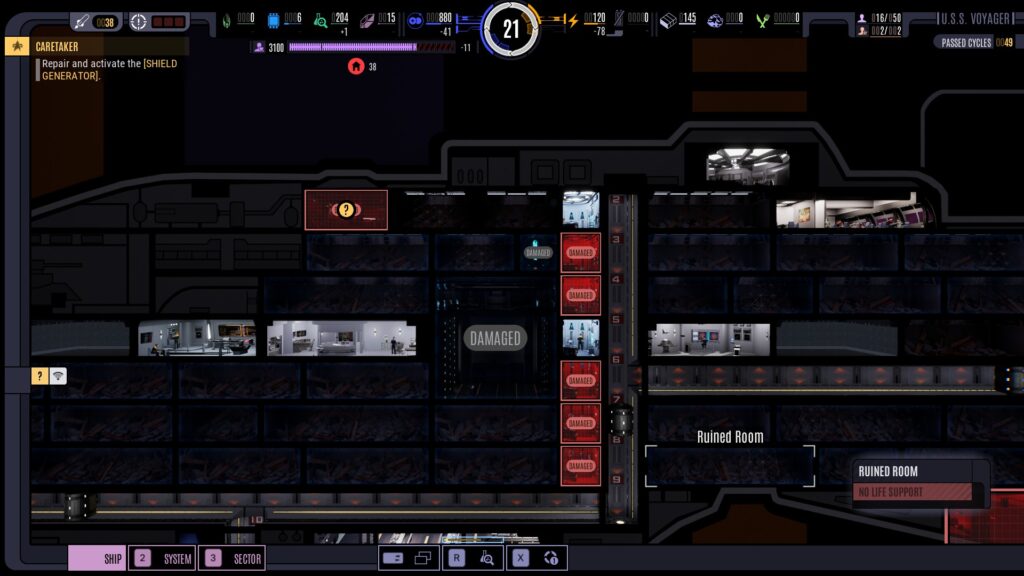
Power management quickly becomes the biggest obstacle. Every room requires energy, but Voyager’s warp core can only provide so much. Upgrading it unlocks higher power tiers, but the more advanced the core becomes, the more fuel it consumes. That leads to a cascading chain of decisions: more power requires more fuel, which requires more storage, which eats into the limited space you have available. The whole system feels reminiscent of Frostpunk, where every improvement introduces two new problems to solve.
Crew assignments add another strategic layer. Hero characters can be stationed in specific rooms to improve their efficiency. Harry Kim excels in the research lab, while Neelix is far more useful in the mess hall helping keep the crew fed and morale stable. These bonuses can dramatically change how effective certain parts of the ship become, and finding the right combination is often the difference between a struggling vessel and a well-oiled starship.
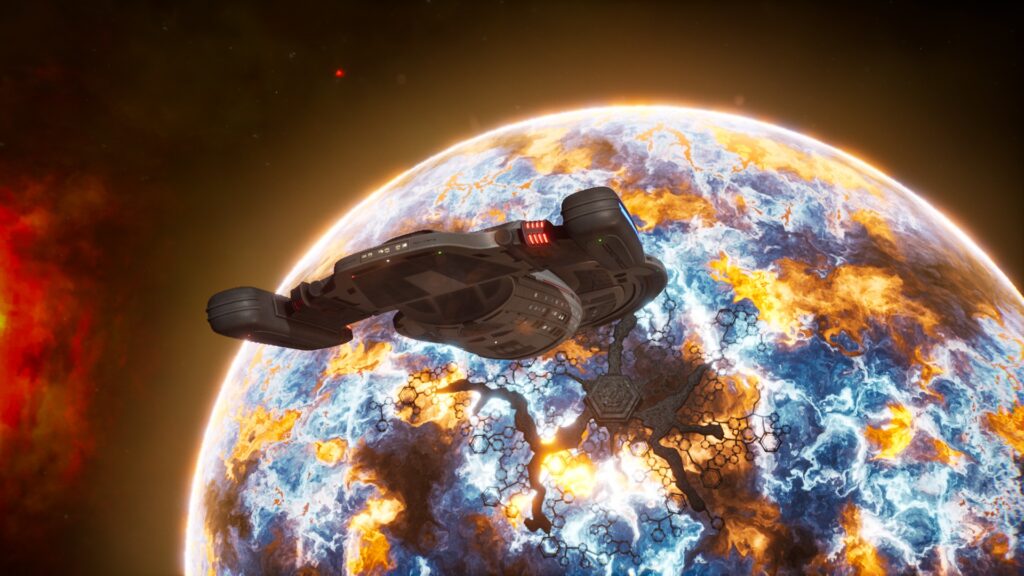
Away missions appear throughout both the story and optional encounters, sending selected crew members to investigate situations beyond the ship. These sequences play out through a chain of decisions, with the game clearly indicating which types of skills will be tested. Icons represent combat, scientific expertise or medical knowledge, giving you a chance to pick the most suitable team before launching the mission. Different crew members excel in different areas — B’Elanna Torres is far stronger at engineering challenges than Harry Kim, for example. Each hero also possesses unique keywords that can grant bonuses during specific encounters. Tom Paris brings the Pilot keyword, while Chakotay contributes Survivalist. Picking the right crew combination can practically guarantee success and bring valuable resources back to Voyager.
Combat, unfortunately, is where the game feels weakest. When battles begin, you select an enemy ship and choose which subsystem to target. After breaking through shields and destroying the hull, the opposing vessel either explodes, flees or surrenders. In practice, these outcomes rarely feel different. If multiple enemies appear you can switch targets, but you cannot split your fire between them, which limits the tactical depth considerably. Torpedoes provide additional damage options, particularly against unshielded sections of enemy ships, but they rarely feel essential. By the end of my second playthrough Voyager was equipped with so many Borg-derived weapons that enemy vessels barely lasted long enough to be considered a threat.
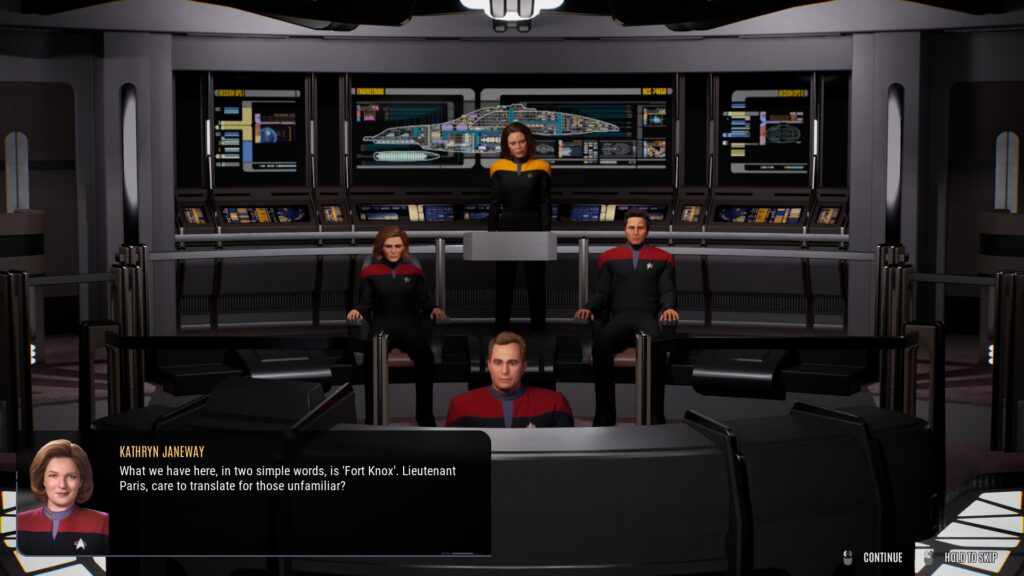
Presentation is another area where the game struggles. The voice work includes appearances from Tim Russ and Robert Duncan McNeill, which is fantastic for fans, but their lines are limited. Without the voice of Captain Kathryn Janeway (by the fabulous Kate Mulgrew), the bridge feels strangely incomplete. The music doesn’t help matters either. The iconic Voyager theme appears on the menu screen, but the rest of the soundtrack fades so far into the background that I eventually resorted to playing episodes of the show alongside the game just to give the experience a bit more atmosphere.
Character models also leave something to be desired. The crew often resemble lifeless mannequins rather than the familiar Starfleet officers fans remember from the series. It’s particularly odd given that the game clearly has access to the actors’ likenesses in other parts of the interface.
Like many strategy games, the experience also lives and dies on random number generation. Sometimes that unpredictability produces memorable stories, but it can occasionally feel unfair. At one point I encountered a story decision with a two percent chance of failure. Naturally, I failed. Game over. Reloading the save and passing the same check immediately afterwards left me unsure whether the system added tension or simply unnecessary frustration.
Despite those issues, I genuinely enjoyed my time in the Delta Quadrant. Across several playthroughs I experimented with wildly different outcomes. I managed to get Voyager home without destroying the Caretaker Array. I saved Tuvix, lost Tom Paris to a black hole, made questionable decisions involving Neelix, and steadily transformed Voyager into something approaching a Borg hybrid starship. Every run produced a slightly different story, and even when things went catastrophically wrong I found myself eager to start again just to see how events might unfold next time.
Star Trek: Voyager – Across the Unknown isn’t perfect. Combat lacks depth, the presentation can feel underwhelming and the RNG occasionally pushes its luck. But its core loop of exploration, ship management and narrative decision-making is surprisingly compelling. If you’re not already a fan of Voyager, this probably isn’t the game that will convert you. But if you are, then commanding the U.S.S. Voyager on its long journey home is an experience well worth taking. So, set a course for the Alpha Quadrant, keep an eye on your fuel reserves, and maybe — just maybe — violate the Prime Directive one more time.
Star Trek: Voyager – Across the Unknown is available now for Xbox, PS5, Switch and PC.
