

Coffee Rush, published by Korea Board Games, is a title that looks deceptively light at first glance — bright colours, cheerful artwork, amazingly overproduced components and a theme built around brewing drinks and serving customers — but once you start playing, you realise it’s a tightly constructed puzzle with a surprising amount of tension. This is a game about efficiency, timing, and spatial awareness, wrapped in a theme that makes the whole experience feel breezy even when the decisions are anything but.
Coffee Rush‘s premise is simple enough: You’re running a café, and customers are lining up with increasingly demanding drink orders. To fulfil those orders, you need to gather ingredients from a shared grid, moving your barista token(s) in initially orthogonal lines to collect what you need. This is painfully slow at the start of the game, but as the turns roll round, you can trade completed orders for upgrades at a victory point cost equivalent to three points down to two. The catch being that whilst you get the benefit of the upgrade, you also lose a point for doing so.
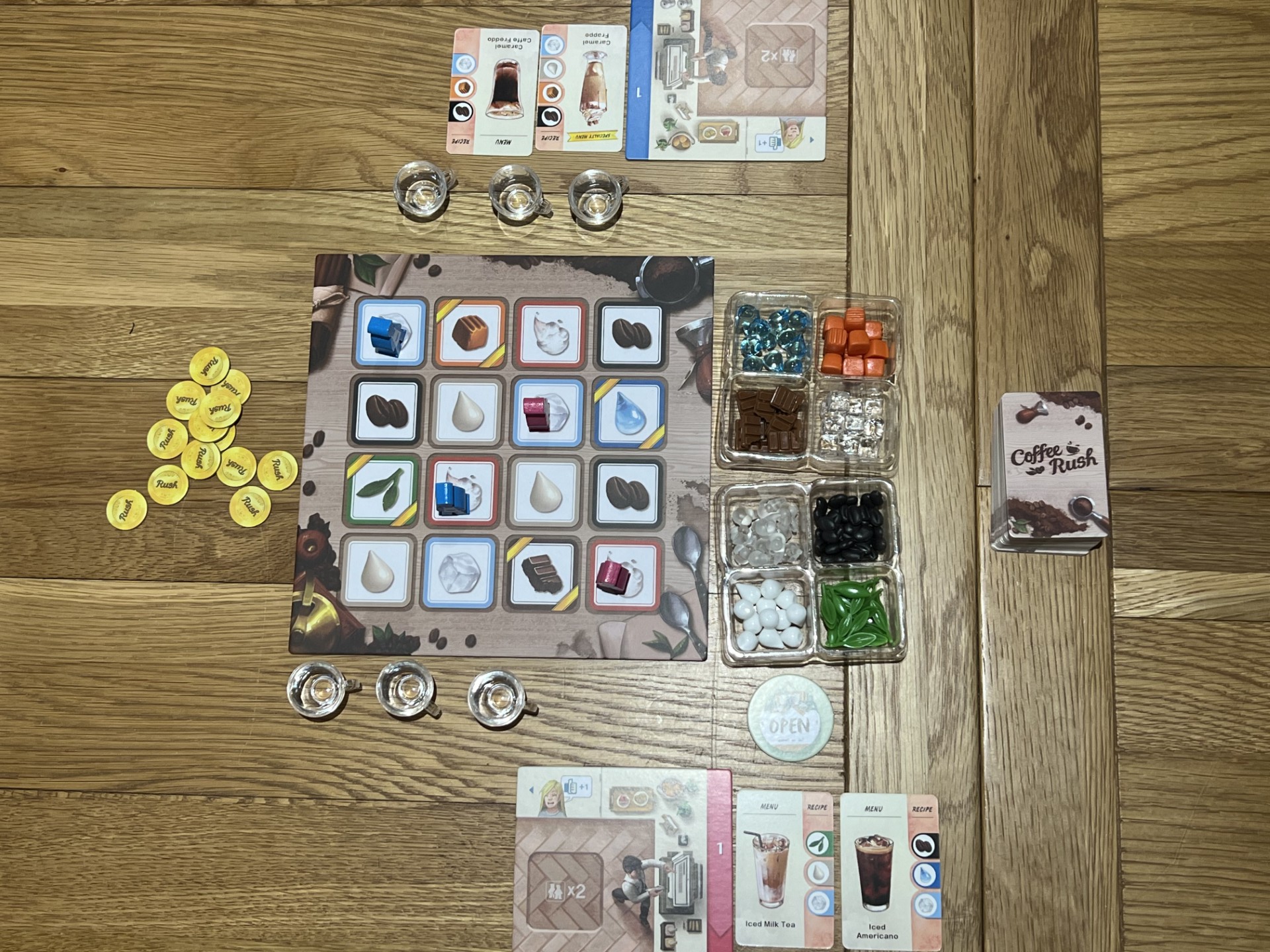
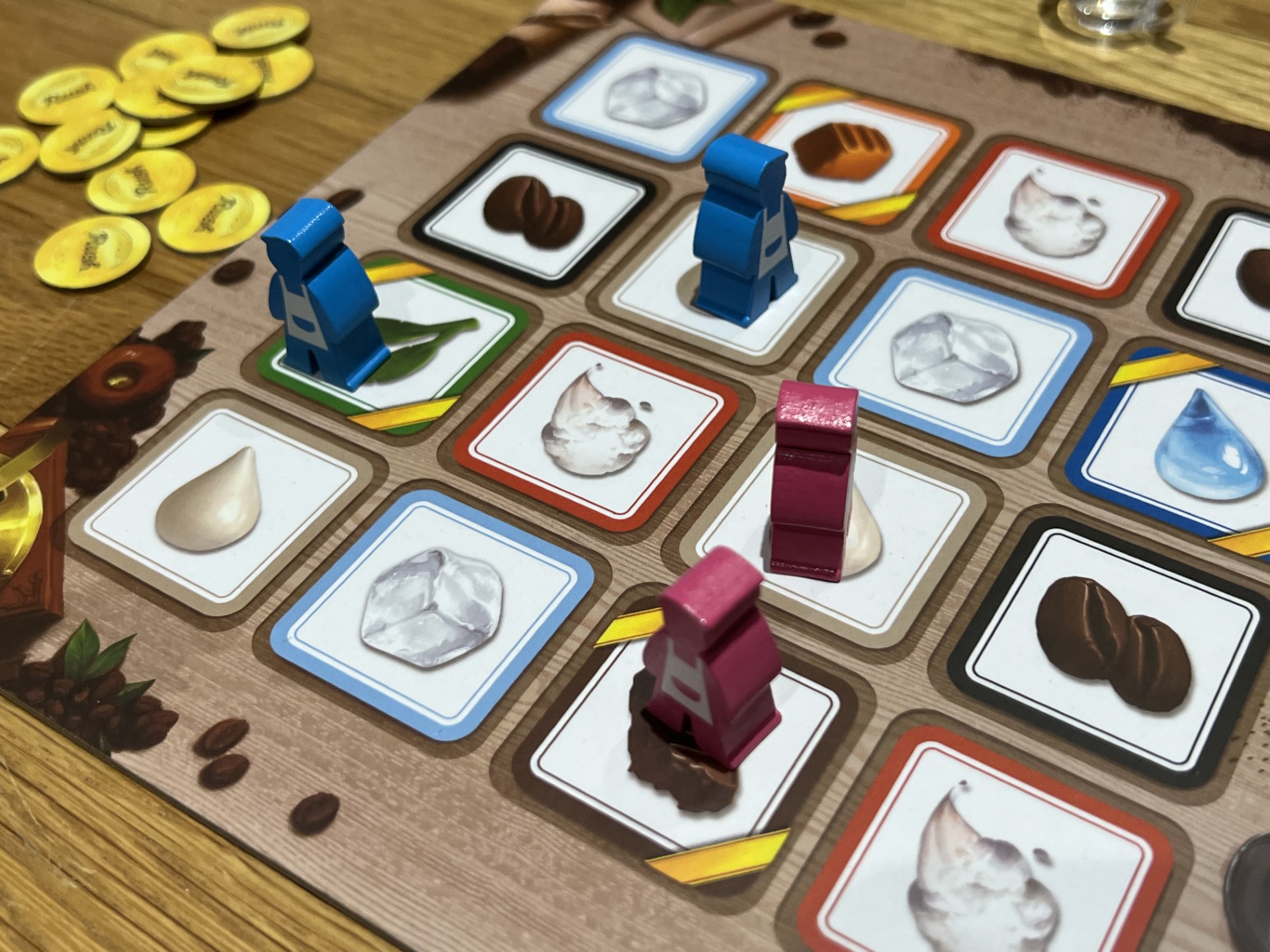
The ingredient grid is the central mechanism, and it’s where much of the game’s tension comes from. Prior to any upgrade, you can only move three spaces either horizontally or vertically, changing direction at will and collecting every ingredient you pass over. That sounds generous, but it forces you to think several steps ahead. Because the grid is communal, you have to work around other players’ meeples (and your own in the two player game where each player has two meeples) because whilst you can pass through them (and collect whatever resource they stand on) you must stop on an empty space.
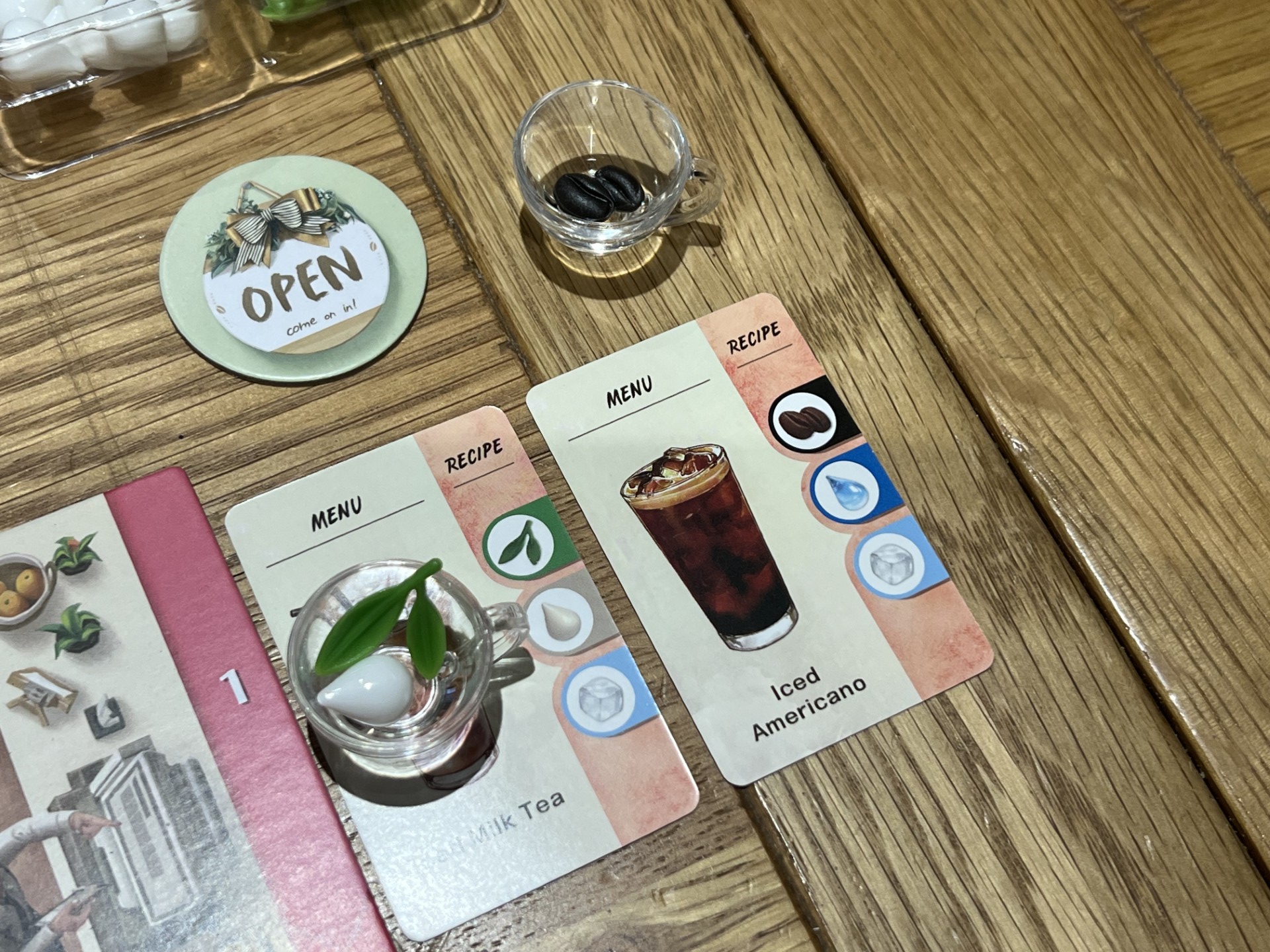
Orders themselves are straightforward: each drink requires a specific combination of ingredients, and fulfilling an order earns you points and sometimes bonuses. Orders are drawn at random and will most frequently require three ingredients — milk, coffee and steam, for example. Some require four, and in those cases, will often be considered premium drinks that grant a bonus Rush token when completed (I’ll come to these later).
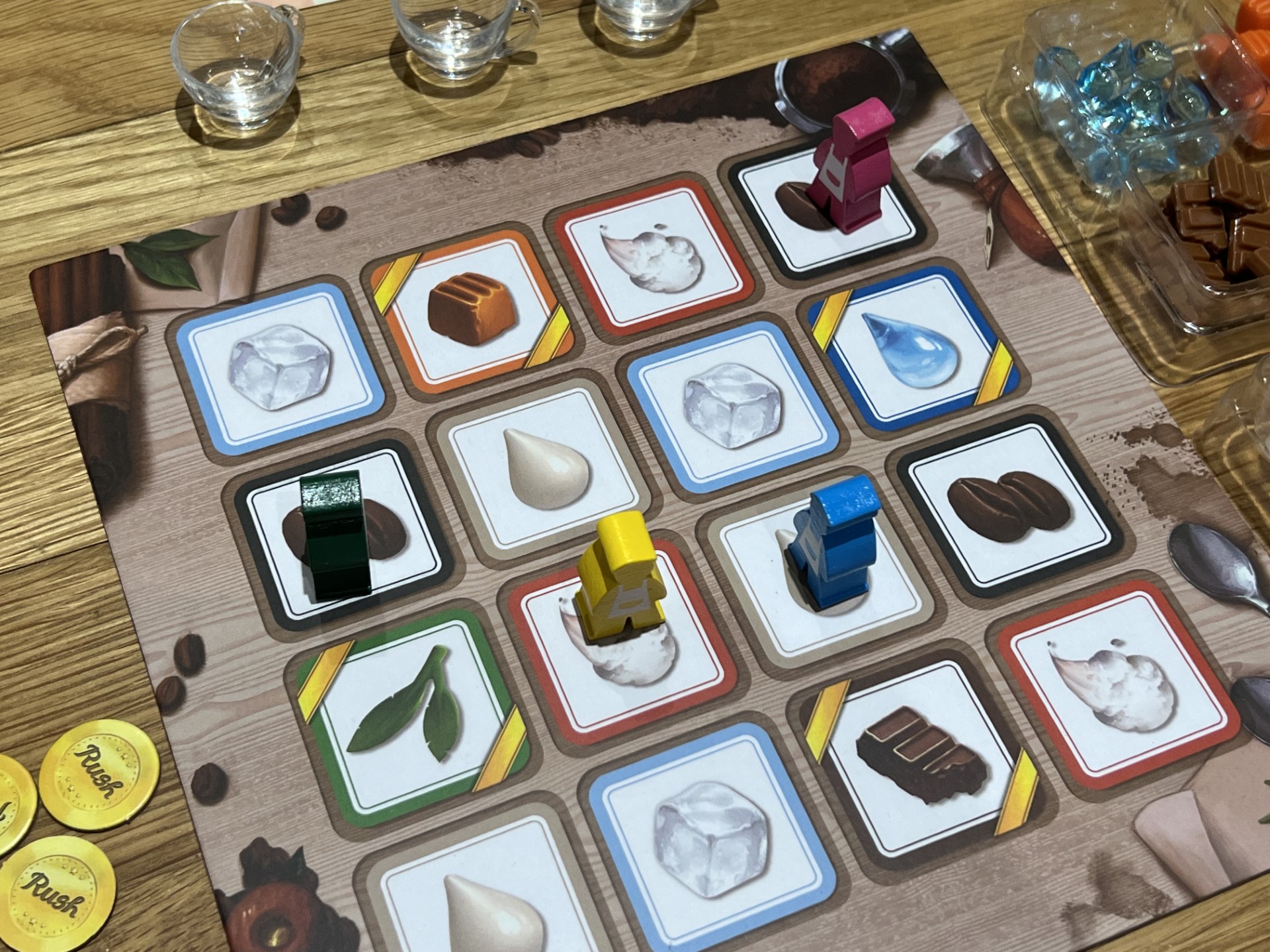
Storage is another clever constraint that brings me onto the components themselves. Each player has just three cups (literally clear plastic cups) and any ingredients taken must be placed into a cup or discarded. Because by mid to late game you’ll have easily upwards of three orders in hand, you’ll need to choose which ones to prioritise carefully. Fail to complete the orders fast enough though, and they’ll drop off the bottom of your board (signifying the customer leaving) and if you don’t have another order that requires ingredients already in a cup, well then you might as well throw the contents away.
Just for clarity, when I talk about the plastic cups and the ingredients here — I do mean this all quite literally. The cups are nice, but the other components in Coffee Rush are something else. There are actual drops of milk, puffs of steam, coffee beans, tea leaves, ice cubes, chocolate and caramel chunks and several others all bundled in the Coffee Rush box. These are cute, functionally and ridiculously unnecessary — but I do love them.
What makes Coffee Rush engaging is how cleanly it blends accessibility with depth. The rules are easy to teach, the turns are quick, and the theme is universally appealing, but beneath that surface is a spatial puzzle that rewards foresight and punishes sloppy planning. It’s the kind of game where you can see your mistakes immediately — a wasted move, an order missed that leads to a wasted cupful of ingredients — and that clarity makes it addictive. You always feel like you could have done better, and you want to try again.
But with that said, Coffee Rush is also hard in an unusually punishing way for a board game. The game end is triggered by one of the players failing their fourth order card. In all modes of play, new orders are sent to the players when the player besides them completes an order. This reminds me of classic puzzle videogames like Puyo-Puyo or Tetris when played in multiplayer. You know when those extra blobs or bubbles drop down into your side of the screen? It’s the same thing in Coffee Rush and having so few moves and five, six, seven or more order cards can melt your brain in minutes.
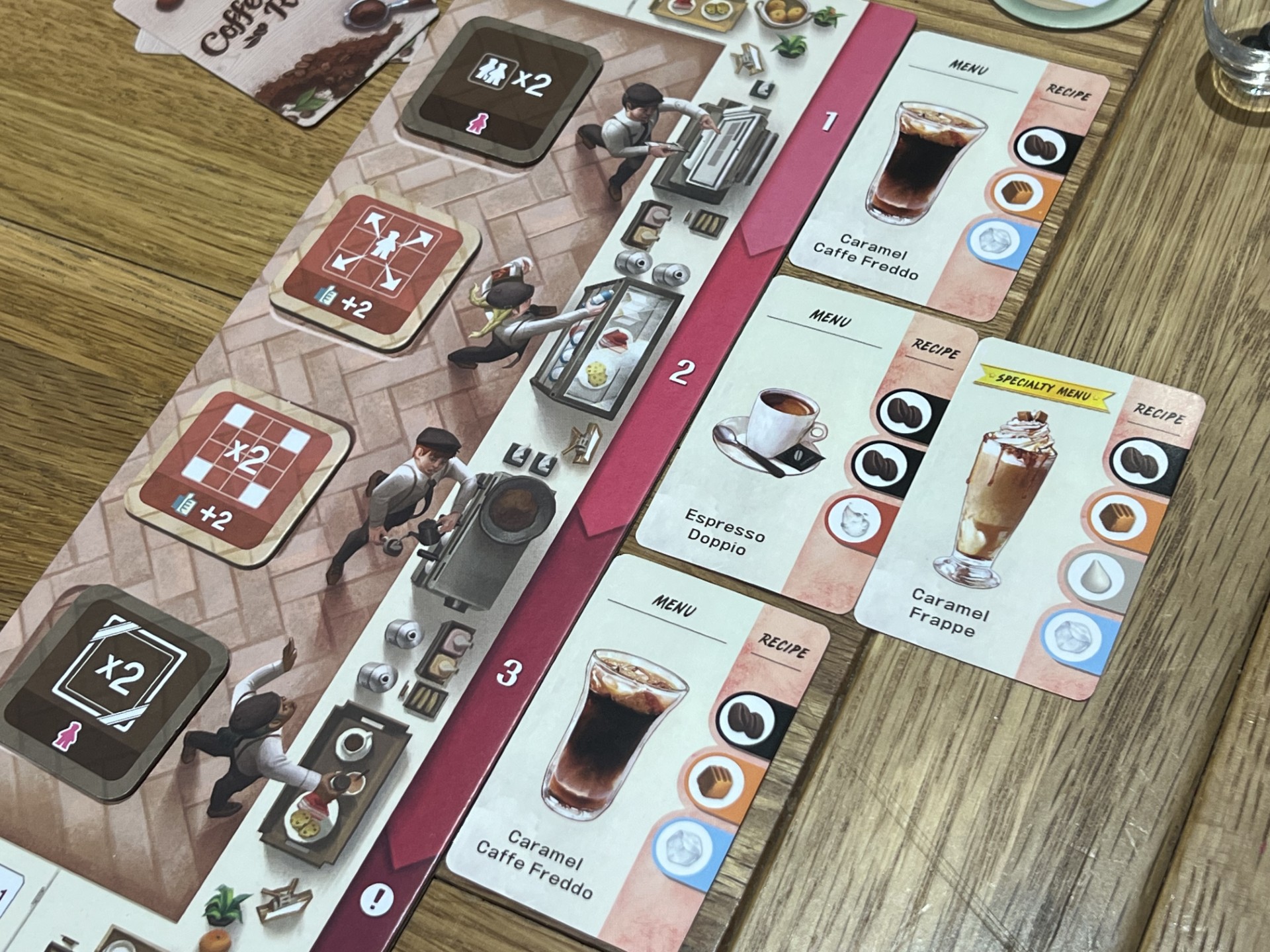
This means that player interaction is indirect but incredibly meaningful here. You’re not attacking each other or stealing resources, but every order you complete affects the other players, and sometimes you can continuously (and more often unconsciously) block the ideal move for another player.
The pacing is brisk. A full game rarely overstays its welcome, and the escalating difficulty of orders ensures that the final turns feel more intense than the opening ones. There’s a sense of momentum as the café gets busier and the puzzle tightens, and the game usually ends just before one player starts to feel as though they are genuinely losing the plot. For me, Coffee Rush is about as stressful as I imagine a board game could get. It’s not played in real time, but somehow it creates a similar sense of pace and urgency as other games that are.
What stands out most about Coffee Rush is how confidently it delivers on its premise. It doesn’t try to be a sprawling strategy game or a heavy economic simulation. It’s a focused, elegant puzzle with a warm theme and a clever central mechanism. It’s a game that works with families, casual groups, and hobby gamers alike — easy to learn, satisfying to master, and full of those small, gratifying moments where a perfectly planned route comes together. Pleasingly, it’s also available on www.boardgamearena.com where you can give it a try for free or as part of a Premium Membership.
If you enjoy spatial puzzles, route optimisation, or games where the board state shifts constantly under your feet, Coffee Rush is a delight. It’s light on rules but rich in decisions, and it captures the bustle and rhythm of running a café in a way that feels both playful and surprisingly strategic.
Coffee Rush is available now from Amazon.
