

From card effects slicing across the screen to enemies being able to grapple and grab you, the first-person camera of Into the Grid brings the genre to a mostly unexplored place. Being thrust face-first into some of these Sentinels forces a sense of urgency and engagement that more distant and static art can’t do as easily.
The “Early Access roguelike deckbuilder” has become so much of a trope that even developers are in on the joke – with Poncle trying to use every word they could possibly think of before finally admitting that yes, their new game will be a roguelike deckbuilder. Before that kicks off next year, though, there’s a first-person roguelike deckbuilder you can play right now. Into the Grid wears a hackerman cyberpunk vibe and thrusts you into the action in a unique first-person perspective.
Outside of combat, Into the Grid adds a management aspect to exploring the overworld, which itself is a digital simulation of “hacking” a futuristic computer system. Rather than the “pick a path” method of similar games such as Slay the Spire or Inscryption Act 1, Into the Grid uses open exploration. In combination with the first-person combat camera this makes the game genuinely fresh and engaging despite being, underneath, another roguelike deckbuilder.
Innovative combat, exploration and even…stealth?
Let’s start with the basics. If you have played Slay the Spire or another of the multitude of these styles of games then you’ll know that every turn you have a certain amount of action points (Or Clock, in Into the Grid). You start with 3 Clock, and you can add more through powerful Protocol cards which affect an entire battle, rather than just one turn. You can also gain Clock back with certain big brain plays (Not the in-game term). In combat itself you are reducing an enemy to 0 HP, and trying to take as little chip damage back as possible. You’ll be sleuthing and slaying your way through many more enemies before the floor boss, so every hit taken counts in the long run.
That’s all pretty standard with the genre, so what about differences?
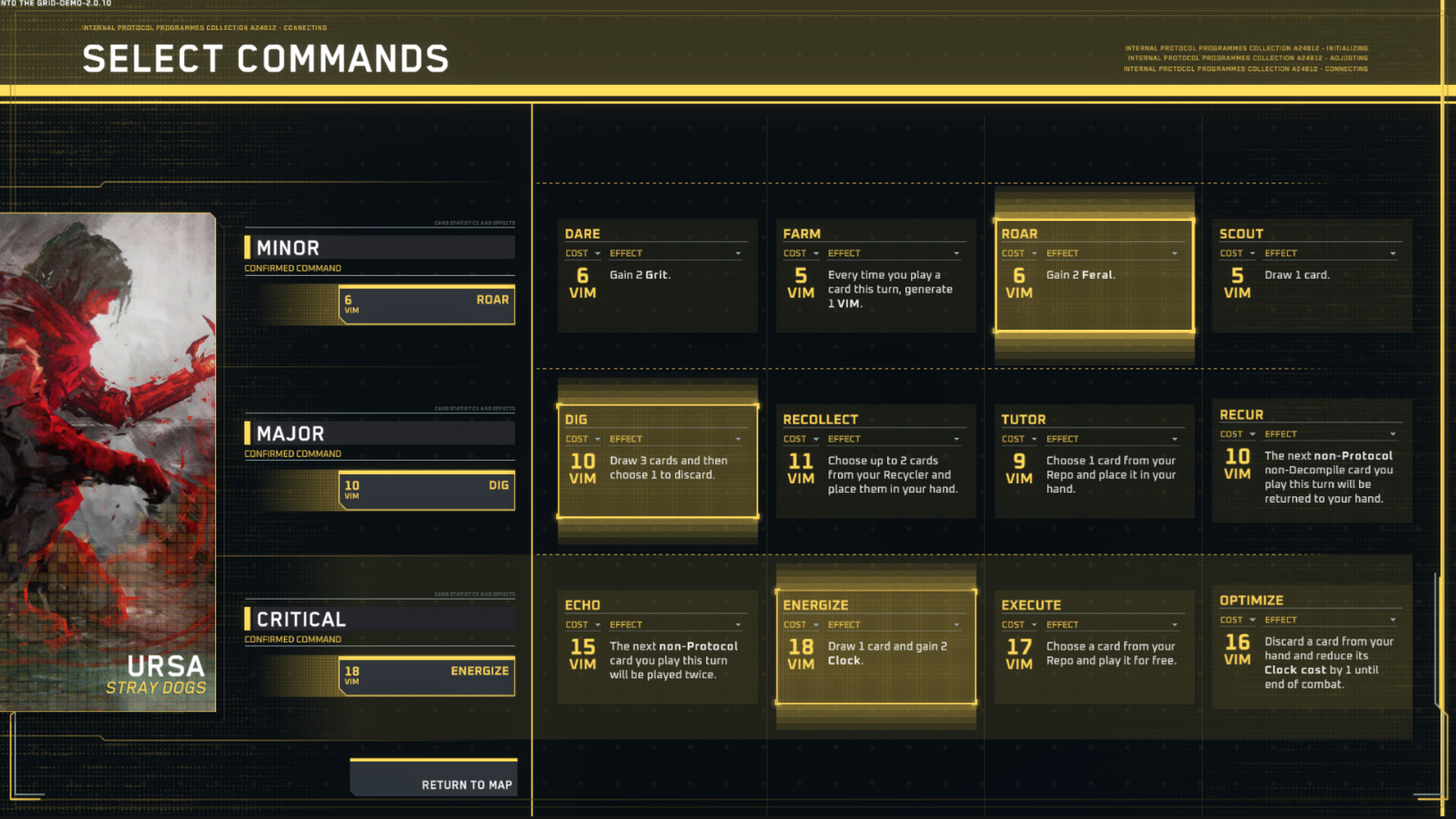
VIM and Commands. In combat you accrue a resource called VIM by playing cards. VIM powers your 3 Commands, which you can switch out any time you are not in combat. This means you can adapt Commands based on your deck, or ignore them entirely if you aren’t focusing on using VIM. Having abilities that aren’t dependent on your draw for the turn, provided you have the VIM, is a great way to fix holes in your deck or hurriedly draw a bunch to try and get your combo piece.
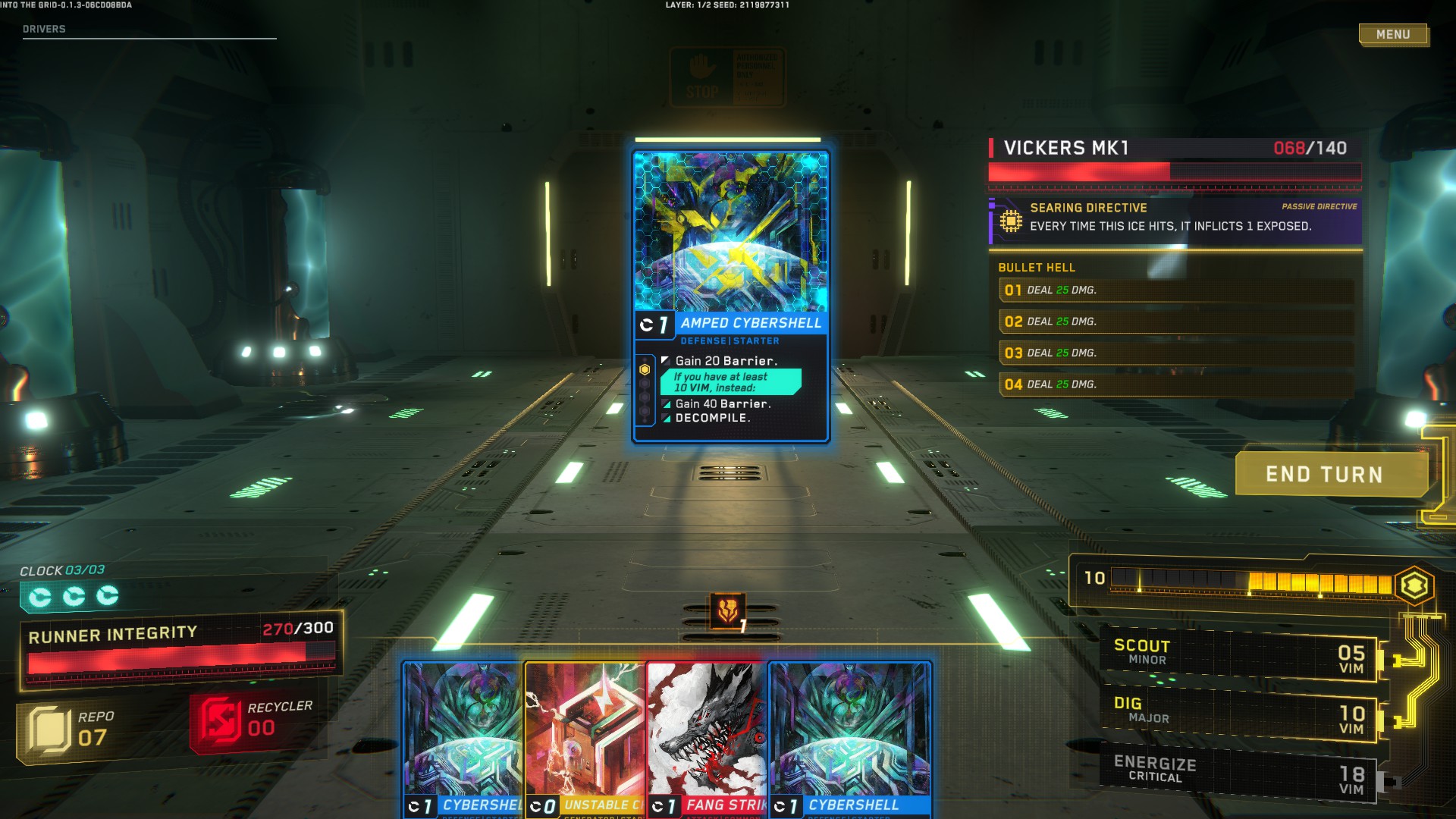
VIM and Card Abilities. In addition to spending VIM on Commands, some cards are upgraded or changed when played while you have a certain amount of VIM. For example, one starting attack and block card for the first character will have double the effect (but remove itself from your deck) if you play it when you have 10 or more VIM. The VIM isn’t consumed, it’s just checked as a trigger for the card to change. This means VIM-spending and VIM-hoarding are both viable deck types, which expands your combat options.
On-Hit Effects and Block. You can use cards to attack, of course, but also apply Barrier. Any damage that an enemy deals that does not bypass your Barrier does not hit. This means that attacks which apply debuffs on-hit are wholly negated if you generate enough Barrier. This incentivises having a healthy balance of defence and attack, and makes the turn you fail to get enough Barrier feel all the more lethal as your negative effects build up.
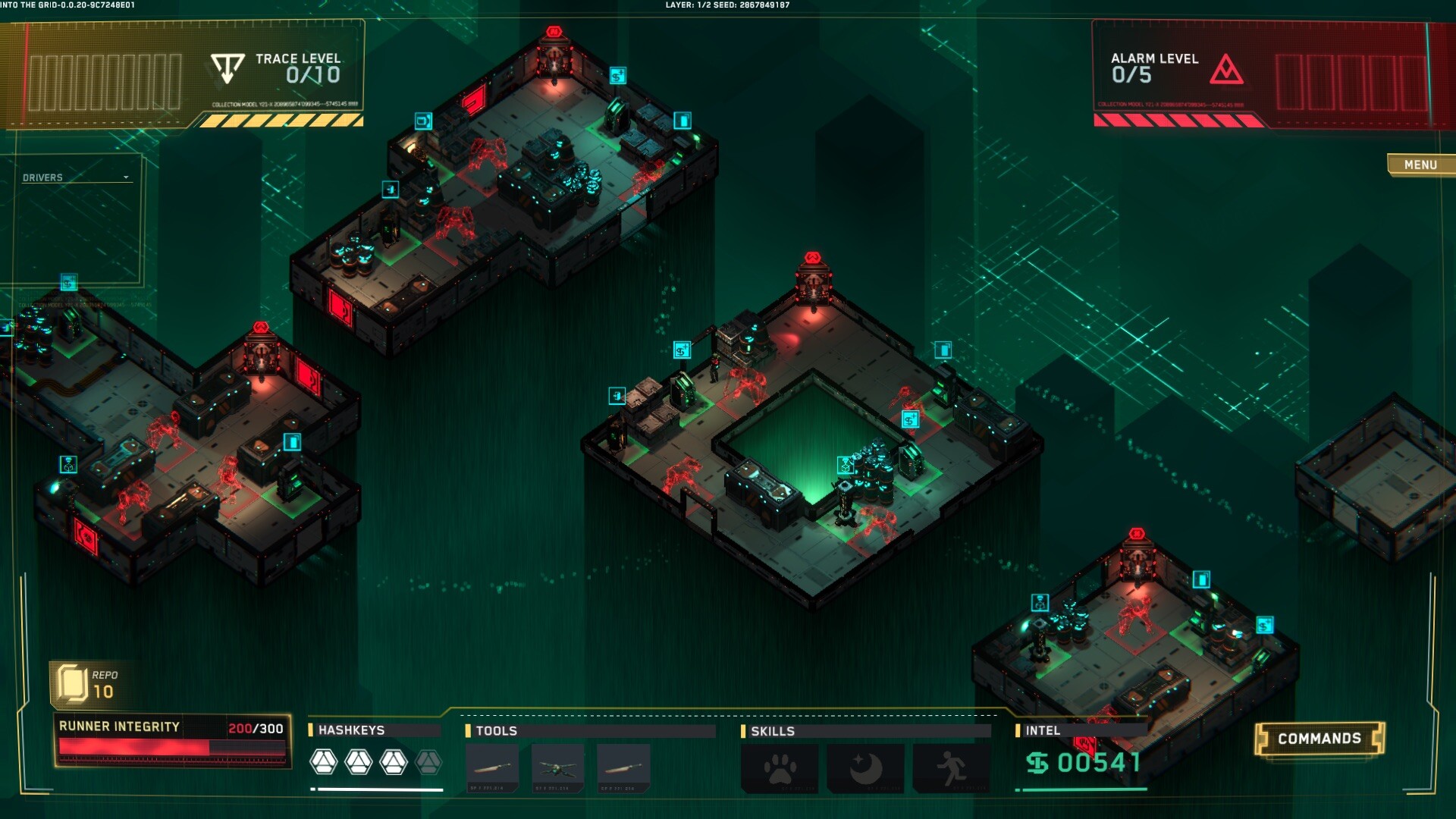
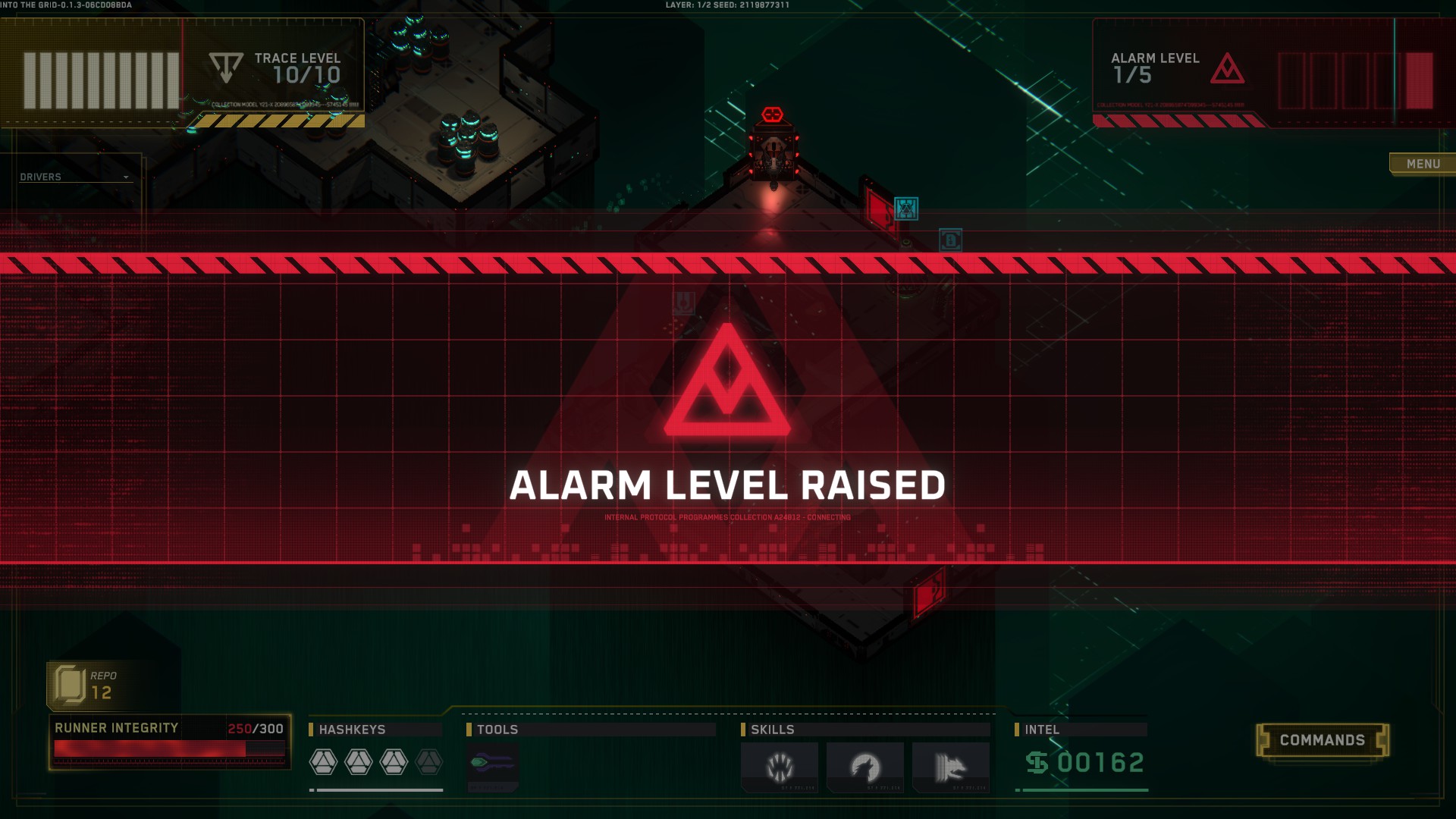
Free-form exploration… and stealth? Perhaps the most abrupt change from a “traditional” roguelike deckbuilder is that Into the Grid allows you to explore the Clusters (rooms) of a floor freely. You may need currencies and to defeat enemies to access certain spaces, but the choice is yours when (or if) you use any single space in the map. Saving encounters for when you’ve drawn some new cards can be just as valid a strategy as destroying everything to maximise resource gain. All the while, your “trace” raises, and each 10 “trace” raises the “alert” by 1. Basically, the more you do, the harder the enemies and exploration will become. But, running straight to the boss is equally destructive…for you. Balancing your deckbuilding, buffing and exploration adds a whole new layer to Into the Grid that “pick-your-path” roguelikes simply don’t have.
Deep mechanics with a stylish shell
Before experiencing any of this engaging gameplay, you’ll probably notice one thing: The first-person camera that activates in combat with Sentinels. This is what makes the game more exciting than many other deckbuilders, as that simple change in perspective has huge ramifications for immersion and style. From card effects slicing across the screen to enemies being able to grapple and grab you, the first-person camera brings the genre to a mostly unexplored place. Being thrust face-first into some of these Sentinels forces a sense of urgency and engagement that more distant and static art can’t do as easily.
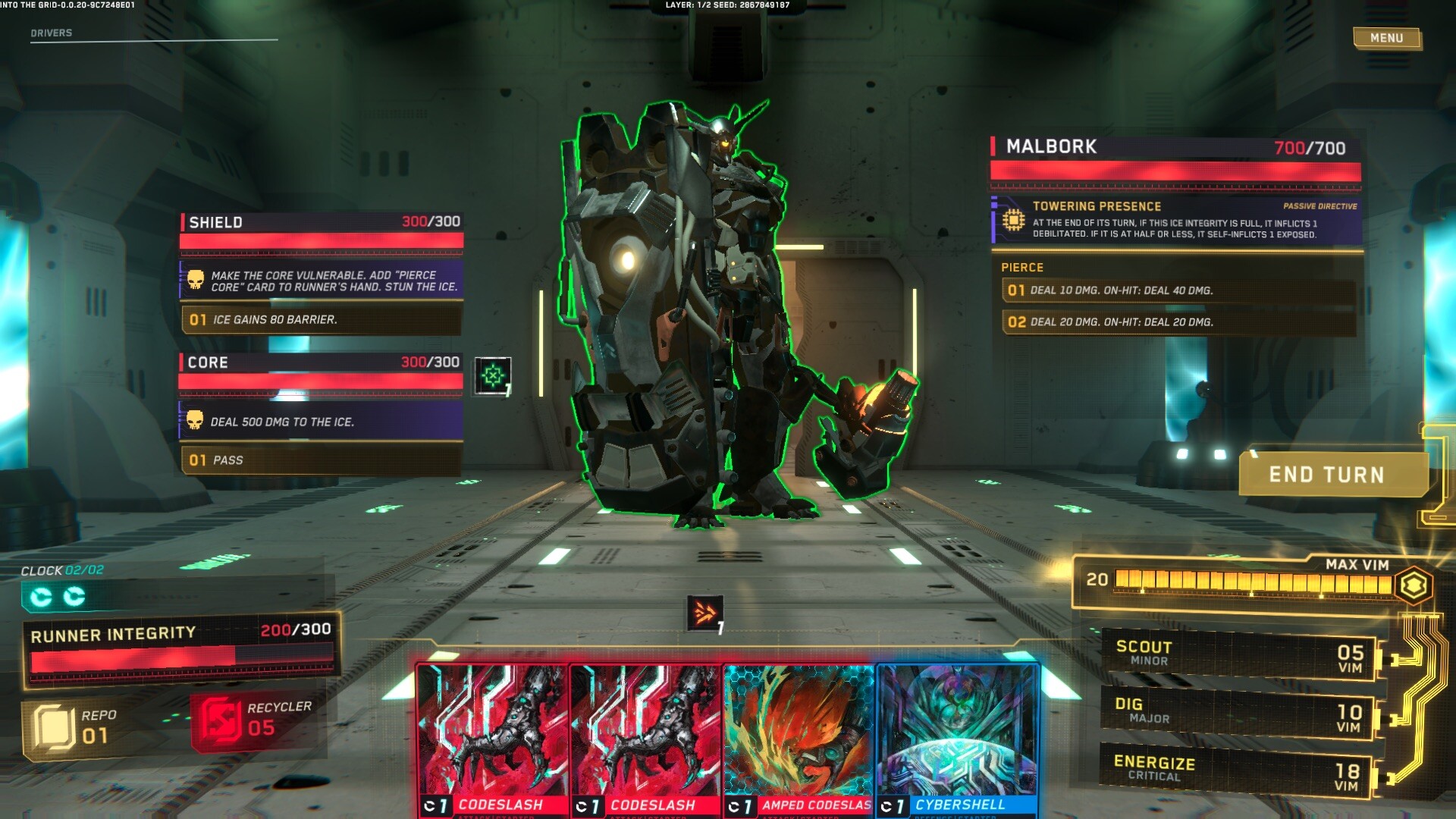
It isn’t all just for show, either, as the first-person perspective leans into the “Peripherals” mechanic. Peripherals are parts of Sentinels you can target separately from the main HP of the Sentinel. This will stop the Peripheral from performing its action and also net you a reward such as drawing a card or removing the Sentinel’s Barrier. In boss and mini-boss fights these Peripherals are very important, as they can bypass or help recover from the bosses threatening intents and status effects. Just like trace and alert, or VIM-spending vs VIM-hoarding, Peripherals add another way for players to make split-second decisions about their approach to fights.
One player might hoard VIM, loot every Node on the floor, be at alert level 4 (out of 5) and finally approach the boss with an incredibly refined deck. By taking their time to uncover everything they removed starter cards from their deck, ensuring only their powerful VIM-hoard cards are included. The sheer damage-per-card could allow them to ignore Peripherals, or could allow them to destroy them quickly to make the fight easier.
Conversely, one player might use Commands and VIM generators to constantly have a high level of Barrier, and rely on manipulating their starter cards via Commands rather than removing or replacing them. This player might target the boss HP and ignore Peripherals because they have enough Barrier not to care, or they might target Peripherals because destroying them will help lessen the gap in their deck’s offence.
However you play, you’ll be making decisions that affect your run at every step of the way both in and out of combat, making “playstyle” something that can shine through.
Balancing thinking with playing
If managing your Commands, Trace, Alert, adding and removing cards, currencies for opening doors, surviving combat, spending VIM, finding the boss Node and managing Clock sounds like it’s a lot to keep on top of, then Flatline Studios’ recent patch for the Beginner difficulty might help ease you into the game. In reality these elements are complimentary and engaging rather than overwhelming or “crunchy”, to use the technical term. You have unlimited time to work out where you’re going, what you are prioritising and what cards to play. When we first got our hands on Into the Grid the Beginner mode hadn’t been patched yet and it was some pre-nerf Radahn levels of difficulty. However, after a few runs and the patch I can now reliably get past Beginner and Intermediate Floor 1. Intermediate Floor 2 is another matter…
The difficulty and apparent complexity could shake the confidence of a new player, especially if this is their first ever roguelike deckbuilder. It’s good to see Flatline Studios trying to make the early game more accessible so that those players stick around to see the depth the game has to offer, even in its Early Access state.
Renew your faith in roguelike deckbuilders today
Into the Grid successfully brings the roguelike deckbuilder into a new perspective, both inside and outside of combat. Having to manage Trace and Alert out of combat while also managing HP, Barrier, Clock and VIM inside it adds a level of complexity that “Pick-your-path” roguelikes miss. While this can make runs noticeably longer as you have to puzzle over which Node to go into, and when to backtrack, the payoff in engagement and depth is worth the extra time.
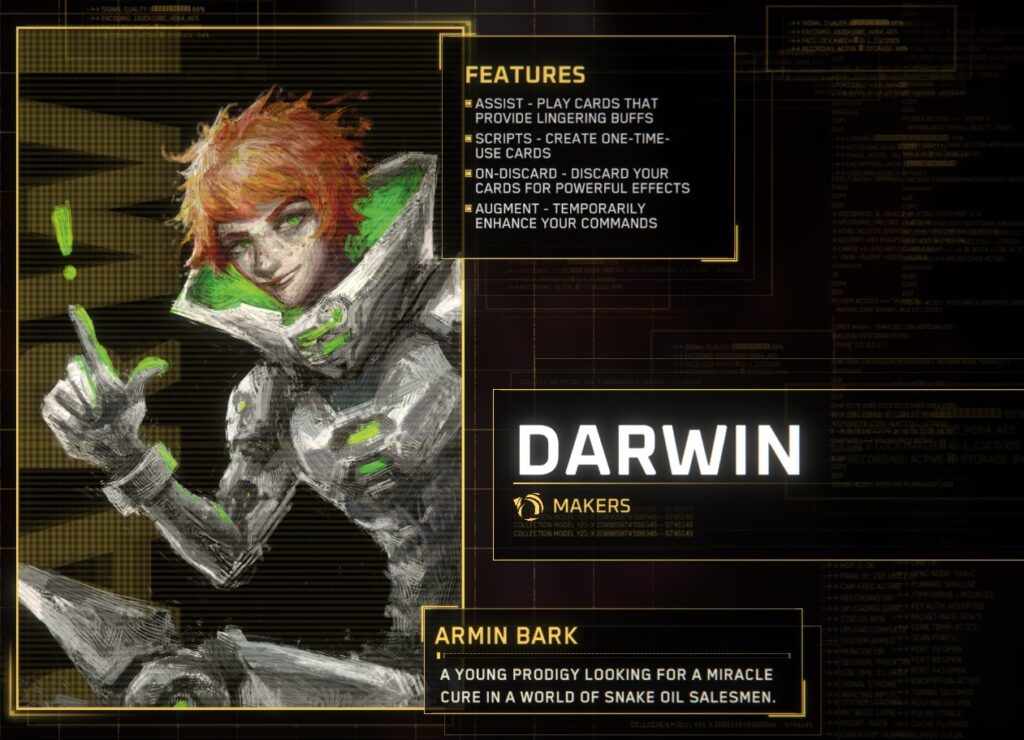
If you’re struggling with the Beginner run you can check out two of my victorious decks, one for each character, using the links below. These links are provided by the game when you finish a run, and look pretty snazzy. Flatline Studios are innovating inside the game and outside it!
Click to View Deck:

Click to View Deck:
Into the Grid is out now in Steam Early Access
