

From Hungry Minds, the Dubai-based group that brought us The Book – The Ultimate Guide To Rebuilding Civilization comes their second offering: The Last Book.
There are books that tell stories, and then there are books that feel like artefacts — the sort of thing you’d expect to find half buried in the ruins of a forgotten library, waiting for someone to brush the dust off and whisper: “what happened here?”
The Last Book – The Diary of the Last Earthling is exactly that kind of object.
From the second I began to open the box that contained The Last Book, I was met with a message emblazoned within: We make beautiful artefacts not too often. Never quite the same. Always a little strange. This one’s yours now. Treat it accordingly.
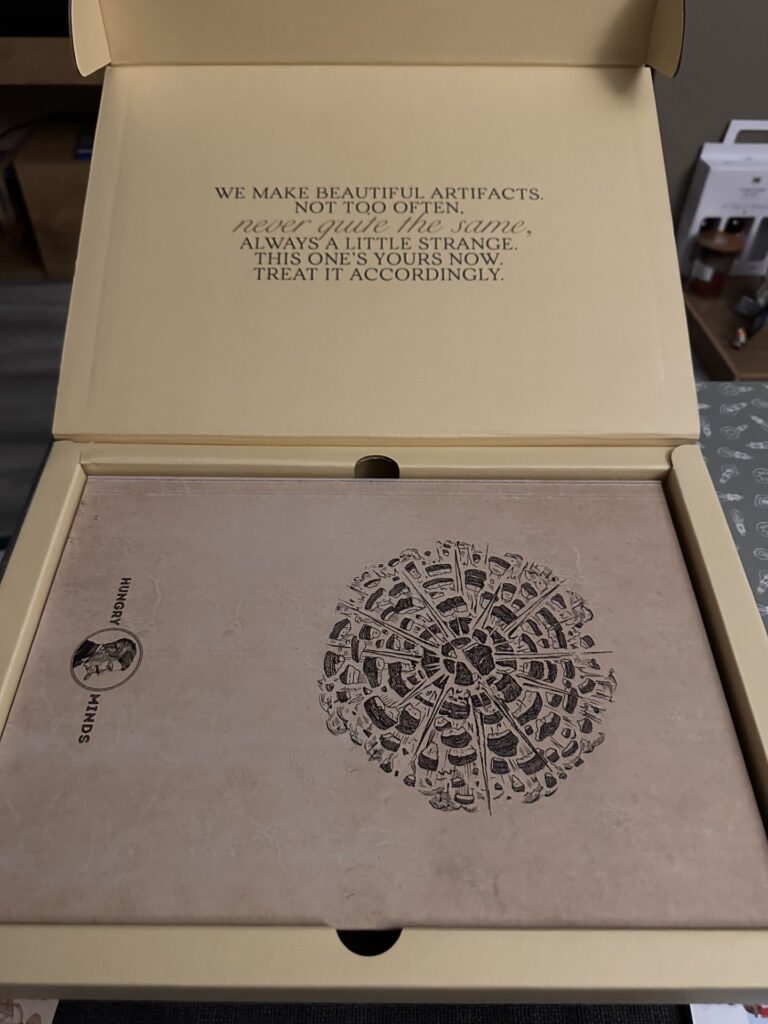
This is no novel, not just because it’s physically a large book which would not look out of place on a coffee table. Rather than guiding you through a traditional plot, the book drops you into the drifting mind of Noah Kaplan, supposedly the last surviving human, as he attempts to catalogue everything worth remembering about a species that is already gone — his own.
The premise sounds bleak, aggressively so. I don’t know how you or I would react if I had seen the destruction of my home world, but this is a book built on warmth, curiosity and that stubborn impulse we have to find meaning in what has been, even when there is no one left to read it.
The Last Book takes place on an alien spaceship that has grabbed Noah just as the earth was destroyed. This takes a certain level of inspiration, which is voiced by Noah, from The Hitchhikers Guide to the Galaxy and the reluctant adventures of Arthur Dent. When I began to read The Last Book I was quickly reminded of New York Collapse: A Survival Guide to Urban Disaster, which was a tie in survival book to The Division videogame. It had a damaged exterior and was a genuine book about survival in New York in the event of a disaster, but had notes and puzzles scribbled left by a survivor in its margins. The Last Book feels like that, only what would have been written if a survivor, who happened to be an artist, had some of his art supplies on him, and a mostly empty notebook that his therapist had told him to complete, complete with some ripped out pages and a damaged cover.
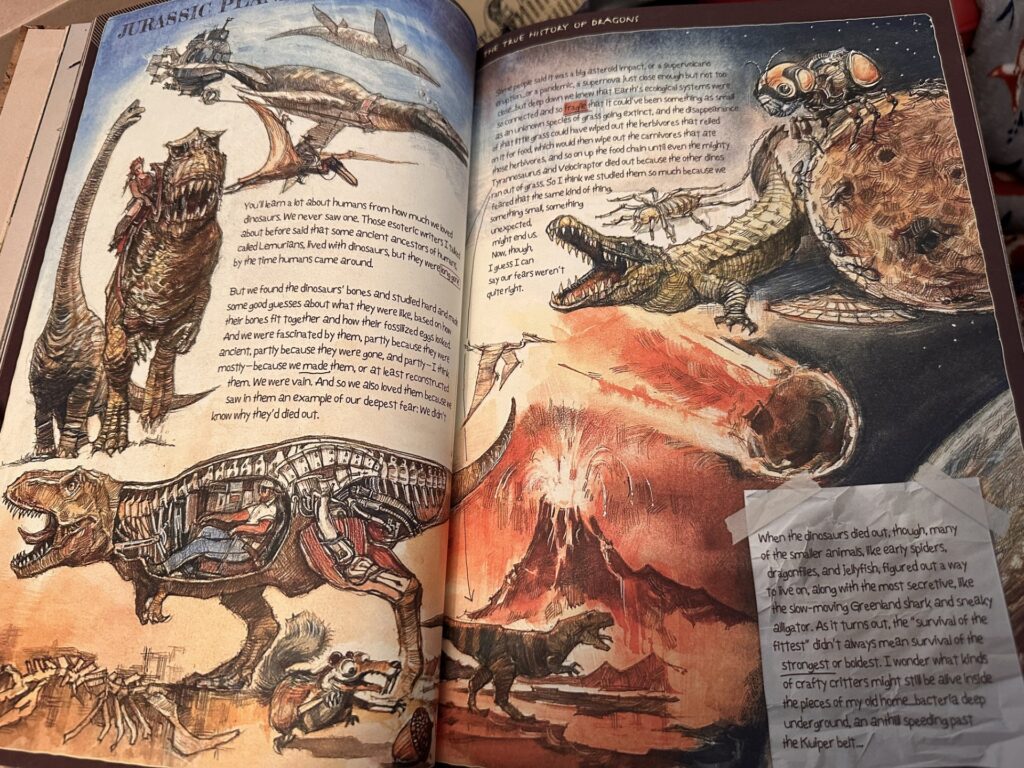
Physically, the book is gorgeous. It’s big, heavy and illustrated breathtakingly. It’s a sort of scrapbook where memories, sketches, notes, myths, diagrams and cultural leftovers sit side by side in chaotic harmony. The Last Book is a world building compendium that looks very much like it was assembled on the floor of an escape pod using whatever Noah had on him, which luckily seems like a lot.
Each page feels personal. Some entries are funny, others are quietly devastating, and many sit in an uncanny place between nostalgia and alienation. The book starts off trying to work out where Noah is, and his exploration of his new space, and then starts to become an outlet for his growing crippling loneliness. Even for those of us who are happy when in our own company, when isolation is imposed on us, it can be devastating. And with no forms of entertainment other than what you can make yourself, what would you do?
The illustrations are the standout champion of The Last Book. They are surreal, vibrant, and often weird, in the best way. I really got the feeling that Noah was desperately trying to remember how humans used to feel, and the art reflects that, half memory and half invention.
What The Last Book does better than most, is capture the emotional heaviness of remembering alone. Noah’s voice drifts between archivist, philosopher and lonely wanderer, and while the book doesn’t lean hard into character development, it doesn’t need to. The gaps, omissions, and odd fixations in his archive, tell you everything you need to know about him.
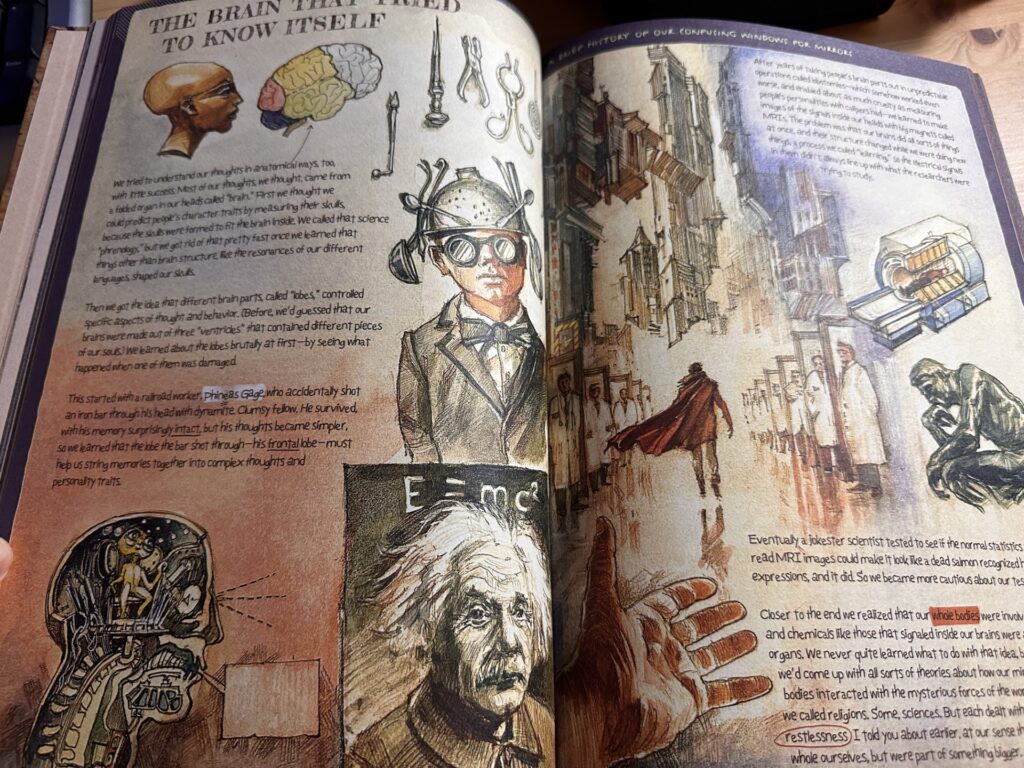
I found it fascinating that this encyclopaedia of humanity is irresistibly biased. But Noah calls that out. He points out that he cannot remember everything and that there are many parts of the world and its knowledge that he just doesn’t know. It does a very good effort at trying to give accounts of eastern myths, legends, religions and even food, when the book is meant to be coming from the perspective of a person raised in New York.
This is the book’s charm, it’s not the definitive record of humanity. It’s Noah’s record. And Noah, like the rest of us, remembers unevenly.
You don’t read The Last Book from start to finish. You graze. You start at the beginning to get the foundation of why he is there, and then from then on you will choose a page at random, sit with it, flip to a page that could contradict or amplify that previous page, and then you jump again. It’s quiet, contemplative, sometimes melancholy, but always visually rewarding.
Long reading sessions are not ideal. The book is physically too dense, too lovingly cluttered, and too intentionally overwhelming. But in short bursts, it shines. Each page is a little campfire for you and the last earthling to huddle round.
The Last Book – The Diary of the Last Earthling is less of a narrative and more an experience. A beautifully crafted relic from a world that, in a way, never existed, but feels intimately familiar. Its few flaws are part of its texture, what it misses are a part of its story. If you enjoy books that reward slow exploration, visual immersion and reflective storytelling, this is absolutely worth sinking into. If you’re interested in learning more, you can find out more about it on the creator’s website.
