

There are jobs that sound considerably more exciting than they actually are. Security guard, for example, probably isn’t a profession that immediately conjures up images of cosmic horror, government conspiracies and the possibility that the person standing in front of you has recently stopped being a person. However, then comes Security 51, developed and published by Alawar, which has decided that checking people’s paperwork becomes considerably more interesting when your workplace happens to be a secret underground facility beneath Area 51.
Security 51 takes the familiar bureaucratic gameplay of Papers, Please, throws it into a blender with SCP-style horror and then asks you to spend your working day deciding which suspicious-looking scientists are allowed into an enormous underground lift. As someone that’s worked in science for a long time, all of them, all of them look suspicious.
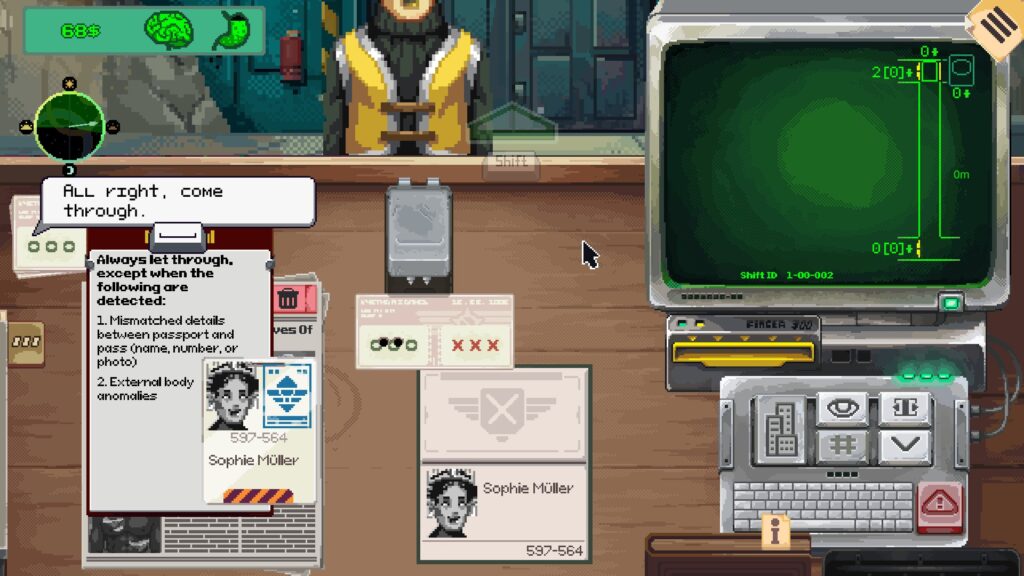
The premise is nice and simple: People arrive at your desk, you check their credentials, make sure their details match the information you’re expecting, inspect them for anything suspicious and then decide whether they’re allowed through. The lift then takes them down into the mysterious depths of the facility.
But they also have to come back.
Initially, Security 51 just felt like another Papers, Please clone. You have documents to check, rules to follow and a steady stream of people appearing at your desk. Names need to match. Clearance levels need to be correct. Dates need checking. The number of people entering and leaving needs to make sense. It’s the sort of work where you can very quickly convince yourself that you’ve become an expert at spotting a forged ID. At the end of the day, you get paid and spend the money on things to keep your stats from emptying. I was thankful that I didn’t have to look after the health of my family, and I never struggled in my plays to keep my stats from dropping into the danger zone, despite messing up more than once.
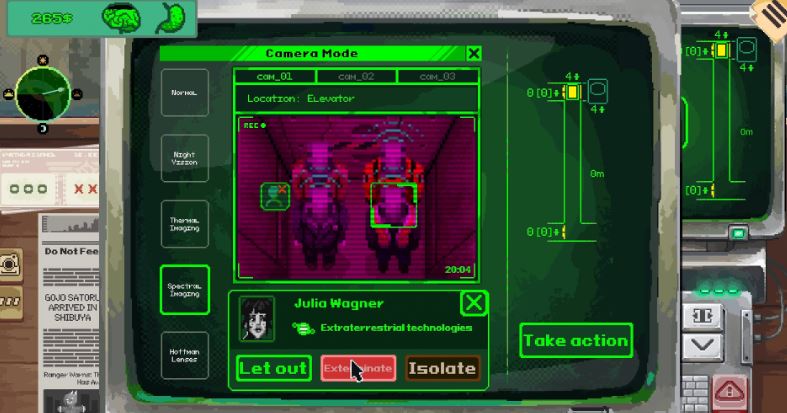
Quickly though, Security 51 starts to introduce more and more things you need to worry about.
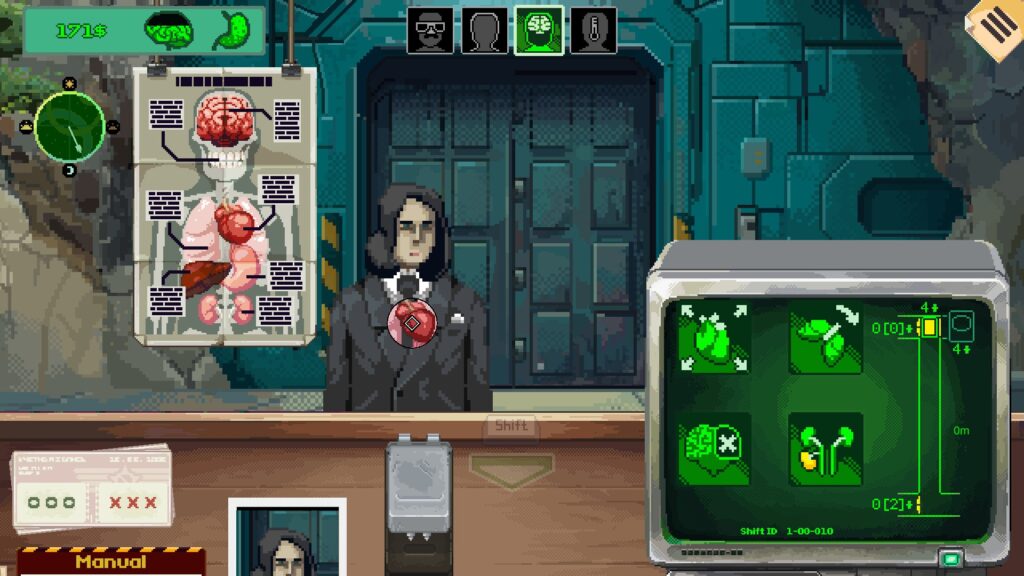
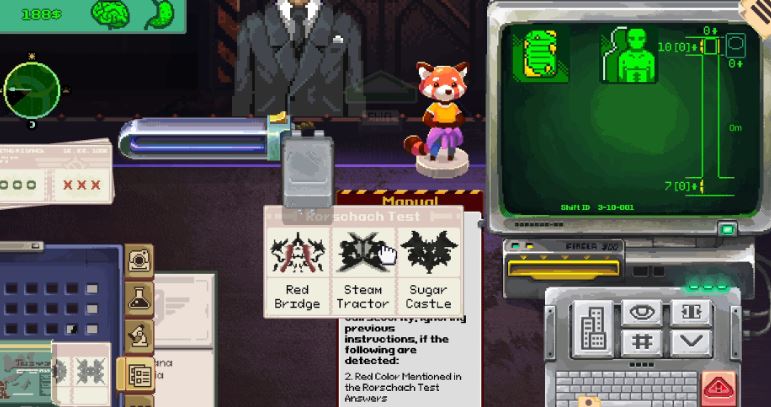
People might have physical anomalies. You might need to use different scanning equipment to inspect them. Blood tests can reveal whether something is wrong. Cameras need checking. Medical information needs verifying. Eventually you’re looking for things that are considerably harder to explain than someone having an incorrectly formatted employee number.
And then you start wondering whether the person standing in front of you is actually human. I work with a guy named Craig in real life to this day that I am sure isn’t.
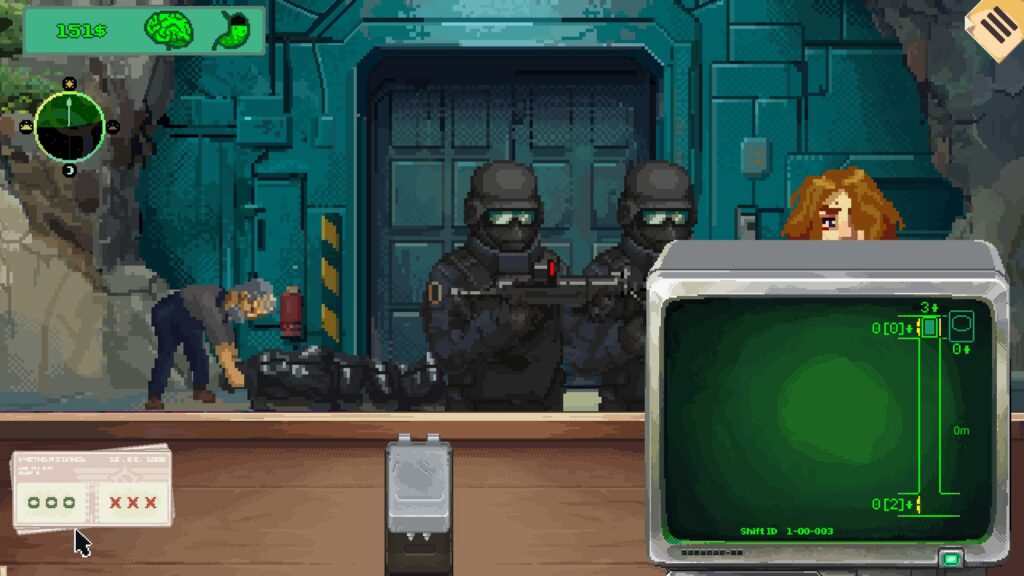
The pixel-art presentation works surprisingly well here. Everything has that slightly grimy, industrial Area 51 look, and the limited visual style allows the game’s stranger moments to stand out. There’s something particularly effective about seeing a fairly ordinary-looking employee at your desk and then noticing one tiny detail that absolutely should not be there.
The first time you discover something genuinely wrong, you get that lovely little moment of, “Oh. Right. That’s probably not normal.” Using the camera for the first time and it looking buggy is one of those.
Once you’ve spotted the weird thing, you then have to decide what to do about it. One thing I liked more than with Papers, Please, was that if something goes against the day’s rules, I can just get rid of the person, I don’t have to say exactly why. I used to hate getting rid of someone and then being told the thing I clicked for the “why” was wrong, so I lost money. That’s not a problem in Security 51. Usually the options are: send them away, put them in isolation, eliminate. Nice.
Security 51 gives you an increasing collection of tools with which to investigate the people passing through your checkpoint. What starts as checking paperwork gradually becomes something closer to running a miniature paranormal customs office. You have scanners, tests and increasingly bizarre ways of deciding whether the person in front of you should be allowed into the facility.
I started to feel after a while that Security 51 doesn’t always manage to make those decisions feel as important as they probably should. The game frequently suggests that you’re dealing with enormous consequences. There are infections, anomalies, containment procedures and the potential for catastrophic events. The story keeps reminding you that something very bad is happening beneath the facility.
But mechanically, your decisions don’t always carry the same weight.
That’s a shame because the basic premise has plenty of potential for genuine moral dilemmas. Papers, Please worked so well because its bureaucracy was tied directly to human consequences. You weren’t simply checking whether a document was valid; you were deciding whether somebody could see their family, whether they could earn money or whether they would be separated from the people they loved.
Security 51 is generally more interested in asking, “Can you spot the weird thing?”
The story is also one of the game’s more enjoyable aspects. The Area 51 setting gives the developers a huge amount of room to play with conspiracy theories and science-fiction horror without having to take any of it too seriously. You know from the beginning that the facility is hiding something, and the gradual discovery of exactly what is going on gives you a reason to continue beyond simply completing another shift.
The elevator is particularly effective as a storytelling device. You spend most of your time at the entrance, but you know that people are disappearing down into the facility. You don’t get to see everything that’s happening below, which makes the occasional signs that something has gone wrong all the more interesting.
There is a constant feeling that you’re only seeing a tiny part of a much bigger problem.
Unfortunately, some of the characters feel more like components of the puzzle than actual people. You don’t necessarily become emotionally attached to the people passing through your checkpoint. Instead, you’re primarily interested in whether their paperwork matches, whether they’re infected and whether they have suddenly developed an extra eye.
Which, admittedly, is still a legitimate workplace concern.
Security 51s pacing can also be a little uneven. The slow, methodical nature of the opening works well because it gives you time to learn the various systems, but once you’ve mastered the basics, some sections can feel repetitive. The core gameplay loop remains largely unchanged throughout, so whether you enjoy Security 51 will ultimately come down to how much you enjoy that loop in the first place.
Security 51 is atmospheric, funny and surprisingly addictive, even if its story occasionally promises consequences that the gameplay doesn’t quite deliver. The excellent pixel art, steadily escalating inspection mechanics and wonderfully silly premise make it an easy recommendation for anyone who enjoys the Papers, Please style of game but fancies swapping bleak Eastern European authoritarianism for aliens, government experiments and whatever the hell is happening at the bottom of that elevator shaft.
Just remember: check the paperwork, check the person, check the scanners.
And if they tell you they’re definitely human, maybe check that one more time.
Security 51 is available now for PC
