

When I first opened up Parks (Second Edition), the first thing that struck me — as with the original — was the incredible presentation and build quality. This is still a small box with a beautiful cover, but once you lift the lid, Parks expands to show off a fabulous Gametrayz insert, some gorgeous wooden hiker meeples and several decks of cards — including the breath-taking parks deck itself, which features some of the finest artwork you’ll see in any game.
Parks (Second Edition) doesn’t mess with this winning formula, but it does refine it — transforming the artwork and adding elements from the Night expansion whilst almost eradicating the ideas from the Wildlife one. In addition, the insert has been tweaked slightly to better accommodate sleeved cards, and the rulebook has been restructured for clarity — a small but welcome change that makes the game even more accessible.
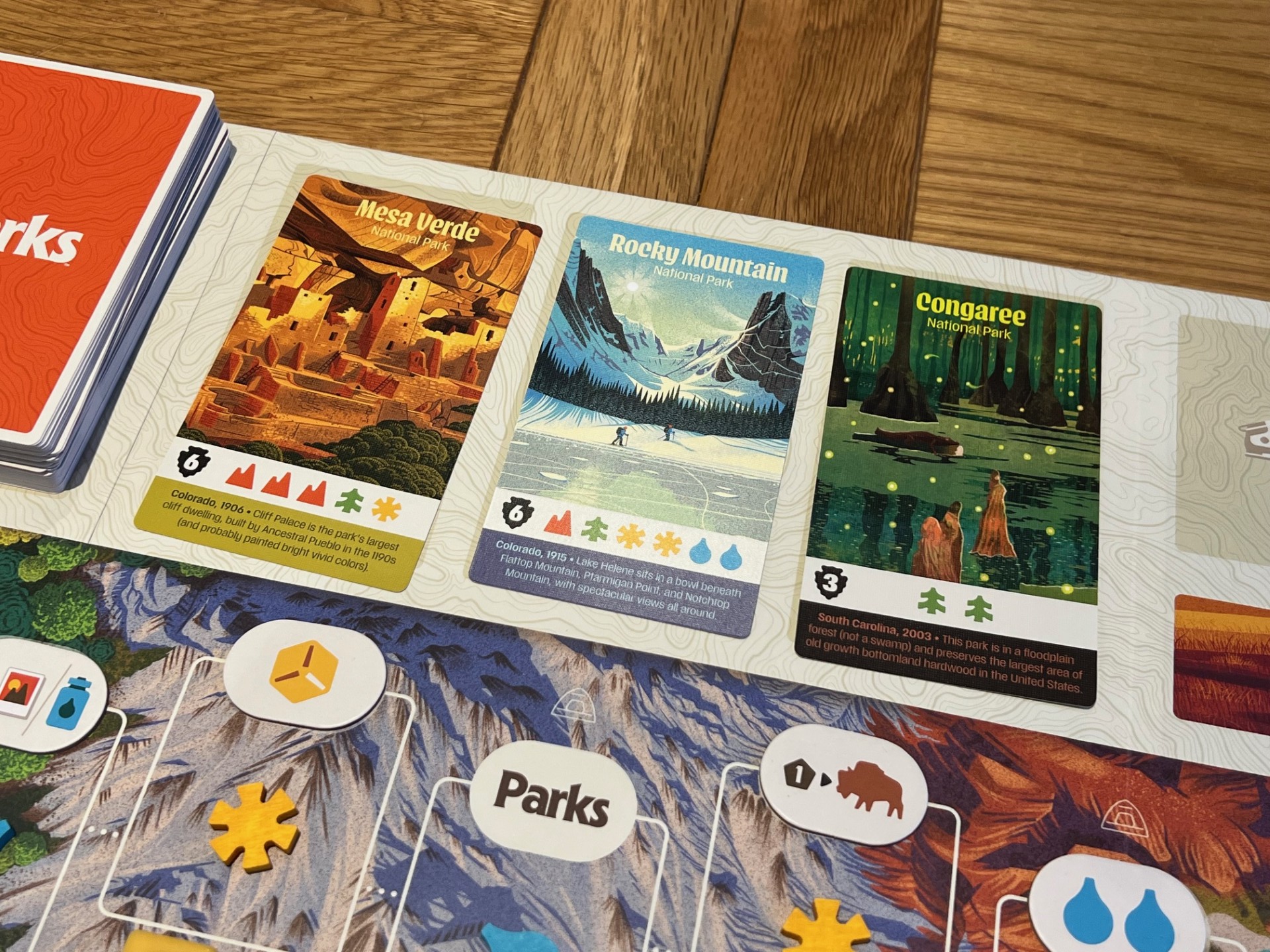
Parks (Second Edition) is still deceptively simple despite a few expansion elements creeping in. The basic gameplay loop revolves around collecting resources — water, trees, sun, mountains, and wildlife (which act as wild resources) — and then converting them into points by fulfilling the requirements on the Park cards.
The realisation that the beautiful construct of Parks is simply a resource conversion engine might feel a little underwhelming at first, but once you actually get into playing Parks, you realise that the gameplay has a lot more to it — including some of the “skipping ahead for some reason” type decisions that you’ll find in rondel games, and also decisions about when to invest in optimising your engine instead of purchasing park cards directly.
The objective remains straightforward — after four seasons of hiking, the player with the highest points total across their parks cards, the photos they’ve taken, and any other source (such as the first player token, which can be claimed at the end of a season’s hiking) will win.
Again, this objective may seem simple, but some small, subtle rules make it more than the sum of its parts. Among those other point sources, every player has a Passion (objective) card (which might be to visit a lot of woodland parks, or to take a certain number of pictures) that can turn the tide, whilst one player at the table always has a shutterbug token, allowing them to take additional photos and eek out an advantage.
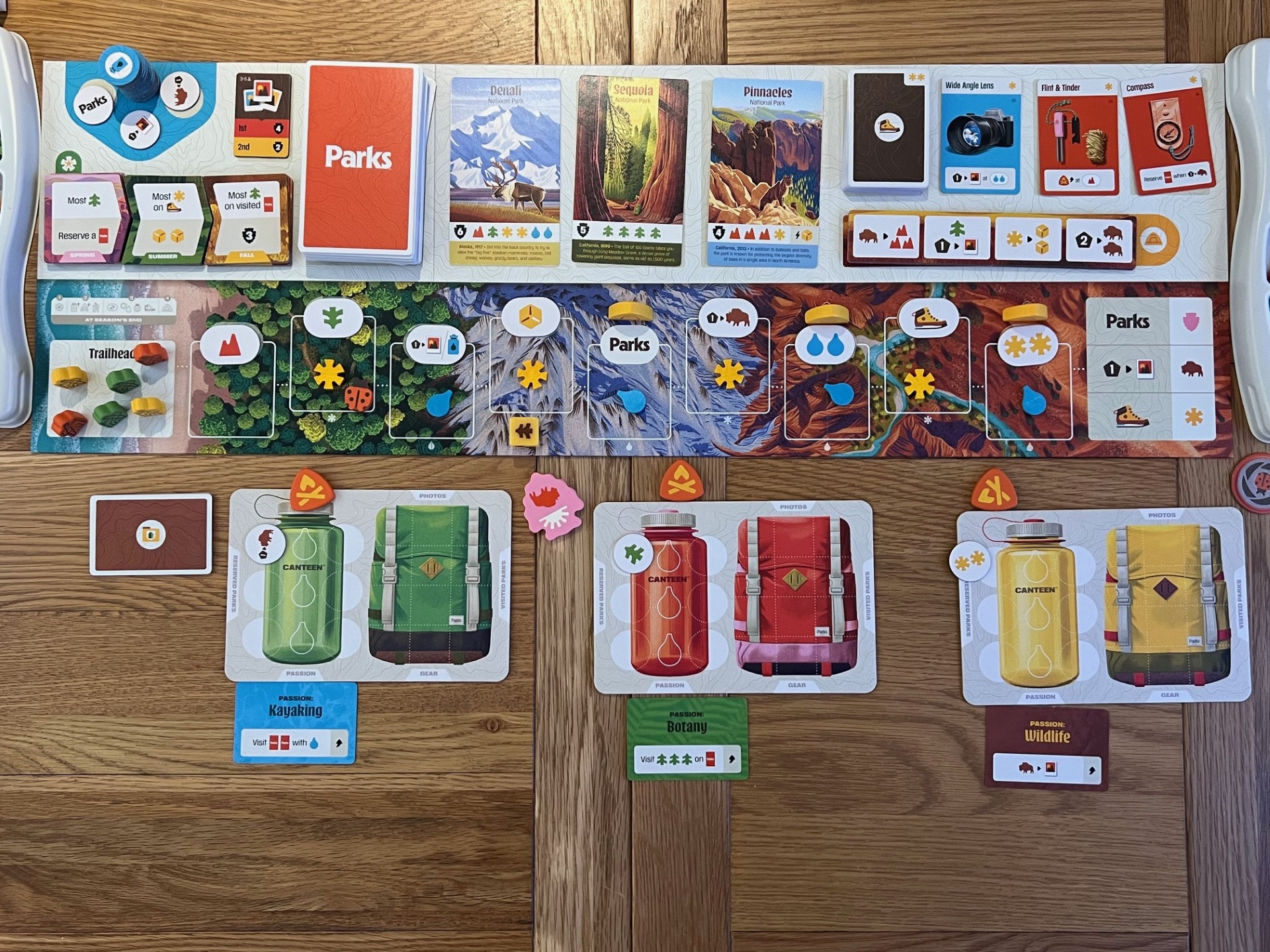
The actual turn structure supports this simple-but-complex approach. Each season, a board is created randomly to feature a number of tiles (increasing by one each season) that are laid out from left to right. Each player has two hikers in their colour that begin on the leftmost space, and must move one of them to any space to the right.
The exception is that if another hiker (even their own) is on a space they want to go to, then they must flip their campfire to its “burned out” side. This means that you’ll often have to skip spaces you want if someone else has already got there, and it means that the board feels extremely tight — especially when you consider that there can be as few as six spaces on it.
Each space has a bonus, usually in the form of a resource. For example, two water tokens or one forest might be printed on a given space. Upon landing there, a player will simply take that resource to add to their supply (which is limited to twelve tokens.) There are also some randomly generated tokens added to most tiles at the start of each season based on a weather card, and once taken (by the first player to land there) they will not be replenished.
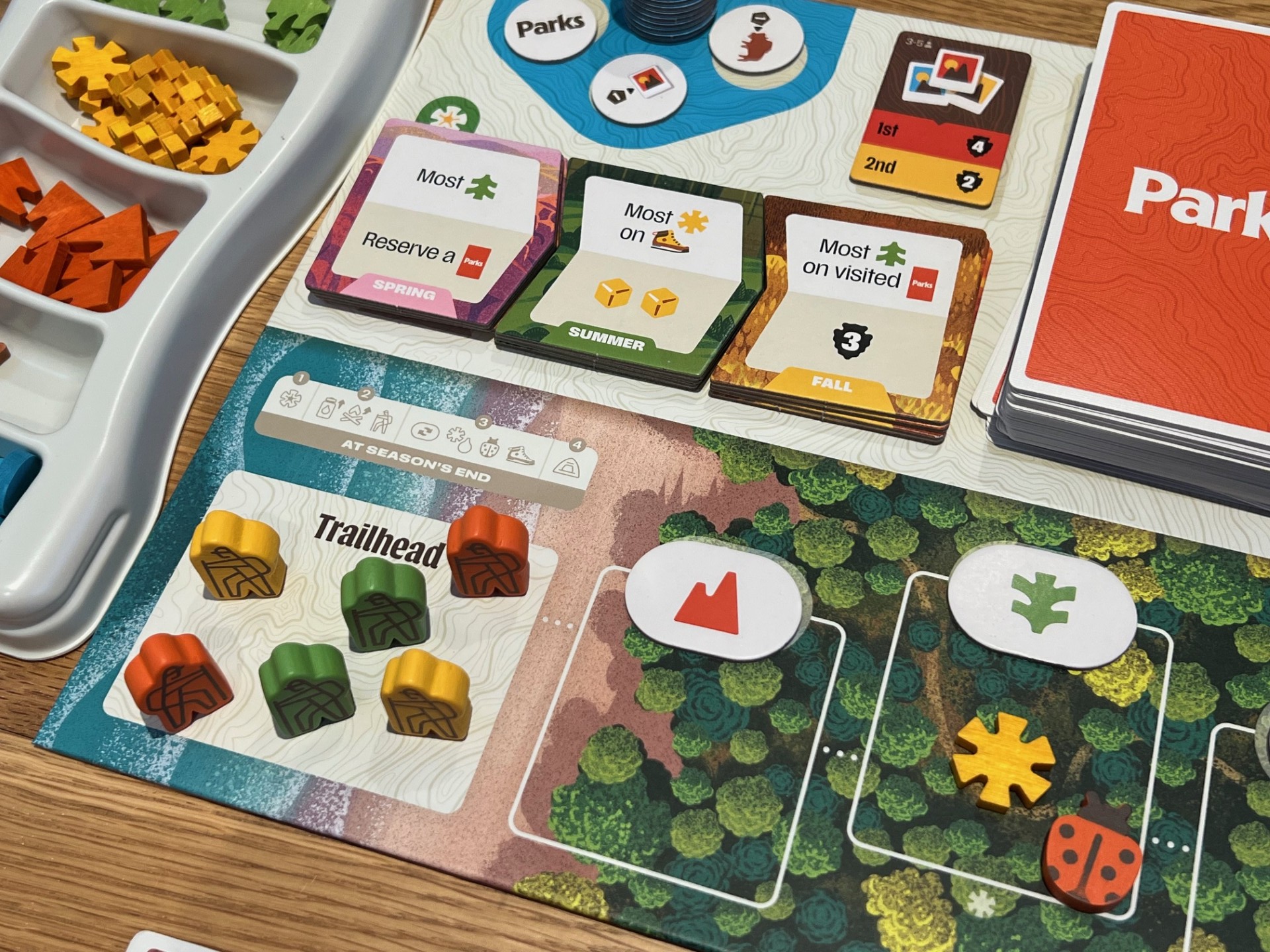
Other (advanced) spaces are introduced each season, with the players able to take pictures, convert resources, and do other “unusual” things. A new advanced tile is added each season, making the final round the longest (theoretically) because it has three more tiles than the first season, even though a player can still skip through to force the end of the game.
When a hiker reaches the end of the trail, they will be placed onto one of the three rows of options — the first allowing them to take the first player token with immediate effect, the second allowing them to buy gear (potentially at a discount), or to reserve or visit a Park card. To reserve a Park card, all you need to do is say so, then add it to your tableau — it doesn’t score at this point, but you can then be safe that no one else can visit it before you.
If you have the supplies needed to visit any park (reserved or not), you may pay them to do so at this point, adding that card to your supply in a separate pile — to ensure you don’t mix the visited Parks up with the reserved ones. I should also mention that if all but one hiker has made it to the end, the last one will have to skip any further turns and jump right to the end as well.
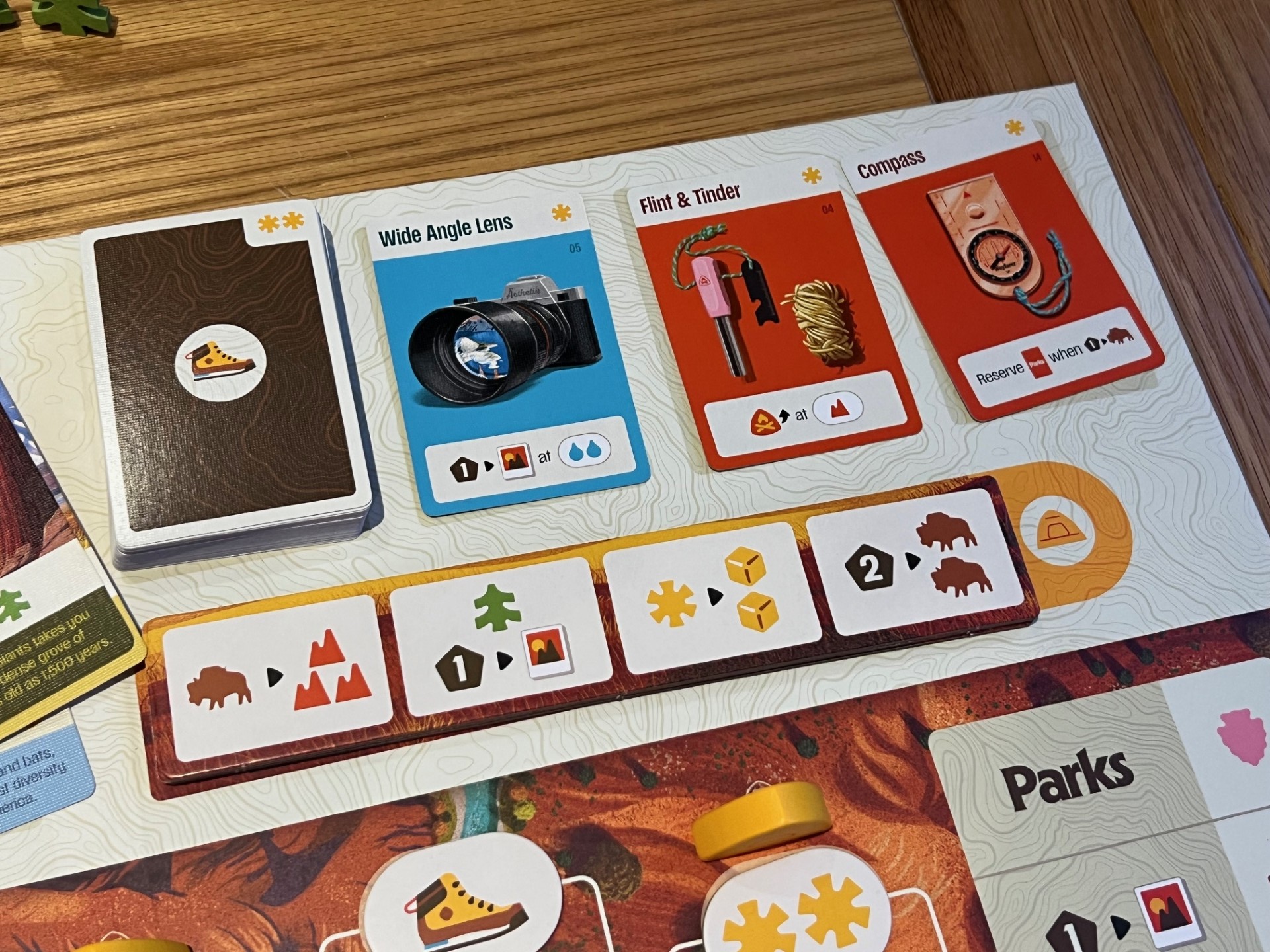
There are a few other interesting things that make Parks (Second Edition) a lot more than just a resource conversion game (although that is still what it is at the core). These include the ability to buy gear that can make Park visits easier, or which can link to another minor feature — that of Canteens. Gear is purchased with sun tokens and will generally have a decent passive effect (such as allowing a Park visit for one fewer mountain tokens), whilst Canteens come from a separate deck and give an immediate benefit when filled with water.
Water, as I mentioned earlier, is one of the game resources, but at the time you collect it (or with a water bottle gear item), you can fill a canteen instead of adding the water to your supply to get the printed benefit. For example, a canteen filled with one water token might repay you with two mountain tokens.
The Second Edition makes a few subtle but meaningful changes to these systems. The gear deck has been rebalanced slightly, with some cards removed and others added to improve variety and reduce redundancy. The wildlife token distribution has also been tweaked to make them slightly more accessible, which helps smooth out some of the more frustrating moments in the original game when you were just one wild short of a perfect turn.
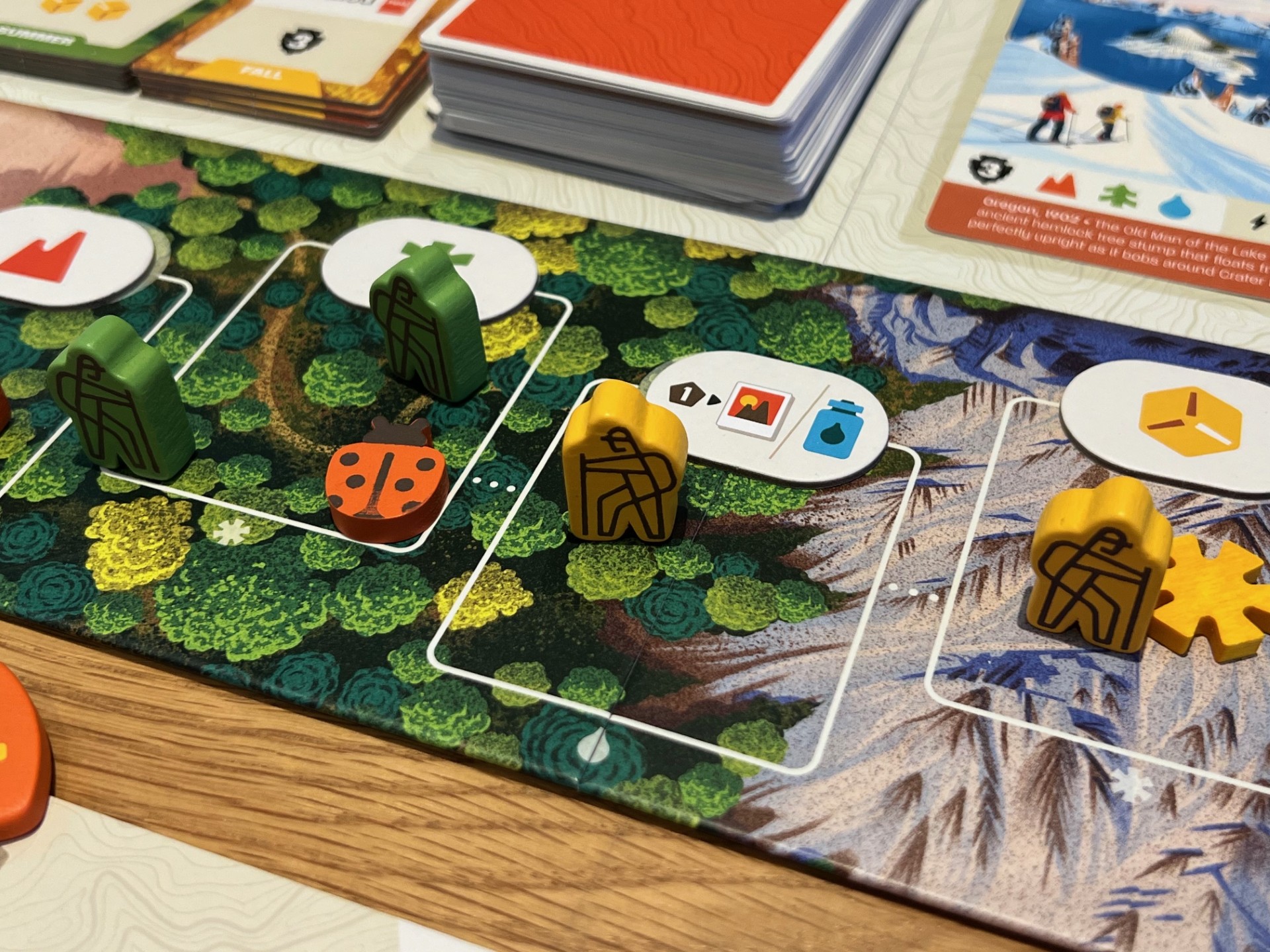
All of this comes together to give Parks (Second Edition) a pretty relaxed and breezy kind of gameplay that just occasionally creates minor contention in the form of competition for spaces that are either obviously powerful or which you can see an opponent wants to visit.
A small and simple tableau or engine-building addition bolts on, with combos between Gear and Canteen cards very possible, and other factors like the first player and camera tokens adding a light dusting of additional complexity. The beautiful artwork and relaxing setting do no harm either, and Parks always results in lots of close examination of cards and people admiring what is included in the box.
Overall, it isn’t revolutionary, but it’s a small and modest box that contains a beautiful game both in terms of aesthetics and gameplay. It’s simple enough to learn quickly, but it has enough additional complexity to attract hobby gamers as well as novices.
Most importantly, fans of the setting — walking in national parks and hiking in general — should find the steady, relaxing gameplay of Parks (Second Edition) a real pleasure, and a pleasant reflection of their own love of the great outdoors. It doesn’t reinvent the wheel, but it does smooth the path — and for a game about hiking, that feels just right.
Parks (Second Edition) is available now from Zatu Games.

Comments are closed.