

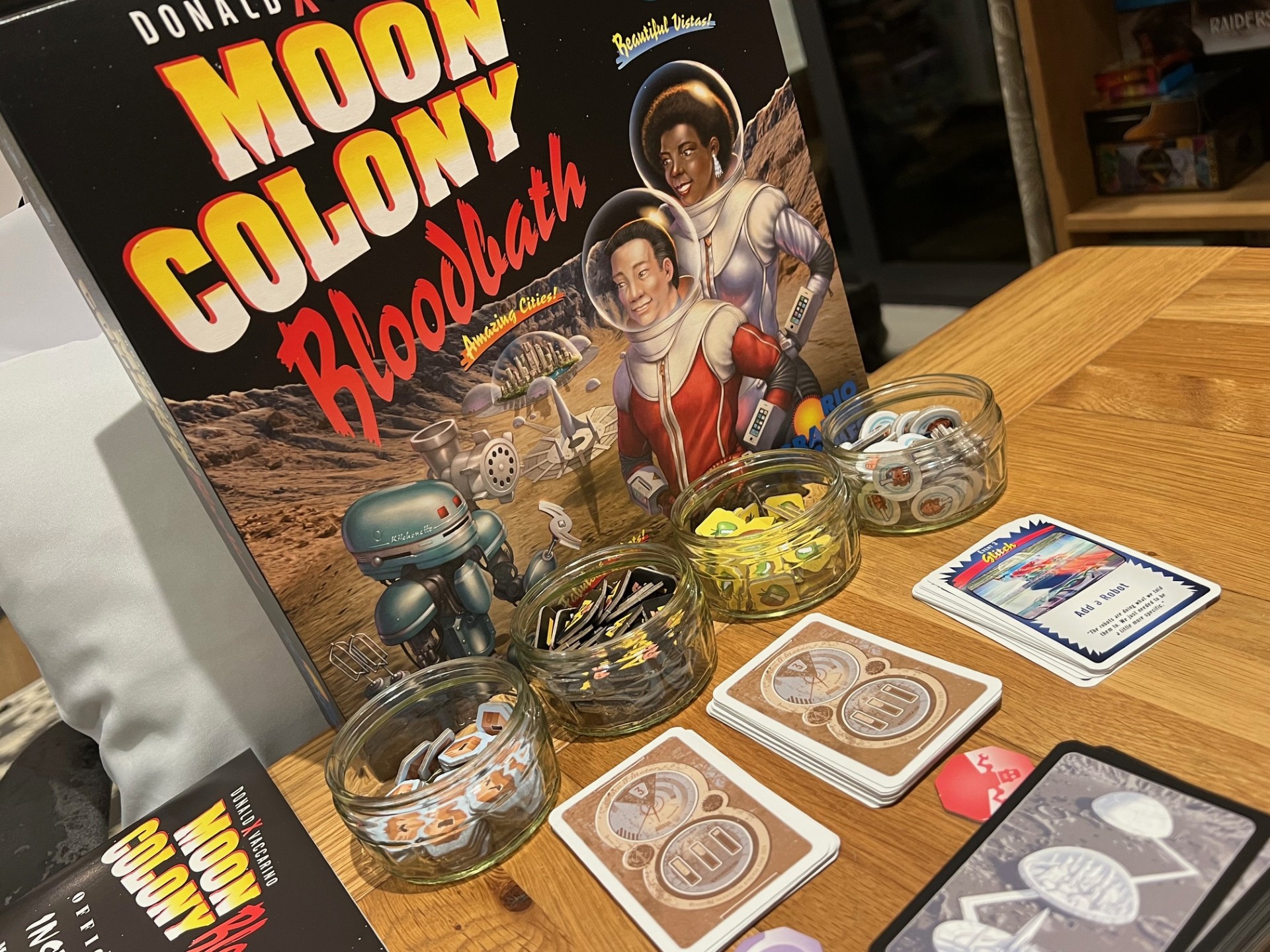
Moon Colony Bloodbath, designed by Donald X. Vaccharino and published by Rio Grande Games, is a tableau-building and deck-destruction game that thrives on its clever arc of play, tongue-in-cheek retro-futuristic art style, and the way it makes players feel both confident and doomed in equal measure. It can be taught in minutes, played in under an hour, yet delivers big decisions, laughs, and a surprising amount of tension.
The setting is immediately striking, without being entirely new. Retro-futuristic in tone, Moon Colony Bloodbath imagines a future where humans live on the moon assisted by robots. Each player takes on the role of a doctor placed in charge of developing their own party of the fledgling titular moon colony.
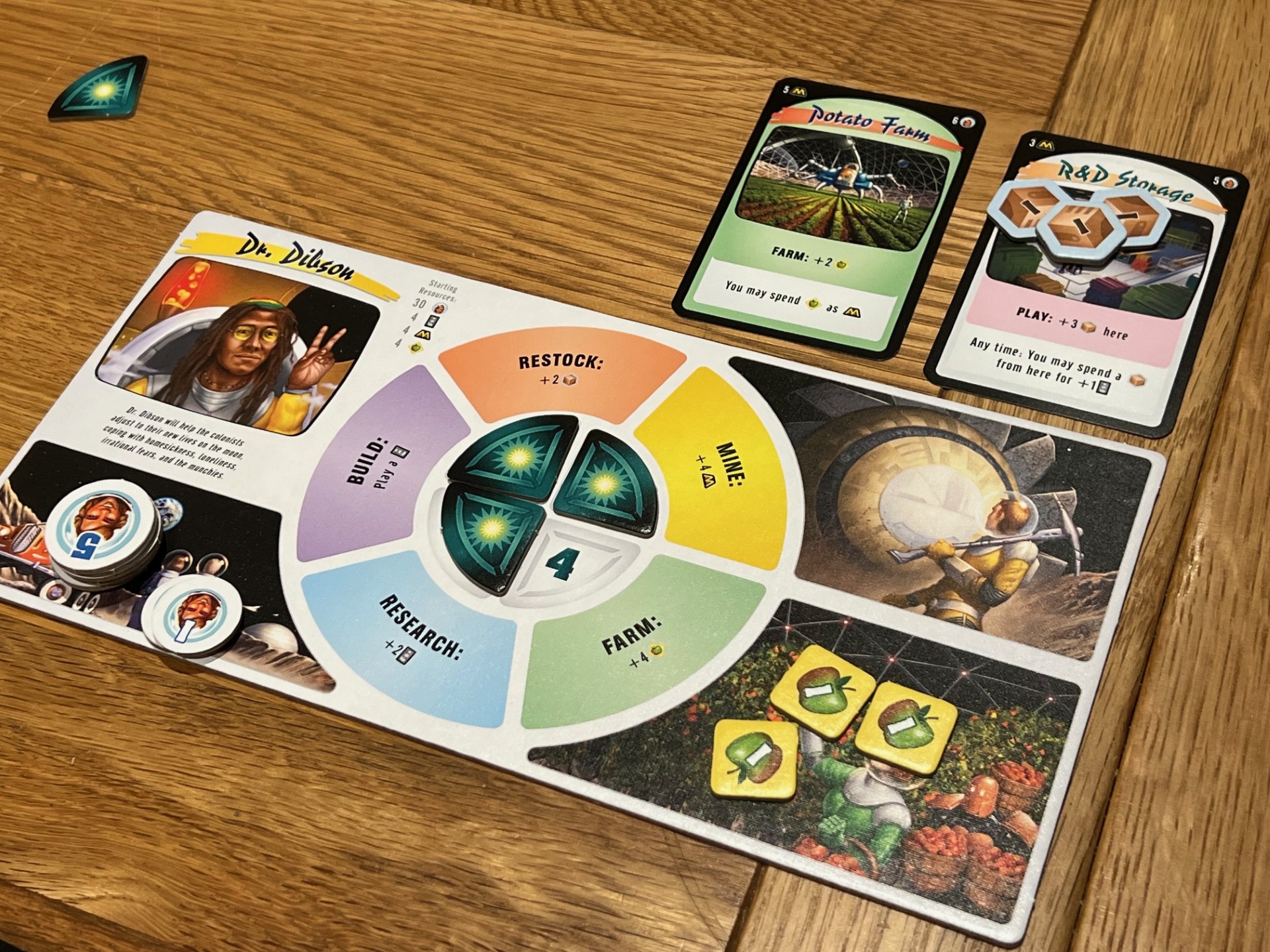
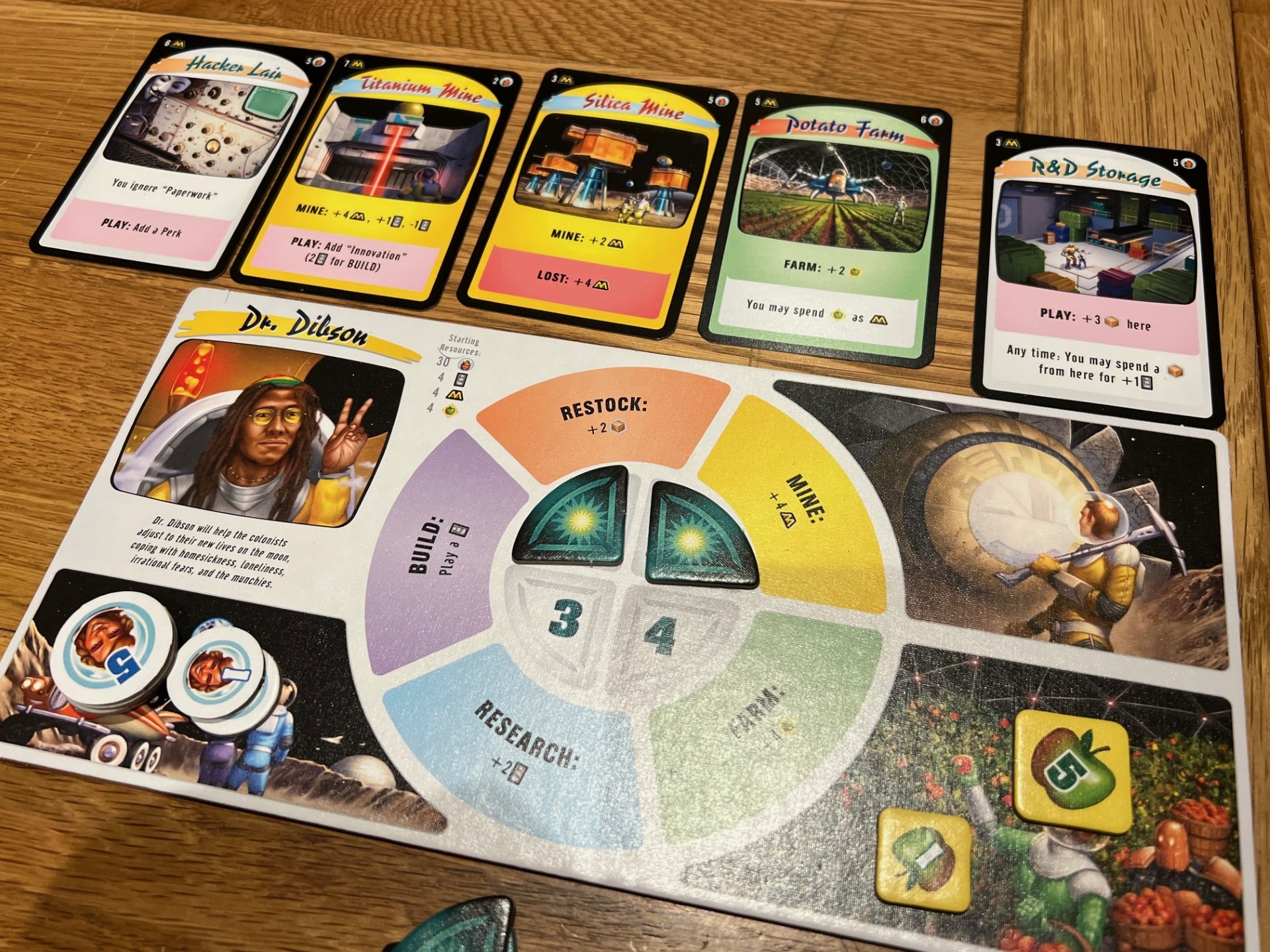
These doctors are colorful characters with distinct personalities, although they are functionally identical, with no asymmetry in setup. The player boards are cleverly designed, doubling as both storage and player aid, with the five core actions laid out clearly: Build, Research, Farm, Mine, and Restock. This makes Moon Colony Bloodbath easy to teach and quick to grasp, while still offering the depth of gameplay (albeit fairly tactical) that players have come to love.
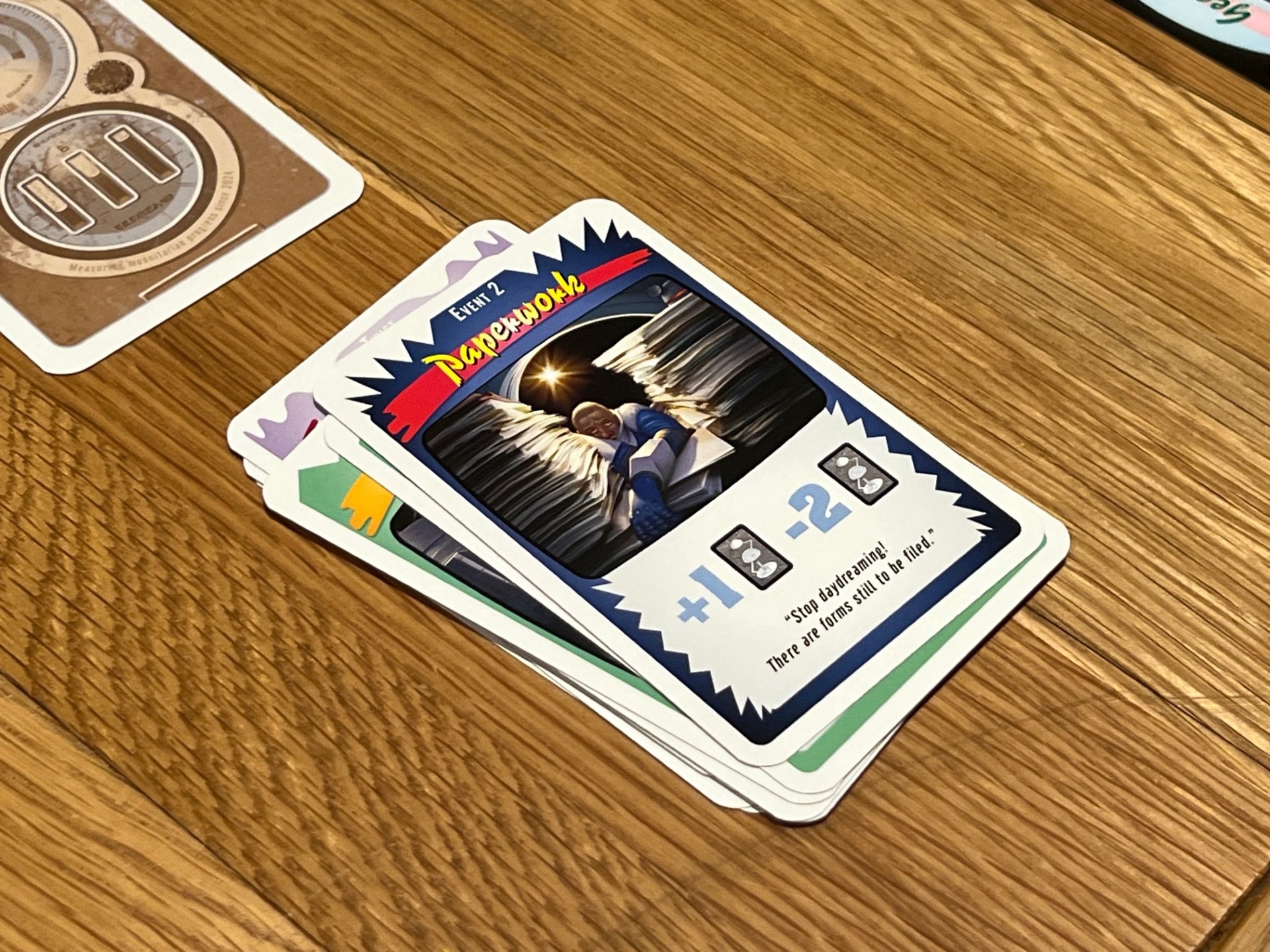
Play is driven by a single, shared deck of cards seeded initially with four work cards, two trouble cards, and two twist cards. These cards are drawn one by one, with players taking turns based on whatever card is revealed. Work cards allow players to choose one of the five standard actions, trouble cards escalate the game by adding the next card from the trouble deck face down to the top of the shared deck, and twist cards shake up the rhythm of play. The trouble deck is always played in the same order, beginning with event number one and ending, if needed, with event number thirteen. More often than not, Moon Colony Bloodbath ends long before the thirteenth trouble card is added.
The main currency is population. If any player ever loses all their population, the game ends immediately, and whoever has the most remaining population wins. Population is represented as tokens, but when tokens run out, players begin converting buildings into more population, based on a value printed in the top right corner. This means that beneficial effects you’ve been relying on (extra food, extra money and enhanced actions) start to dwindle.
The shared deck never gets gentler, so the sense of decline is palpable. This mechanic forces players to weigh short-term survival against long-term efficiency. Do you sacrifice a production building now to keep your population alive, knowing you’ll lose its effect later, or gamble on surviving another round and sacrifice a building that perhaps produces fewer population, but doesn’t have an effect you might later rely upon?
The arc of play is what makes Moon Colony Bloodbath so clever. Early in the game, half the cards are work cards, meaning players can develop their colonies quickly. It feels good: you make money, gather food, and play development cards that enhance actions or provide immediate bonuses. Development cards serve multiple purposes, giving you effects such as more money when you farm or mine, or allowing you to add a personal perk card to the shared deck that only benefits you when drawn. This creates a sense of progress and ownership. In my first few plays, I felt clever and well-prepared, building up six to ten buildings and enjoying the benefits they provided.
But then the trouble cards start to pile up. Hunger forces you to spend food for every building you own. Accidents and leaks directly kill your population. Robots appear, killing colonists and occasionally adding further twists. The deck becomes increasingly hostile, and the sense of safety evaporates. The arc is brilliant because it mirrors the narrative: humanity builds confidently on the moon, only to discover that survival is fragile and collapse inevitable.
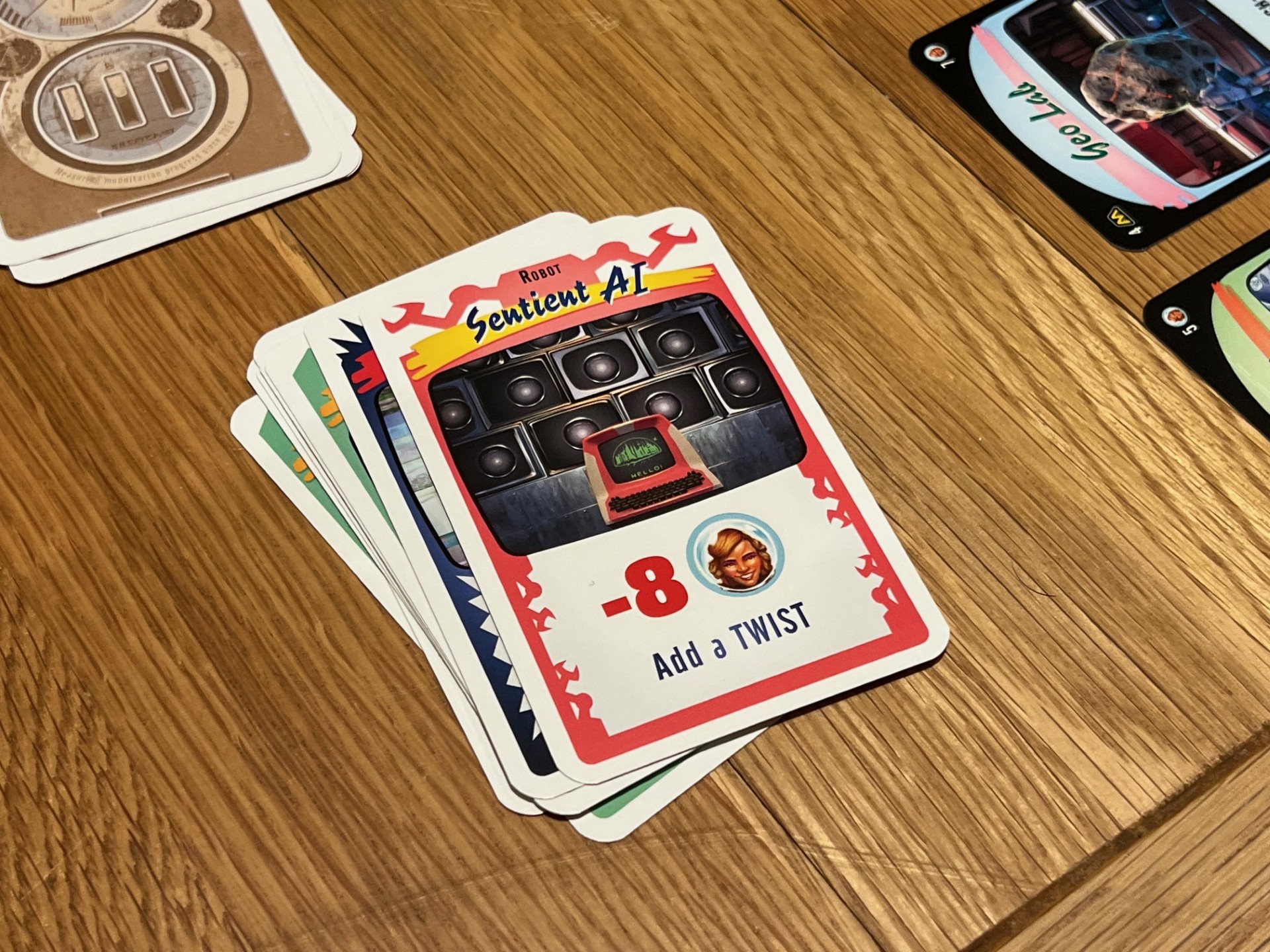
Despite the grim-sounding mechanics — starvation, accidents, robots killing colonists — Moon Colony Bloodbath never feels oppressively serious. The art style and playful tone keep things light. It’s macabre, yes, but in a way that invites laughter rather than despair. In one play, I watched as a friend’s colony collapsed spectacularly after a series of robot attacks. Instead of frustration, the table erupted in laughter. The game encourages this kind of response because it’s short, punchy, and designed to deliver big swings.
It’s impossible to discuss Moon Colony Bloodbath without mentioning Donald X. Vaccharino’s most famous design, Dominion. Where Dominion pioneered deck-building, Moon Colony Bloodbath plays with deck-destruction. The shared deck becomes increasingly hostile, and players must adapt to its escalating threats. Vaccharino understands how to create arcs of play that feel satisfying, and here he uses that skill to craft a game that begins with comfort and ends in chaos. It’s a clever inversion of the usual deck-building narrative, and it makes Moon Colony Bloodbath feel fresh even within familiar mechanics.
Replayability is decent, but the game does tend to play out the same way each time. The arc is consistent: early growth, mid-game pressure, late-game collapse. For me, this consistency makes the game cry out for expansions. Expansions could add asymmetry to the doctors, giving each one unique abilities or starting conditions. They could expand the options for development cards, introduce new trouble events, or add variety to the robots. As it stands, the game is a blast, but it feels like the foundation for something bigger.
One of Moon Colony Bloodbath’s greatest strengths is its accessibility. You can teach it in five minutes and play it in under an hour. Despite this brevity, it delivers big decisions and meaningful tension. This makes it ideal for both casual players and experienced gamers. For casual players, the simplicity of the rules and the humour of the theme make it approachable. For experienced gamers, the clever arc and the tough decisions provide depth.
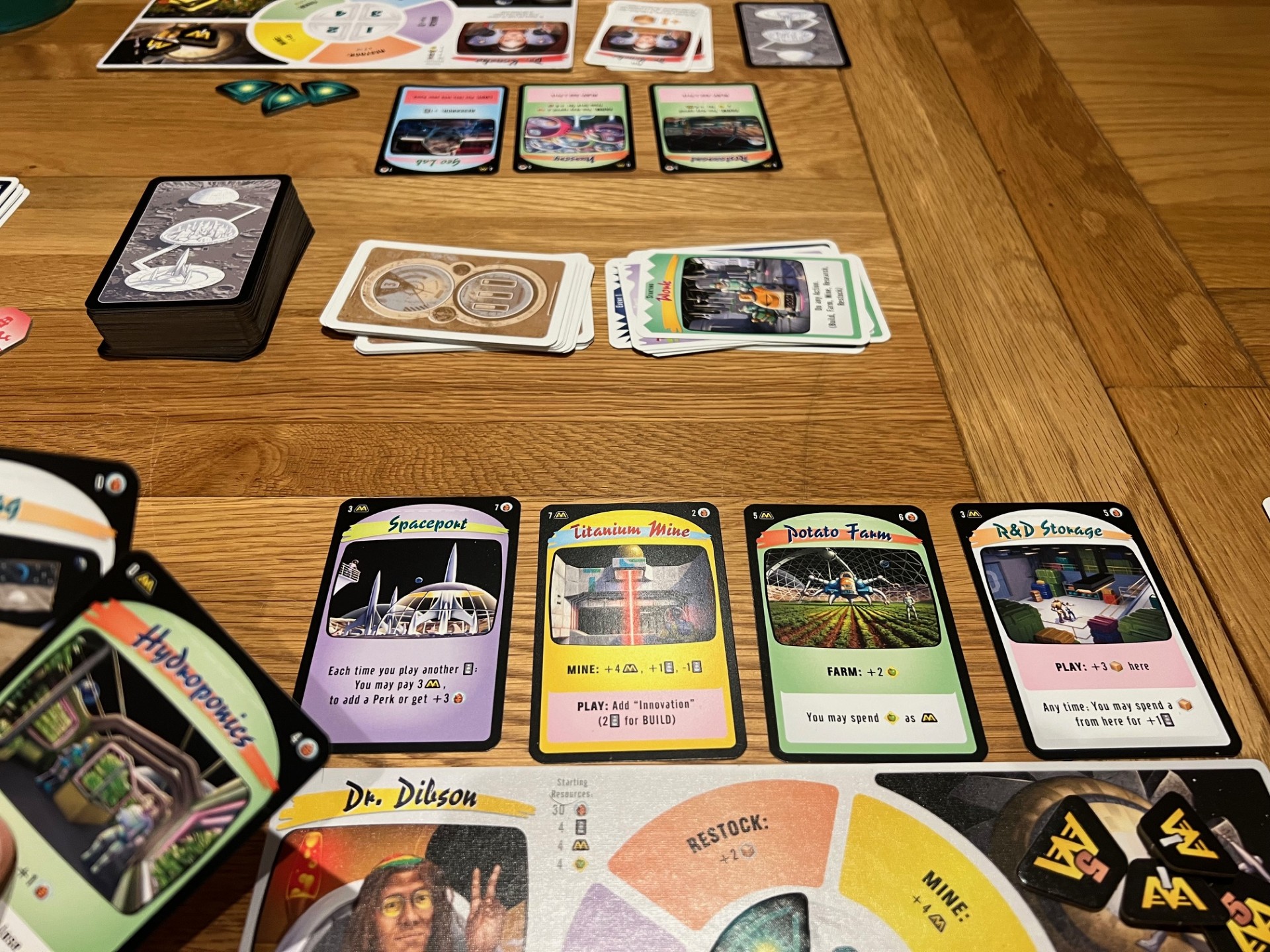
In my own plays, I found Moon Colony Bloodbath to be a game of contrasts. Early turns felt empowering, as I built up my colony and enjoyed the benefits of my development cards. Later turns felt desperate, as I scrambled to keep my population alive and sacrificed buildings I had grown attached to. One moment that stood out was when I had to convert my most powerful building into population to avoid elimination. It was a painful decision, but it kept me in the game, and ultimately led to my victory. That kind of tension is what makes Moon Colony Bloodbath memorable.
Moon Colony Bloodbath is a clever, confident design that delivers laughs, tension, and big decisions in under an hour. Its retro-futuristic art style and tongue-in-cheek tone keep the mood light, even as the mechanics depict starvation, accidents, and robot attacks. The arc of play — from comfort to chaos — is brilliantly executed, making players feel clever and safe before pulling the rug out from under them. While the game tends to play out the same way each time and cries out for expansions to add asymmetry and variety, it remains a blast. For me, the moments of quiet dread, desperate decisions, and sudden collapses made it a standout — a game that proves Donald X. Vaccharino still has plenty of tricks up his sleeve beyond Dominion.
Moon Colony Bloodbath is available now from Amazon

Comments are closed.