

The Lambada is a Brazilian dance where people bend their knees and make lots of small steps. Lambada is not about the dance, it’s instead about matching colours, getting rid of all of your cards and avoiding forbidden colours.
Bright colours and fun carnival-style designs are the main thematic ties between this fun and approachable card game, although at a stretch you could probably say that the idea of a Forbidden Colour ties into lambada’s nickname as The Forbidden Dance. However, the word itself is incredibly important to how Lambada plays because it includes the letter A three times, making it the most frequent and important letter (and card) in the game.
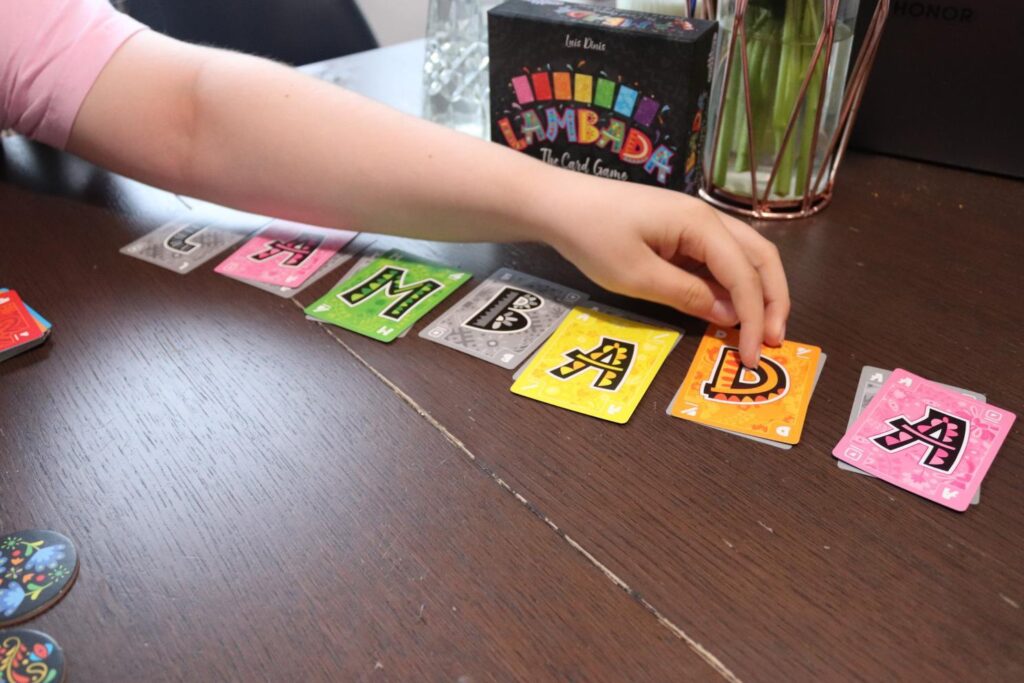
Lambada is incredibly simple, and it’s clever name choice means that it also feels incredibly minimalist — something that it would achieve if each of the places in it weren’t letters in the name, but instead arbitrary symbols or numbers. To play, you place out grey versions of each of the letters of the name, and then shuffle and distribute seven cards to each player. The remaining deck is placed face up, and two cards are played onto the grey cards.
A player turn is then incredibly simple, you place a coloured letter card from your hand over one of the letters of Lambada. If its the first iteration of the colour to be on the board, you draw a card and play moves to the next player. If you place a colour and it’s the fifth of that colour to be on the board, or you play a card which is the Forbidden Colour (the top facing colour on the deck) then you draw three cards and play moves to the next player. If, and this is how you win, you place a card that’s a colour that’s already out on the board, and it doesn’t break any of the rules above, then you also pass a card of your choosing from your hand to the next player. The first player to clear all of their cards wins.
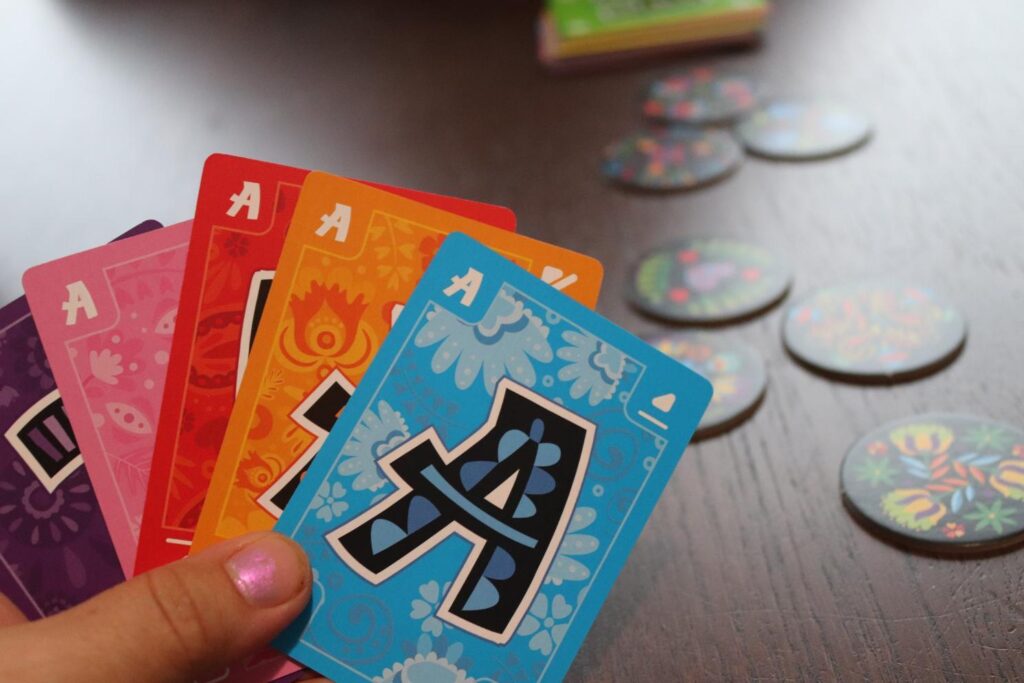
The fact that I can describe the entire player turn rules in one paragraph is telling of the simplicity of the rules. And, as I’m sure you might imagine, it makes for a quick (basically Uno-speed) game that can be prolonged or shortened by clever fudging of the next player’s turns through passing on forbidden or as-of-yet-unused cards. The fun thing about the top of the deck being the forbidden colour is that it’s incredibly dynamic and reactive to how play is going — it’s unlikely that two players will not be able to play in a row unless their hand is nearly out, keeping the tension high until the end. More tactical players will also, in longer games, be able to memorise what the next player along has, and there’s no rules against communication between players.
Lambada is a great little warm-up game, and one that increases in strategic options with familiarity.
Lambada is available now from Amazon.

Comments are closed.