

From developer Panik Arcade — a relative newcomer — CloverPit comes hot out of the gate and is already grabbing attention.
CloverPit is chasing two very loud modern trends. First, the ongoing roguelite renaissance that truly kicked off in the early 2010s with The Binding of Isaac and FTL, then roared into the mainstream with the phenomenal Hades in 2020. Then came the giant: Balatro in 2024. And oh boy, did the industry pivot again. Taking a universally familiar idea – poker, and bolting a roguelite onto it had all of us scrambling to play it on every device that wasn’t nailed down.
Now comes CloverPit, once again giving us a simple, instantly recognisable premise: the slot machine. And, once again, adding the roguelite twist.
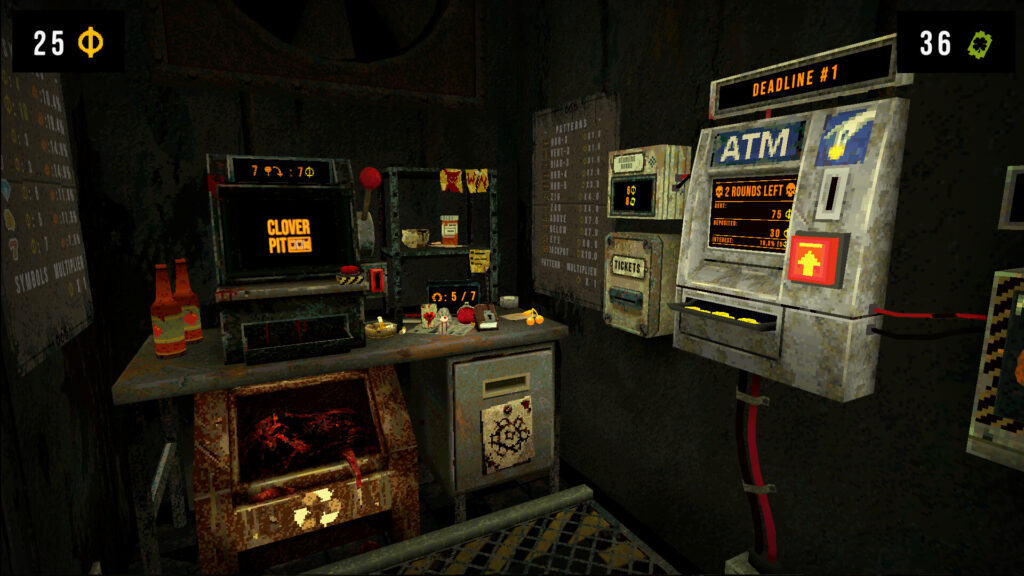
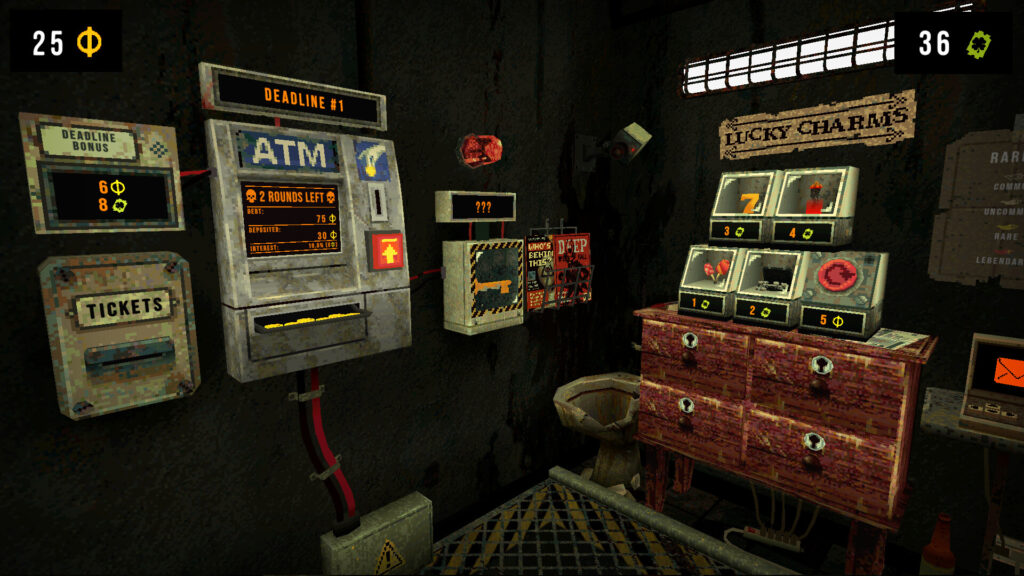
As the comedian John Robertson would say, “You awake to find yourself in a dark room!” A room that looks like it could have been rendered with Quake II assets. Gazing around slowly, you spot the essentials: a red phone, a cash machine (ATM for my international friends), a set of drawers, a… toilet (yes, you can interact with it), and a shop. But the commanding presence in the room, the thing everything else orbits, is the slot machine.
CloverPit tells you one thing: play the game. You start with coins and tickets. Coins fuel the machine; tickets let you buy modifiers in the shop. When you walk up to the machine, you’re given two options: take three cranks and earn more tickets, or take seven and earn fewer. A simple risk–reward slider.
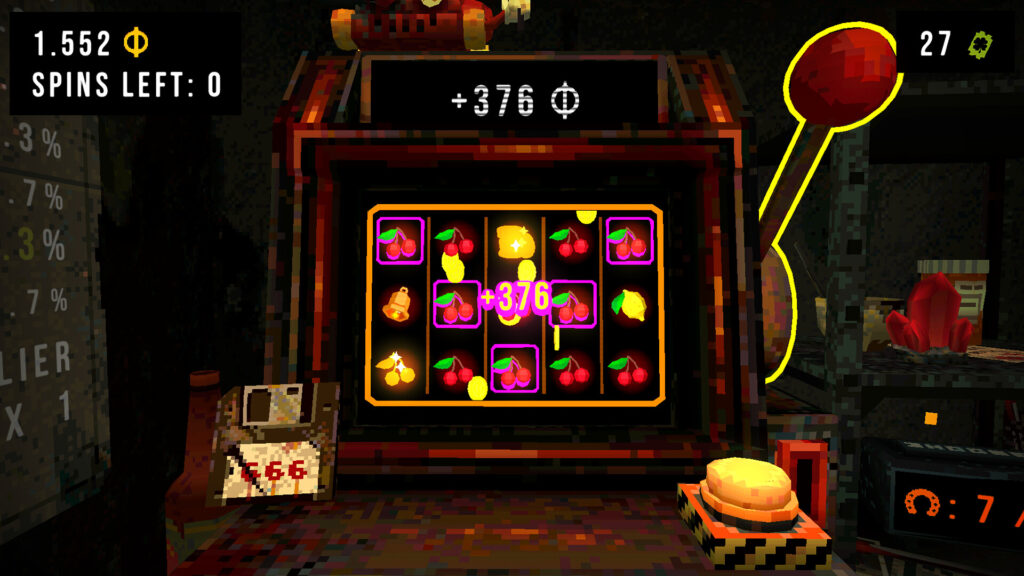
Like any slot machine, you earn coins from the patterns of symbols you land. Each symbol has its own value, each pattern its own multiplier. CloverPit teaches you almost everything you need to know in the first five minutes – and honestly, that’s both a strength and a limitation.
At your side sits the ATM, and in this game, it might as well be your god. It constantly reminds you how many rounds you have to hit the required coin target. The first deadline is 75 coins -easy, but still possible to miss if the machine decides today is not your day. Then it jumps to 200, 666, 2,333, 12,500, and finally 33,333. In my experience, the first two rounds were a comfortable 95% success rate. The third round, though? That’s where runs went to die.
When you do fail, the room shakes, the machine mocks you, and you’re thrown into the pit of the almighty Sarlacc. Sorry – wrong franchise. You’re thrown down a dark chasm and unceremoniously deleted, END OF LINE MAN!
RNG (Random Number Generation, or “luck” to most humans) is your biggest enemy in CloverPit. Fail in the first few rounds and, truthfully, there’s often nothing you could’ve done. Only later, after several upgrades and modifiers, do you start to get a sense of control. Even then, what appears in the shop is random, so your build relies on yet more luck. During my time with the game, I found that if I could get a solid engine past Round 3, I was basically unstoppable and could chew through the later targets with pocketfuls of cash.
There is a story in CloverPit, and this does separate it from a typical gambling-style mobile app. It’s not explicit, and it took me three hours to hit my first hint of narrative. But it’s there, humming in the background, as the game would have you think, hidden past just that next crang of the slot machines arm. The iconography in your little prison room gives you clues; I have my own theory about what’s going on, but where’s the fun in spoiling the mystery?
 Panik Arc
Truthfully, there isn’t a lot of “game” in CloverPit. You pull a crank, watch the reels, and hope for the best. It’s well-made, I had zero technical issues, even after far more hours than I expected to give it. But for me, games feel most rewarding when my choices matter, when wins feel earned and losses feel like my fault. It doesn’t offer that sensation. More than once, after a streak of failed runs, I’d threaten to quit only to suddenly hit a miraculous jackpot on my very last pull. It happened too often to feel accidental. I can only assume the game keeps a quiet eye on your loss streak and knows exactly when to give you a pat on the head to keep you invested.
In the end, I can’t recommend CloverPit. It is well made. It is addictive, dangerously so, given that the only money on the line is what you paid upfront. But that giant, flashing, sparkler-covered BUT remains: I never felt like I had agency. The closest comparison I can give is a Telltale game where your choices don’t really affect the ending, except here the ending is predetermined by a slot machine. CloverPit leans heavily on the same psychological hooks as real gambling, and that loop does little for me beyond reminding me I could be playing something where I actually have control.
Stay away. Play a real game. Save a little money, and perhaps a little sanity, too.
