

I want to like Everwarder, I really do. If I had to give it a genre label, it would be tower-defense/rogue-like… It doesn’t quite capture what the game is about, but it’s the closest box I can find.
Everwarder drew me in with its simple but charming pixel graphics and tinkly soundtrack, and kept me going with a (mostly) easy to follow tutorial. Then it smacked me in the face with a nail bat.
You control a mote of light trying to defend a crystal. By building a web of crystals (or smashing into it yourself), you can beat back the darkness covering each level. The catch? When a square of darkness is destroyed, it spits out enemies. You can take three different types of towers (there’s a rock-paper-scissors type system) with you into a level, and spawn these around the main crystal you need to defend. In order to finish a level, you must connect a certain amount of beacons to your crystal network and then spawn (and defeat) a boss from the exit portal. You get resources from the darkness to build more crystals, and resources from enemies to create more towers, it’s a very satisfying loop in concept.
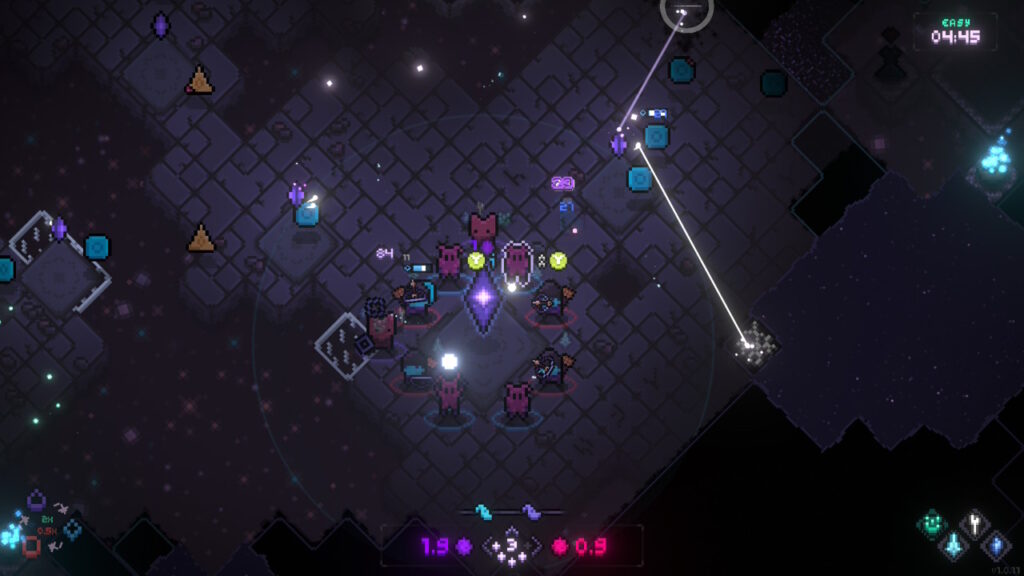
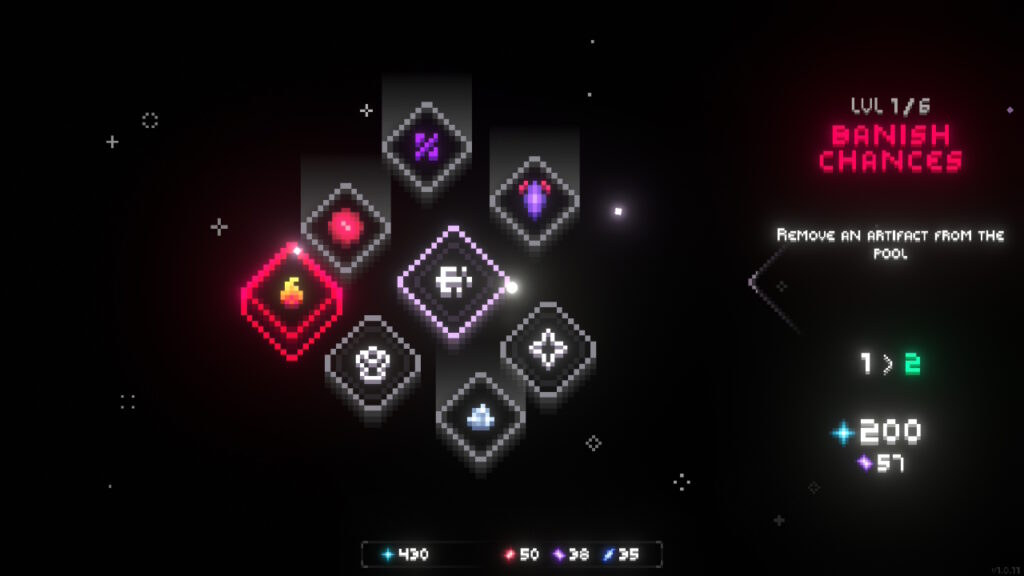
The game has three main stages, and multiple levels of difficulty or modifiers you unlock to apply to each of them. The first time you clear a stage at a certain level, you unlock something new. This is where the rogue-like structure comes into play. Nestled in the darkness (and as rewards for completing challenges and stages) are resources, which can be spent in the hub world between stages to upgrade units, yourself, and to unlock new features etc. During runs you also collect “artifacts” that can boost your towers, or unlock structures that add additional challenges into the randomly generated versions of these template stages.
I was very doubtful that I was going to enjoy the game until midway through playing the second stage for the first time. At that point, something in my brain shifted and I saw the vision. qLate has a really tight concept here, it’s just unfortunate that in practice it doesn’t pay off in the long term.
It might just be me, I have a low tolerance for repeated failure. After the first run through of each stage, it’s like Everwarder suddenly sees red and the difficulty spikes. At first, I assumed it was because I was trying the next level of difficulty up, and maybe I needed to go back and grind in on the first set for a while to earn resources. This would have been annoying, but I could deal with that. Nope, even going back to the stages I’d cleared no problem at all moments ago, I was now getting my backside handed to me with no mercy or thought for my ego.
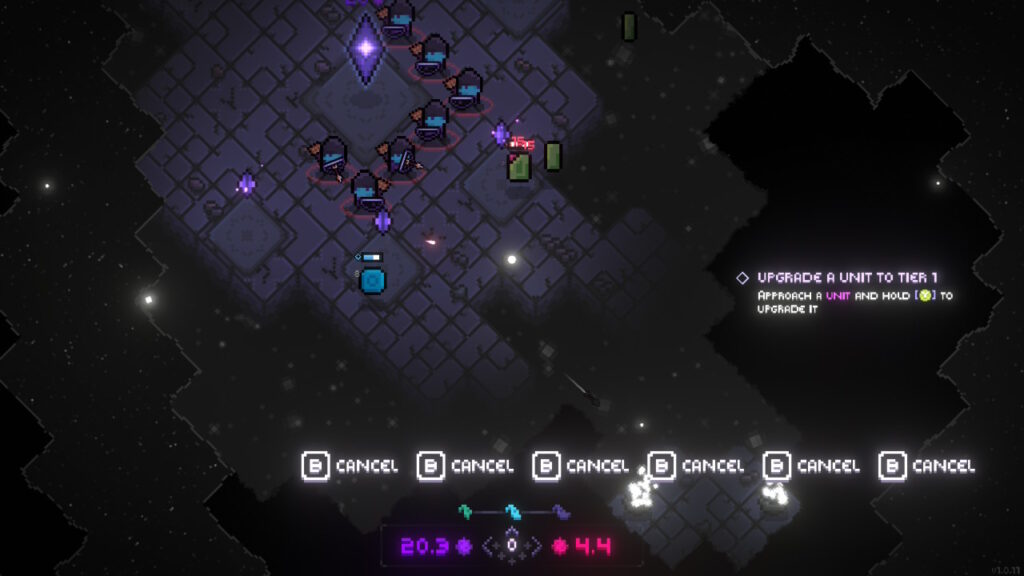
To go back to the positive (and to try and wash the bitter taste from my mouth), the actual second to second gameplay is fantastic. Once the ideas stick in your head, it’s easy to melt into that pleasant flow that I always valued in these kinds of games. It does take a while to get there, the menu systems aren’t always intuitive (there are no instructions on navigating most of the hub world, and some areas allow you to use the DPad, some don’t), and there are some glitches and issues in the tutorial (dismissed commands sticking around, buttons not working right, etc.), but there’s clearly a huge amount of love here.
It’s my understanding that qLate is a one man band, and they deserve a great amount of kudos for what they’ve singlehandedly produced here. However, that doesn’t make the game anymore fun to play in the long term.
To reiterate what I’ve said already, I want to love Everwarder, and I’m pretty sure someone with a higher tolerance for failure (hello Soulslike players) may be able to break through this difficulty spike that has skewered me, but it’s going to be a while before I attempt to crack this nut again.
Everwarder was reviewed on Nintendo Switch but is also available on Steam.
