

There are villains, and then there are the sort of villains who gaze thoughtfully at an entire planet and decide, with quiet conviction, that it’s all a bit unnecessary. Not evil, exactly. Just… inefficiently existent. Earth Must Die! is built on that very particular flavour of logic.
Earth Must Die! is a gleefully odd, very British point-and-click adventure from Size Five Games and No More Robots, it places you in the polished boots of VValak — an alien aristocrat whose empire is in decline, whose patience is thin, and whose solution to most problems is planetary eradication. If you happen to be familiar with a lot of stand up comedy from the UK, then this might be the game for you.
The game stars people like Tamsin Greig (who had me in stitches in Black Books), Alex Horne (the mind behind Taskmaster) and a familiar Mike Wozniak also. The always stern sounding Don Warrington from Death In Paradise and Ben Starr, from Final Fantasy XIV and a rising star in the game world. Yes, I went there. The main star is of course Joel Fry, who I first think of for a small, but important part in Game of Thrones and the lead in The Bank of Dave. He is an actor who isn’t a household name, even in the UK, but I have always found his acting incredibly good and he stands out as VValak and plays the part perfectly.
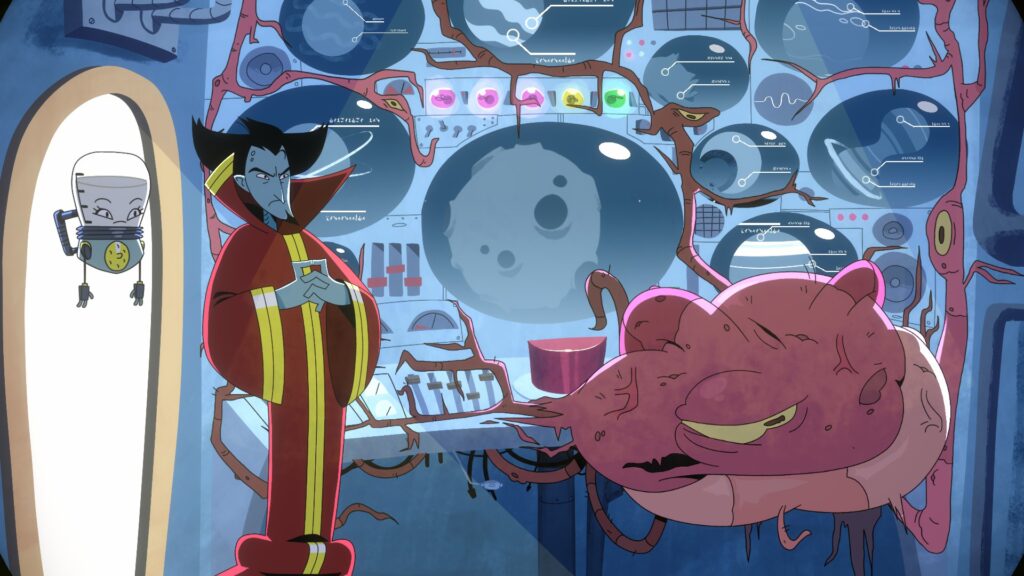
In Earth Must Die!, you quickly find that when your empire is in decline, it needs a quick win, and sadly Earth is next on the list. I feel like this reminds me of something, but I must be going mad.
Now, if you’ve spent any time with classic point-and-click adventures, you’ll feel immediately at home here. My first one was Ace Ventura, and it took me seven years to finish (looking at you totem pole puzzle). But then I moved onto games like Discworld Noir and Monkey Island, and things started to look up. You’ll click on things. You’ll chase dialogue. You’ll occasionally stare at the environment with the quiet suspicion that you’ve missed something obvious. But I never did that. Honest. In Earth Must Die!, you get the distinct honour of controlling the greatest emperor in all time: VValak. VValak is a wonderfully committed piece of character design in that he doesn’t actually do things. He instructs. He delegates. He points vaguely and expects the universe to comply. He is, after all, an emperor.
Instead of directly interacting with the world, you’re often working through intermediaries — assistants, devices, or whatever unfortunate entity happens to be within shouting distance. You ask and you command your way through the game. I don’t think I recalled if VValak ever actually touched anything himself, unless you count sitting in a chair. It adds a slight layer of abstraction to the usual formula, and more importantly, it reinforces the central joke: That you are playing as someone both immensely powerful and deeply impractical. The ultimate nepo child really.
The puzzles sit in that familiar adventure game space between “ah, of course” and “well, that’s nonsense, but I’ll allow it.” There’s logic here, certainly, but it’s the kind of logic that has been gently filtered through alien aristocracy. Solutions often feel less like engineering and more like persuasion — convincing the game that your particular brand of reasoning is, if not correct, then at least entertaining enough to proceed. Most of the time you talk to people, and as long as you have the right knowledge, they will do what you need them to.
And that, really, is the heart of Earth Must Die!. It is, above all else, committed to being funny. It is funny. Like all things though, humour is subjective, so if you don’t find people making silly voices funny, or you get wound up by people making the most stupid choices possible, this might not be for you.
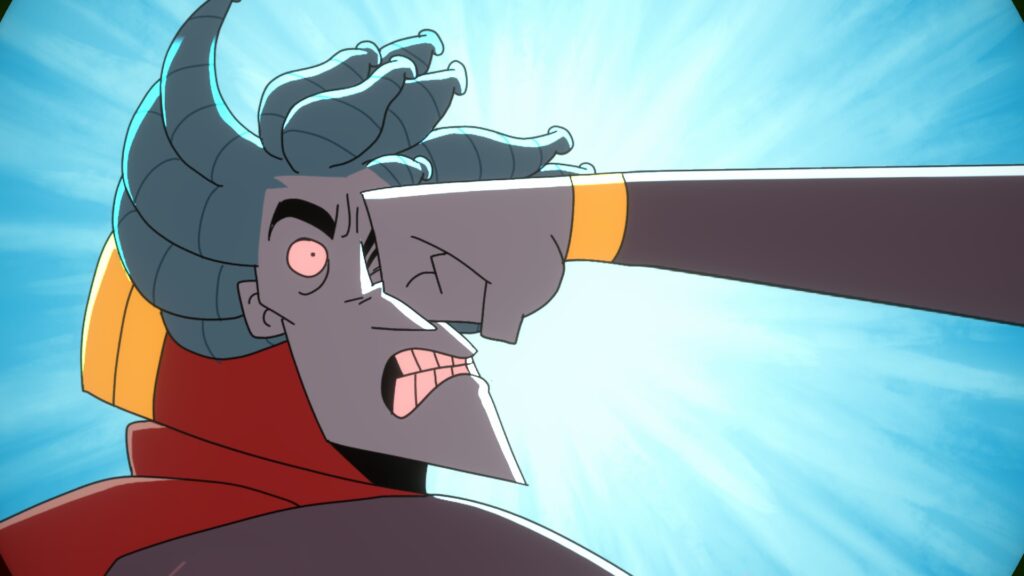
The script is packed with dry observations, absurd escalations, and the occasional line that lands with the quiet confidence of a joke that knows exactly what it’s doing. It’s less interested in telling a tightly wound narrative and more focused on creating a steady rhythm of setup and payoff. Some jokes land better than others, inevitably, but the game rarely lingers long enough for that to matter. There’s always another line, another situation, another small piece of nonsense waiting just around the corner. Its pace is good, and I didn’t get bogged down in a section I found the humour not working for me for very long at any point.
Visually, it matches this tone nicely. Bright, expressive, and just a little chaotic, the presentation keeps everything readable without ever feeling sterile. The style made me think of Afterparty from 2019. I think of it as a kids cartoon show, maybe early 00’s with bright bold colours, SO MANY PASTEL COLOURS, and the kind of art style I would have seen on Cartoon Network on an early Saturday morning back in the old days. Characters emote well enough, environments invite interaction, and the whole thing feels like it’s in on the joke with you — which, for a game about destroying a planet, is probably the correct approach.
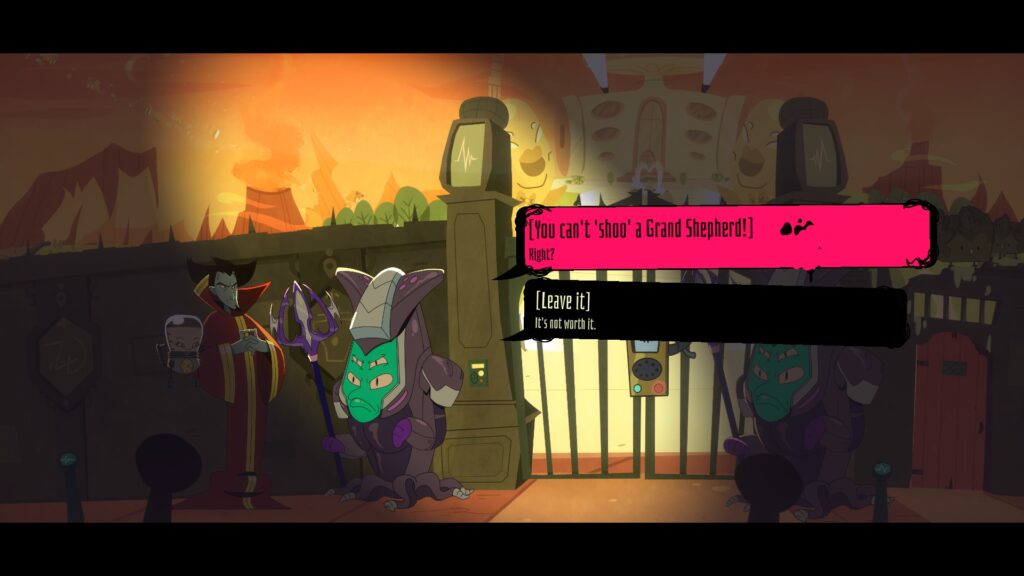
If there’s a sticking point, it’s one familiar to the genre. There will be moments — quiet, contemplative, slightly stubborn moments — where progress slows and you begin the gentle ritual of clicking on everything in sight. Not out of frustration, exactly, but out of a kind of hopeful curiosity. It’s the point-and-click equivalent of checking the fridge again, just in case something new has appeared. It does its best to guide you to the right thing when you are just not getting it. I never had to crack out a search engine, but there were times when I just wasn’t getting what it was trying to steer me towards.
The humour, too, won’t be for everyone. It leans into a distinctly British sensibility: Dry, occasionally a little crude, and entirely unbothered by whether it should rein itself in. For those on its wavelength, it’s consistently entertaining. For others, it may feel like being trapped in a particularly eccentric lecture — amusing, certainly, but perhaps a touch indulgent.
Still, when everything aligns — when the puzzle clicks, the dialogue lands, and VValak delivers another perfectly judged line of disdain — Earth Must Die! becomes something quietly special. Not revolutionary, not particularly grand, but confident in its identity and committed to its own peculiar brand of humour.
By the end, you may not feel like you’ve saved the galaxy. You probably haven’t improved it, either. I’m not entirely sure I felt like I had improved VValak either, now that I think about it. But you will have spent a few hours in the company of a character who believes, quite sincerely, that pressing the big red button is not just the easiest solution…but the correct one. And there’s something oddly fun about that.
Earth Must Die is available for Windows PC now.
