

Defenders of the Wild 2.0 is charging toward Kickstarter, and it is not here to ask politely.
From Outlandish Games and designed by T.L. Simons and Henry Audubon, Defenders of the Wild 2.0 this is a fierce, uncompromising cooperative experience that looks you square in the eye and asks whether you’re actually ready to live by the Defenders Code, or whether you’d rather watch your woodland home get strip-mined by soulless machines.
A quick disclaimer before we get our paws dirty: This review is based on an advanced copy of version 1.99, so expect some tweaks before the Kickstarter campaign locks everything in. We reviewed the original Defenders of the Wild back in 2025, and this new version very much feels like it has come back sharper, angrier, and with something to prove.
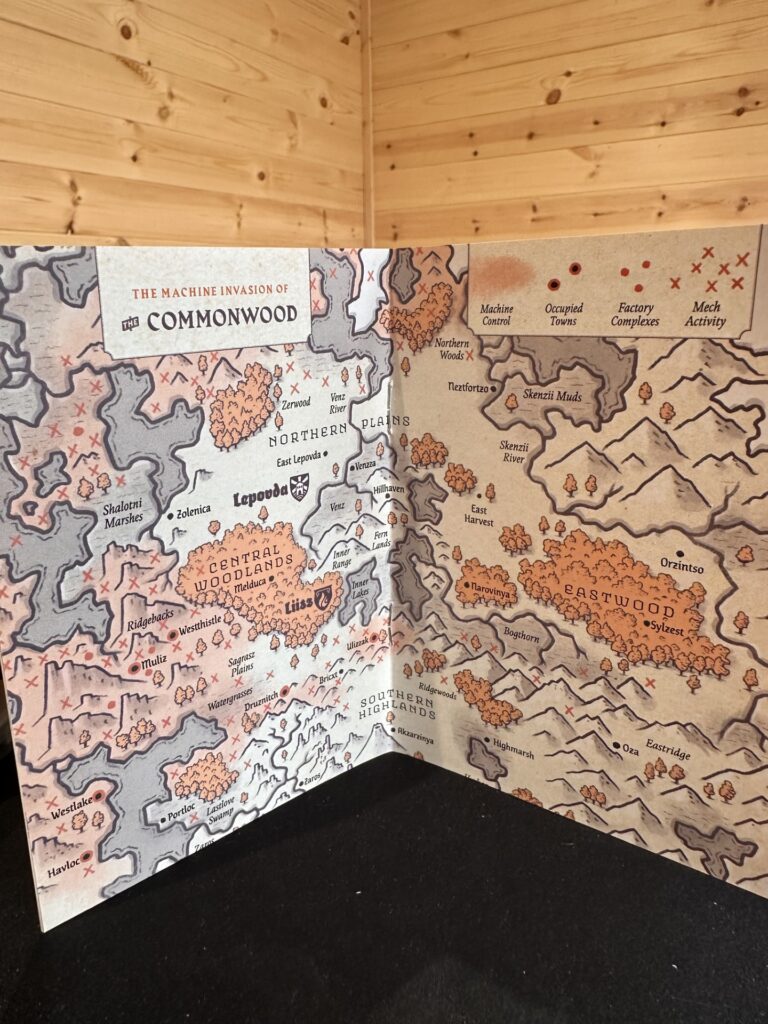
In Defenders of the Wild, you and up to three other players take on the roles of rival factions who have finally decided that mutual survival beats ideological purity. The Order lurk in the forests, the Council hold the plains, the Coven thrive in the marshes, and the Sect hide away in the mountains. The game opens with a piece of in-world fiction called The Red Leaflet, and reading it genuinely felt like stumbling into an alternate timeline where the animals of The Animals of Farthing Wood radicalised, organised, and decided they were done being pushed around. The theme is loud, proud, and absolutely intentional. You’re fighting a central machine core that spreads pollution, erects massive factories, deploys killer mechs, and builds walls to carve up the land. Subtlety is not on the menu.
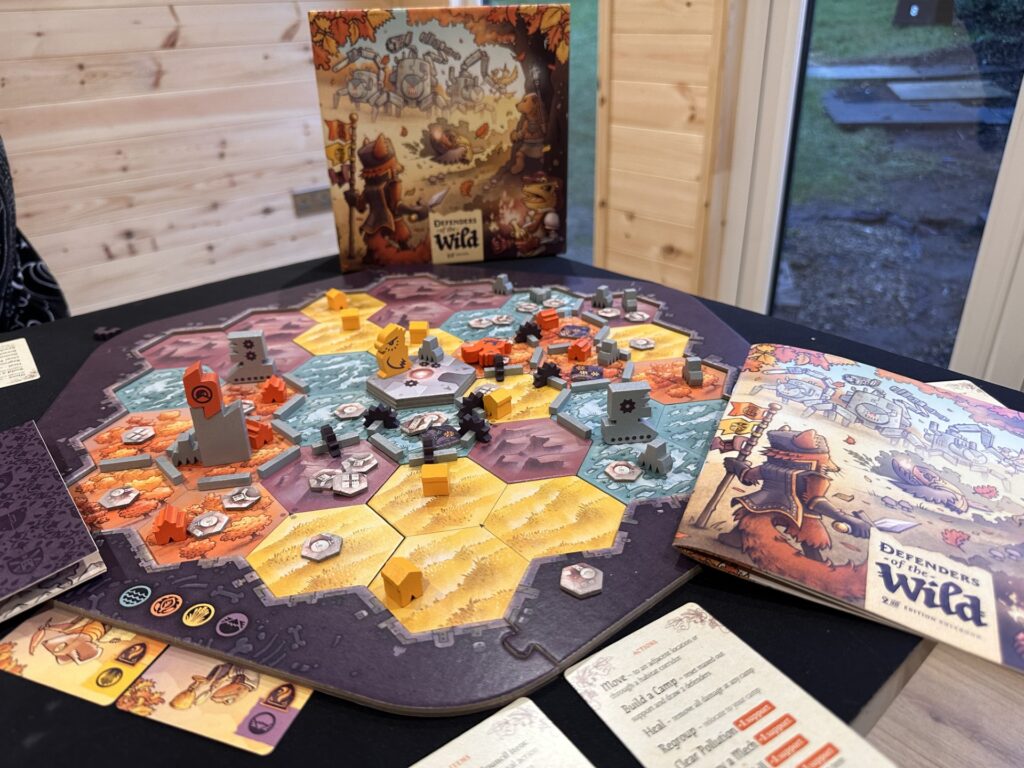
Visually and tonally, Defenders of the Wild wears its influences on its sleeve. The character art wouldn’t look out of place in Everdell, while the idea of rogue machines devastating the natural world will immediately bring Horizon Zero Dawn to mind. That said, this doesn’t feel like a hollow remix. The world has enough personality and conviction to stand on its own, and it commits so hard to its message that it’s difficult not to get swept up in it.
Winning the game requires coordination, sacrifice, and just a bit of audacity. You’ll need to generate enough support to establish all of your faction’s camps, then send your organiser – essentially your faction’s on-the-ground leader – into the machine core through its single vulnerable entrance. Lose all hope by letting two defenders from the same habitat die, run out of enemy components like walls, factories, mechs, or pollution, and the machines steamroll what’s left of your world. No pressure, then. Just the survival of everything you care about.
Each round begins with a deliciously tense moment of simultaneous card selection. Everyone secretly chooses a card from their hand and reveals it together. You’re not allowed to discuss what cards you’re holding beforehand, but once they’re face up, the table talk begins in earnest. Your deck consists of twelve cards: six generic faction cards and six tied to your two possible organisers. Factions do play differently, but not so differently that losing your first choice will sour the experience. One of the smartest design choices here is how factions reward cooperation. Finish a move action on another faction’s camp and you gain an item tied to them. Bread from the Council gives you extra actions, Coven potions heal or clear pollution, Sect rockets help blow things up, and Order maps make movement faster. It’s thematic, elegant, and encourages players to overlap rather than silo themselves and this movement-based reward really clicked with me.
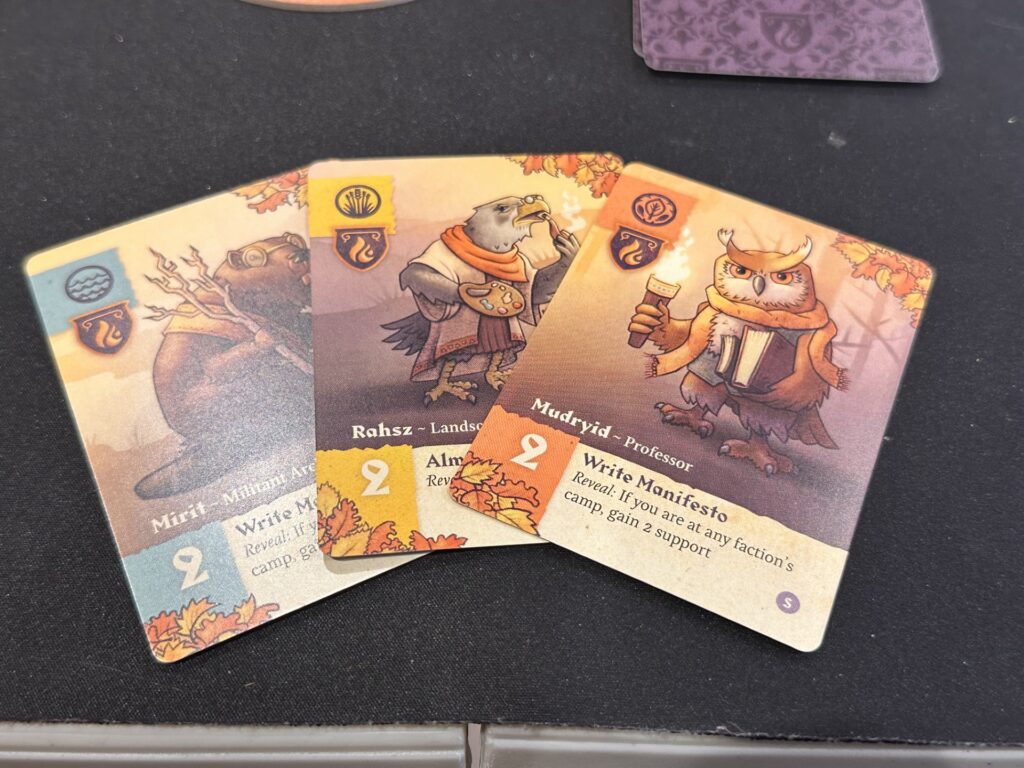
The number on the card you play determines how many actions you get, between two and five. Moving, healing, fighting mechs, tearing down walls, rewilding factories – it’s all familiar co-op territory, but executed with confidence. Camps are the real prize, though. Building one means maxing out your faction’s support and placing it in your home region, and the hidden card selection reinforces the idea that this resistance operates in semi-independent cells. You might be fighting the same enemy, but you’re not always perfectly aligned, and sometimes that tension hurts.
Combat is where the game really bares its teeth. Whenever you take an action, any mech in or adjacent to your space attacks you. It perfectly captures the feeling of sneaking through hostile terrain and suddenly being spotted. It also means your fortunes can turn on the head of a pin. A couple of bad dice rolls on a single turn can wipe you out, costing you a card chosen at random by another player and permanently reducing your future options. Losing a high-value card early is brutal, and the game does not apologise for it. I still blame my partner for killing my best card, leaving me with nothing but two and three action cards.
After each turn, a mech card is revealed, and this is where the world pushes back. Construction machines trundle across the map, throwing up new walls, spawning more mechs, spreading pollution, or shifting their own paths in deeply inconvenient ways. Surround a tile completely and a factory springs up, bringing with it a factory card that is, without exception, awful. These moments are relentless, and they ensure the game never lets you feel comfortable for long.
The production is gorgeous, and while the narrative elements may feel familiar, the emotional hook absolutely lands. I wanted to save these creatures. I cared about the Commonwood. At one point it genuinely felt like my own cat had shaken me awake and demanded I join a doomed but determined resistance.
There are a few rough edges at this stage. The rulebook is comprehensive, but some sections could use a stronger proofread, and our copy was missing the toxic track on the board, this made it tricky to keep track of the pollution that was spreading outside the board. While the included reference card is useful, adding an additional card with turn-sequence reminder with combat and factory effects on the reverse would make onboarding smoother.
Upon writing this review I was given a list of updates from the 1.0 version of Defenders of the Wild. Having not played the original, and I actively avoided reading our review of that as well to ensure I came to this fresh, I can highlight some of these and my thoughts to help you decide if this new version is for you if you have already defended the Commonwood before.
The new victory condition of core infiltration and reduced loss conditions appear to streamline the game, and I can say that both were well balanced. I was always trying to put out fires, but I was equally able to work my way towards victory. Defender abilities have been updated to mean that each faction plays differently and so that complements different playstyles. When I put the cards out in front of me, I can see how they are catered to different styles, but when playing the game, i just didn’t feel it. Maybe with more mastery of the game or with different player counts it will become more apparent to me. Quality has been stepped up on all art and components, and I do think that stands true as everything about Defenders of the Wild is beautifully presented. Lastly, the rulebook. It’s 30% shorter than the first edition, but I still think that it feels cumbersome. The length is good, but the flow of it is just off which slows down comprehension of the rules to new players.
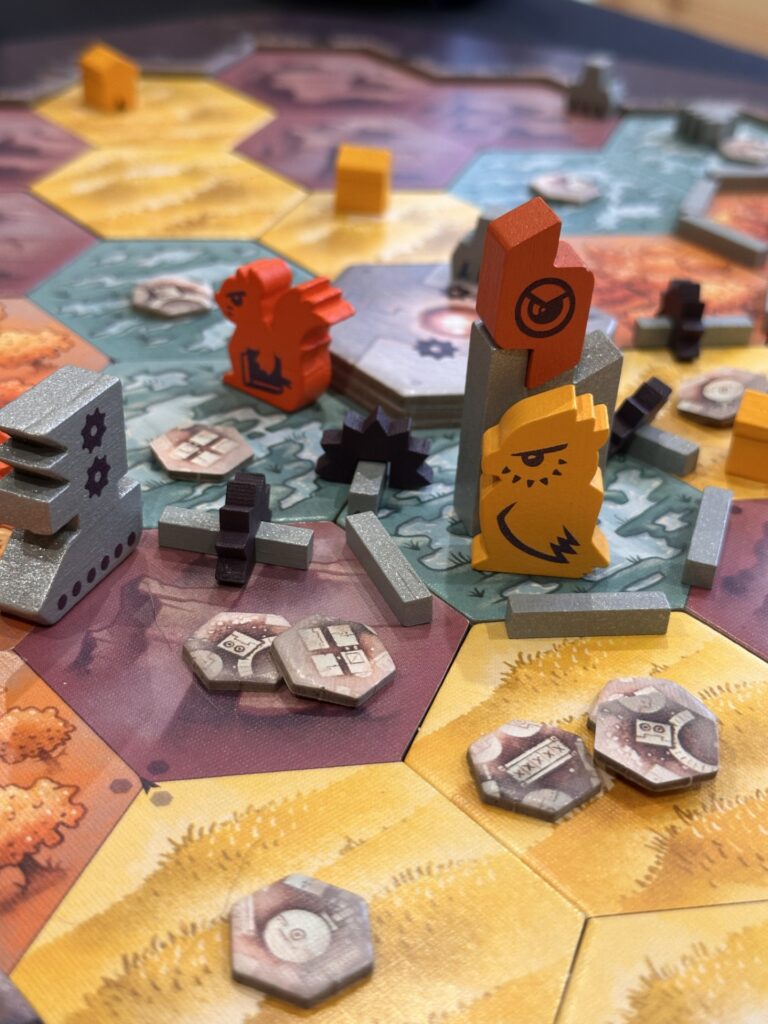
Defenders of the Wild 2.0 is hard, as it should be. The opening turns lull you into a false sense of security, and then suddenly the map is choked with pollution, mechs are everywhere, and every decision feels like damage control. It’s fair, but it doesn’t pull punches. An uncomfortably apt metaphor, honestly. I loved my time in the Commonwood. My partner made it into the machine core, but I didn’t survive long enough to join them, cut down just short of the end. I’ll be back, though. Those machines haven’t won yet.
You can find out more about Defenders of the Wild 2.0 on its Kickstarter.
