

There’s something undeniably comforting about a dungeon crawler that knows exactly what it wants to be. From Brain Seal Entertainment — the studio behind other gems like Monarchy (which I happily lost an entire weekend to) and Story of a Gladiator (a game I enjoyed far more than I expected) — comes the latest entry in the Dark Quest series.
When a studio reaches the fourth game in a franchise, it’s usually one of two things: A cheap cash cow churned out quickly, or a genuine labour of love striving to be better than what came before. Dark Quest 4 is very much the latter. Every part of this game feels like a loving homage not only to its previous iterations, but to the tabletop classic that the series has always worn proudly on its sleeve: HeroQuest.
I’m a huge HeroQuest fan. I own a fully painted set and often take on the role of game master, letting my friends adventure through dungeons I’ve prepared for them. The problem I’ve always faced, though, is this: How do I play HeroQuest solo? I don’t particularly want to play with strangers, and getting friends together regularly becomes harder as life gets in the way.
Enter Dark Quest 4, thundering into the room like the barbarian on its cover, throwing me over its shoulder and charging face-first into the nearest dungeon while screaming, “Here we go, little man — we game good now!”
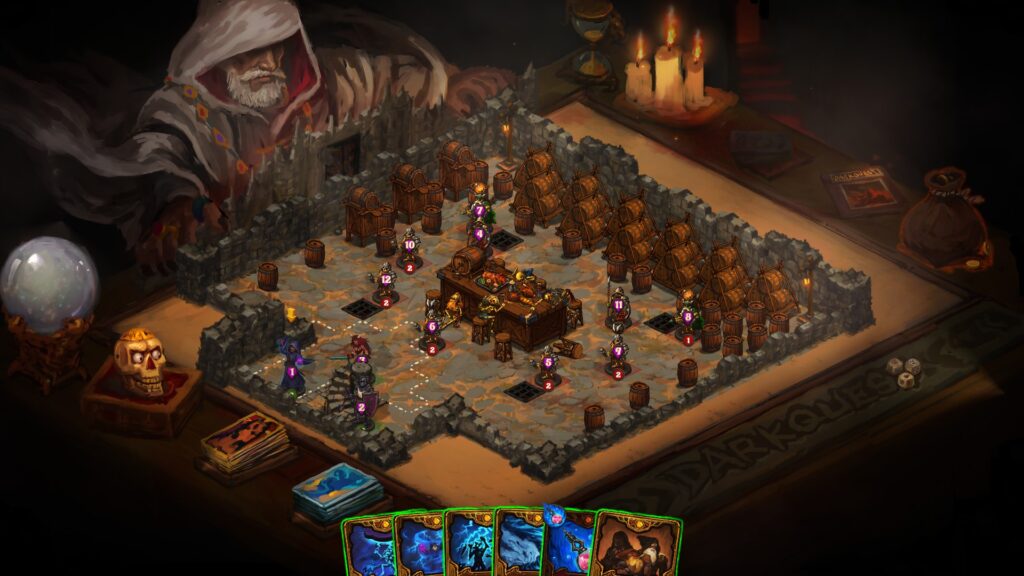
Visually, Dark Quest 4 absolutely nails its aesthetic. The game has a painted, tabletop look that immediately clicks — like a slightly less grim, less polished Darkest Dungeon. Playing feels as though you’re hovering above a physical game board. Your bag of coins sits off to the left, clickable at any time to check your gold. Nearby are two decks of cards that wiggle enticingly when clicked; I kept expecting them to do more, and if they do, I’ve yet to discover it. Looming above the board is the evil sorcerer, hidden behind a GM screen, occasionally chiming in with threats. These small touches add a lot of charm and really sell the tabletop illusion.
After a brief tutorial dungeon, you’re dropped into the Adventurers’ Camp. Here you’ll find a blacksmith, trainer, potion seller, and other NPCs offering upgrades and new abilities for your heroes. From the camp, you choose your next quest from a grid and select which three adventurers you’ll take with you into the dungeon.
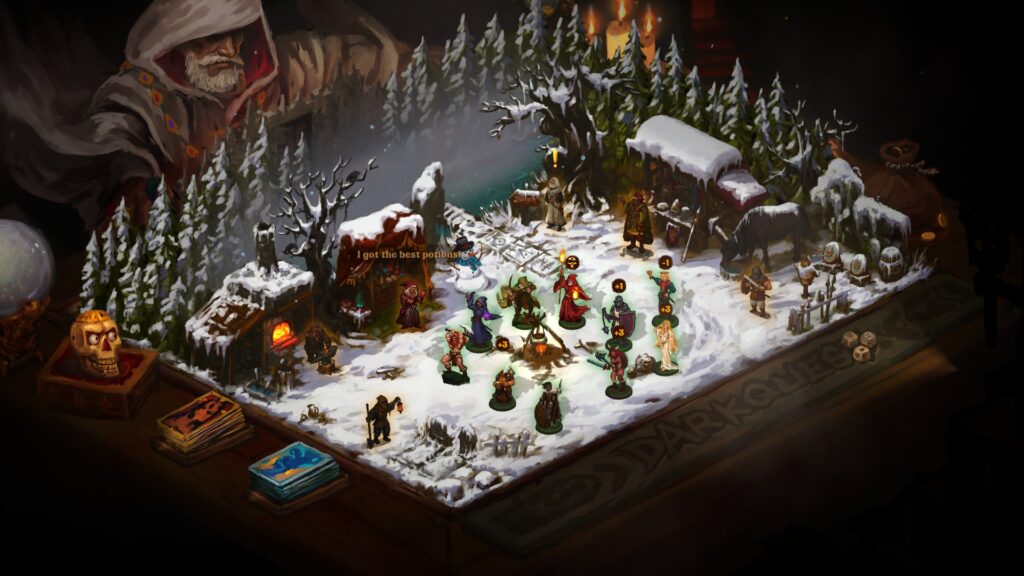
Gameplay is intentionally simple, mirroring its tabletop DNA. You move a limited number of spaces, open doors to reveal rooms, and crack open chests in the hope they contain gold rather than a mimic. When enemies appear, everyone — heroes and monsters alike — is assigned a turn order, and combat begins.
On each character’s turn, you choose from a small hand of action cards. You’ll always have a basic attack and the option to skip your turn, but additional abilities are unlocked through trainers and upgrades back at camp. For example, the Lightning Wizard starts with a basic attack that deals one damage to a single enemy, but later gains access to spells that hit multiple enemies for significantly more damage.
As you play, you’ll quickly develop strategies to deal with the game’s biggest challenge: numbers. You’re always limited to three heroes, while enemies often arrive in swarms. Blocking doorways with your toughest melee fighter while your wizard lays traps and your archer peppers enemies from afar becomes a reliable approach.
This, however, is also where one of Dark Quest 4’s drawbacks emerges. I found myself using the same tactics in nearly every dungeon, and gravitating toward the same heroes. Despite a roster of ten characters, I effectively rotated between two squads — my “A Team” and “B Team.” If the game didn’t penalise you for taking the same heroes on consecutive runs, I probably wouldn’t have switched at all. While quests provide vague hints about what to expect, they’re rarely useful, and charging in blind often felt like the only real option.
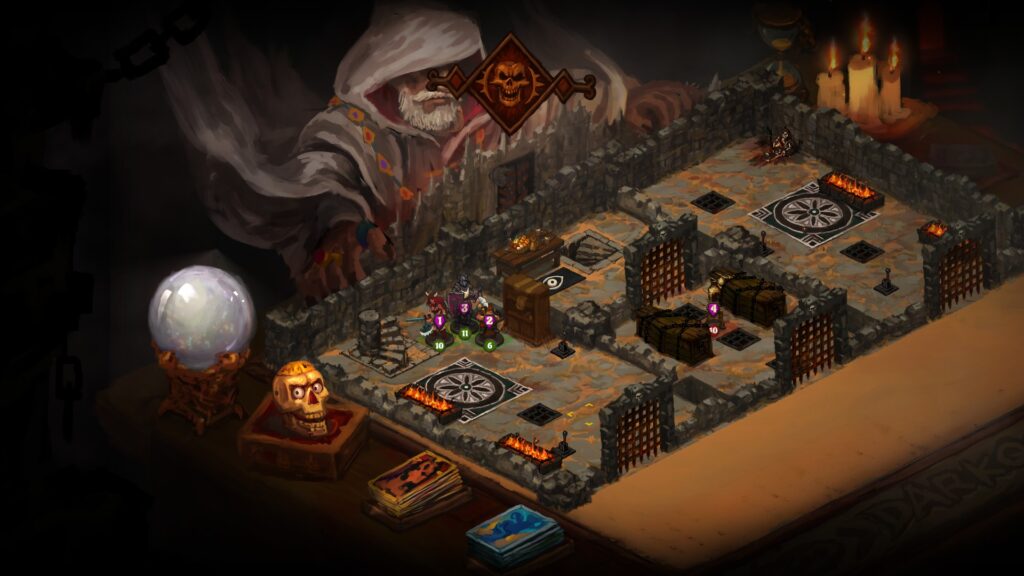
There’s no permadeath in Dark Quest 4. Fallen heroes simply sit out the next adventure before returning, which removes some tension but also enables odd behaviour — like intentionally sacrificing your B Team on a doomed run just to get your A Team back in action. If a quest ends in total failure, you also lose all the gold you earned on that run, which can be incredibly frustrating if things go wrong in the final room. It meant that in order to save money for upgrades, I would have to run through previous quests again and again. Similarly, losing a hero early due to bad luck can make the rest of the dungeon feel pointless, as completing the mission becomes highly unlikely.
Mission variety is solid enough for short sessions, but not quite enough to keep me playing the entire campaign in one uninterrupted stretch. I reached around 48% completion before hitting a wall that required grinding earlier levels for gold. That said, this feels like the kind of game I’ll happily return to after a break to push through and finish.
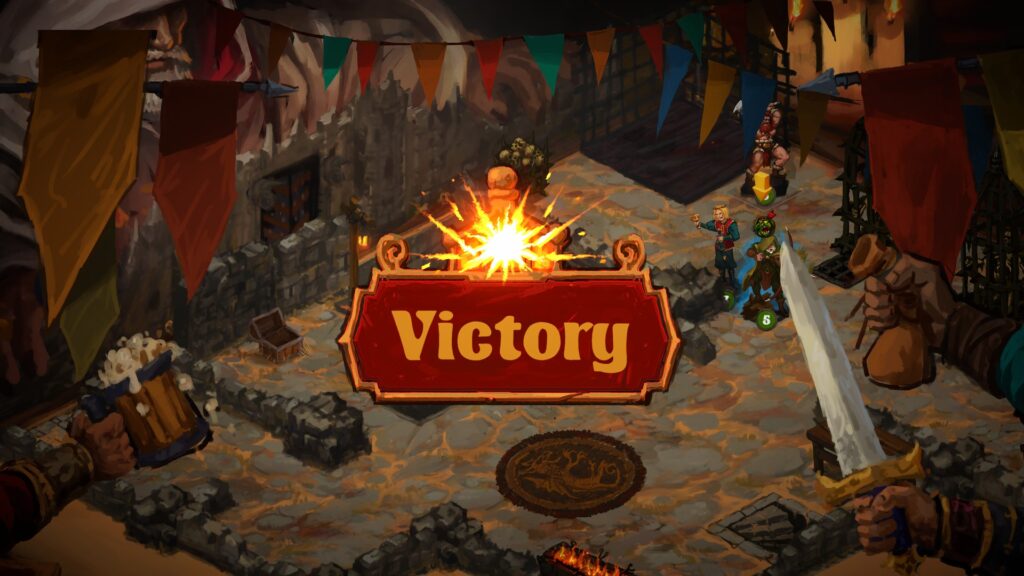
There are also difficulty options that allow you to tweak hero health, damage output, and enemy strength at any time. While I avoided these — since they remove much of the challenge – they’re an excellent inclusion for players wanting a more relaxed experience, or for introducing younger adventurers to dungeon crawling without the frustration.
Overall, I’ve really enjoyed Dark Quest 4. While I’d love to see larger party sizes and more varied enemy behaviour in future updates, this is still a fantastic game that distils the pure DNA of its inspirations into a faithful and enjoyable digital experience. I can’t wait to see DLC — or Dark Quest 5 —and when that happens, you can be sure I’ll be back to review it.
Dark Quest 4 is available now for Xbox, Nintendo Switch, and PC
