

Company of Heroes: 2nd Edition is one of the most ambitious real‑time‑strategy‑to‑tabletop adaptations that I’ve ever come across, and the latest (second) edition shows just how far Bad Crow Games has gone to refine, rebalance, and expand the original design.
It’s a dense, highly tactical World War II wargame that mirrors the structure, pacing, and decision‑making of the Company of Heroes PC series surprisingly well. The rules are complex, the learning curve is steep, and the table presence is enormous — but the payoff is a deeply satisfying system that captures the feel of the videogame in a way that few adaptations ever manage.
Like the PC game, Company of Heroes is about controlling territory, gathering resources and (perhaps less like the PC game but still similar in its own way) using those resources to build an army capable of scoring more victory points than your opponent. The board is divided into hexes and includes a number of specific control points, each of which generates manpower, munitions, or fuel when controlled. Just like in the PC game, these resources are the lifeblood of a successful strategy.
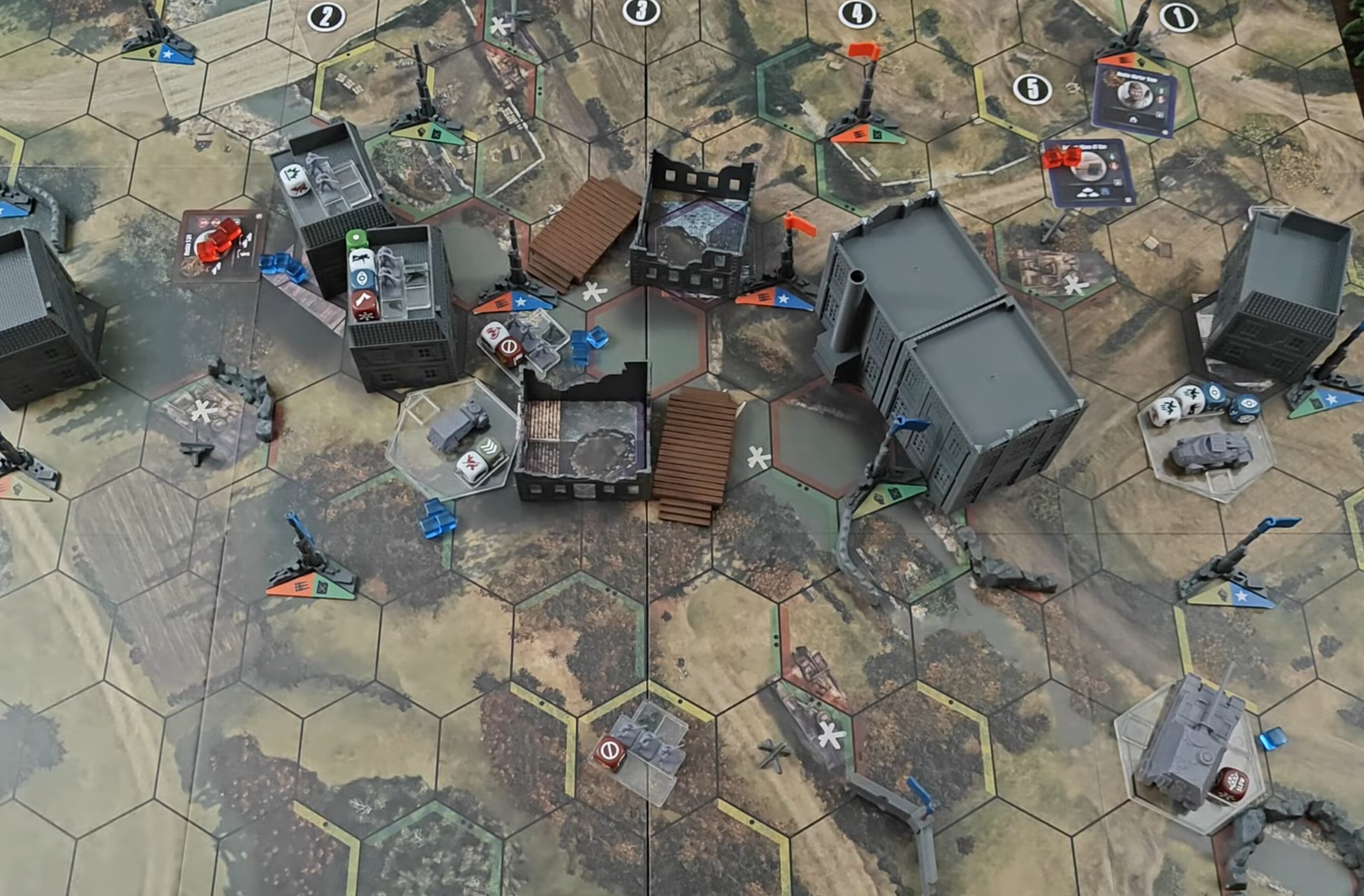
Manpower fuels basic unit production, munitions allow for upgrades and special abilities, and fuel unlocks vehicles and late‑game tech — including upgrades to your command centre which in turn unlocks more and better units. The second edition emphasises this economy even more strongly, making the fight for map control feel urgent from the very first turn, again, just as it is in the PC game. Critically, it also wants you to unlock upgrades and new units even within the limited structure and timeframe of a board game (rather than a videogame) so things move relatively briskly on this front — more on that later.
The rules are structured around a sequence of phases that repeat each round. First, players collect resources from the sectors they control. Then they issue orders to their units, moving infantry squads, capturing points, or positioning vehicles. Damage (which is assigned in a somewhat deterministic way) is resolved based on line of sight, range, unit abilities and upgrades, cover, inherent defensive capability and some dice rolling, but it’s not as swingy as you will often see in dice-based war games. At the end of each round, players spend their resources and experience to expand their command centre, purchase new units, or upgrade existing ones. It’s a loop that mirrors the rhythm of the RTS: expand, fight, build, repeat.
Movement and combat are where Company of Heroes complexity becomes most apparent. units move across the map in increments following the assignment of command points, with infantry taking cover behind terrain features or occupying buildings. Vehicles have facing, armour values, and firing arcs depending on their design, making their positioning critical.
Line of sight matters, as does range, and the second edition’s updated ruleset cleans things up a bit, but it remains a bit of a bear. To make an example of this, when a mortar unit wants to fire at an enemy, the player must consider that the weapon range is five, but the unit line of sight is only two. This means that another unit must be able to see (or spot in military terms) a unit being fired upon if it is outside the mortar units line of sight, but inside its range. Mortars can also fire “over” cover like buildings, whilst a tank, even if it is technically in range with an enemy unit spotted, could not (because it fires on the level.) Whilst complex, this is just the first of several times where I’ll tell you that Company of Heroes works because each of these relatively fiddly rules follows one simple convention: common sense.
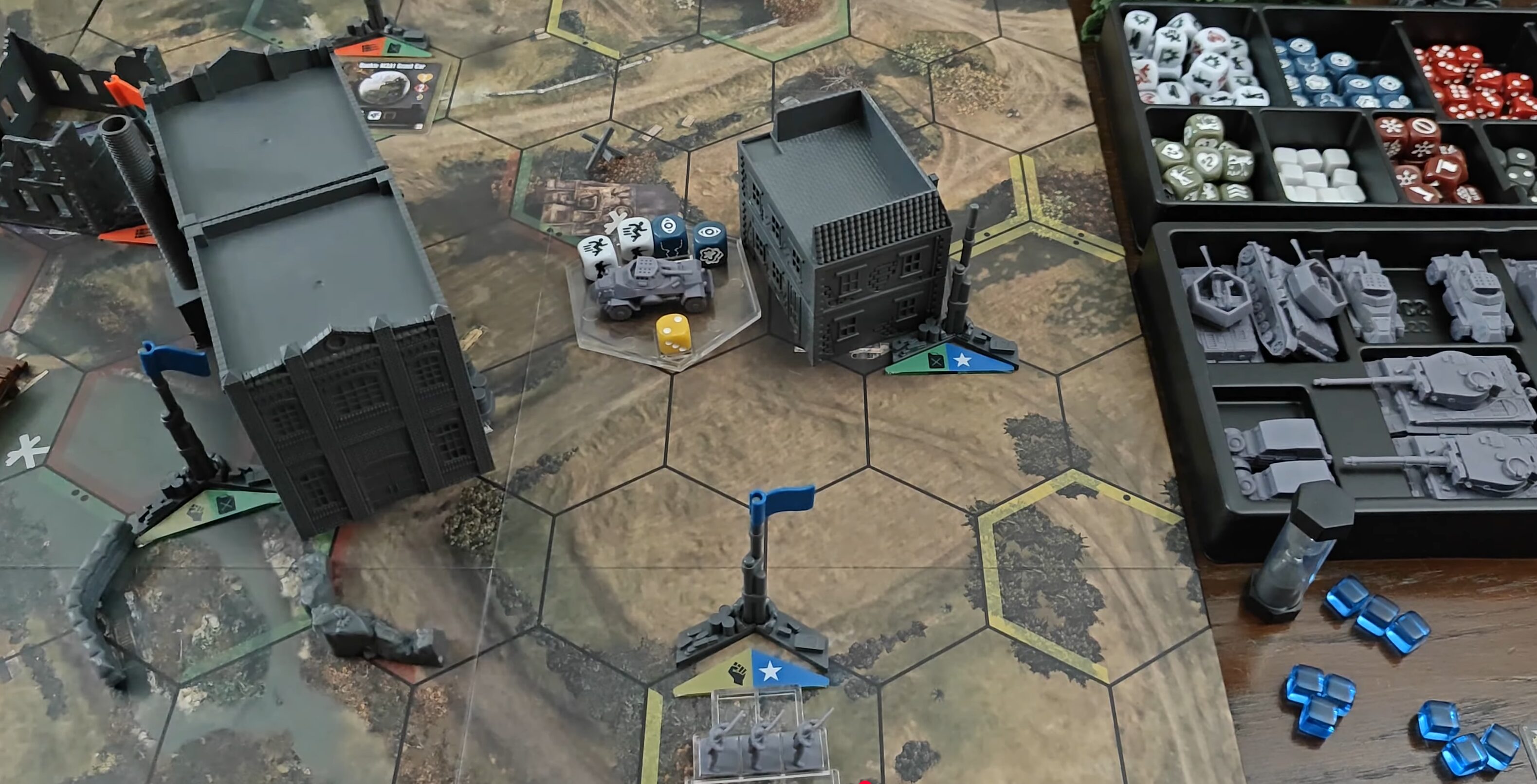
One of the most distinctive features of Company of Heroes is the way that units are represented. Rather than miniatures alone, the game uses plastic slotted trays that hold up to five miniatures and some dice. Each miniature represents the unit health, and may also include special features like a mortar or machine gun, as well as dice turned to specific faces to show upgrades (like additional damage or line of sight).
When a unit takes damage, you simply remove a model, or when a unit is upgraded, you add the dice on whatever face represents your chosen upgrade. This system is both nicely tactile and functional, allowing for a huge variety of units without overwhelming the table with dozens of loose miniatures spilling everywhere. Interestingly, Company of Heroes features more dice than almost any other game I’ve played, and yet, a lot of them never actually need to be rolled.
The second edition introduces a number of refinements based on community feedback that goes well beyond my specific experience with either version. Assault rules have been tightened, commanders have been rebalanced, and faction differentiation has been sharpened. The Wehrmacht feels powerful and methodical, the US forces are flexible and aggressive, and the other factions (available in expansions one of which I’ll touch on below) each have their own flavour. The addition of lots of new scenarios gives the game enormous replayability, and the improved components make setup and teardown smoother than before.
A key part of its appeal is how faithfully it captures the feel of the PC series. In the videogame, you’re constantly juggling map control, unit preservation, and tech progression. The board game recreates that tension. If you overextend, you risk losing key units and falling behind in the tech race. If you turtle, your opponent will seize the map and starve you of resources. Every decision feels meaningful, and the consequences of mistakes are immediate and punishing. I love that there are rules for retreating units as well, potentially allowing a smart player to restrict their opponents access to VP(awarded for each unit defeated) and introducing a chance to resupply a powerful but damaged unit.
All that said, the rules are quite intimidating at first. There are edge cases, exceptions, and interactions that take time to internalise. For example, when a tank fires at infantry in cover, you need to consider damage type (AP isn’t perfect against infantry), cover bonuses (with level one, two or three cover available), and whether the target has been suppressed by previous attacks or has a defensive modifier among its upgrades — and all of that comes after range, facing and line of sight has been checked. But, once you understand the system, it flows smoothly. The complexity isn’t arbitrary; it’s there to model the tactical depth of the videogame and it almost always makes sense.
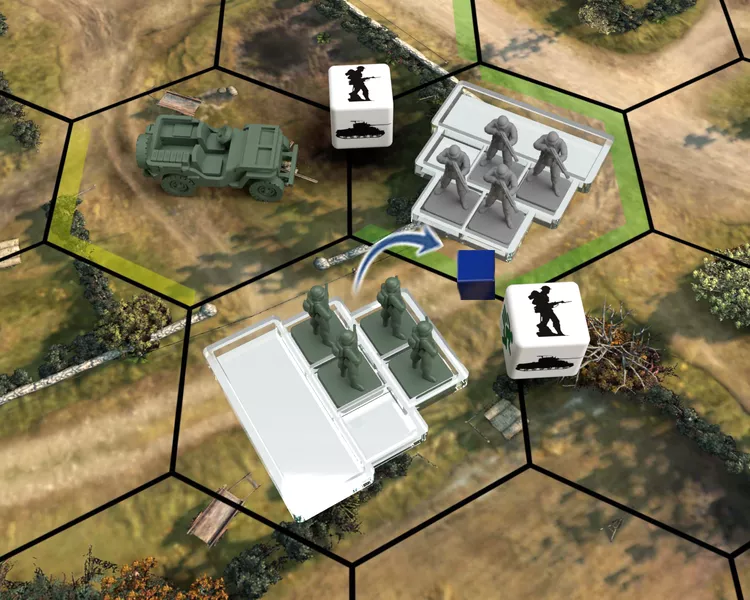
One of the best examples of this depth is the way suppression works. Machine‑gun teams can lay down suppressive fire that pins enemy infantry, reducing their movement and combat effectiveness. This creates opportunities for flanking manoeuvres or assaults. Vehicles can crush cover or infantry if positioned correctly, but they’re vulnerable to anti‑tank weapons in a way that really makes you want to keep them supported. These interactions create a battlefield that feels alive and reactive, just like in the RTS.
The economic layer is equally rich. Deciding when to tech up, when to invest in upgrades, and when to push for late‑game units is a constant puzzle. A player who rushes tanks might dominate early, but a player who invests in infantry upgrades and map control might out‑economy them in the long run, but will certainly lack punch. Commanders add another layer, offering unique and upgradeable abilities and late‑game powers that can swing the tide if used well, albeit, with further rules and nuances that have to be remembered.
Despite its complexity, Company of Heroes: 2nd Edition is surprisingly fast‑paced once players know the rules. Turns move quickly, combat resolves efficiently, and the game rarely bogs down. The tension builds steadily as players race to unlock their end‑game units — heavy tanks, elite infantry, and devastating artillery. When these units hit the board, Company of Heroes shifts into a dramatic final act where every move feels decisive.
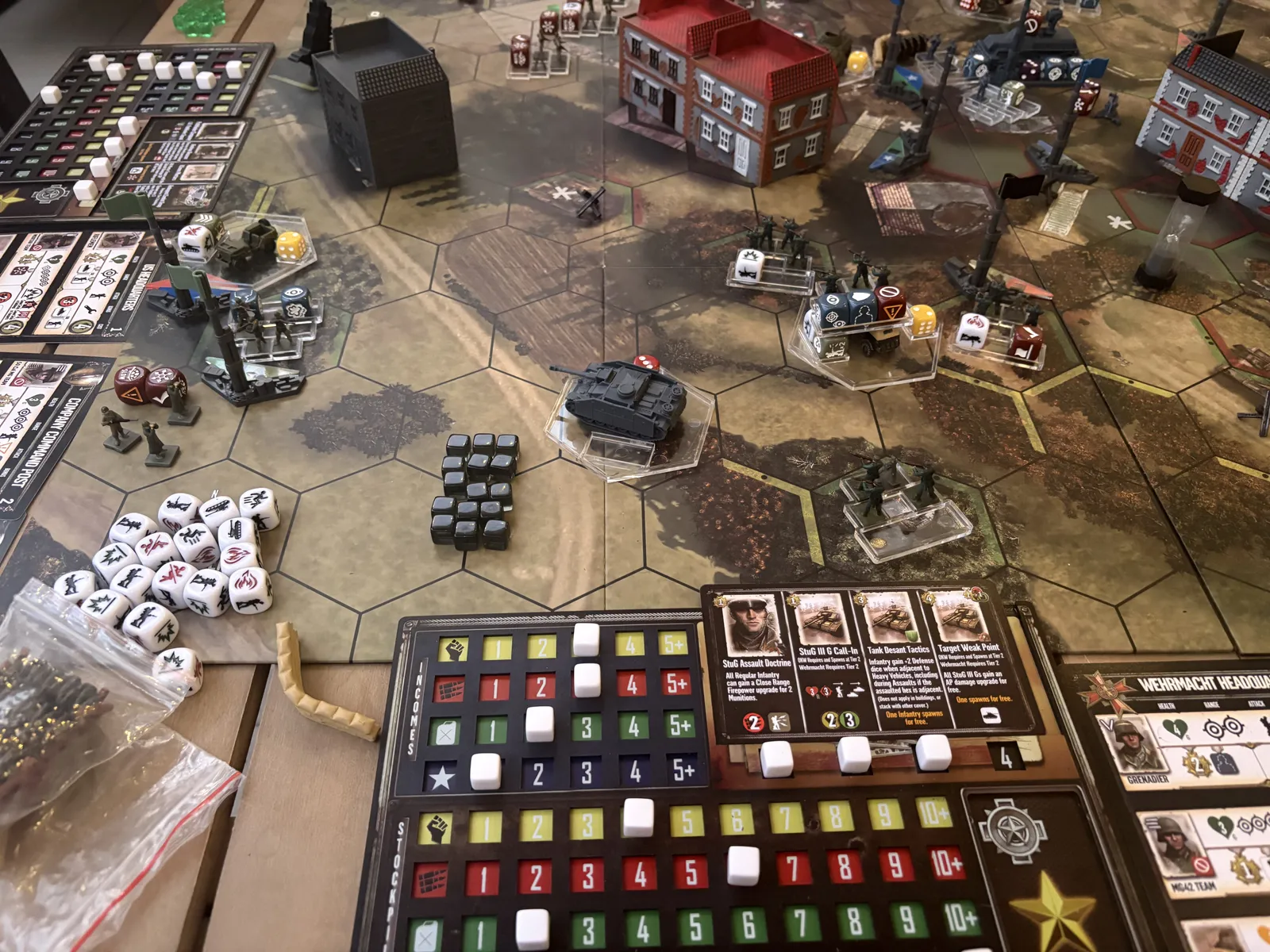
What really elevates the experience is how well it captures the feel of the videogame’s tactical tempo. In the PC series, battles are defined by constant micro‑adjustments: shifting squads into cover, rotating tanks to protect their weaker armour, timing grenades, and coordinating pushes across multiple fronts. The board game translates these micro‑decisions into a turn‑based structure without losing the sense of urgency.
Every action feels like a trade‑off. Moving a squad into heavy cover might protect them, but it might also leave another flank exposed, over-extend the line or leave that unit at the command point cap. Spending munitions on an AP upgrade now might save a squad and threaten nearby armour, but it might also delay a crucial upgrade later. The game forces you to think in layers — immediate survival, mid‑term positioning, and long‑term tech progression — just like the RTS.
The interplay between infantry and vehicles is one of the most satisfying aspects of how Company of Heroes has been designed. Infantry are flexible, able to capture points, take cover, and use terrain to their advantage. Vehicles, on the other hand, are powerful but vulnerable if misused. A tank that charges ahead without support can be flanked and destroyed by a well‑placed anti‑tank squad — especially if it’s a tank that can’t fire its anti-personnel weapons in a 360 degree arc.
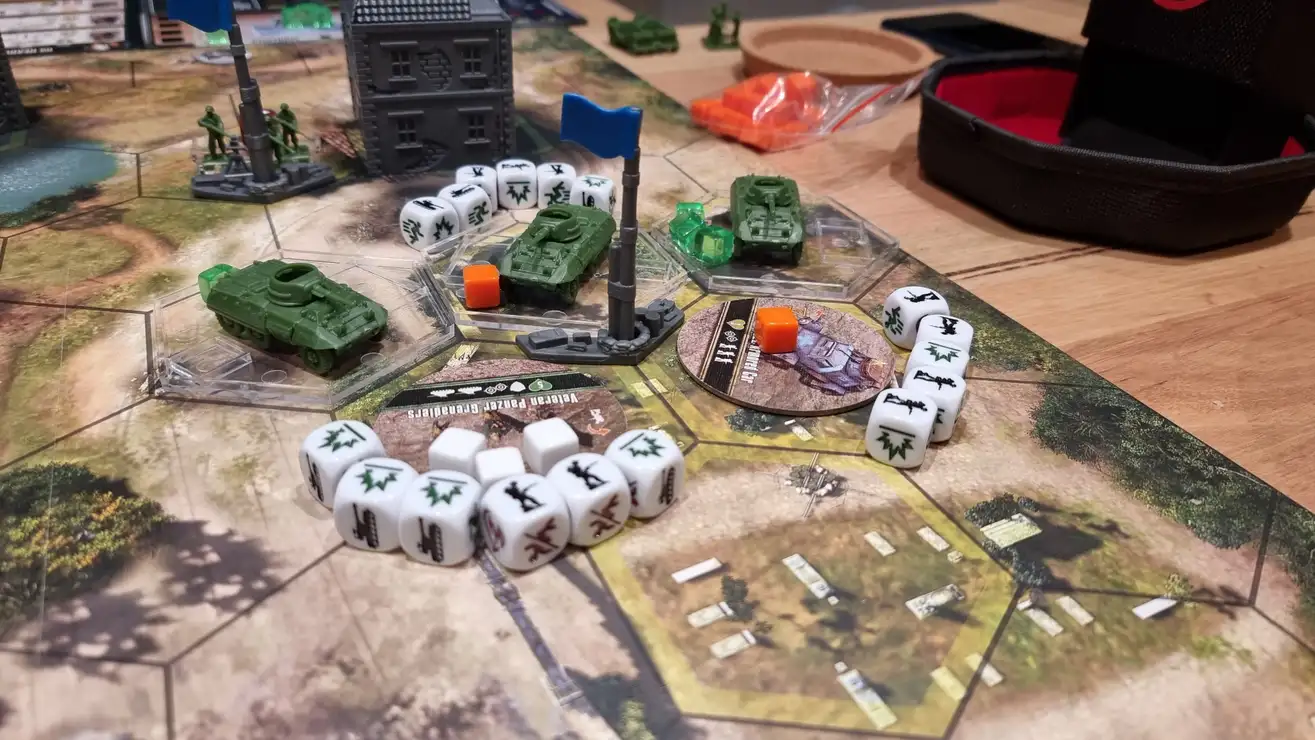
Conversely, a tank used carefully — screening infantry, pushing through barbed wire, and controlling open ground with good spotters just in front — can dominate the battlefield. The second edition’s improved vehicle rules make these interactions even more dynamic. Facing matters, armour values are critical, and the way you position your vehicles can determine the outcome of an entire engagement.
Cover is another area that I’ve touched upon but need to describe in more detail. Just like in the PC game, cover is essential for infantry survival. Light cover reduces incoming damage from gunfire; but heavier cover can make a squad nearly immovable without “high explosive” damage or pinning and flanking. Buildings offer even stronger defensive bonuses, but they come with risks — flamethrowers and high explosives (like mortars) can destroy entire buildings (and the units within them) with relative ease. The rules for cover are detailed, but they’re intuitive once you’ve played a few rounds. These features create a battlefield where positioning is as important as raw firepower and tactical retreat is an actual option.
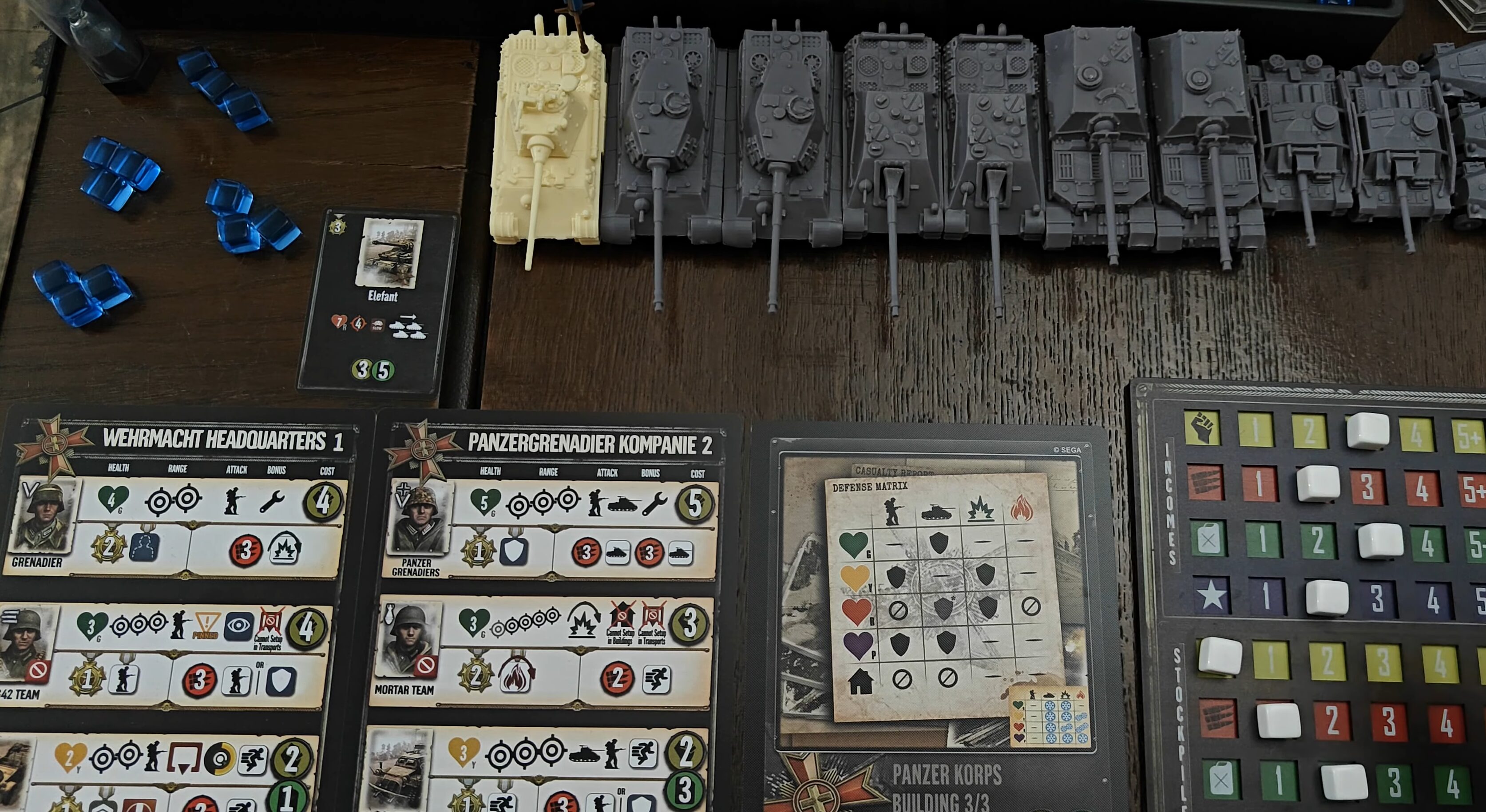
The tech tree system is also worth highlighting. Each faction has its own set of buildings and upgrades, and choosing when to advance your tech is a major strategic decision. Rushing to Tier 2 or 3 unlocks powerful units like Panzer IVs or Sherman tanks, but doing so too early can leave you with a fragile frontline. Investing in infantry upgrades — BARs, MG42s, flamethrowers and such (all represented by additional die faces to slot onto your bases) — can give you early dominance, but you risk being outmatched later if your opponent reaches their heavy armour first. This tension mirrors the RTS perfectly. You’re always weighing the benefits of immediate strength against the promise of late‑game power.
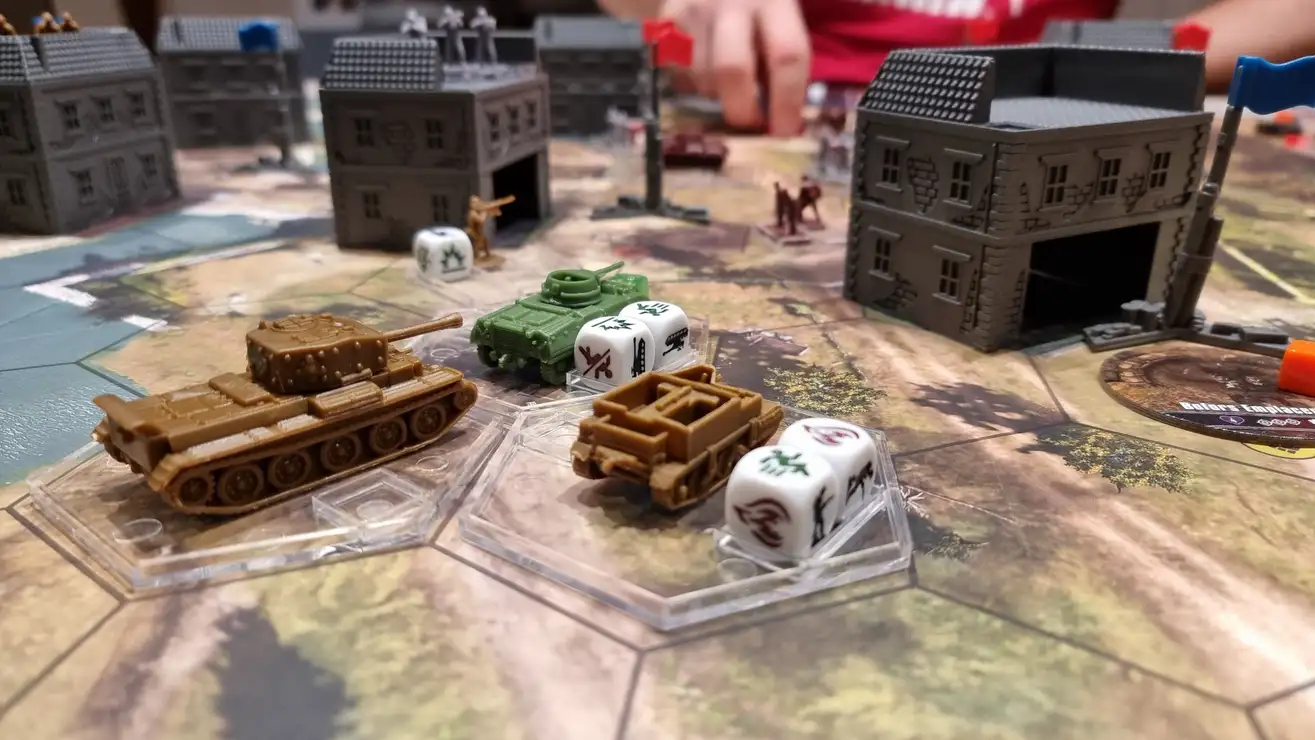
The scenarios and maps add even more depth and there’s a lot more choice than I will ever need. Some maps favour aggressive play with clustered resource points that reward early pushes and lead to a relatively short game. Others are more defensive, with chokepoints and long sightlines that encourage careful positioning and make breakthroughs difficult. The map pool is limited by the actual game boards available, but there’s still enough here to tailor the experience to a specific group’s preferences — fast, brutal skirmishes or longer, more strategic battles.
Despite its complexity, Company of Heroes is surprisingly accessible once players understand the core loop. The rulebook is dense, but the iconography is clear, and the second edition’s improvements make the game easier to teach than the first. Going back to my comments about common sense, I would describe the experience as “complex but intuitive” which is fairly rare for this kind of wargame. The first few turns will definitely feel overwhelming, but by the middle of your second or third game, practical logic will start to show through the density.
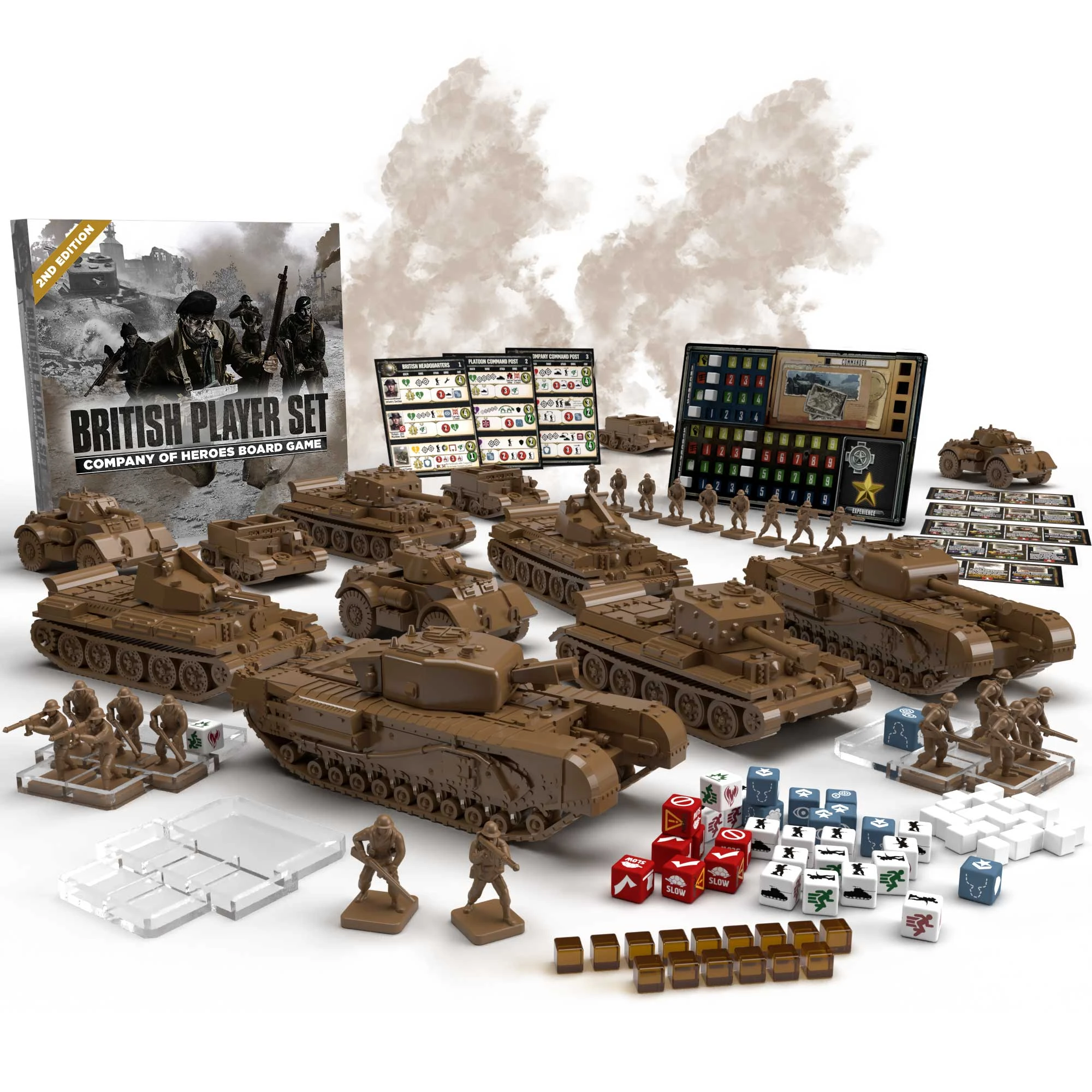
The British Player Set
The British Player Set expands Company of Heroes: 2nd Edition with a faction that feels completely distinct from the Americans and Wehrmacht, leaning heavily into defensive play, positional control, and late‑game power spikes. In the videogame, the British are known for their reliance on emplacements, elite infantry, and powerful armour, and the board game captures that identity extremely well. British infantry squads are expensive but durable, and their upgrades — such as Bren guns and PIATs — give them strong mid‑range firepower. The British emphasis on cover and entrenchment means that once the British establish a foothold on the map, dislodging them becomes a serious challenge.
What makes the British particularly interesting is how their (or, erm, our) economy and tech progression differ from other factions. They tend to advance more slowly in the early game, relying on careful positioning and defensive bonuses to hold key sectors. But once a British player unlocks their late‑game units — especially the Churchill and Cromwell tanks — the faction transforms into a heavy, grinding force capable of pushing through entrenched enemy lines. This creates a satisfying arc where the British begin cautiously, consolidate their position, and then surge forward with overwhelming force. For players who enjoy methodical, positional play and the satisfaction of building an unbreakable line, the British Player Set adds a rich new strategic dimension to the game.
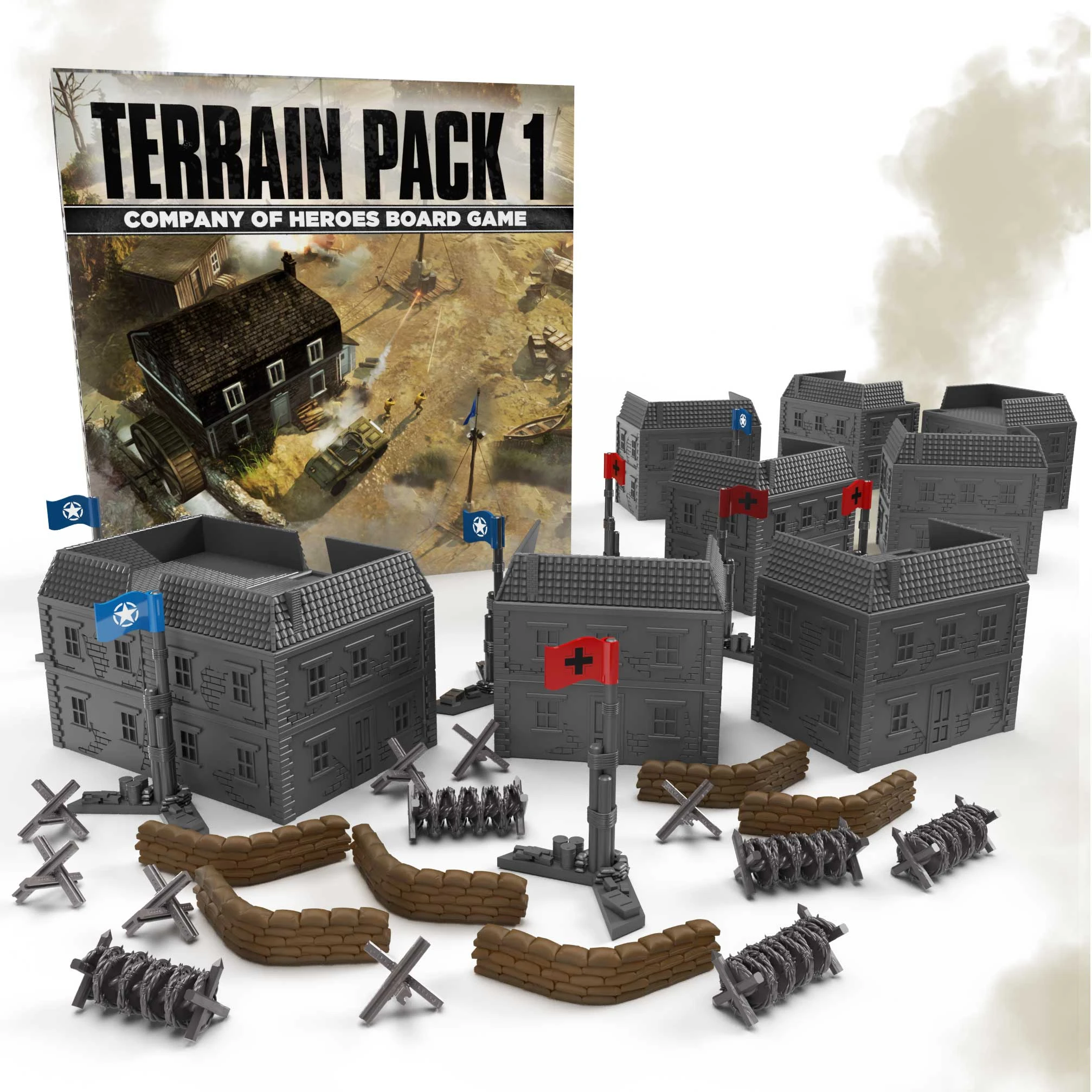
Terrain Pack 1
For me, Terrain Pack 1 is perhaps the most impactful and essential addition you can make to your copy of Company of Heroes: 2nd Edition, not because it adds new units or factions, but because it massively improves the visual appeal of an already impressive looking game. The pack introduces a wide variety of three‑dimensional terrain pieces including buildings, control points, sandbags, and more which either replace or augment the tokens and printed terrain on the map boards.
These pieces don’t just improve the visual presentation; they meaningfully alter how battles appear on the table. Line of sight becomes more understandable, cover becomes more intuitive to read, and movement paths become more constrained or more exploitable depending on how the terrain is arranged. If I have a single complaint about this pack, it’s only that it leads to the potential for spaces to become a bit too cluttered to remain entirely usable, but it’s a small price to pay that rarely causes an issue.
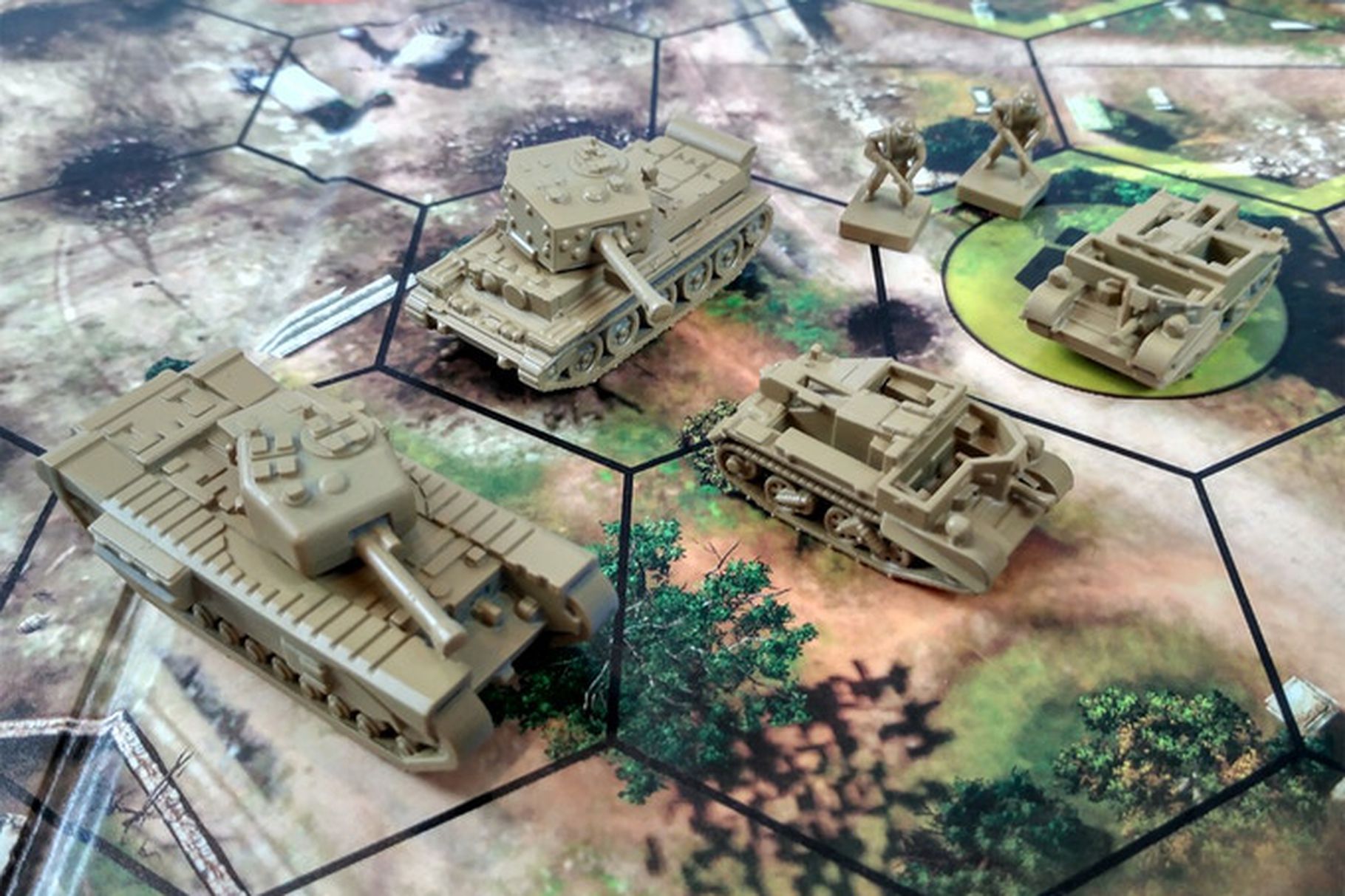
Ultimately, Company of Heroes: 2nd Edition succeeds because it respects both its source material and its players. It doesn’t simplify the RTS into a generic skirmish game; it embraces the depth, the economy, the tactical nuance, and the constant pressure that define the digital series. It’s a demanding game, but it rewards the time you invest in it with rich, cinematic battles and a sense of strategic mastery that few tabletop wargames can match — after all, just look at it!
For fans of the videogame, this is one of the most faithful adaptations ever made. It captures the tactical nuance, the economic pressure, and the constant push‑and‑pull of map control. For wargamers, it offers a deep, rewarding system with enormous replayability. The rules are complex, but the payoff is worth it: a rich, immersive wargame that feels like commanding a real battlefield.
You can find out more about, and do a late pledge for, Company of Heroes: 2nd Edition on its Kickstarter page.
