

When it comes to games about running businesses, there are a few that come to mind… and some of them end in big arguments and disappointment. I’m not saying that Big Boss fixes all of the issues of games about exponential, capitalist growth, but I will say that everybody left happy each time I played it.
First things first: Yes, hey, it is funny that this website is called Big Boss Battle and we’re reviewing Big Boss. Secondly, and more importantly though, Big Boss is an impressive looking board game that’s also deceptively simple. In it you’ll play an investor, of sorts, and you’ll create and place small businesses while riding the wave of monopolising, rapidly expanding corporations. Sound boring? It’s actually not, and is surprisingly fun to play.
One of the first things you’ll notice while unboxing Big Boss is how many components it has. It’s certainly a little daunting to open a box that has at least a couple of hundred pieces, with over fifty of those being interlinking plastic. It turns out, though, that those are really just scoring pieces, with you either placing four (in the case of founding a corporation) or a single one of those pieces on your turn. Their elevation is important not just visually — because it does look cool — but for your scoring; If you place the piece three up, it’s worth three points, for instance.
But, I’m getting ahead of myself. One first look at Big Boss would have most people assume that you’re going to be playing as one of the corporation, factions that spread across the board. You’re not. In fact, you could never place a second tile within the same corporation in a game and still come out on top at the end.
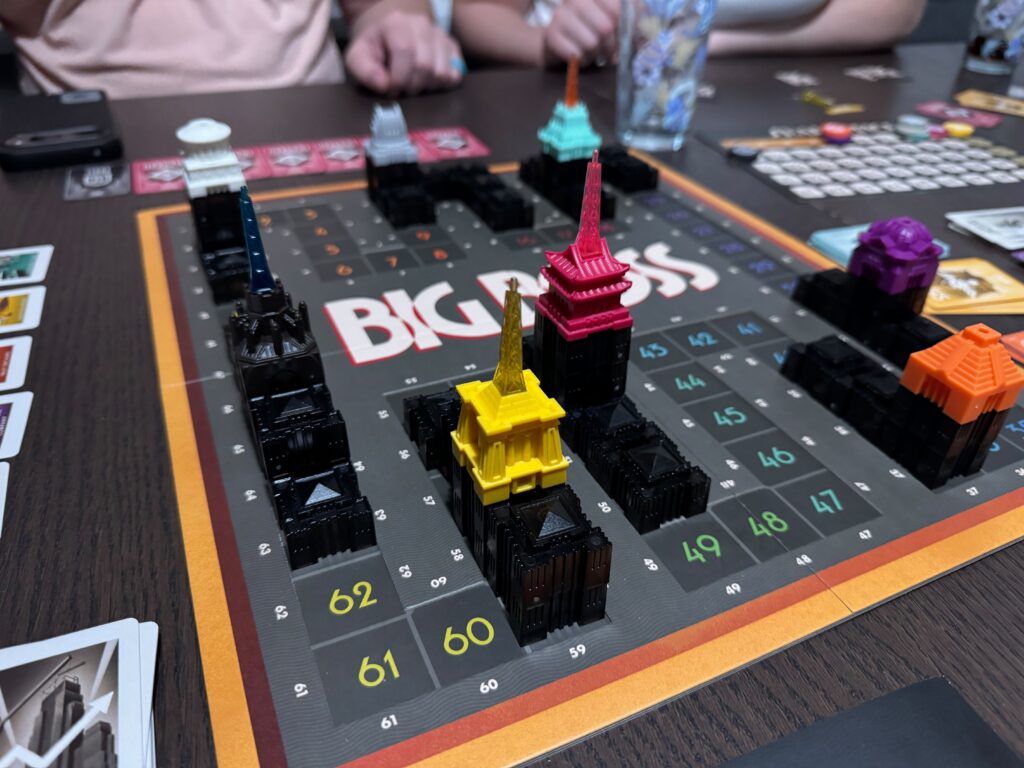
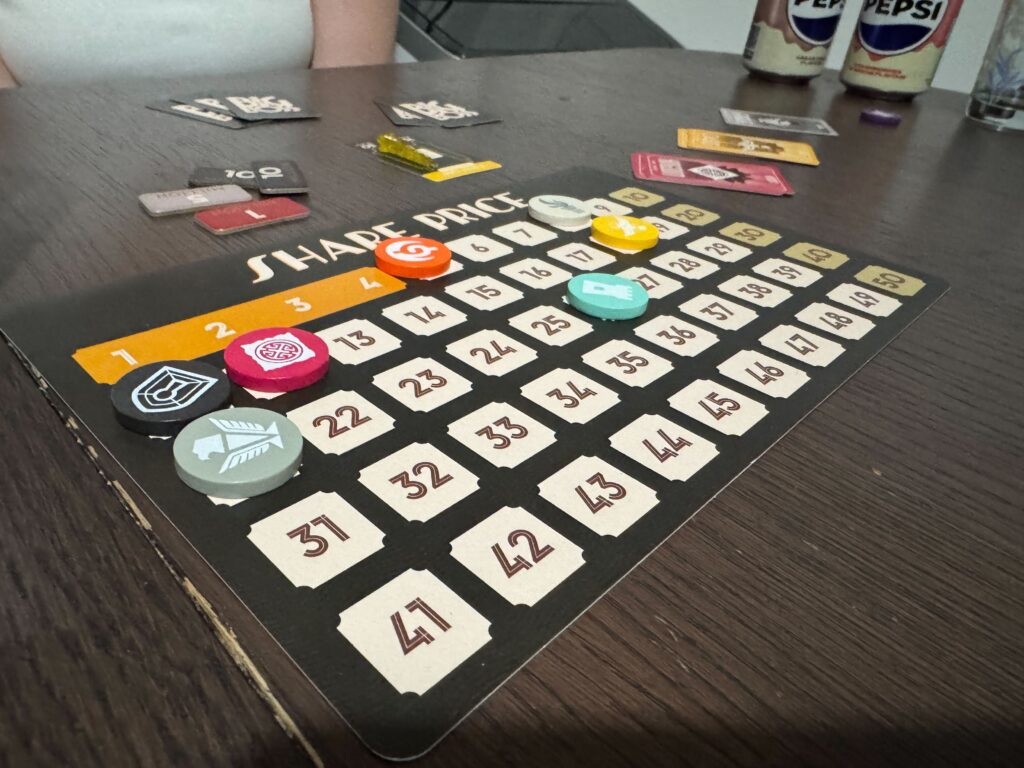
Set up has each Corporation’s shares and Headquarters placed around the board, a share tracker placed out with tokens for each corp, and the business deck shuffled (with a few distributed to each player). There are also ‘Level Up’ tiles, which the pure Big Boss experience simply uses to place a business in an otherwise impossible position. There are included rules for Acquire, which is the game that Big Boss is based off (and a simplified version of) which repurposes these tiles.
Each player’s turn is as simple as either buying a new card, or playing a valid business card. In the case of the latter you’ll place a business in a position where it has at least three empty spaces between it and the next business. If all of the corporations are not in play yet then you’ll take four of the building pieces and create a structure three wide, with one space two high, you’ll then place the headquarters token on top. After placing your business you’ll adjust the share price accordingly, then collect payment equal to the new share price and then you can pay to install one of your two radio towers, or buy shares in any existing company (for the price of the share). Simple.
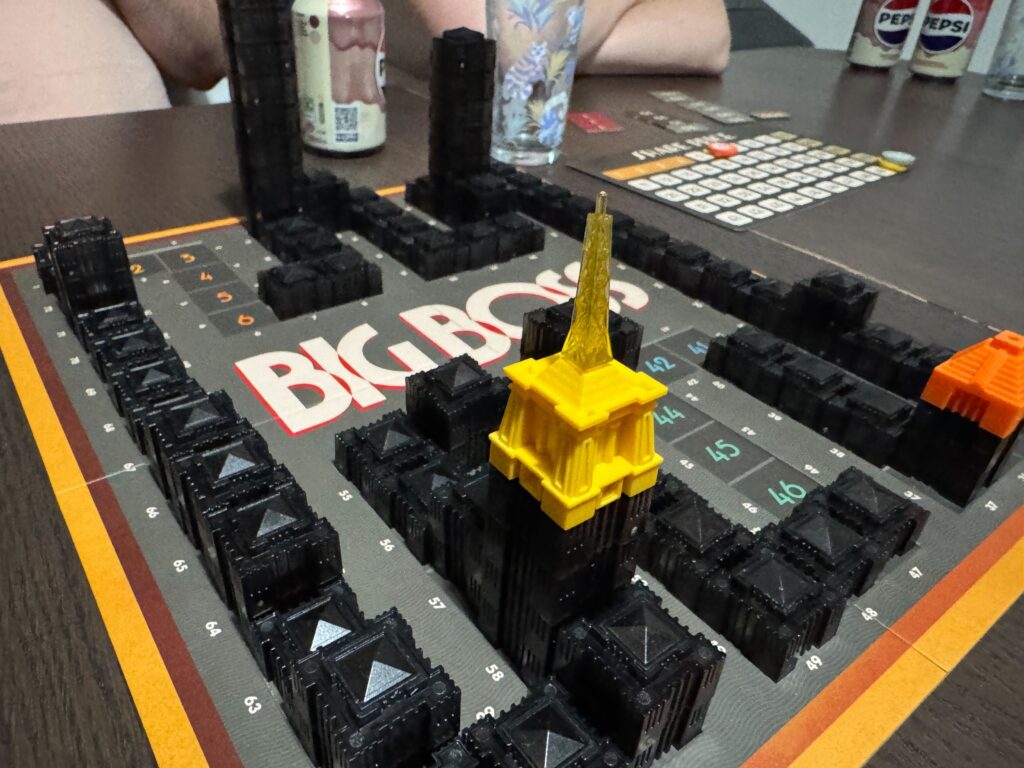
Complexity comes in that corporations can merge if they touch, with the larger company consuming the smaller one, ramping up its share price and causing all players to cash out. In these cases the shares pay out for the current share price in the company — and a radio tower, which will often be the difference between winning or not, will pay out the value of three shares. This is an amazing way to cause your share prices (which you hopefully bought low) to rocket in value, however this is also where the most important, late-game defining rule comes in: Companies can never have share values higher than 50m, even if they’ve just acquired another company. That means that once they’ve ballooned to full-size there is no point in buying shares in them — although a massive point in adding smaller businesses to it (as you’ll get a share price pay-out).
And, that’s really it for Big Boss rules. The strategy comes in careful company placement and acquisition, as well as getting your radio towers onto the corporations that you think will hit maximum share price during the game. The rest is business and bluster.
Big Boss manages to become a seamless play experience within a few turns, and it’s hard to get tired of how cool it looks. Critically, because nobody actually owns any of the buildings (although it could be said that getting a radio tower on the right building is a coup) there’s always a lot of flexibility in how you play, with nobody forced out uncomfortably early.
Big Boss is available now from Amazon

Comments are closed.