

Explore the world and race to complete your jet-setting objectives in Atlas: Explore the World.
There’s a quiet, enduring appeal to games that invite us to explore — not through conquest or competition, but through curiosity and connection. Atlas: Explore the World, published by ION Game Design and designed by Robin Spathon Ek, is a game that embraces this ethos wholeheartedly. It doesn’t ask players to dominate or outwit each other in the traditional sense. Instead, it offers a journey — one that’s grounded in geography, movement, and the joy of discovery. In a market often saturated with conflict-driven mechanics, Atlas stands out as a game that celebrates the world and our place in it.
At its core, Atlas is a competitive, map-based game for 2 to 4 players, where the objective is to complete missions by travelling across a detailed world map, collecting souvenirs and marking off destinations in your blog. Players take on the role of explorers, each with a hand of objective cards and personal preferences that guide their movement and decision-making. These objectives might require visiting specific regions, connecting cities across continents, or achieving thematic goals such as exploring coastlines or traversing deserts. The game is not about trivia or knowledge recall — it’s about spatial planning, route optimisation, and strategic timing.
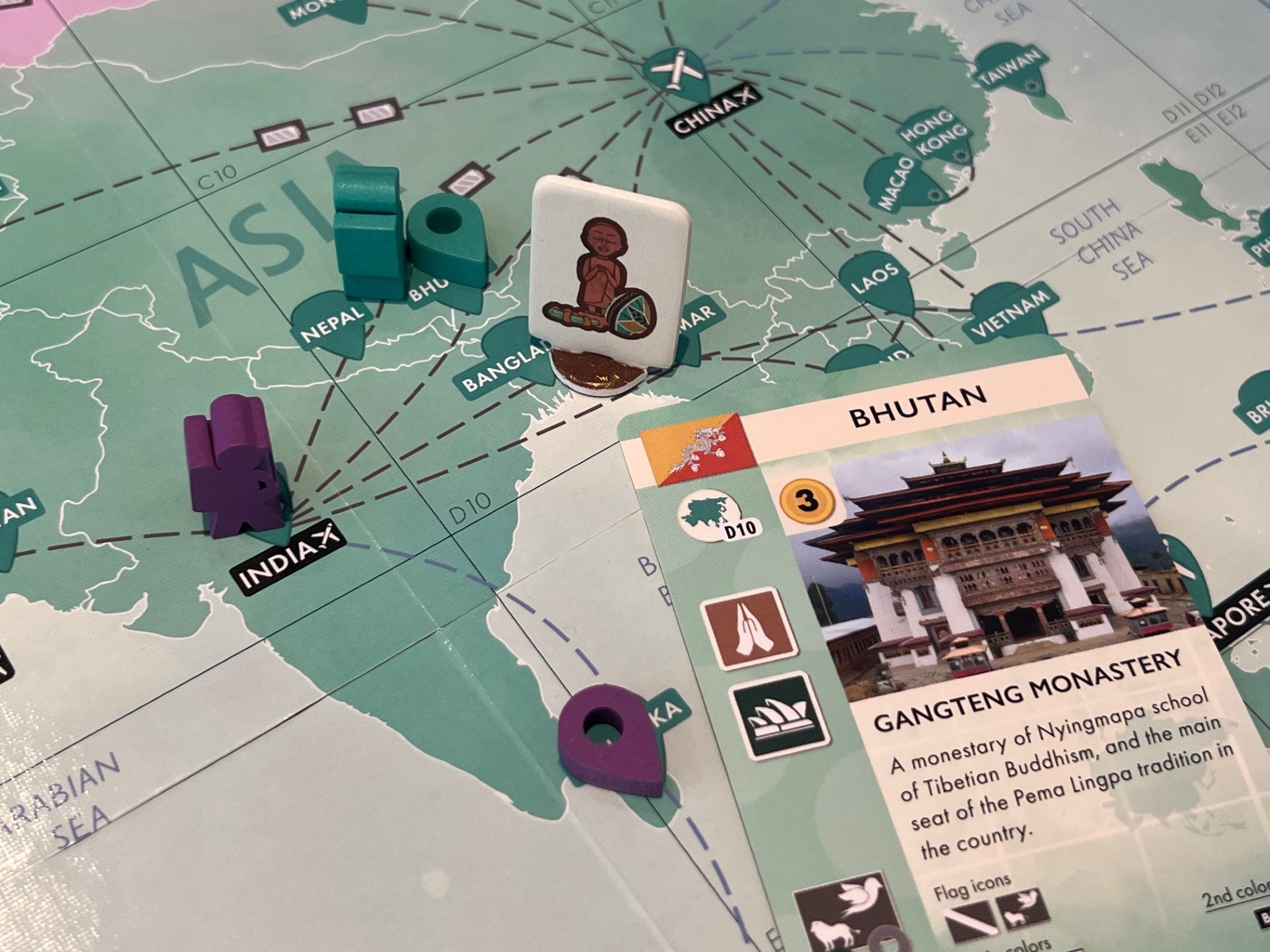
The game unfolds over a series of turns wherein the player will take one main action and then a bonus action. Actions include travelling (either by land, air or sea), exploring, working, resting and blogging, with a few minor or sub-actions (such as buying souvenirs) that are situational. Travelling costs energy or cards, with land or sea routes being especially tiring, and air routes being more efficient but coming at a cost of valuable destination cards. Movement of both kinds works a bit like it does in Pandemic weirdly, although the game itself is nothing like Matt Leacock’s cooperative classic.
Objective and destination cards are the heart of the game. Each objective card presents a geographic or Vexillology challenge — visit certain locations, collect maps from a certain region or enjoy a specific set of experiences, for example. There are a number of public goals that are visible to all players and drawn randomly during setup, whilst all personal objective cards are private, adding a layer of hidden information. The variety of missions ensures that no two games feel the same, and players must constantly adjust their plans based on the evolving board state.
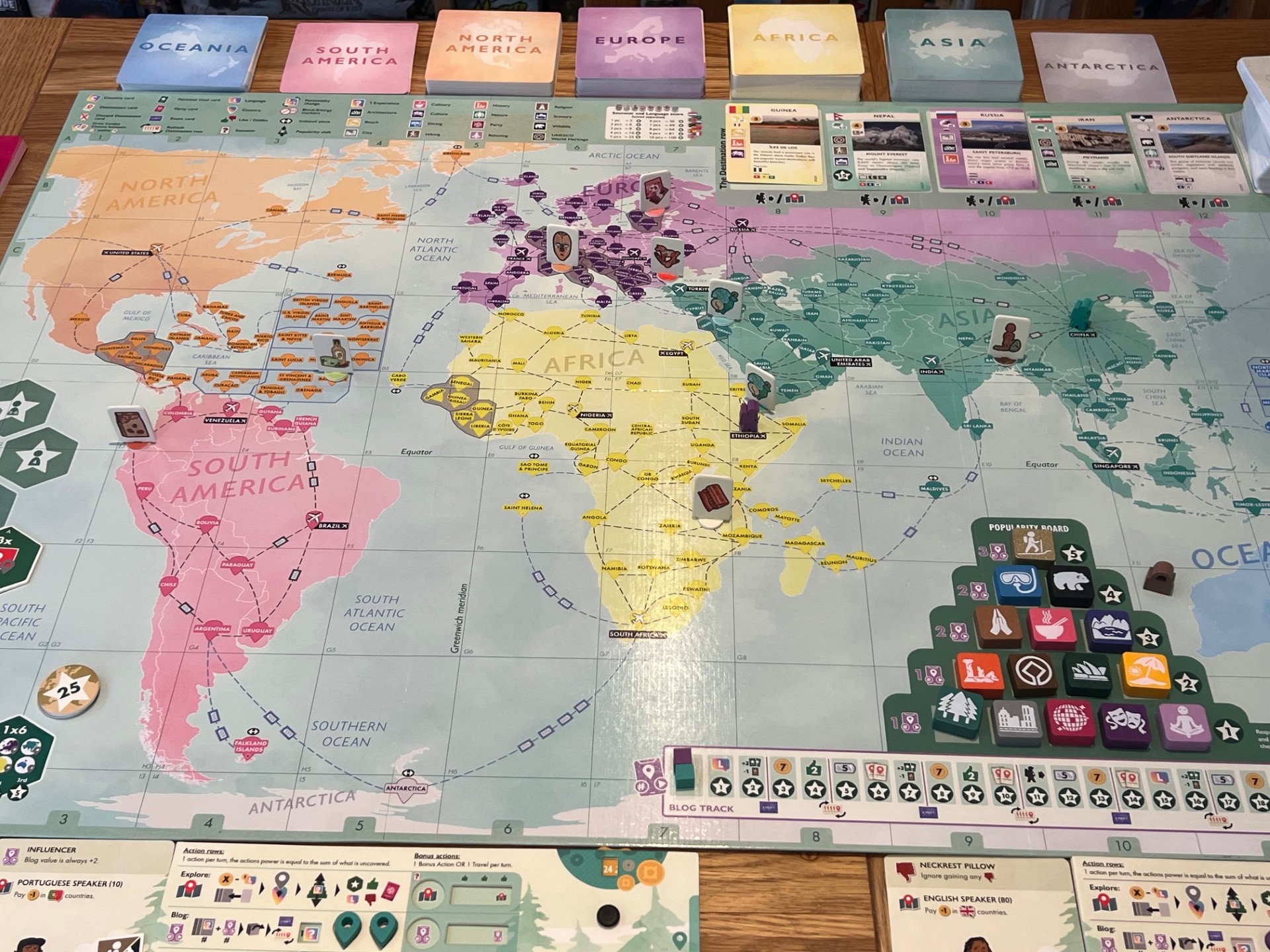
One of the most elegant aspects of Atlas is how it encourages players to think globally. The map is not just a backdrop — it’s a living, breathing part of the game. Players must consider geography, connectivity, and timing as they chart their paths. The game rewards those who can see the bigger picture, who can plan several turns ahead while remaining flexible enough to adapt to changing circumstances. It’s a game of movement and momentum, where every decision feels meaningful.
The visual presentation reinforces this sense of exploration. The map is beautifully illustrated, with a soft, painterly aesthetic that evokes travel posters in estate agent windows and yet retains a lot of granular detail. The cities are clearly marked, the routes are easy to follow, and the iconography is intuitive. The components — cards, tokens, and player boards — are well-produced and thoughtfully designed. Atlas is a game that looks and feels good on the table, inviting players to immerse themselves in the experience.
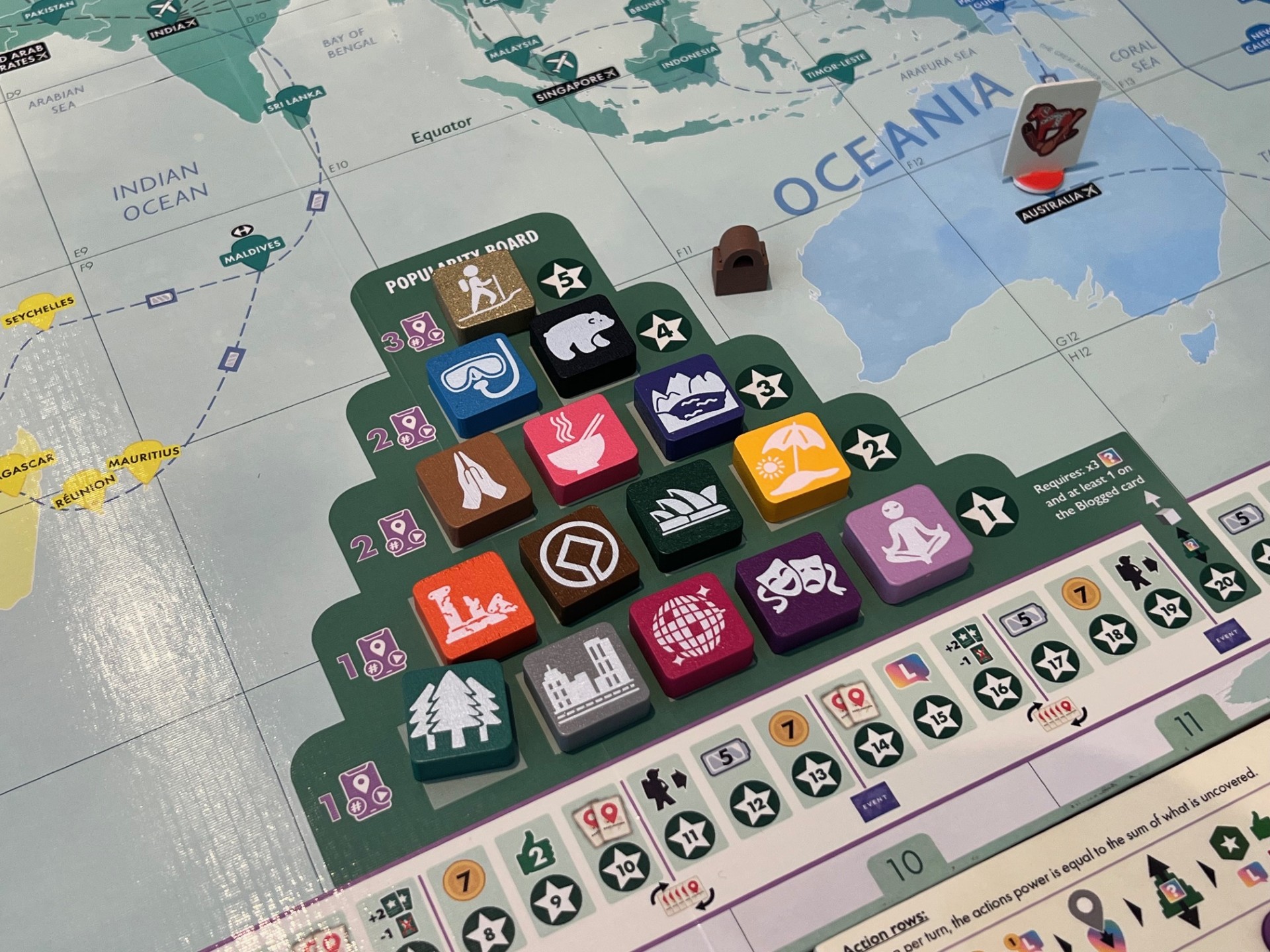
In terms of player interaction, Atlas is more about positioning and pacing than direct conflict. You’re rarely blocking opponents outright, but you are racing to complete the public goals, competing to place exploration tokens, and occasionally outmanoeuvring each other on the map by affecting the “popular” activities pyramid. It’s a game of subtle competition, where timing and foresight matter more than aggression. This makes it well-suited to a wide range of players, from more mature families and educators to seasoned gamers looking for something a little different.
The game scales well across its 2 to 4 player count, with each configuration offering a slightly different rhythm. At two players, the game becomes more strategic and positional, with more freedom to plan long routes that might result in a souvenir, or a public goal. At three or four, the board feels more dynamic, with increased competition to visit key cities and mission objectives – moving through a city you’ve already visited costs no energy, and this becomes a key element of the game. The sheer number of objective and destination cards ensures strong replayability, and the inclusion of different objective types allows for a wide range of strategies.
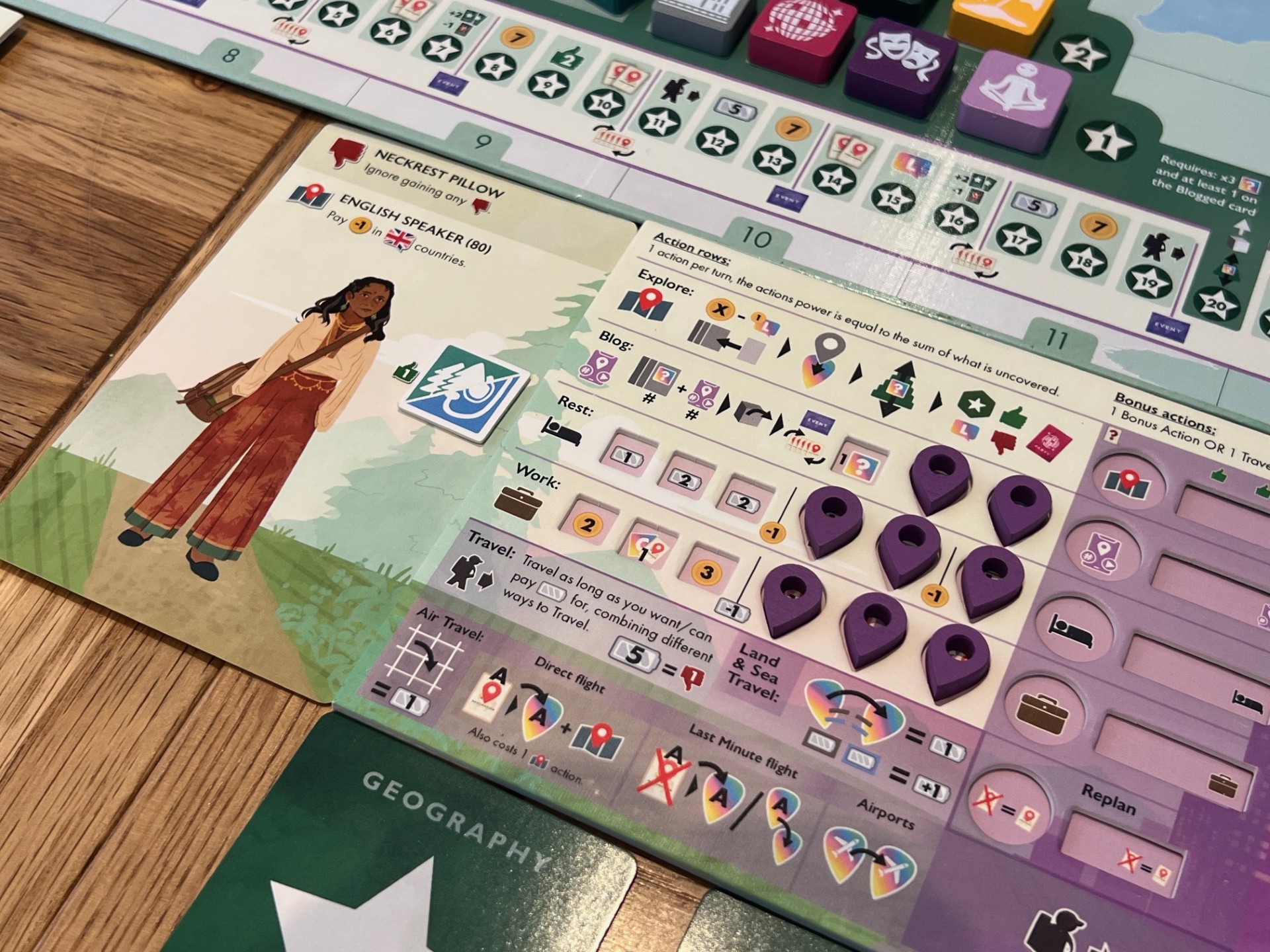
There are a couple of minor downsides to Atlas, including its sheer scale – and the fact that in general it “looks” imposing even though in practice it isn’t too bad. The huge number of decks and cards makes it look and feel complex, but the reality is, most cards can be taken at face value – with the location decks all sorted by number meaning that you actually search them for the card you need. Destination cards are drawn randomly and along with the objective cards, can dictate play, but there are plenty of ways to get new ones by doing work or blogging.
These are small concerns in the context of what Atlas actually offers. It’s a game that respects its players, treating them like adults and allowing for the expansive inclusion of many cities, countries, locations and wonders. Atlas offers a genuinely engaging way to explore the world from your tabletop thanks to the number and variety of destinations, often sparking conversation around the table as different destinations are seen. It’s not just about where you go in Atlas, and often the offboard chat is just as valuable as the gameplay.
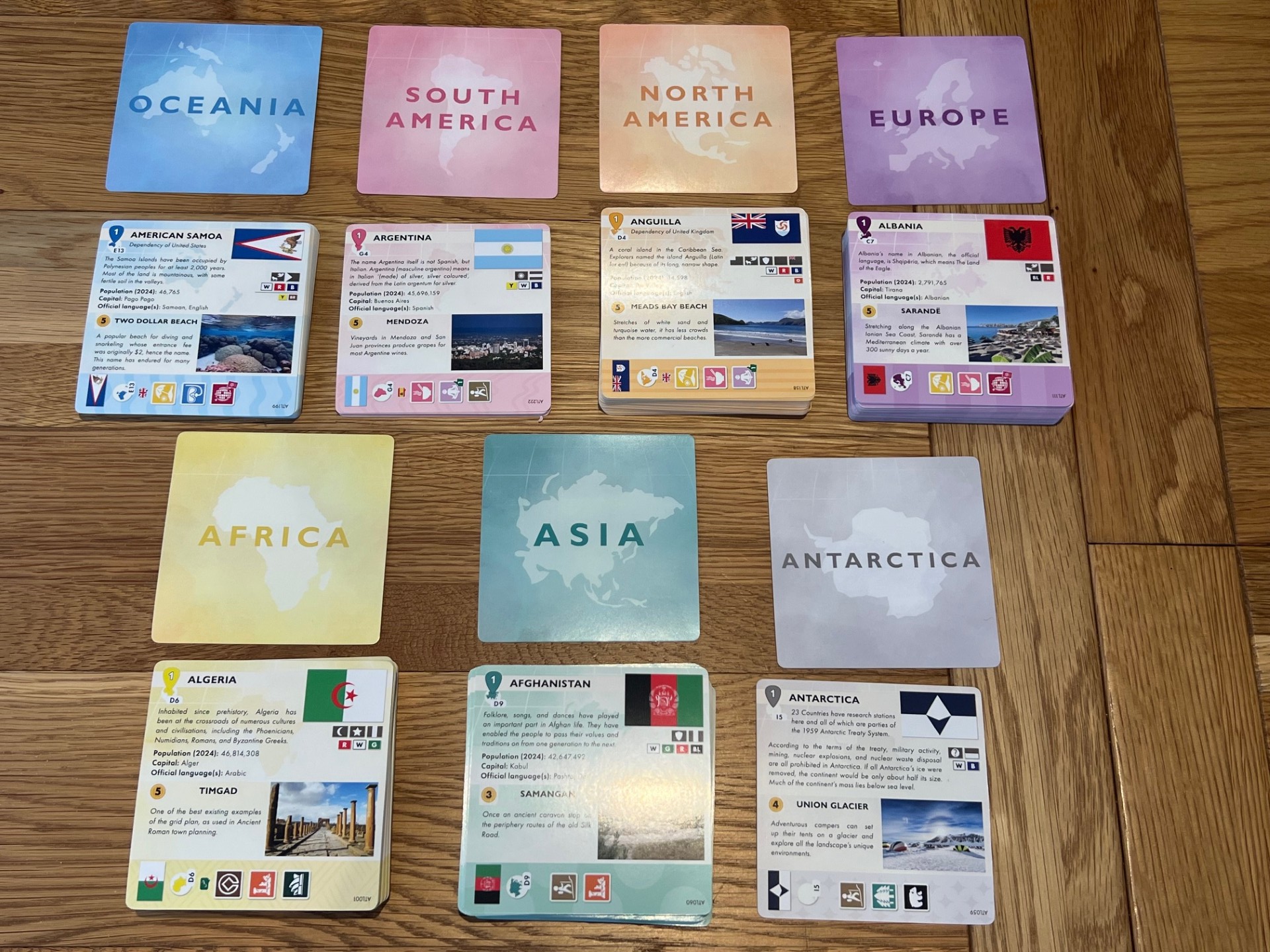
In closing, Atlas: Explore the World is a thoughtful, beautifully crafted game that invites players to engage with geography, movement, and global strategy in a meaningful way. It’s a rare example of a game that is both educational and strategically satisfying, offering depth without too much complexity and competition without conflict. Whether you’re tracing routes across continents, navigating the tropics or racing to complete a public objective before your rivals, Atlas makes every journey feel like an adventure.
ION Game Design has delivered something really nice here — a game that feels timely, relevant, and refreshingly optimistic about travel. In a world that often feels divided, Atlas reminds us of the richness and interconnectedness of our planet. It’s a game that encourages curiosity, rewards exploration, and leaves you just a little bit more connected to the world than when you started. And in the end, that’s a journey well worth taking.
You can find out more about Atlas: Explore the World on its Kickstarter page.

Comments are closed.