
Arkham Horror The Card Game Chapter Two Core Set Review – A Perfect Starting Point?

There are games that invite you to sit around a comfy table with friends and enjoy a pleasant evening full of laughs and light-hearted competition. Then there is Arkham Horror: The Card Game. This one hands you a flickering lantern, leans in just a little too close, whispers something deeply unsettling about things man was not meant to know, and gently ushers you—and anyone brave enough to join you—out into the dark.
Published by Fantasy Flight Games, Arkham Horror: The Card Game’s Chapter Two Core Set takes what was already one of the most atmospheric and mechanically rich card games on the market and reshapes it into a far more approachable starting point. This Chapter Two Core Set feels less like a repackaging and more like an invitation—albeit one written in slightly ominous handwriting.
Arkham Horror: The Card Game has long had a problem that comes with success. After years of expansions and a deeply invested player base, knowing where to begin can feel like trying to choose the least concerning doorway in a haunted house. The Chapter Two Core Set steps in to solve that, offering a structured and accessible entry point without stripping away any of the depth that makes the game so compelling. As someone who has played before but never owned a copy, this is the first time it has truly felt like the game is saying, “Go on then, let’s see how you get on.”
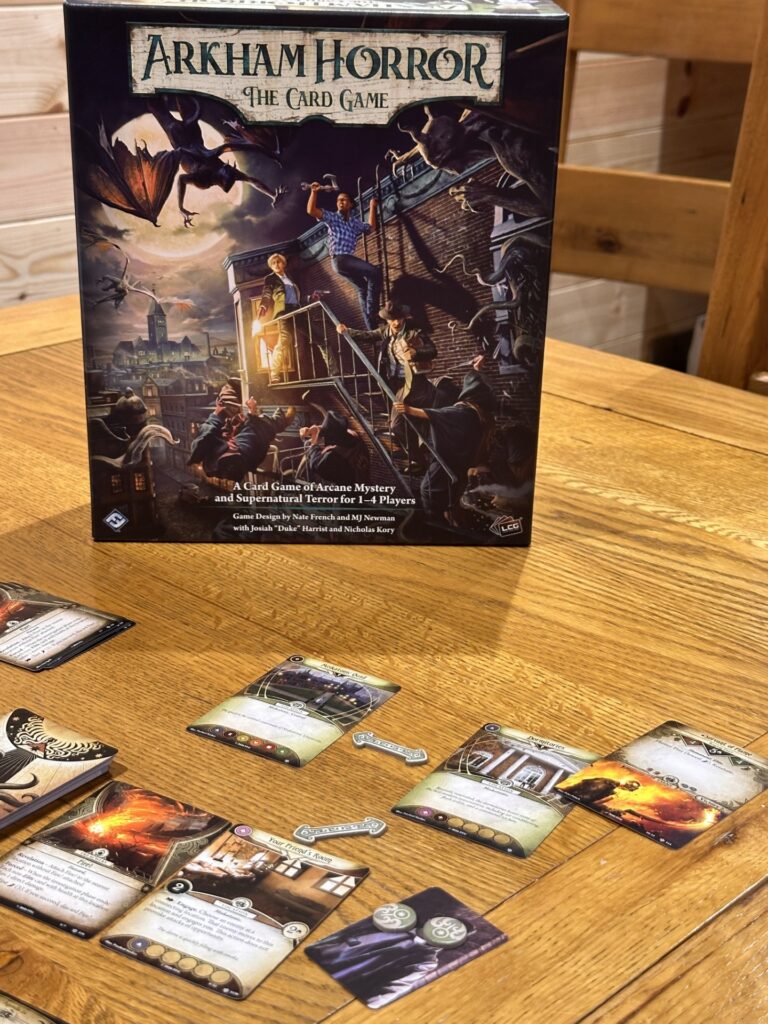 Set firmly within the mythos of H. P. Lovecraft, Arkham Horror builds itself around narrative consequence. Each scenario unfolds like a chapter in a novel—one that remembers your decisions and is more than happy to hold them against you later. The layout in front of you quite literally resembles a book, with agenda cards on the left acting as a steadily advancing timer, and act cards on the right revealing the story as you progress. It’s simple, elegant, and quietly oppressive in the way it keeps nudging you forward whether you are ready or not.
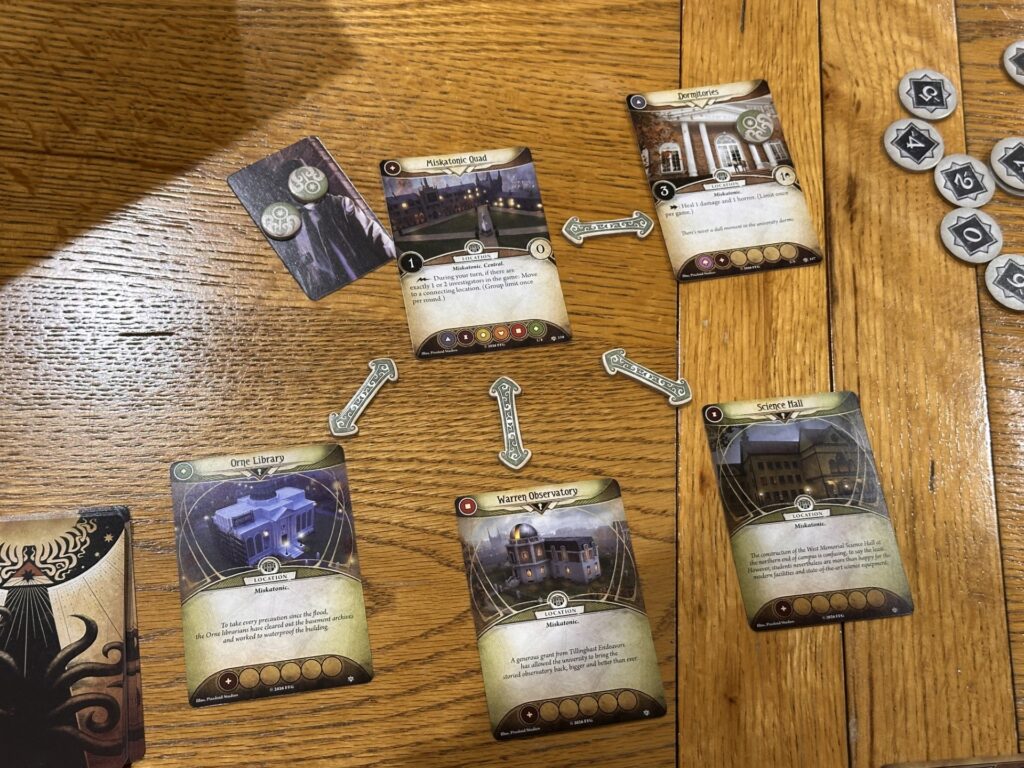
What begins as a relatively grounded investigation—perhaps something as unassuming as a dorm room in Miskatonic University—quickly expands. New locations appear, connections form, and before long the table in front of you feels alive with movement, risk, and a creeping sense that things are slipping just slightly out of your control. Enemies begin to appear, hazards take root, and occasionally the worst outcome isn’t failure, but what happens after it.
The Chapter Two Core Set includes five investigator decks, each built around a clear identity. Daniela Reyes leans into direct confrontation as a Guardian, while Joe Diamond thrives on intellect-based investigation as a Seeker. Trish Scarborough excels at resource generation as a Rogue, Dexter Drake toys with probability as a Mystic, and Isabelle Barnes, as a Survivor, is at her most effective when everything has already started going wrong—which, in Arkham Horror, is more or less the default state of affairs. None of them feel like traditional heroes. They feel like people doing their best in circumstances that are very much not in their favour.
At its heart, Arkham Horror: The Card Game is a cooperative deck-building experience, where your deck reflects not just your abilities, but your limitations and the way you approach problems. The rulebook does an excellent job of guiding you through those early steps, giving each investigator a solid foundation before encouraging you to experiment and adapt as you grow more comfortable. It’s structured enough to support new players, but open enough to reward those who want to dig deeper.
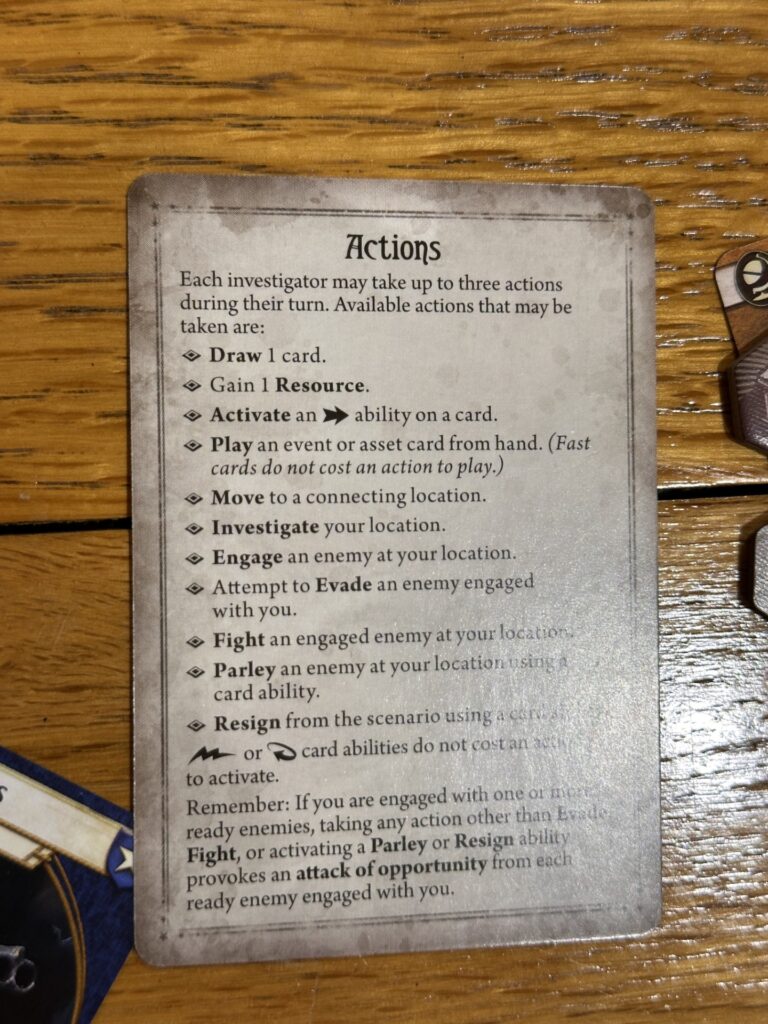
Gameplay flows through a series of phases, each one tightening the pressure a little more. The Mythos phase advances the doom clock and introduces new complications, often in the form of encounter cards that can disrupt your plans in ways both subtle and severe. The Investigator phase then gives each player three actions—move, investigate, fight, draw—and asks you to make them count. On paper it’s straightforward. In practice, it rarely feels that way.
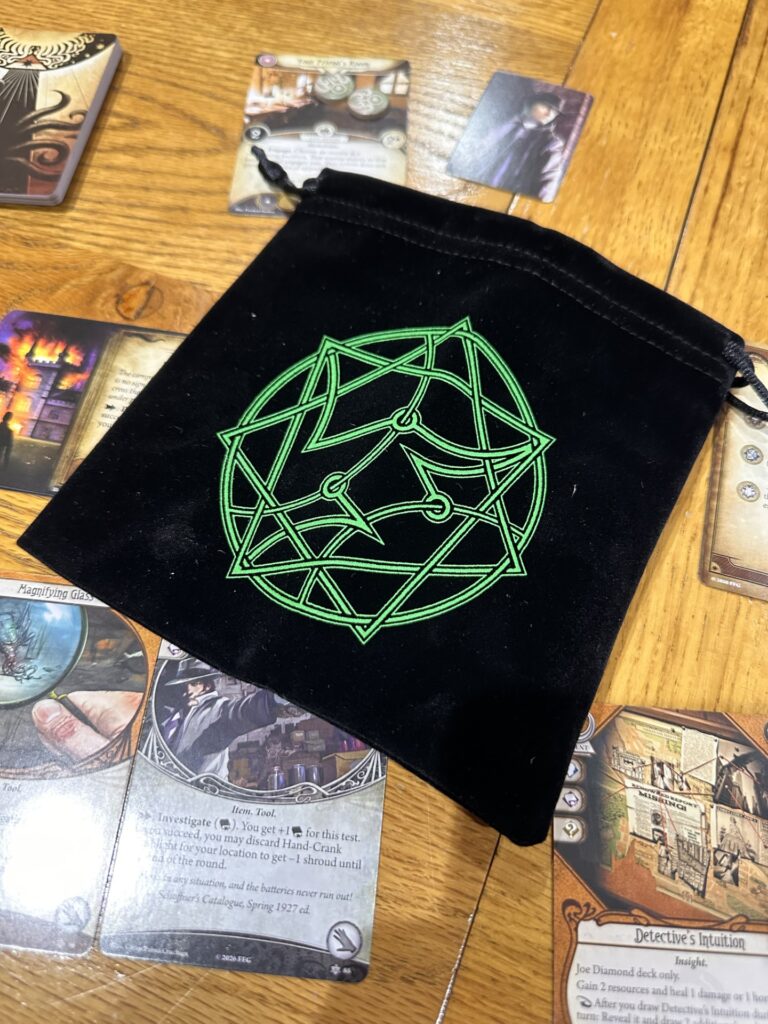
Most meaningful actions involve tests, and these are resolved by drawing from the chaos bag (I quickly started to call it the bag of doom) —an innocuous-looking pool of tokens that somehow manages to feel personally invested in your downfall. You might pass comfortably, scrape through by the smallest margin, or watch a carefully planned action fall apart because of one unfortunate pull giving you a minus two token you hadn’t accounted for. It’s not randomness for the sake of it; it’s tension distilled into a single moment. Every draw matters, and every failure has weight. Can you stand by your convictions and let a bad token pull stand? Or pretend you dropped that one back in and you just had to pull a new one?
What the game does particularly well is maintain a constant sense that you are just about holding things together. The doom clock ticks forward, enemies edge closer, and your carefully constructed plan begins to fray at the edges. It’s not loud or dramatic tension. It’s quieter than that. It’s the hesitation before drawing from the encounter deck, the realisation that you don’t quite have enough actions left, the creeping suspicion that this scenario may not end well—and the understanding that the game will continue regardless.
Because Arkham Horror: The Card Game doesn’t really care if you win. It cares that you experience it.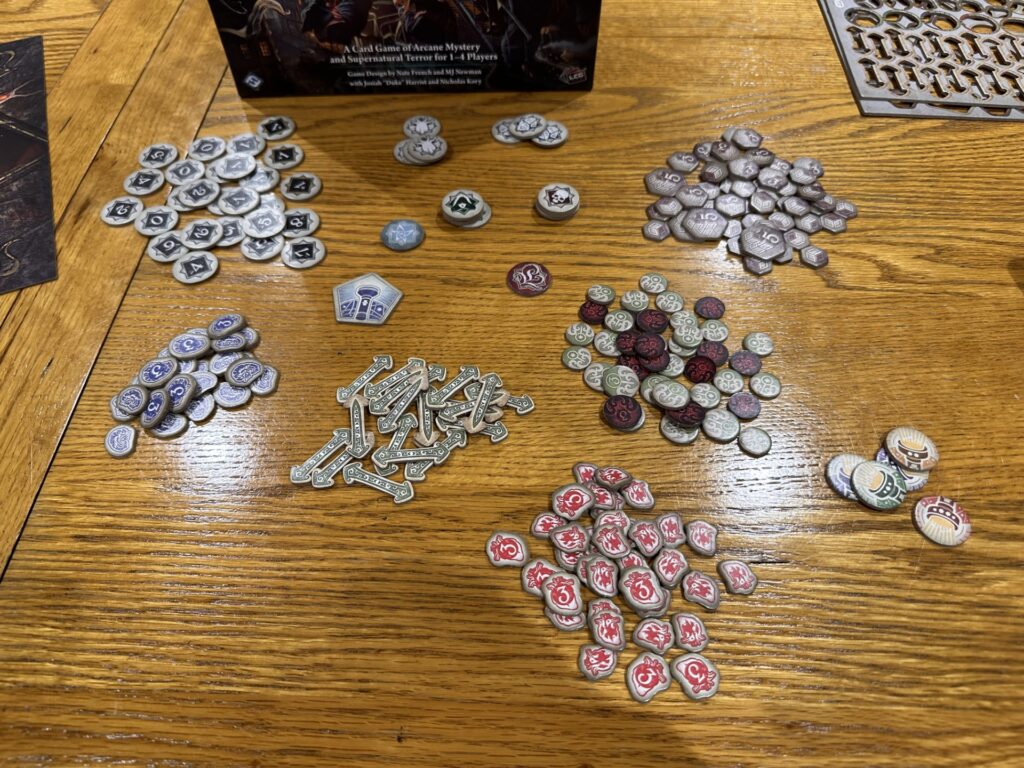
The Second Edition Core Set also makes some welcome practical improvements. The included dividers are genuinely useful for organising your collection, although the lack of token storage is noticeable and you will likely find yourself reaching for spare bags. The box itself feels sturdy enough, though perhaps not something you’d confidently store vertically without a little caution. Small things, but worth noting. My only other negative comment was the lack of bullet tokens for the times you have a card that contains a gun card with four bullets and you have to track on your own how many bullets you have fired.
Visually, the game remains as strong as ever. The artwork captures a world that feels both decadent and decaying, as though even its most refined corners are only just holding back something far worse. There’s a balance here that works particularly well—the cards are clear and readable, but never at the expense of atmosphere. Everything feels cohesive, considered, and quietly unsettling. If you are able to obtain the promo cards with the release of the Second Edition Core Set, their artwork, being pure black and white, are also a stand out thing to have in your decks.
It’s also worth saying that Arkham Horror: The Card Game is not always fair. It can be punishing, occasionally brutal, and at times feel like it is actively working against you. Skill alone does not guarantee success. A good familiarity with your deck, and the possible cards that will work against you are your greatest ally here. The encounter cards however can work against you in ways that you had not planned for, or predicted, so luck needs to be on your side. But if you are willing to embrace that uncertainty—to accept possible failure as part of the story—it becomes something far more interesting. Every decision matters, every card you have played and every action taken, even every mistake makes every small victory feel genuinely earned.
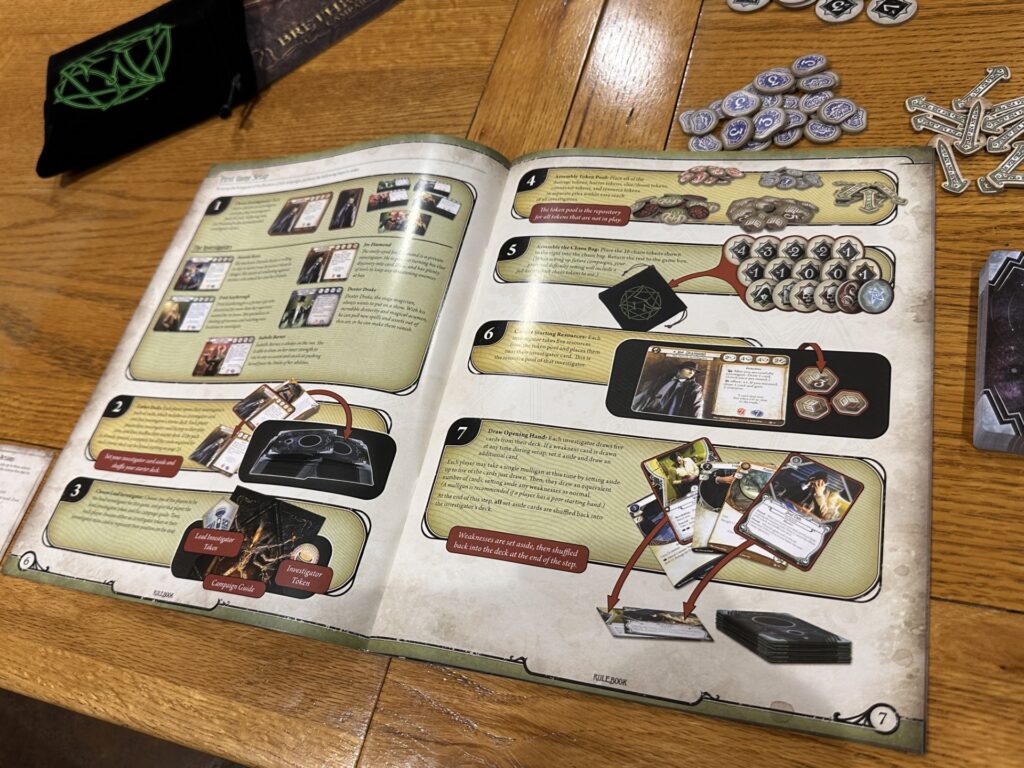
The learning curve can appear steep at first, even with the excellent guidance from the rule book provided, but it doesn’t take long before the systems begin to click into place. And once they do, the game reveals just how well it all fits together. What initially feels overwhelming (the rule book is big) becomes intuitive, and quickly I felt I understood exactly what I thought I needed to do at all times.
Arkham Horror: The Card Game – Second Edition Core Set succeeds because it commits fully to its identity and the amazing worldbuilding it is built on along with a game system that brings fantastic stories into your games. It is tense, thematic, and occasionally cruel, but above all. Every game is memorable. Skill and luck sit side by side here, never entirely comfortable with one another, and that uneasy balance is where the game finds its strength.
Much like the stories that inspired it, this is an experience that lingers.
Not because everything went right.
But because so much of it went wrong in exactly the right way.
You can learn more about Arkham Horror: The Card Game on the Fantasy Flight Games website.
