

Pac‑Man: Craze Maze is a short, family‑friendly maze‑building puzzle that captures the arcade feel in quick, tactical rounds. Whilst it’s best for casual groups and retro fans who want 15–25 minute games with light strategy and low setup overhead, its myriad of icons and mildly convoluted ruleset make the barrier to entry a littler higher than it should be.. although the payoff is worth it in the end.
Oddly, at first, Pac‑Man: Craze Maze asks players to “build” their own maze rather than race a token through a shared board as you might expect. Each turn the player draws a maze card or takes the top one from the discard pile and then either places or replaces a tile in their personal grid. The aim is to try and assemble a single continuous route from the Pac‑Man card placed during setup to an exit that maximises dots, fruit and power pellets while managing ghosts. The rules are fairly compact (albeit dense at first) and the turns are simple, which keeps the table moving and makes the game approachable for families and mixed‑ability groups. I play regularly with my five, nine and eleven year olds, and we all have a great time.
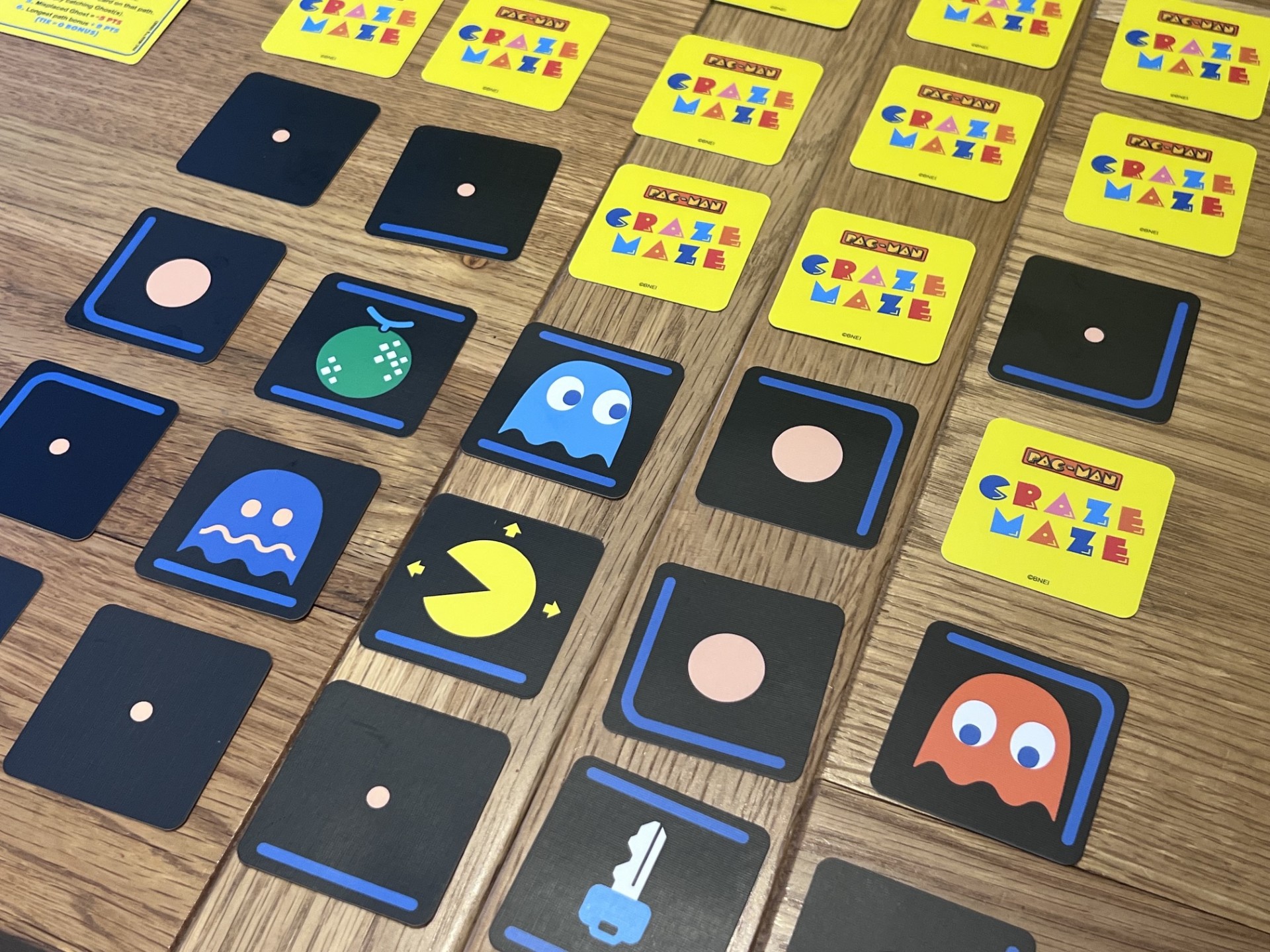
Its core decision space is neat and surprisingly tactical. Because you build your own maze and then score a single best path, the tension is about construction and denial rather than movement. You want to create high‑value corridors for yourself while making tidy paths harder for opponents. The ghost mechanic introduces a risk‑reward layer: ghosts can score big points if up to four of them are placed after a large power pellet, but a lone ghost will cost you five points.
The round structure is short and rhythmic. A typical game runs through a handful of placement turns and then a final reveal where everyone traces their best path. Because each player manages their own grid, downtime is fairly low and the social energy comes from watching how others shape their mazes and from the reveal when everyone shows their chosen route. Those reveal moments are where the excitement kicks in (especially for younger players) as the map can often feature twists and turns that work either with or against a given player.
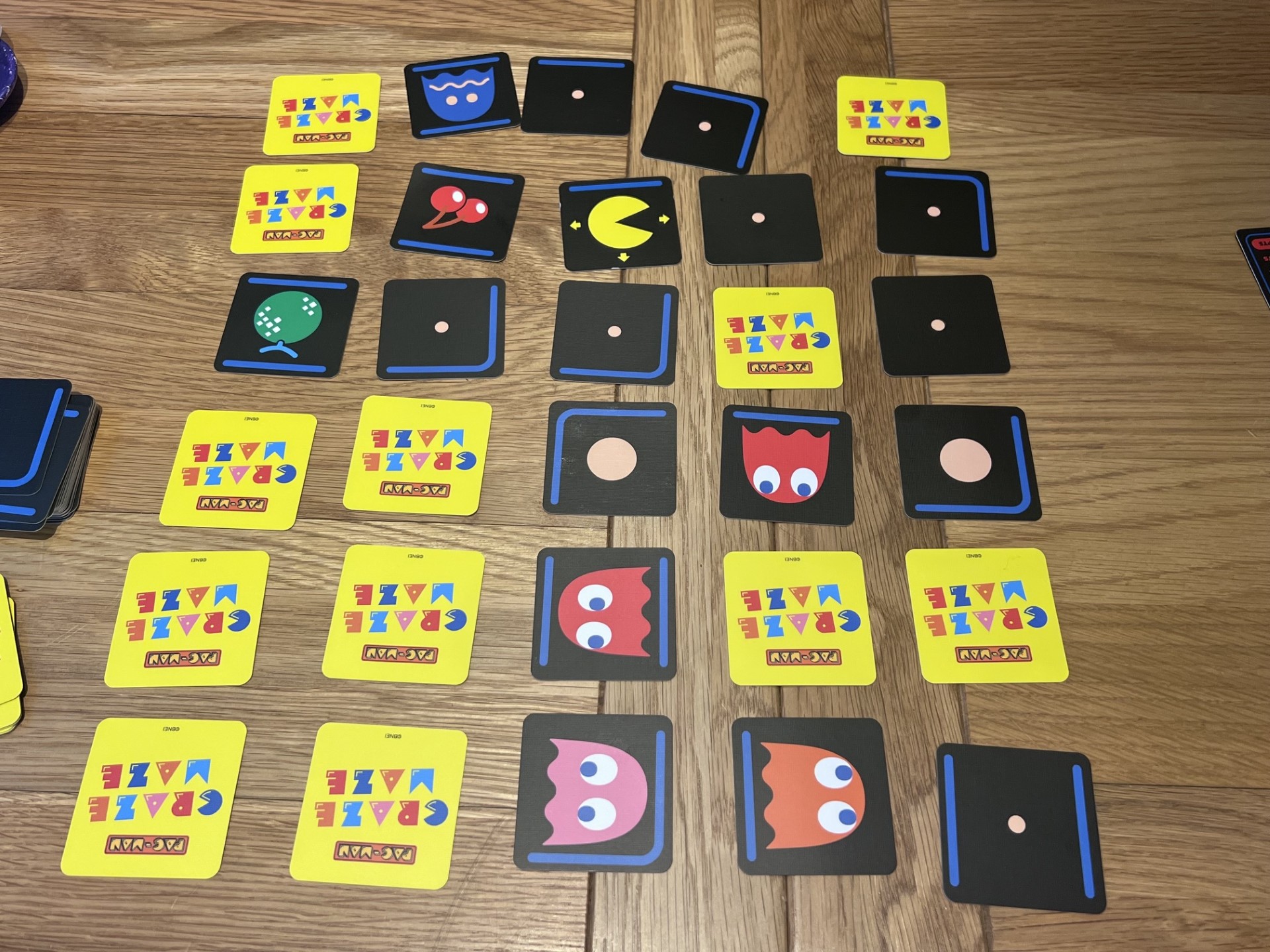
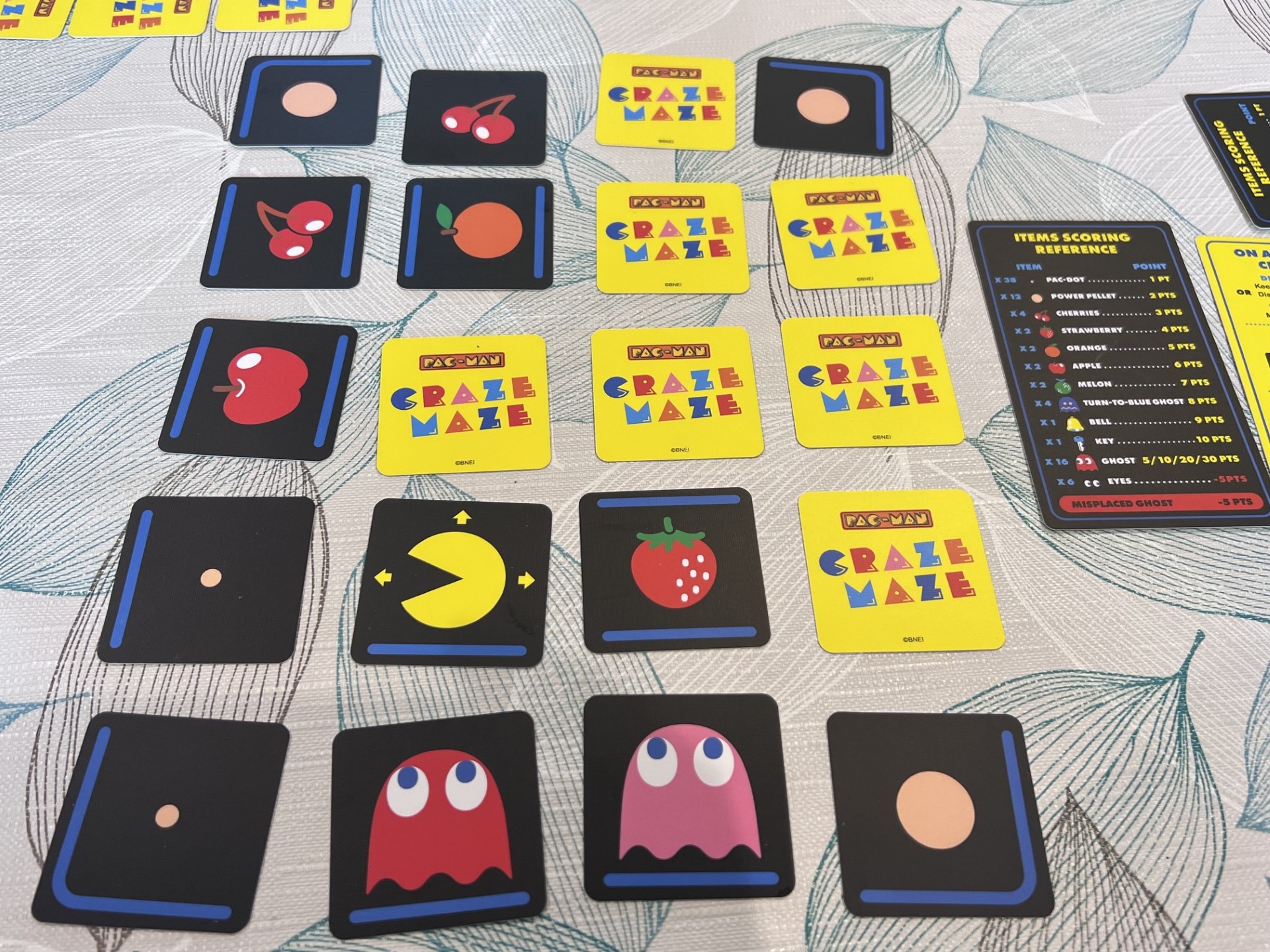
Components and presentation are nostalgic and appropriate for the price and small form-factor, rather than luxurious. The art is colourful and retro, the cards and tiles are compact, and the rulebook is short and to the point. As I’ve hinted at already, I had a couple of issues with the rules, but this was mainly down to language and the number of symbols — most of which are simply used for visual flair and different scoring possibilities.
Pac‑Man: Craze Maze is an almost entirely tactical experience. On a turn, you’ll only have access to two cards — the face up one on top of the discard pile, and a hidden one from the draw deck. What you’ll actually do is pick one of these and then use it to replace a card in your existing maze, which in turn results in the card that comes off being flipped and added to the top of the discard. This means that players can form ideas of what they want (for example you might know that you need an open-sided card in order to exit the maze, or a power pill to eat ghosts) but whether one turns up or not is entirely random.
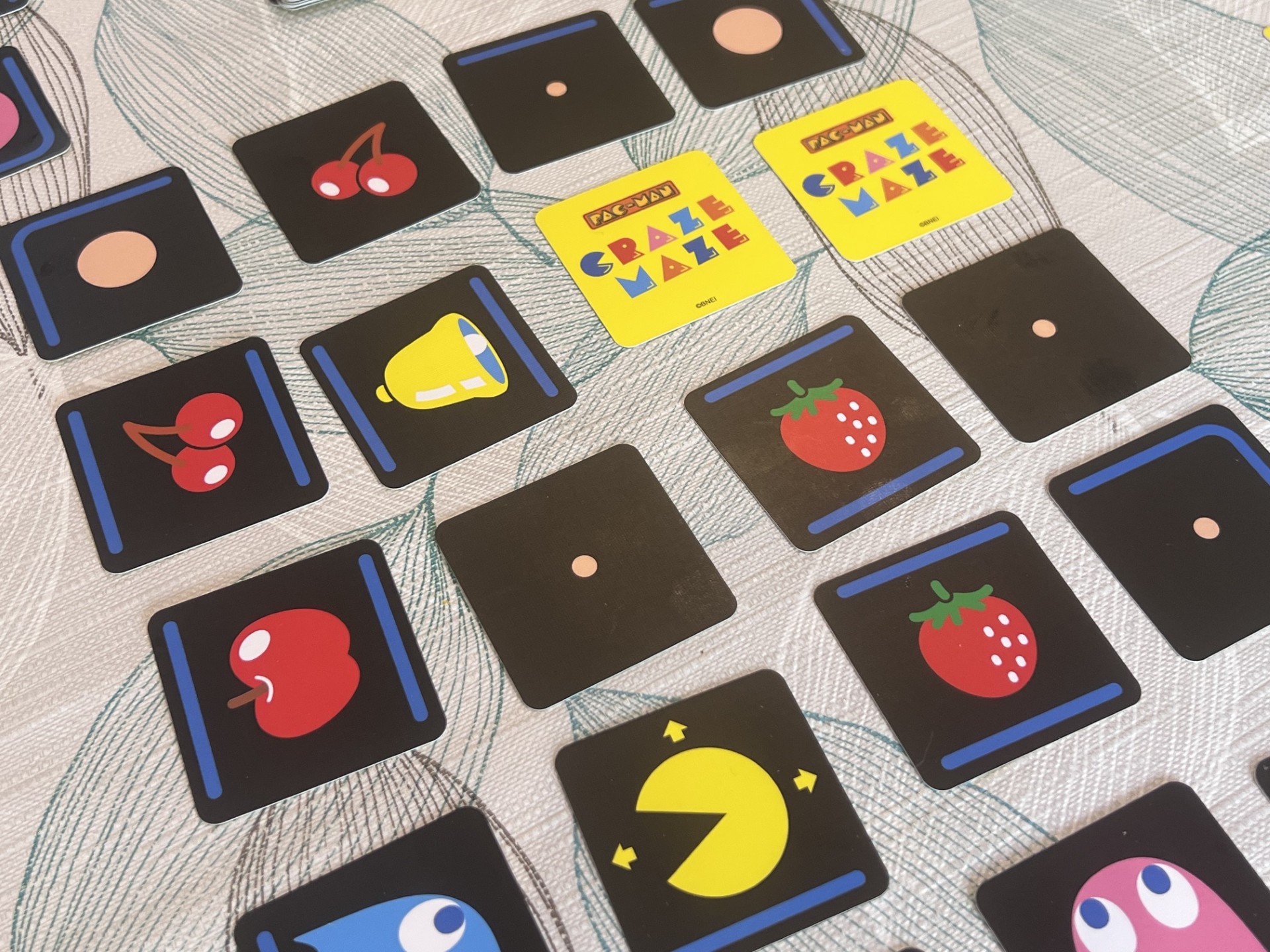
This also means that interaction is limited entirely to heckling each other and the one single card that interacts with other players’ board. That comes in the form of eyes, which, when drawn, are used to replace a card on your opponent’s maze. A good example of this might be that when you draw one, you may choose to remove an opponent’s power pill that is currently positioned to take out a line of ghosts. That power pill would be added to the discard pile and the eye card goes in its place, which is infuriating for that player and every bit as chaotic for the rest of the table as you’d expect. Thankfully, these cards are relatively few and whilst the example I gave here is very possible, it rarely happens at a time or magnitude that completely spoils the game.
Despite being a bit random and very tactical, where Pac‑Man: Craze Maze succeeds is in delivering a fast, focused, nostalgic experience that’s easy to teach and quick to play. It captures the feel of Pac‑Man without trying to recreate the arcade’s reflexive gameplay; instead it translates that feel into a tidy scoring puzzle that rewards timing and spatial judgement. The best sessions will undoubtedly be with youngish children, who soak in the artwork and lean into the chaos as only children can.
If you’re buying for family game night, a casual group, or a retro fan who wants a compact, approachable title, Pac‑Man: Craze Maze is a solid pick. It’s portable, forgiving, and fun in short bursts. If you need a heavyweight strategy game or a long campaign, look elsewhere. For what it sets out to do — a short, social maze builder with a nostalgic theme — it delivers cleanly and enjoyably.
Pac-Man: Craze Maze is available now, you can find out more about it from No Loading games’ website.
