

There are many board games about animals living peacefully in nature. Grazing deer. Industrious beavers. Happy little woodland creatures cooperating under the gentle glow of the forest canopy. Perch is not one of those games.
Instead, Perch asks a far more interesting question: what if birds were petty, territorial opportunists willing to shove each other off branches for a handful of victory points?
Designed by Douglas Hettrick and published by Inside Up Games, Perch is an area-control game for two to five players that initially presents itself with bright colours, friendly artwork and a general aura of woodland tranquillity. It’s charming. Approachable. Almost relaxing. And then you start playing.
Suddenly it becomes clear that this is less “peaceful forest habitat” and more “avian jostling match for prime real estate”.
In Perch, over five rounds, players will compete to control various perches. These perches will score slightly differently. You might have a perch that scores six points for the most birds, two for the second and then one for third place, and then another where first and second place earn one point and third place five points. If you have played Smash Up before, this way of scoring the different perches will be very familiar, only in Perch, the perches stay in place throughout the game.
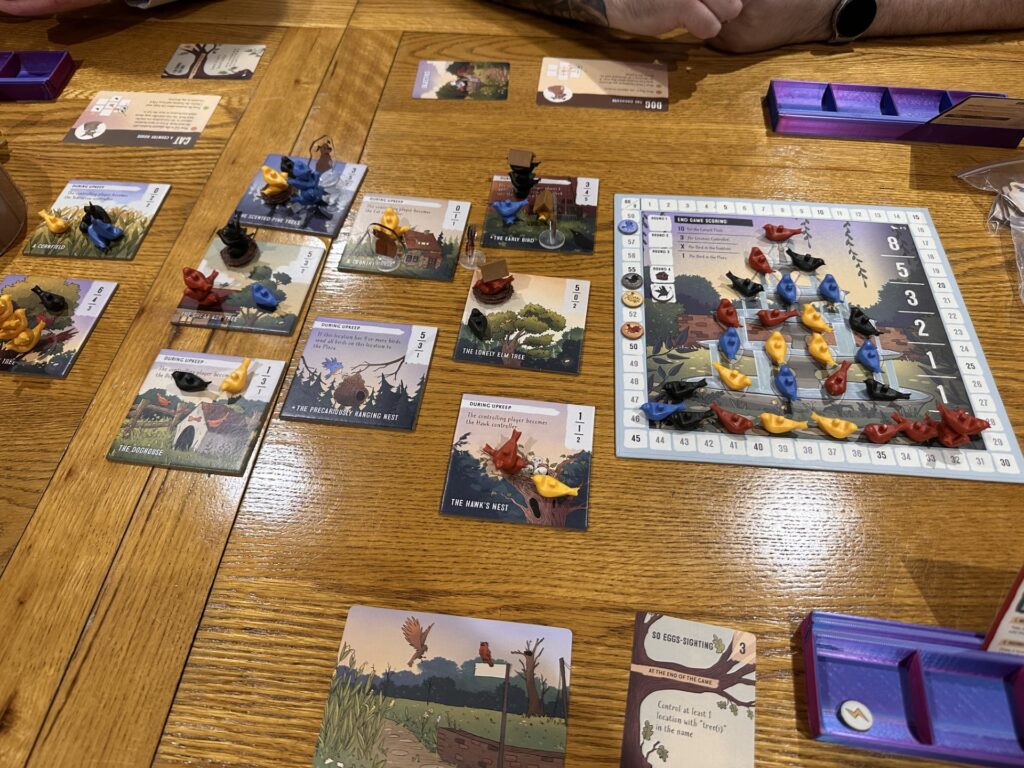
At the start of each round, players contribute birds from their personal supply into a communal bag.
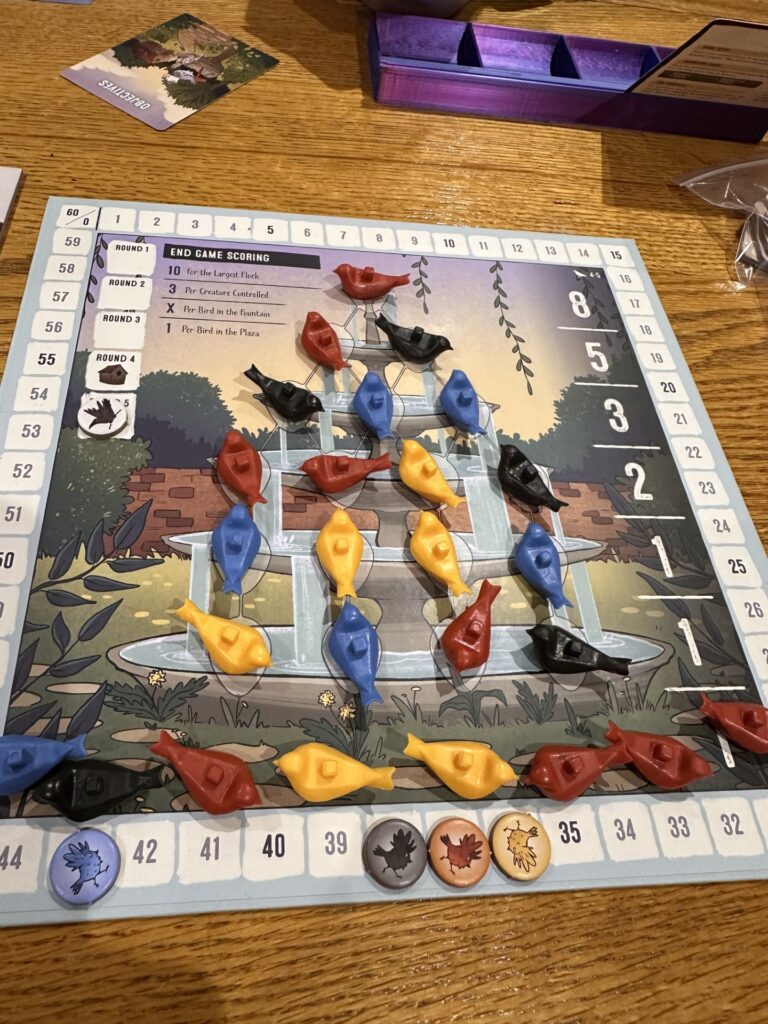
At the start of round four, players receive a bird house, when placed on one of your flocks, you cannot add more of your birds to that location, but you also cannot have them killed or moved by others. Round five gives you a lightning strike that makes it feel like Zeus has decided to enter the chat, and he can zap one bird of your choice to the fountain. I used this to great effect zapping my own bird to the top of the fountain and scoring enough points to win me the game.
Birds are then drawn randomly from that bag to form the placement pool for the round. Here’s the important part: the birds you draw don’t necessarily belong to you. And you can place them anyway.
This single rule transforms the entire experience. Instead of carefully building up your own network of birds, you’re constantly making tactical decisions about where to deploy whatever avian lifeform fate has handed you — whether it’s yours or someone else’s.
Sometimes that means helping yourself. Sometimes it means sabotaging someone else with their own bird. Which is, frankly, delightful.
What follows is a wonderfully interactive puzzle where every placement matters. You’re not just competing for majority control; you’re nudging the balance of power across the entire board. A single bird in the right location can swing scoring positions dramatically.
Someone comfortably sitting in first place? Drop another bird into that perch and suddenly second place might be worth more. Someone quietly lining up a perfect scoring opportunity? A well-placed outsider can turn that tidy plan into a flurry of confused feathers.
It constantly encourages these small moments of opportunistic disruption. It never feels mean-spirited, but it absolutely rewards players who are paying attention to what everyone else is doing.
The perches themselves add further variety. Each one has its own scoring conditions or special effects, and the board is constructed from a modular set of perch tiles each game. That keeps things nicely unpredictable, ensuring players can’t rely on the same strategy every time.
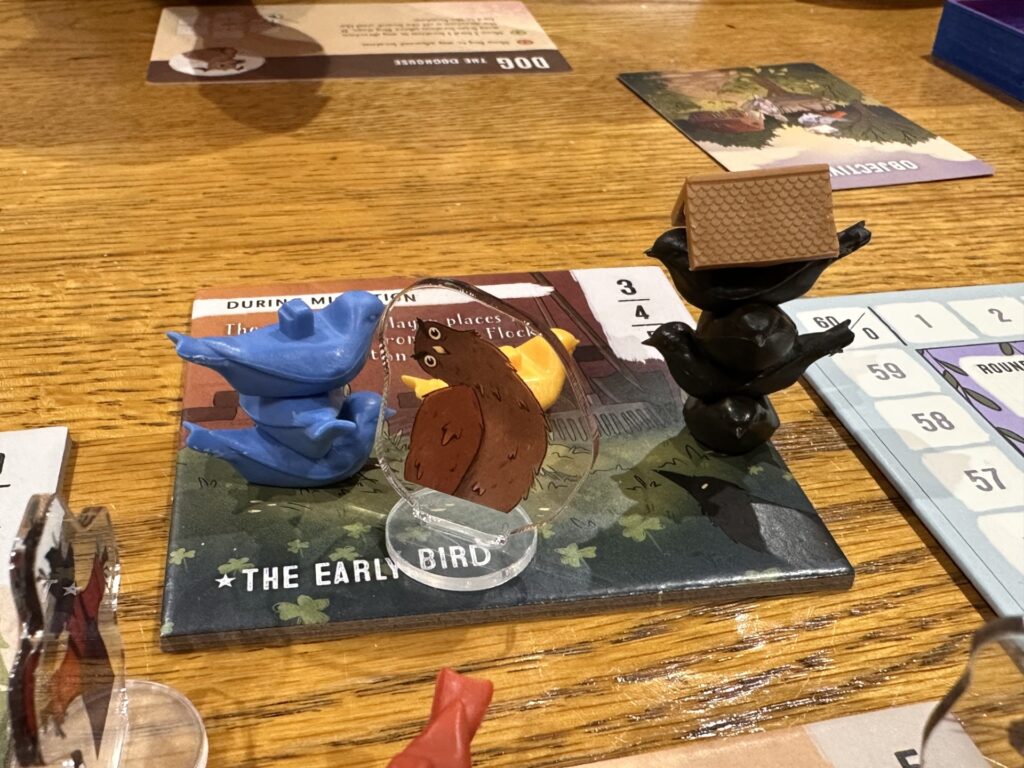
Some perches simply reward majority presence. Others introduce woodland animals that shift birds around the board or remove them entirely. I rather enjoyed controlling the hawk, and not just because the standee was perfectly me. It keeps the board state fluid, forcing players to adapt as the forest canopy evolves from round to round.
Despite all this interaction, Perch remains refreshingly easy to grasp. The rules are straightforward; the rounds move briskly. I grasped 90% of the game from just the small player aid card I had in front of me. It’s the sort of design that invites newcomers in while still offering enough tactical depth to keep seasoned players engaged.
Of course, the level of interaction won’t appeal to everyone. Players who prefer solitary optimisation — the sort of games where everyone quietly builds their own scoring engine in parallel — may find the constant jostling a little too lively. I myself am one of these people, Perch is not a game for me. But this does not mean that I do not see the beauty and design brilliance here, it is also stunning in its art, I would put a print of it on my wall in a second. I’m just not a person who plays these types of aggressive games. Ironically, I won our game, largely because I kept getting killed and filled the fountain with my poor dead birds. We ended up thinking of the fountain purely as bird heaven.
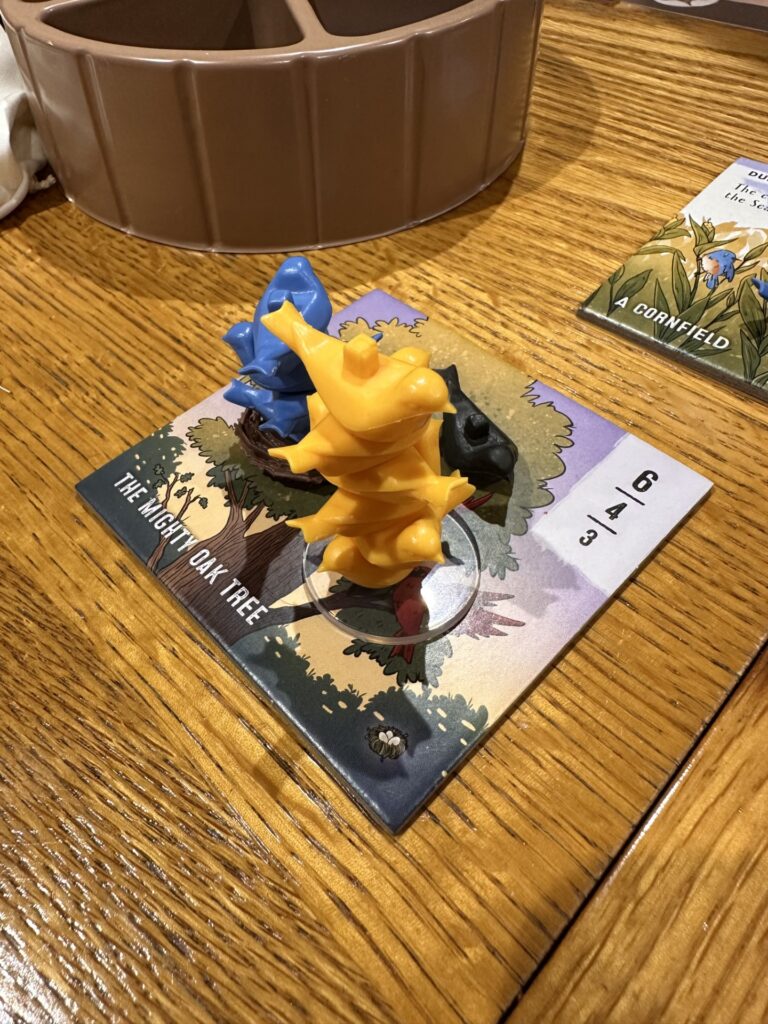
In Perch, birds get moved. Plans get disrupted. The occasional carefully crafted strategy will fall off a branch entirely. But that’s exactly what makes the game fun.
Visually, the production leans heavily into the woodland theme, with bright colours and charming illustrations that give the whole experience a friendly, welcoming feel. It’s a clever contrast with the underlying gameplay, which quietly encourages players to be just a little bit mischievous.
Underneath the feathers and foliage lies a tightly designed little strategy game — one that rewards observation, opportunism and the occasional well-timed act of avian sabotage. In other words, Perch is a charming woodland game about birds politely sharing branches. Right up until someone decides they’d quite like that branch for themselves.
Perch is available now, including on Amazon.
