

Pokemon Fire Red and Leaf Green were released for the Game Boy Advance in 2004 (themselves remakes of Pokemon Red/Blue/Green that were released in 1996/98 depending on your region for the Game Boy). In celebration of the 30th Anniversary of Pokemon (otherwise known as Pokemon Day), these two games just got rereleased on Switch as (nearly) identical ports. If you made it through this paragraph without aging into dust, you did better than me.
It probably goes without saying, but Nintendo didn’t send us a code for this one. Instead our author decided to write something up from their own library. And, why not?
Dear Reader, I am a Pokemon kid. Always have been, always will be. I made a name for myself at one of my previous jobs as having the entire Pokedex for the first generation memorised, including evolution levels and learnsets. One of my first gaming memories is sitting on the staircase as a child, making mum walk through Rock Tunnel in Blue because I was too scared of the dark to play it (since I never found “Flash” as a kid). I do not tell you these things to flex my mad games credentials (though you should still bow to me), I do this as I feel that it’s important to know that as objective I will try and be during this review, I really do love this franchise.
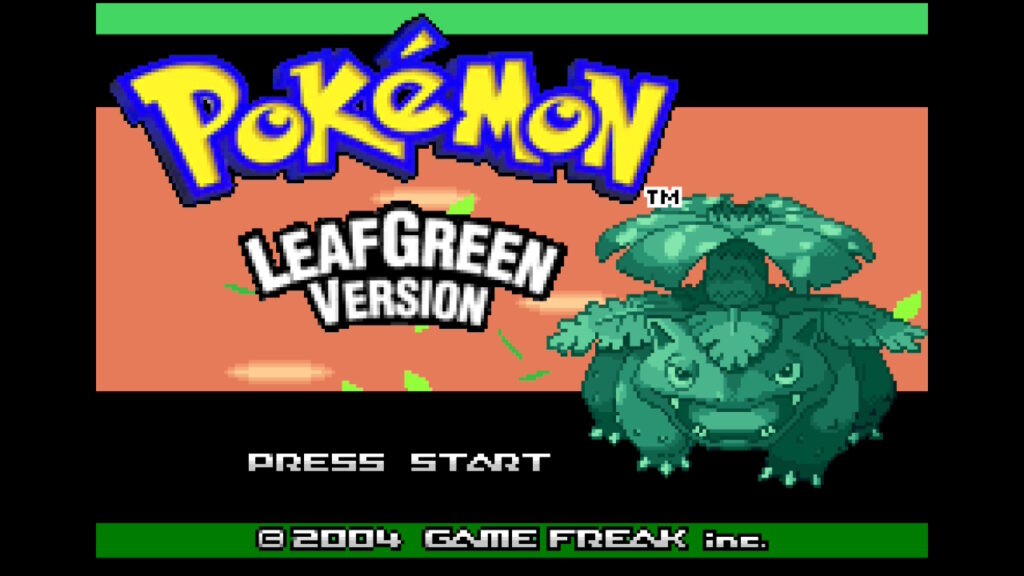
For anybody who has not heard of or experienced a Pokemon game before (we do not judge, everybody has to encounter something for the first time), FRLG have you playing as a child on their quest to be a Pokemon Master. To do this, they must battle creatures in the wilds of the Kanto region, stuff them into little balls, and use them to beat up other people’s creatures in fights in order to earn eight badges, and then take down the Elite Four. Oh, and you somehow derail the plans of a huge crime syndicate in the process.
At the time of writing this review, I’m six badges and about 20 hours in to a copy of Leaf Green, by the time I’d beat the Elite Four on my original copy I think I was roughly 30 hours in, but the post-game content took me well past that (I’ve long since sold my original copy of Fire Red, but if my memory and other games are anything to go by, I normally hit the 80-90 hour mark on any one Pokemon game before the next title is released). This is a very long way of saying that as long as you vibe with this style of game, you’re going to get a lot of bang for your buck.
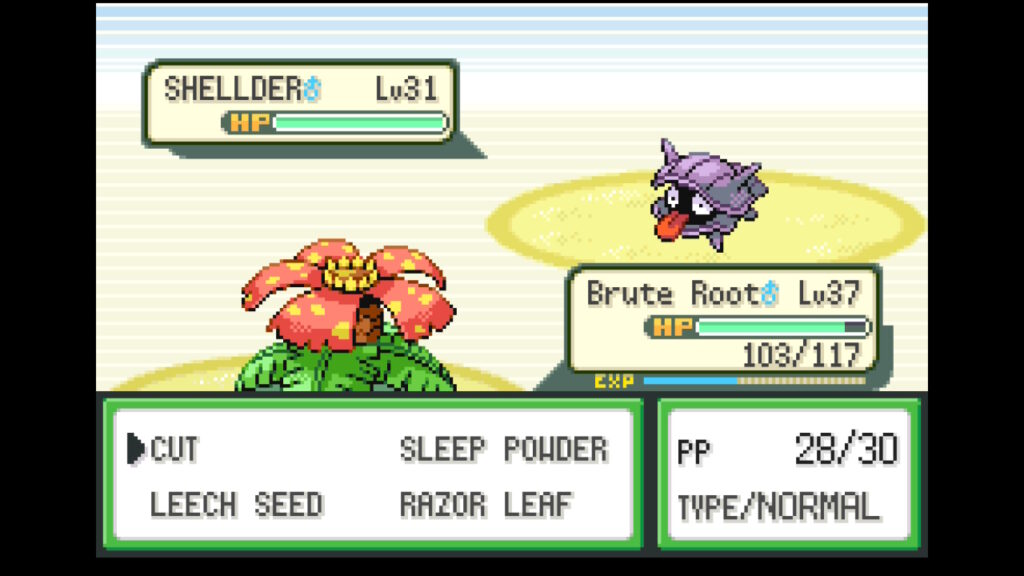
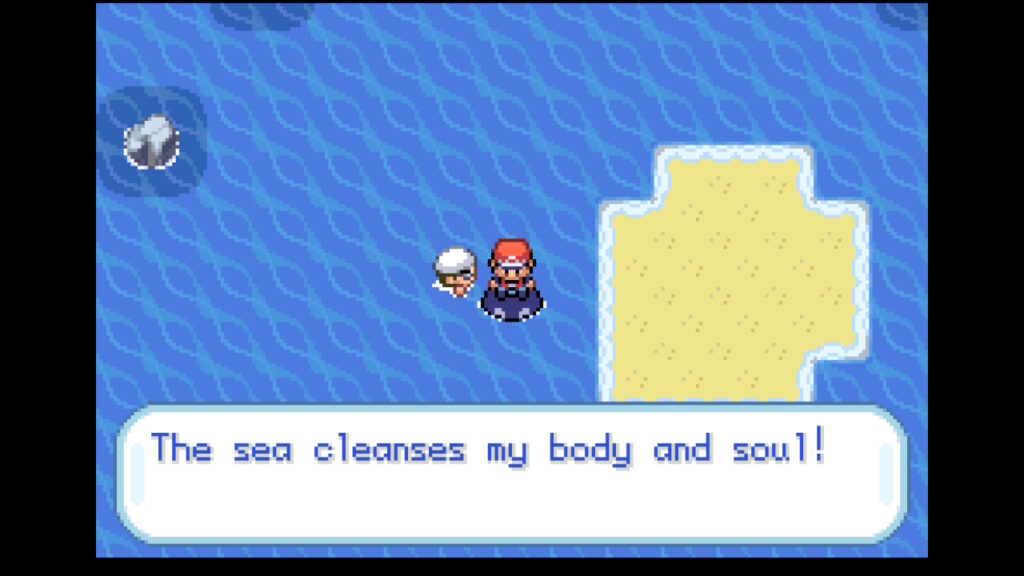
Your Pokemon can have up to two types (of a possible 17), and there’s an elemental rock-paper-scissors mechanic that adds damage multipliers to your attacks, which introduces the strategy to the turn-based combat that will make up the majority of your playthrough. You find Pokemon in grass, caves and water, and you want to damage them without completely draining their health so you can use a device called a Pokeball to catch them and add them to your team. At any one time you carry around six Pokemon (with the rest being stored in a PC), and you can teach them special moves like “Cut” and “Surf” in order to help you navigate obstacles in the overworld, rendering this into an almost metroidvania experience.
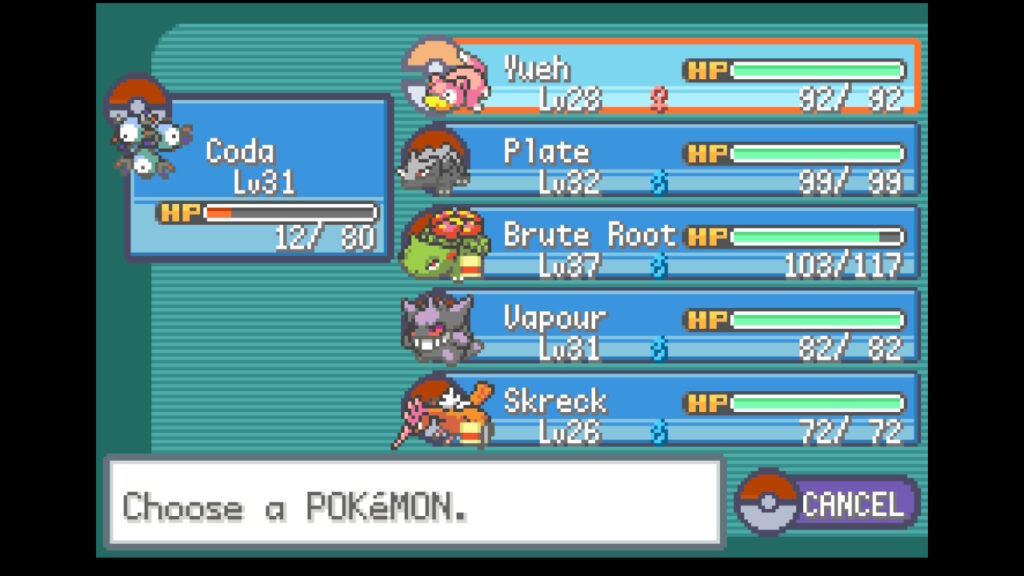
Now, if you’ve been screaming at me for the past three paragraphs because you’ve hit the Hall of Fame in several games before, I just want to remind you that we have had a lot of quality of life updates since these GBA classics. Pokemon only level up if they are used in a battle, HMs take up one of your four valuable move slots (and can only be deleted by one specific NPC), there’s no online multiplayer (so trading and battling has to be done in person), your item bag has limited space, and the move pools are limited at best.
I have favourites when it comes to these games, and I’ve never been one to nay-say the modern installments, but even I’d forgotten exactly how much friction these older games give you on certain things. In later games, moves have their own physical/special attribute, but in this one it’s based on the type, making several Pokemon completely useless because they’re built as physical attackers, but they only use special moves (R.I.P. my Hitmonchan trying to use Fire Punch successfully). Switch Training (having the Pokemon you want to level up in the first slot so it always features in battle) was a relic I did not miss.
What I did notice, now that I’m two decades older, is that these games have the perfect amount of sign posting. If you go into every house, and follow the context clues, I do not think you will get lost. Again, this could be some subconscious memories seeping through, but even wandering around dungeon puzzles, I found it easy to 100% an area without having to look up a map or guide.
The port has introduced a couple of problems specific to this version. Nintendo, in their infinite wisdom, have added a filter onto the custom names you give characters and Pokemon (bye bye calling your rival DickButt), but since this wasn’t present in the original game, you don’t get a warning if you accidentally trip this (which you will, as even the most innocuous names sometimes get flagged). Instead, the game just treats it like you opted out of a custom name, meaning you’re stuck with Pokemon having their default name IN ALL CAPITALS until you find the one NPC in the entire game who can rewrite a nickname (Lavender Town, you’re welcome).
The other problem comes from the control mapping. The Game Boy Advance had two triggers, A, B, Start and Select (and a D-Pad). The game had a soft reset coded in, so if you ever pressed A/B/Start/Select at the same time, it boots you back to the title screen. Great for shiny hunting, escaping a soft-lock, all that jazz. These ports also map Start and Select to X and Y on your Switch. I want you all to look at your Switch controller, and then at your (potentially) fat thumbs, and tell me that that is a safe position for instant progress removal in a game that only has manual saving? It’s awful. Let alone if you add my tendency to mash buttons to stop my Pokemon from hurting itself in confusion (an old superstition from a simpler time) and I’m currently up to about four hours of progress lost purely due to somebody not thinking hard enough.
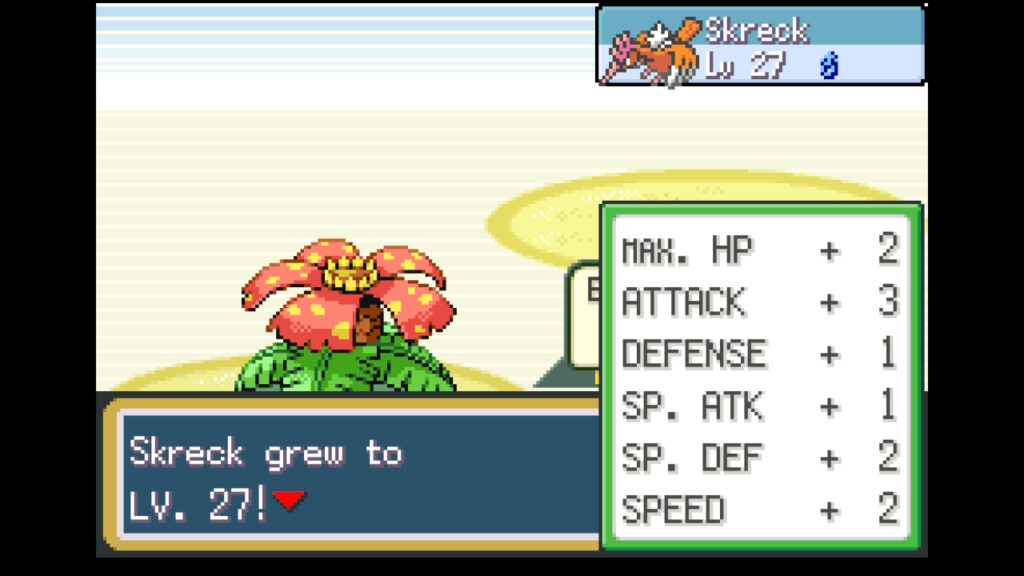
Yes, I know now not to do it, but when I’m lost in the sauce and my Venasaur has smacked himself in the face for the third time in a row, I tend to forget.
The audio is timeless, although I had forgotten just how grating the low health beep was (it’s constant too. Nightmare), and the original pixel art has been done no favours when scaled up on a big TV. I still find it charming, and much prefer the 2D sprites to the modern 3D models. It isn’t really an issue in handheld mode, but I have a modest sized TV and in certain circumstances text and images just become a garbled blocky mess as Nintendo has clearly done no work in making sure the pixels translate properly.
Speaking of quirks, I see a lot of talk online about how Nintendo are “robbing” people because you have to buy each language version of the game separately. I can understand why this causes consternation at first, but it’s simply a relic of the fact that the original cartridge only ever had one language loaded on it. Also, just to take my reviewer hat off for a moment, why exactly is this a problem? Are you really going to replay the game in multiple languages? Just buy it in your preferred tongue and leave it at that. I don’t think you can make online fans happy though, because for every person screaming that they shouldn’t be hiding rereleases of retro games behind their subscription, there’s another screaming that they shouldn’t be charging extra for this kind of thing (and they are often the same person).
If you’ve never played a Pokemon game before, I honestly think a more modern entry might serve you a little better in terms of introducing the mechanics of the game and just the ease of the play experience. However, if you’ve ever for a second wondered why Pokemon became the phenomenon it is, this is the best version of Gen 1 to play, and I honestly believe that its charms far outweigh the friction of its age.
Pokemon Leaf Green was reviewed on a Nintendo Switch 2, but is actually a Nintendo Switch game.