

Twinkle Twinkle, designed by Ammon Anderson and published by Allplay, is the much-loved and fairly rare family game that manages to be genuinely charming for children while still offering enough structure and replay value to keep adults engaged. It’s light, quick, and immediately approachable, but beneath the friendly artwork and simple rules lies a surprisingly thoughtful little puzzle about pattern‑building, spatial planning, and opportunistic scoring. Playing it with children feels joyful, but playing it with adults reveals just how neatly the design has been tuned, and just how clever everyone is!
The premise of Twinkle Twinkle is wonderfully straightforward: you’re building constellations in the night sky by placing interstellar bodies — stars, planets, comets, and black holes — onto a shared board. Each type of celestial object scores differently depending on its placement, adjacency, or pattern, and the way each object scores can be changed from game to game.
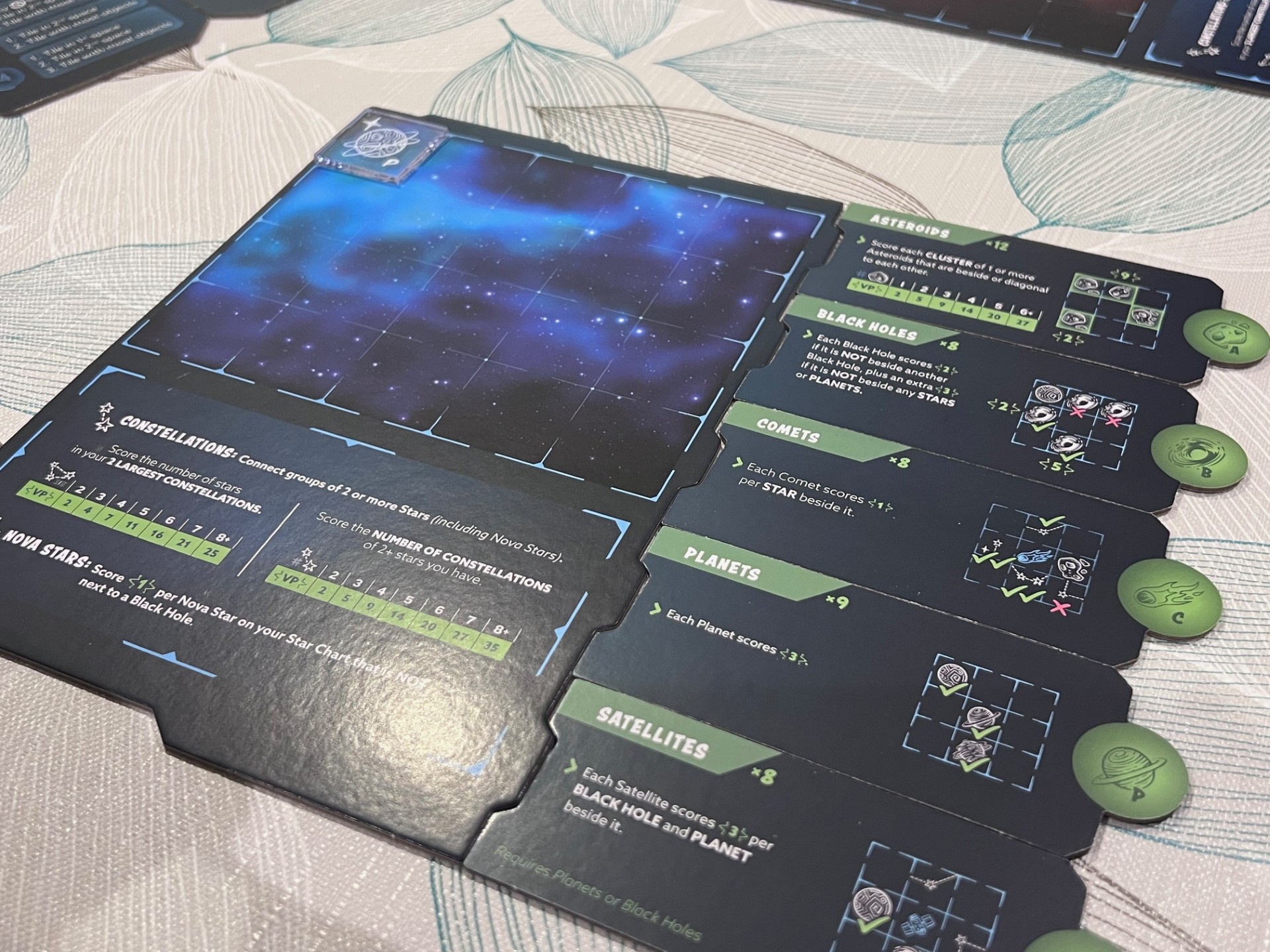
That modular scoring system is the basis of Twinkle Twinkle’s replayability. One session might reward long chains of planets, another might favour clusters of stars, and another might turn black holes into high‑risk, high‑reward anchors for your constellation. Because the scoring conditions shift so dramatically, the game never settles into a single dominant strategy. Whilst I thought the scoring might be complex and unwieldy as I set up, it soon became clear that it’s as clear as the night sky once you have the pieces laid out in front of you.
What makes Twinkle Twinkle especially effective with children is how tactile and intuitive it is. The pieces are chunky and inviting, the board is clean and readable, and the act of placing celestial bodies feels creative rather than mechanical. Kids can experiment freely — building patterns that look pleasing or simply following their instincts — and still stumble into clever scoring opportunities.
Adults, meanwhile, will find themselves thinking several turns ahead, trying to anticipate how the scoring cards will interact and how opponents might block or exploit certain spaces. It’s a lovely balance: accessible enough for young players, but with just enough depth to keep grown‑ups invested for what is really a very brief 30-40 minute playtime.
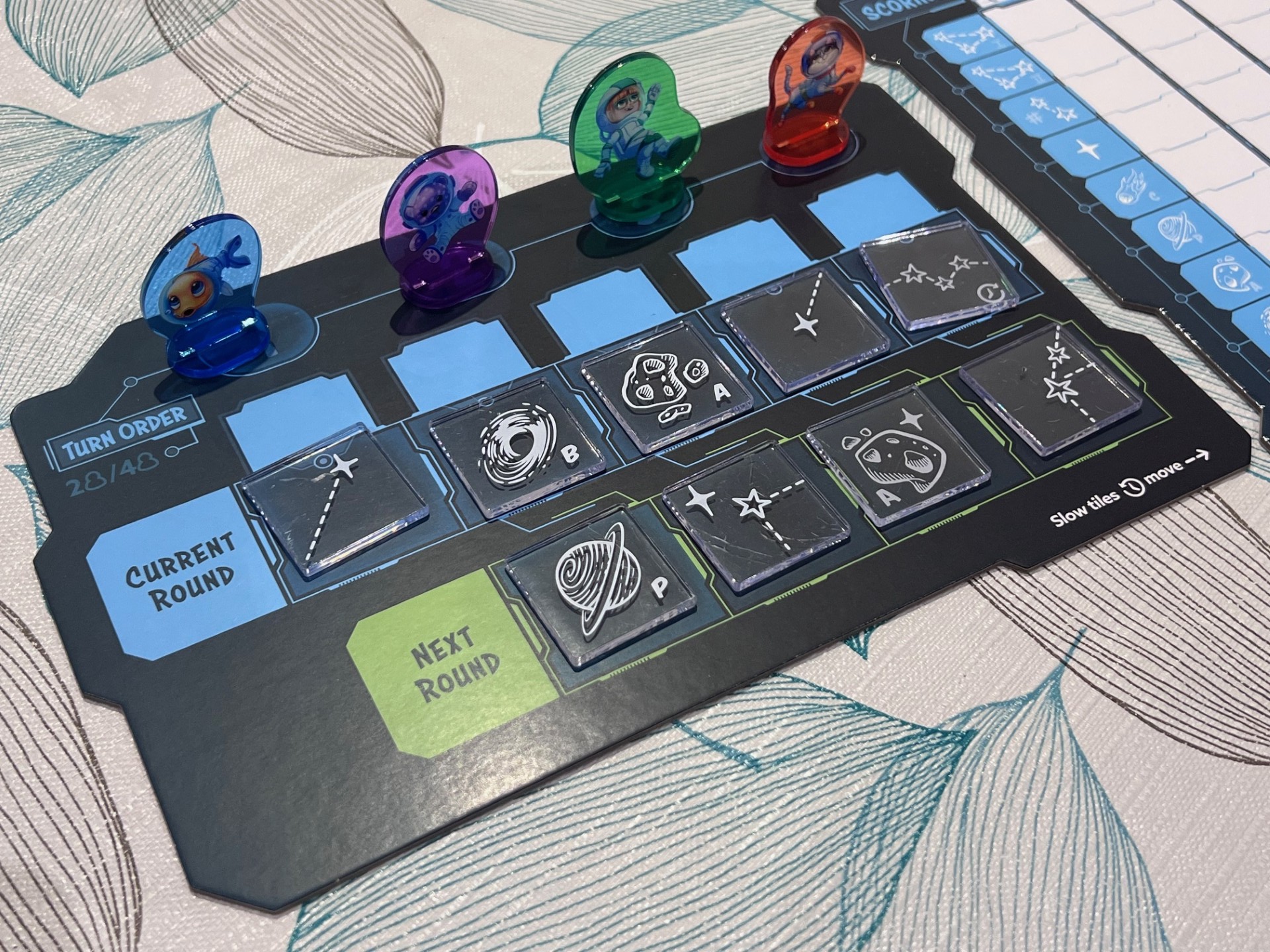
The turn structure is brisk. Players begin the game with an attractive standee on one (or two if you’re playing with two people) spaces on the turn order track. Below that, they’ll see the five tiles available this round, and then four more for the next round. They take a turn by moving their standee above one of the tiles for this round and then place that tile on their board. The interesting bit is that the place where their standee is will now dictate their turn order for the next round. Once four tiles are taken, the remaining tile slides all the way to the left, meaning that it will guarantee first pick next time, but presumably because it wasn’t chosen last time, it wasn’t a very desirable tile…
This is a great mechanic in itself because it gives the game its own natural economy regarding the value of the tiles. Because everyone is drawing from the same pool of tiles, there’s a subtle layer of interaction too — not confrontational, but gently competitive. You might take a comet because you need it, or because you know someone else needs it more. You might pick a relatively weak star tile from the left to guarantee that you get the satellite you need in the next round. It’s the kind of soft interaction that works beautifully in family games and we’ve seen it work to great effect in games like KingDomino.
One of the most delightful aspects of Twinkle Twinkle is how it encourages creativity without sacrificing clarity. Each player board ends up looking like a real constellation map, and children, in particular, respond well to this — they feel like they’re building something beautiful rather than simply trying to win. And because the scoring is transparent and visual, it’s easy for youngish (maybe seven and older) players to understand why they earned points, which helps keep the experience positive.
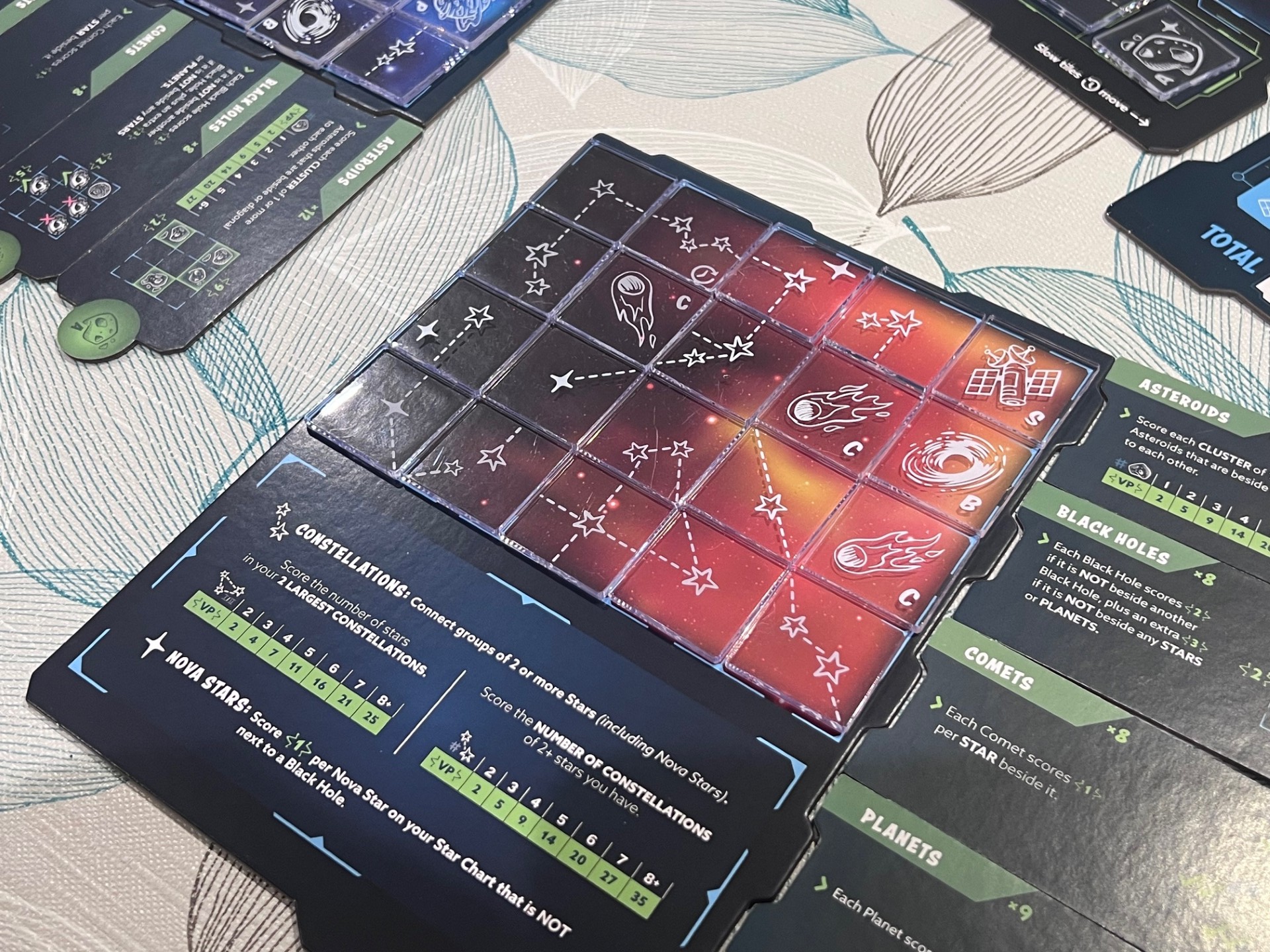
The game’s replayability is excellent for something so compact. The variable scoring cards dramatically change the puzzle each time, and the mix of celestial bodies ensures that no two constellations look alike. Twinkle Twinkle is the kind of game you can play twice in a row without it feeling repetitive, and it’s short enough to slot into a school night or a quick weekend session.
Ultimately, Twinkle Twinkle succeeds because it understands exactly what it wants to be: a light, clever, family‑friendly puzzle with just enough strategic bite to keep adults engaged. It’s warm, inviting, and beautifully produced, and it offers a rare blend of accessibility and depth. Playing it with children feels magical; playing it with adults feels quietly competitive. And in both cases, it leaves you wanting just one more round.
You can find out more about Twinkle Twinkle on the website of the developer, Allplay.
