

Endangered, designed by Joe Hopkins and published by Grand Gamers Guild, is a cooperative game that wears its heart entirely and unapologetically on its sleeve. It is about saving animals, yes, but not in a vague, feel-good kind of way. Instead, Endangered focuses on the grind, the politics, and the precariousness of fighting extinction. Underneath its striking wildlife art and approachable rules is a tense dice-placement game where you are constantly balancing short-term survival against a long-term political win, and that balance is where Endangered really comes alive.
At its core, Endangered is a co‑operative dice placement game for one to five players, with each session built around a specific species module. The base game includes tigers and sea otters, each with their own setup, special rules, and ways the habitat deteriorates over time. The shared goal is always the same: keep the animals alive long enough and in sufficient numbers to convince a majority of UN ambassadors to pass a resolution protecting them. Mechanically, that means getting at least four out of six ambassadors to vote “yes” in one of two scheduled voting years, while also making sure the species hasn’t been wiped out along the way.
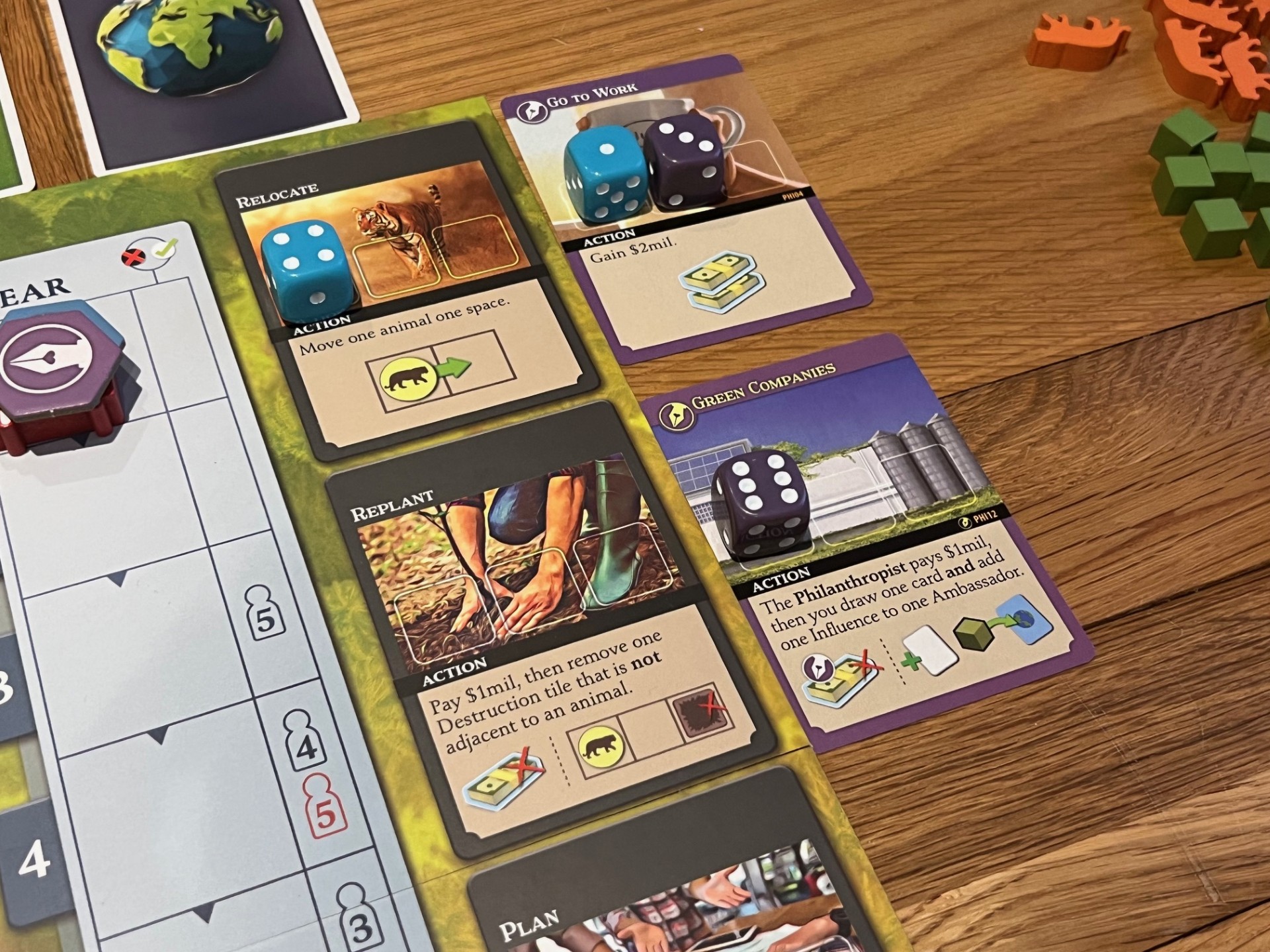
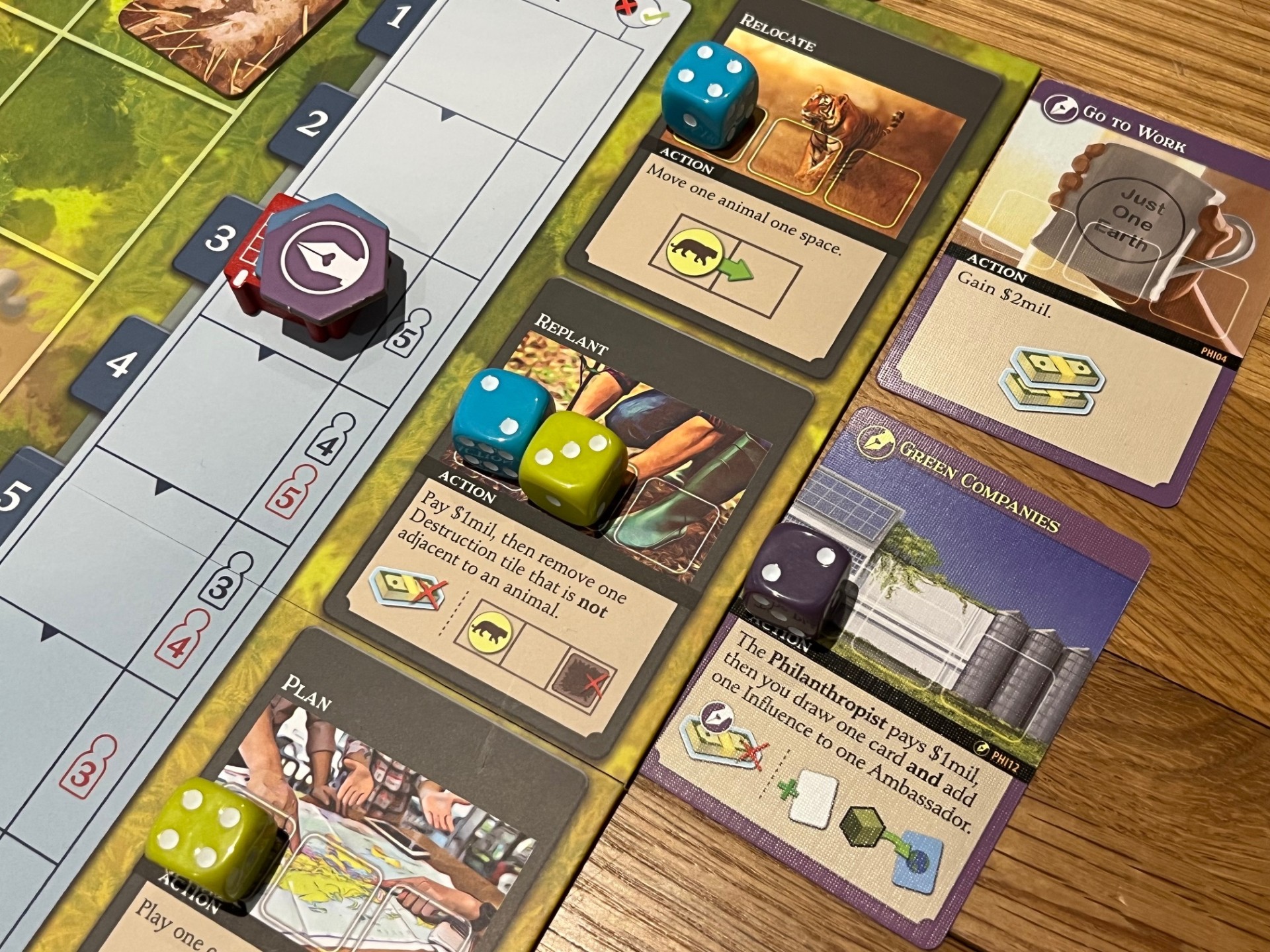
The turn structure is clean, but filled with tense decisions. Each round represents a year. Players roll their personal pool of dice and then, in turn order, place (all of) them onto action cards in a shared tableau. Most actions are available to everyone, but the crucial wrinkle is that dice must be placed in ascending order: a die can only be used on an action if it is strictly higher than any die already on that card.
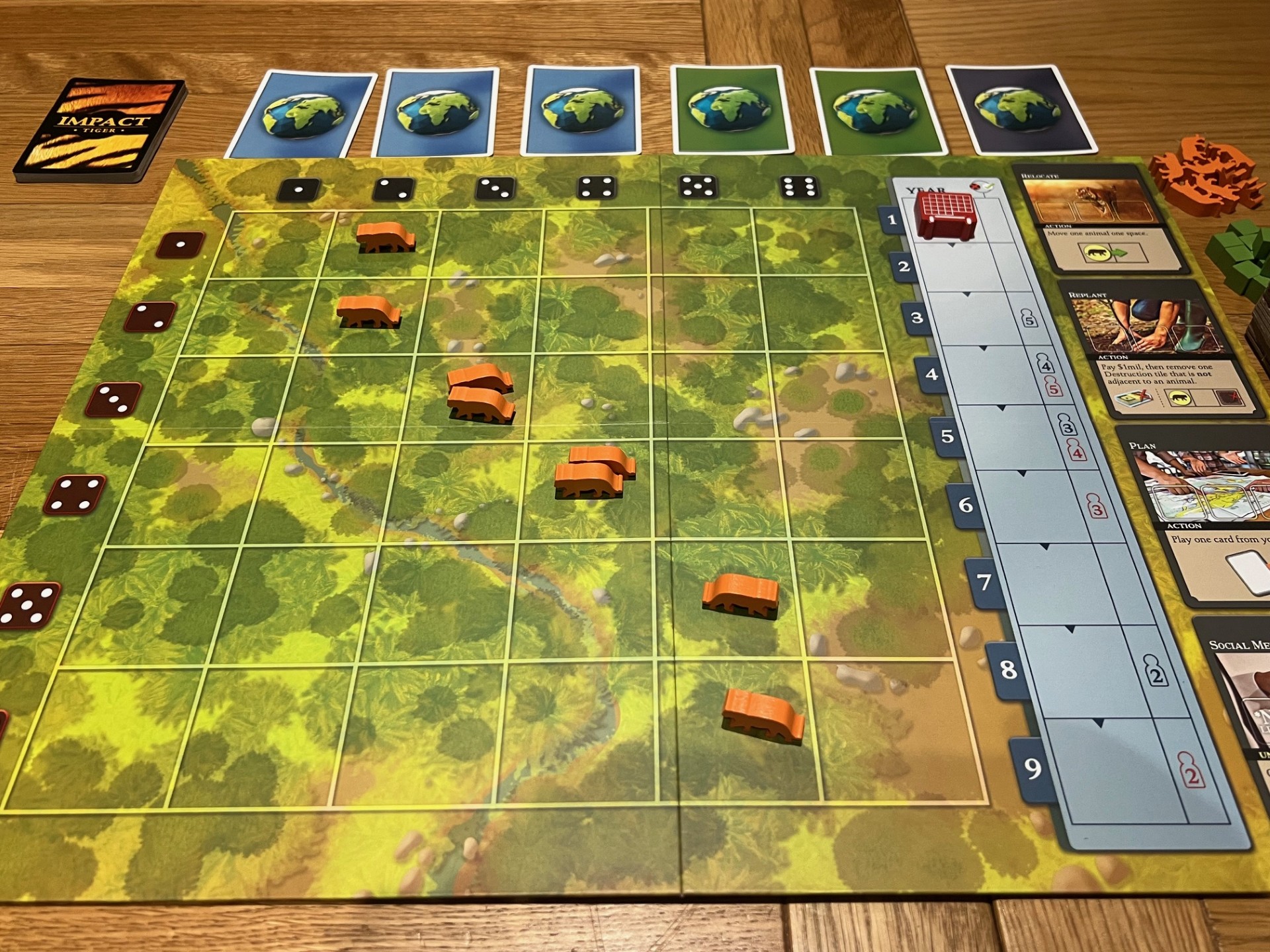
If you place too low, you may give other players a chance to use the same action later, but if you place too high, you might lock that space out until your turn on the following year — when you’ll pick up all your dice again. This “locking” effect turns what would otherwise be a familiar worker-placement rhythm into a sharp, interactive puzzle where you’re constantly reading the table, negotiating, and sometimes taking a suboptimal move because it keeps an option open for a teammate.
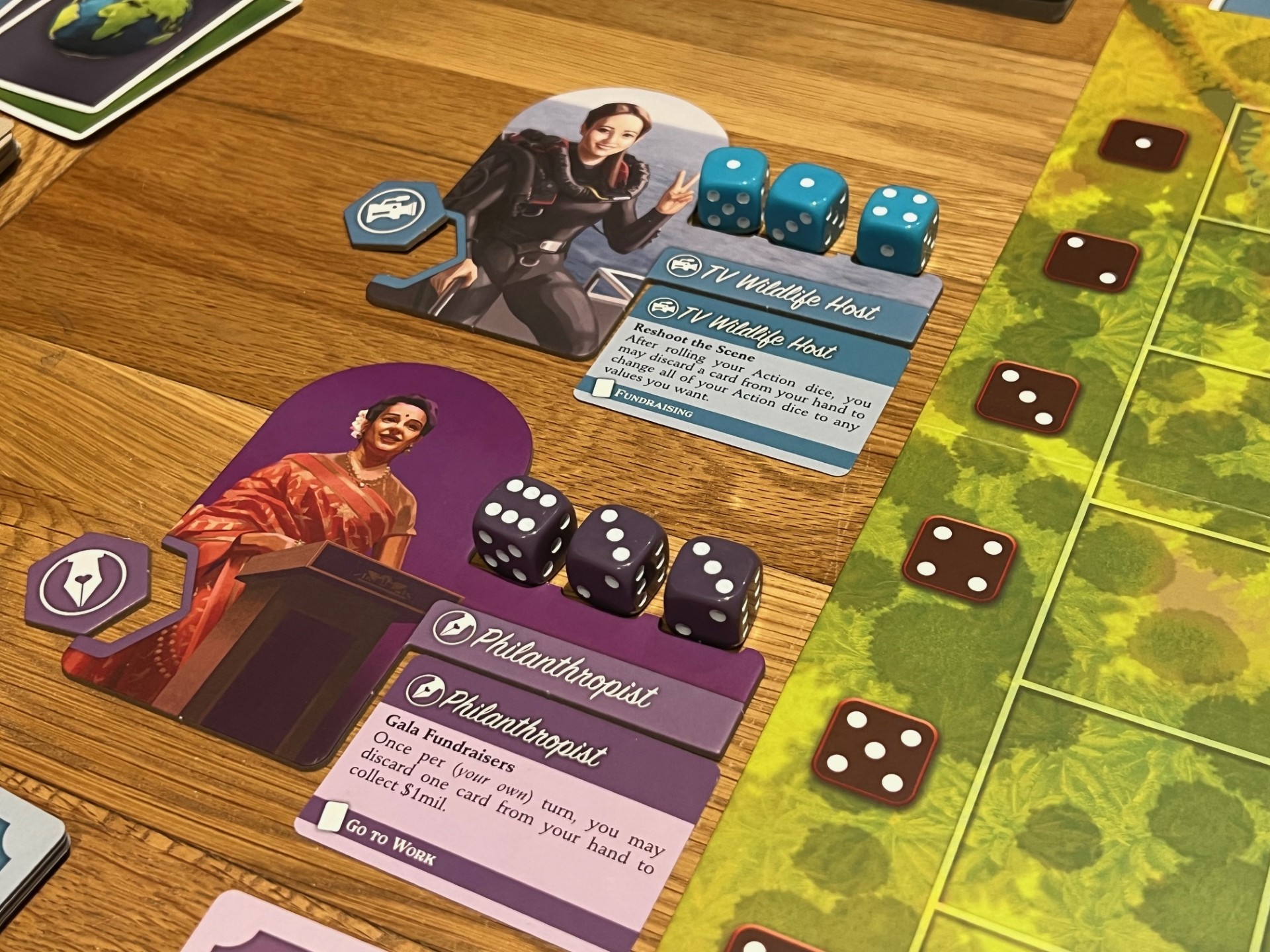
Player roles (chosen during setup) add another layer of asymmetry without overcomplicating things. You might play as the Zoologist, the Environmental Lawyer, the Philanthropist, the Lobbyist, or the TV Wildlife Host, each with a unique deck of action cards and a once-per-round or otherwise unique power. On your turn you can introduce new action cards to the shared tableau from your hand, expanding the team’s toolkit by adding new dice spaces.
That “card play as infrastructure” is one of Endangered’s quiet masterstrokes: you aren’t just using actions, you’re building the menu of actions everyone will rely on later. It means role choice actually matters, and it reinforces the idea that conservation is about building institutions and tools over time, not just reacting to crises. This mechanic also gives Endangered momentum — because as the threats to your animals become more real, so too does your range of options for combating them.
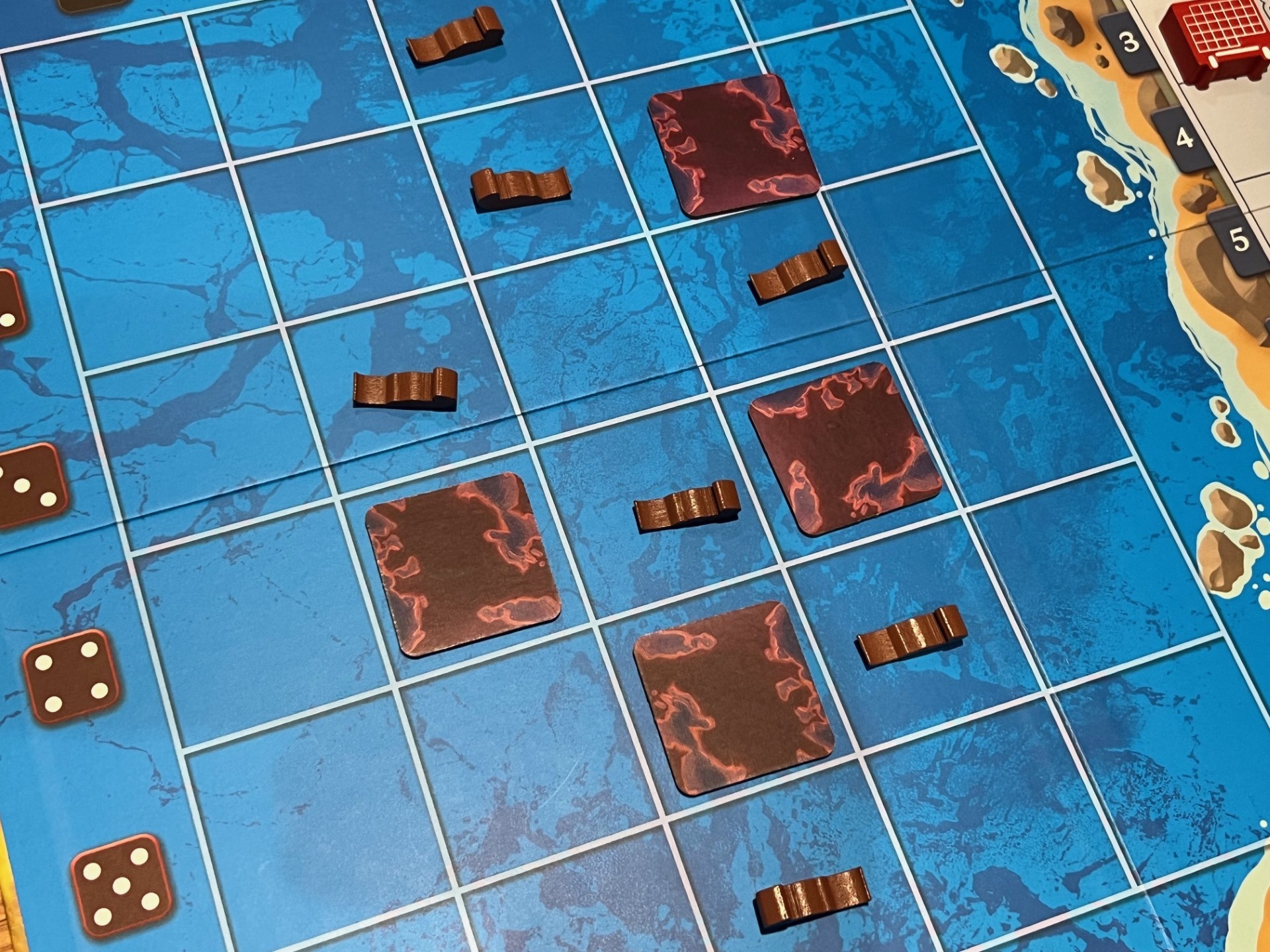
The crises, though, are ever-present. After players have taken their actions, each year ends with three key steps that form the heartbeat of Endangered: impact, offspring, and destruction. First, you draw an Impact card from the scenario deck. These are often bad: oil spills, poaching, political setbacks, or economic pressures that alter rules, remove animals, or add ongoing problems you’ll need to fix. Some are positive if you’ve added them via your own action cards, but the deck itself is mostly there to remind you that the world does not cooperate with your plans.
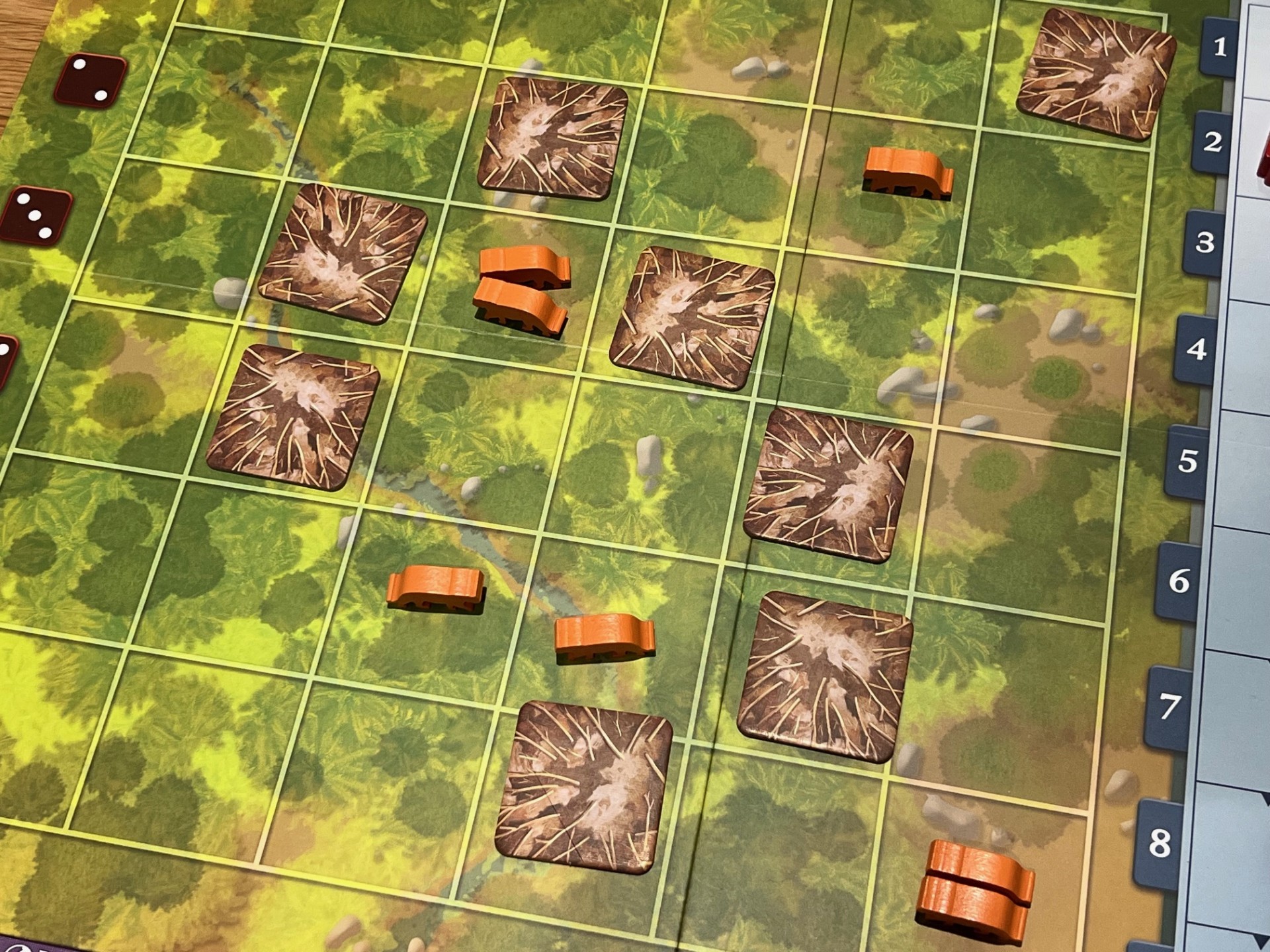
Next comes the offspring step, where you roll the offspring die to see if your animals reproduce, but only if you’ve managed to keep mating pairs adjacent on the habitat grid. Finally, you roll the destruction die, which drops new destruction tiles onto the map, representing deforestation, pollution, or other habitat loss. If a destruction tile lands on an animal, that animal is gone; if too many tiles pile up, the board starts to feel frighteningly empty and there can even be an automatic loss condition.
That central habitat grid is both simple and evocative. In the tiger scenario, you’re working against the slow but inevitable advance of deforestation. In the sea otter scenario, you’re watching kelp forests erode and oil slicks spread across the ocean. The animals themselves are big, charming meeples, and seeing them vanish one by one has the desired emotional impact — especially on younger players. That said, looking at it purely mechanically, the board is all about spatial puzzles: nudging animals into safer positions, clearing destruction, creating space for offspring, and avoiding chokepoints where a single bad roll could wipe out a cluster.
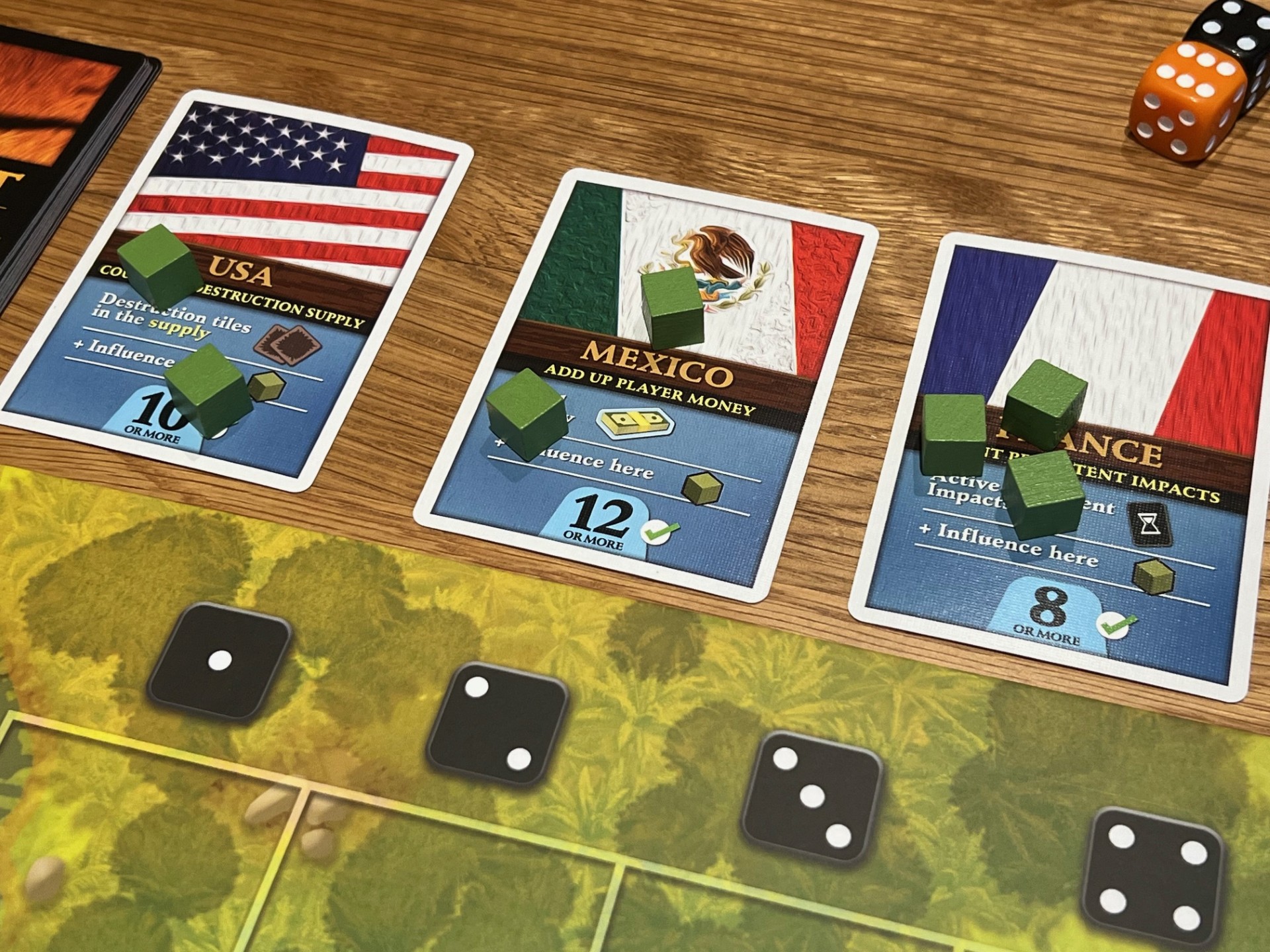
Then there are the ambassadors — which is where Endangered separates itself from many co‑ops that are “just” about survival. Before the game, six ambassadors are drawn, each with a hidden scoring condition and a threshold you must meet to earn their vote. One might require a certain amount of money, another a minimum animal population, another a number of Impact cards dealt with, or progress on specific conservation projects.
Throughout the game, you place influence cubes on these ambassador cards by taking specific actions and spending resources, representing lobbying efforts. This first flips an ambassador card so that you can see what it does, and then later, allows you to add influence to them directly. Influencing ambassadors is your main (and usually only) win condition, but the twist is that voting only happens in two specific years of the game, and you need four votes in the same voting year to win. If you fail the first vote, you get one more shot the following year, but by then the habitat is usually hanging by a thread.
This dual victory condition — survive the ecological onslaught and hit political thresholds on a schedule — creates a superb push-and-pull. Some turns, you must focus entirely on putting out fires: moving animals out of danger, clearing devastation, or dealing with nasty ongoing Impact cards. Other turns, you feel compelled to invest in long-term influence or money-generating actions, even though you know it might cost you a tiger or two. It’s very easy to lean too hard in one direction: save everything but neglect lobbying and you lose in the vote; chase ambassador conditions while the board burns and you’ll simply run out of animals.
Difficulty-wise, Endangered lands firmly in that sweet spot of “very difficult, but not unfair.” The dice and Impact deck are undeniably swingy; there are games where destruction rolls feel relentless, and others where you catch a break at the perfect moment. Thankfully, the design gives you ways to mitigate luck: actions that shift target numbers, manipulate the destruction pattern, or allow thematic use of player powers to swing the game back to a more palatable place. In fact, one of my favourite things about Endangered was how the roles each felt both unique and evocative of whatever they were supposed to be — political roles are better with ambassadors, whilst the TV host is better at making an impact on the ground.
One of the strengths that comes through quickly is how modular and expandable the system is. The base box’s tigers and sea otters already feel quite different in mood and priorities, and later expansions add other species — from pandas to jaguars and monarch butterflies — each with their own Impact deck, setup rules, and special threats.
The core mechanisms remain recognizable, but the problem space shifts: sometimes you’re managing land fragmentation, sometimes ocean pollution, sometimes human encroachment in a different form. It gives Endangered that “framework” feel, like a co‑operative system that can host a wide range of conservation stories without needing to relearn the game from scratch.
With that said, it is a bit disappointing that the core game only includes two species. As far as I know, there are three small expansions (adding one scenario each) and one large expansion (adding six) whilst a recent Kickstarter will add more scenarios relating specifically to Australia. I think two scenarios in the base game box is perhaps a bit stingy, but then again Endangered does play very differently based on the chosen personalities, difficulty level and even player count.
From a production standpoint, Endangered is strong without being ostentatious. The artwork on the box and cards is striking, with the animals given a dignified, almost poster-like treatment that fits the subject matter. The habitat tiles, destruction markers, and ambassador cards are clear and functional, and the animal meeples are large enough to be both tactile and table-present. It’s the sort of production that invites curiosity from across the room, which is nice for a game that has a strong educational undercurrent.
At the table, the game flows well once everyone understands the rhythm of a year. Early plays can have a bit of rules-referencing, particularly when Impact cards stack up with ongoing effects, but because so much of the tension comes from visible board state and ambassador conditions, the cognitive load isn’t overwhelming. Quarterbacking — the classic co‑op problem — is possible but slightly blunted by each player’s personal dice and unique cards; you can’t simply script everyone’s turn in perfect detail because you’re working with different hands and dice results.
In solo play, the Endangered system holds up really well too, essentially turning the game into a multi‑hand puzzle where you juggle the different roles based on all of the information to hand — in my case by playing two roles side by side. A quick note here to say that Endangered actually works really well at all player counts — as a tight solo or two player coop, or with three to five players where quarterbacking and specific planning gets harder, but negotiation and table-talk takes precedence.
Thematically, Endangered walks a careful line. It is undeniably didactic: you are literally trying to save tigers or otters from extinction, and every step of the process — from habitat destruction to political lobbying — maps to real-world conservation challenges. But it never feels like a lecture stapled to a dry puzzle. The mechanisms are tight and gamey, and the moments of triumph or disaster are undeniably fun in a very board-game way. You’ll cheer when offspring rolls go your way, you’ll groan when a destruction tile lands in the worst possible hex, and you’ll genuinely sweat the turn before the vote, trying to squeeze out one more influence cube.
For me, that’s the magic of Endangered. It’s a game that creates stories: of the time you lost the tiger scenario by a single destroyed animal on the very turn you secured four votes; of the sea otter game where you invested early in lobbying and then had to scratch and claw just to keep enough animals alive to make those votes matter. It respects the seriousness of its theme without sacrificing the tension and satisfaction that make co-operative games compelling.
Endangered is a thoughtful, well-crafted co‑op that manages to be both mechanically engaging and emotionally resonant. If you’re looking for a game that goes beyond generic “save the world” tropes and gets into the messy, multi-front reality of conservation — habitat, population, politics, and time pressure all at once — it’s absolutely worth putting on the table. And if you fall for its system, the expanding lineup of species ensures there’s always another crisis to tackle, and another story to tell, together.
Endangered is available now from Amazon.
