

Faraway, designed by Johannes Goupy and Corentin Lebrat and published by Catch Up Games, is a small-box tableau builder that punches well above its weight.
Supplied to us by Hachette UK, Faraway is a small box game that offers a clever twist on sequencing, scoring, and spatial logic whilst presenting itself with quirky, otherworldly art design that never fails to catch the eye. It’s a light, filler-weight game, but the clever “back-to-front” mechanic is more demanding that you might immediately think, and beneath the colourful cards and compact footprint lies a puzzle that rewards foresight, restraint, and just the right amount of risk.
You take on the role of explorers venturing across the continent of Alula, visiting eight distinct regions, each of which will be represented by an oversized square card in your personal tableau. These regions — drawn from biomes like the Endless River, Mushroom Forests, Cave Cities, and Rocky Deserts — are populated by denizens with unique traits and scoring conditions.
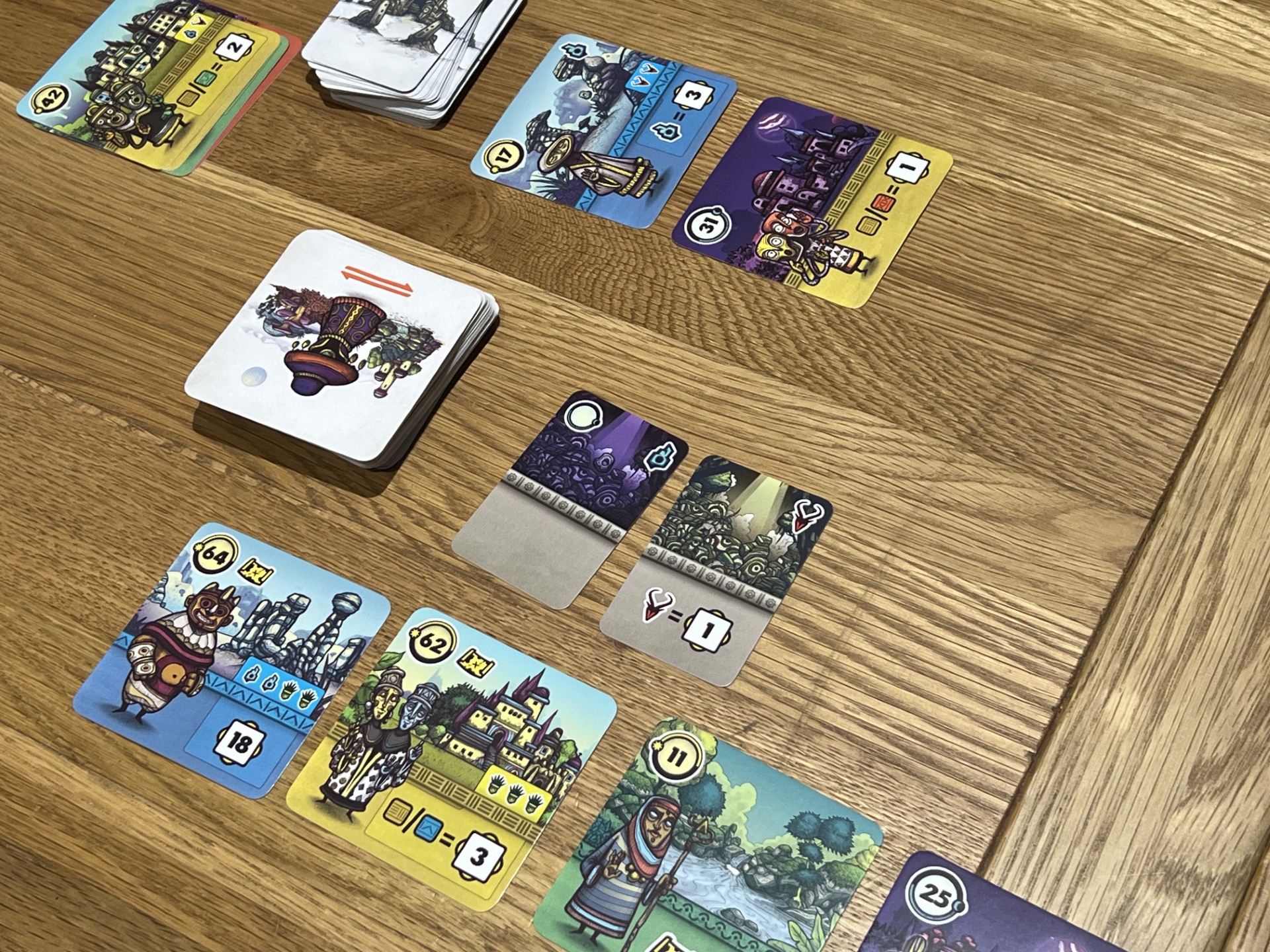
Each turn, players choose one of the three cards in their hand and place it in front of them, forming a line of eight cards placed in strict sequence. But here’s the twist: scoring happens in reverse. You’ll resolve your final card first, then the seventh, then the sixth, and so on — meaning every card is scored as if the ones before it haven’t yet been played.
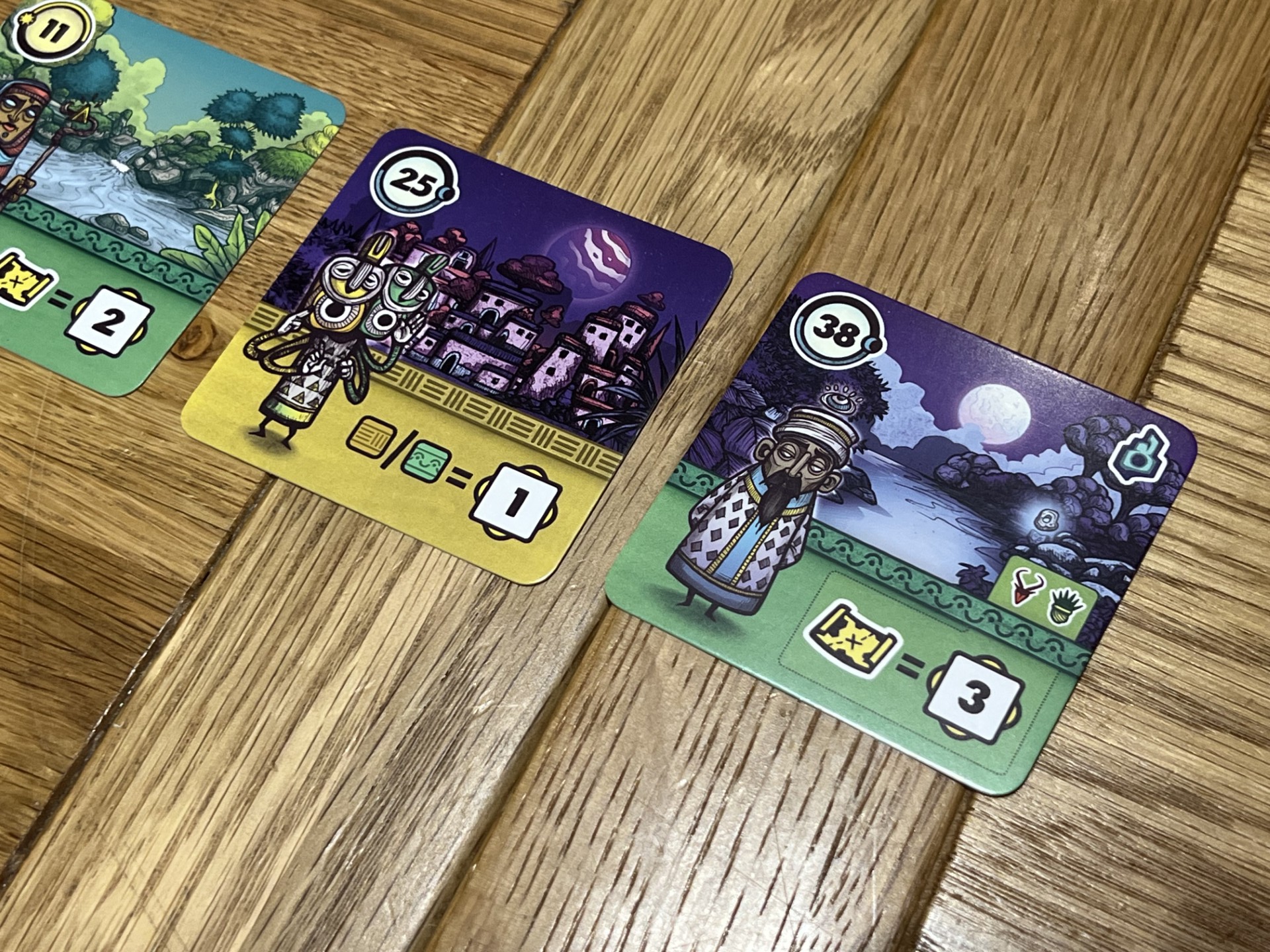
This mechanic is the heart of Faraway, and it’s what elevates the game from filler to finesse. Cards often require specific symbols or conditions to score, and since those symbols may only appear on cards you’ll see later, you’re constantly weighing short-term gains against long-term setups. To make a clear example, if my first card played only scores when I have a visible “pineapple” on another card, then I know that I’ll have seven more cards that will resolve first, and therefore a good chance of getting my pineapple. If that same card were my seventh card (meaning that it would resolve second) then I’d need to make sure I had a pineapple to play on my final card.
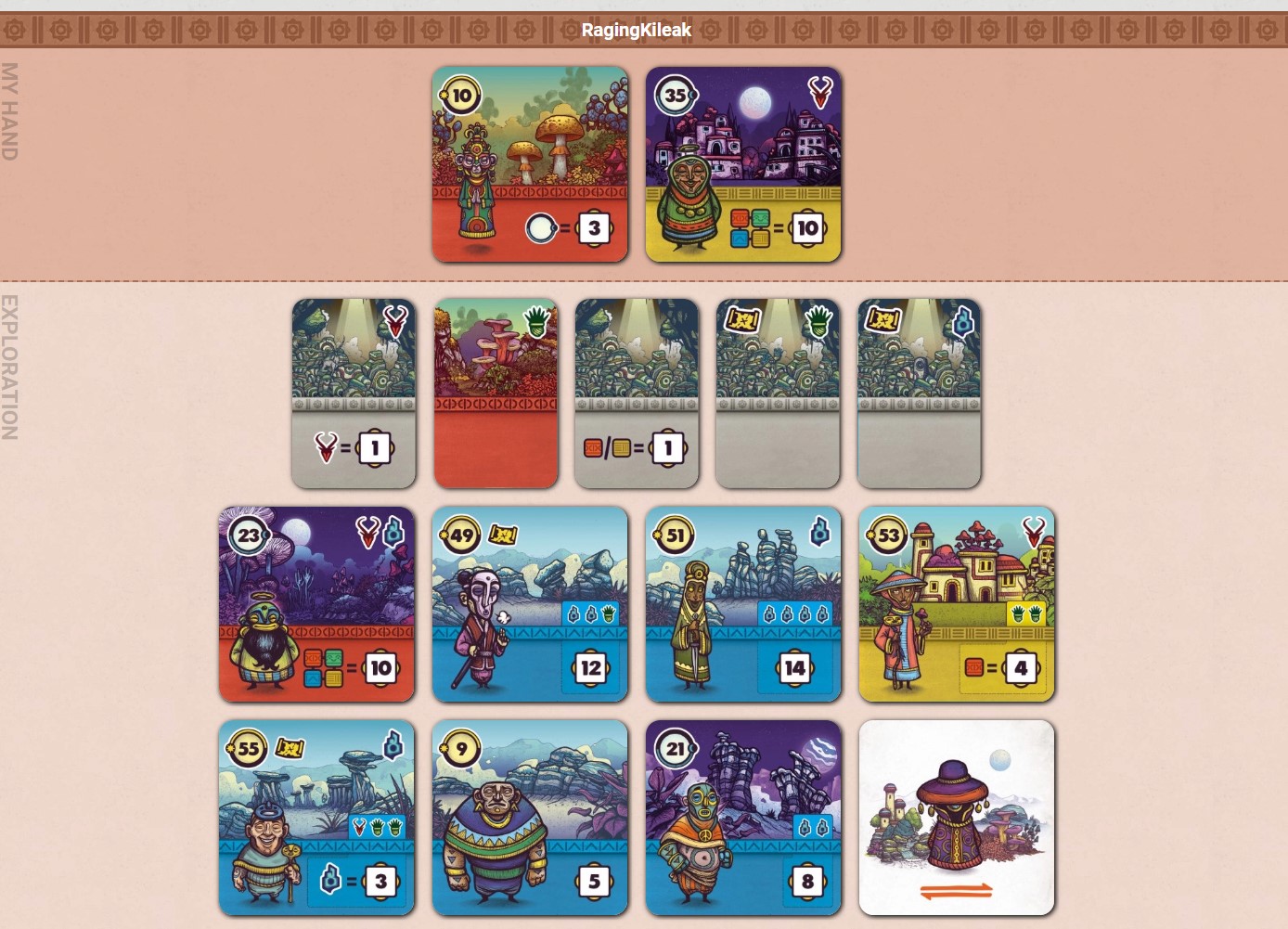
Faraway probably wouldn’t work if players didn’t have a hand of three cards and a drafting mechanic with which to replenish that hand. Drafting itself is handled via initiative — players who play lower-numbered cards get first pick of the next round’s offerings. This creates a natural tension between playing strong scoring or icon cards (high numbers) and securing better options for future turns.
There’s another mechanic which slightly bends the rules I’ve described above as well, in the form of Sanctuary Cards. These Sanctuary cards, drawn from a separate deck, offer passive bonuses and scoring triggers that can help smooth out rough patches or amplify key plays—but most critically, they are active for your entire journey. You can get these cards by playing a card that has a higher number than the previous card in your sequence, but any successful run in Faraway will typically involve a minimum of four or five Sanctuary Cards. To return to our previous example, if I had played a Sanctuary Card with a pineapple at any point, I would no longer need to worry about where the pineapple scoring card was played in my sequence, because the Sanctuary Card would always be available to trigger it.
Visually, Faraway is bold and distinctive. The artwork is stylised and strange, but undeniably memorable. I was never entirely sure whether the people of Alula were friendly or not, and I love how the characters seem to stare out of the cards at me as though my presence is just alien to them as they are to me. Most importantly, the iconography is clean and accessible, and the card layout supports quick scanning and intuitive play. Faraway fits comfortably into the filler category—easy to transport, quick to teach, and playable in well under 30 minutes — but it lingers in the mind far longer than its runtime suggests.
Replayability is strong, especially once players begin to internalise the reverse scoring and draft dynamics, with the former of those things being a bit of a head-wobbler at first. Faraway rewards experience, but never punishes newcomers thanks to the fact that optimal ways through the cards are somewhat self-limiting, unless someone gets outrageously lucky. While luck of the draw can occasionally lead to suboptimal hands, the strategic ceiling is high enough to keep players engaged across multiple sessions.
Faraway is available now from Zatu Games.

