

Playing The Lord of the Rings: Fate of the Fellowship feels like much more than just a game — it’s the retelling of an epic story. Frodo is one step from despair, the Nazgûl are circling, and you’re desperately trying to recruit Rohirrim troops while praying the gorgeous custom dice don’t betray you. It’s tense, thematic, and unmistakably epic, but it’s also unmistakably Tolkien-esque and Pandemicky, all at the same time.
Designed by Matt Leacock and published by Z-Man Games, The Lord of the Rings: Fate of the Fellowship is the latest evolution of the Pandemic system, and it might just be the most ambitious one yet. It’s not just a reskin of a tired and basic system — it’s a full-blown reimagining, pulling mechanics from other divergent entries such as Fall of Rome, Reign of Cthulhu, and Rising Tide, then layering them with a rich narrative and a surprising amount of crunch.
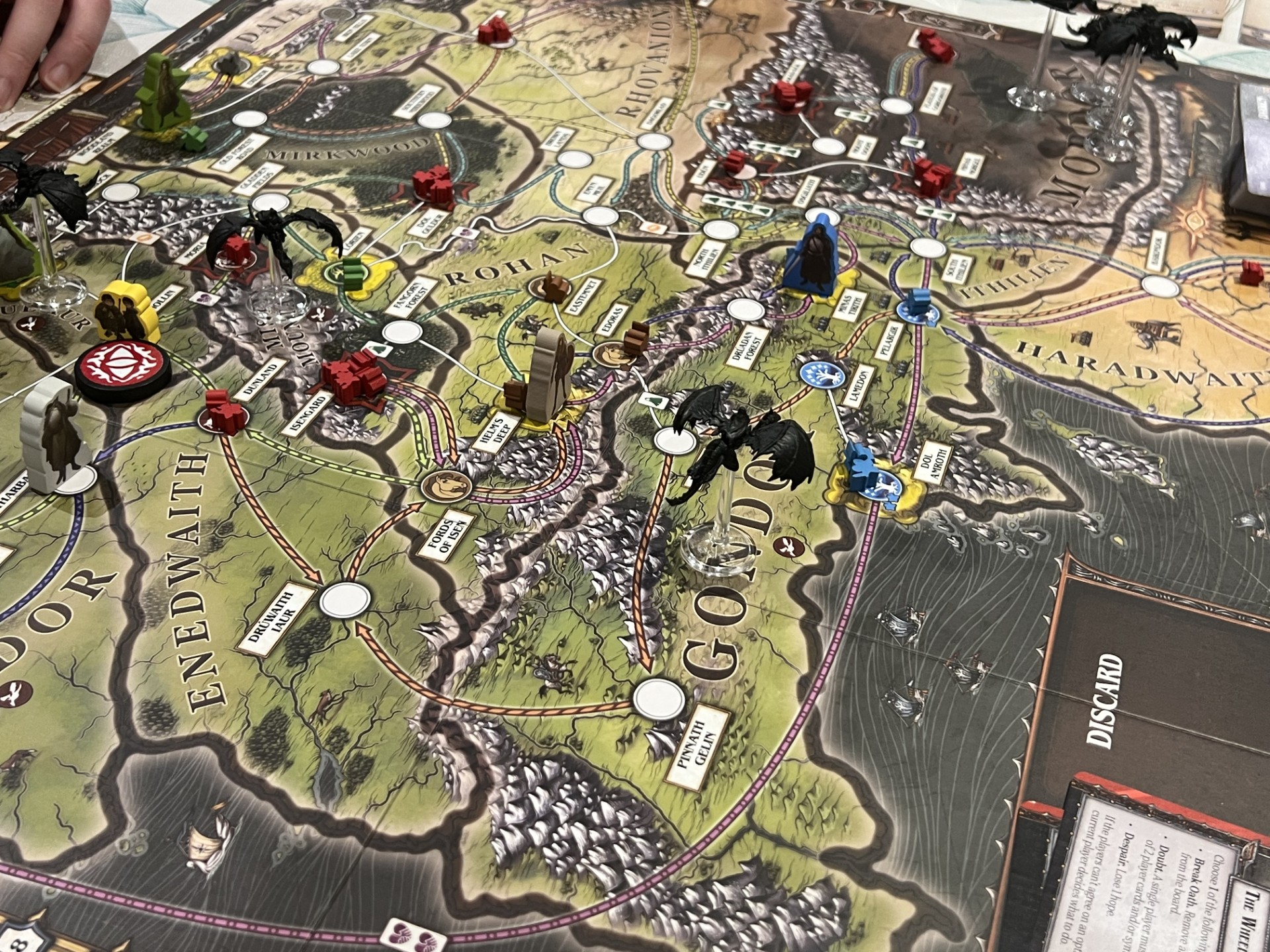
Let’s start with the basics. The Lord of the Rings: Fate of the Fellowship is a co-operative game where each player controls two characters (or perhaps three technically, because the Hobbits are grouped in pairs but act as one character) from the Lord of the Rings universe. You’re not just Frodo (with Sam) or Legolas. You’re Frodo/Sam and Eowyn, or Aragorn and Merry/Pippin. Each character has two or three deeply thematic and completely unique abilities. Legolas can use “Sure Shot” to remove enemy troops or send a Nazgûl packing back to Mordor. Eowyn has “I Am No Living Man,” which lets her slay a Nazgûl outright if the dice are kind and one is present in battle with her. She also recruits Rohirrim troops for free — because of course she does!
This asymmetry is one of the game’s strengths. You’re constantly weighing which character to activate, how to use their powers, and how to position them on the board. What makes this even more interesting is that on a turn, you’ll take four actions with one character and one action with the other. This gives the player options and allows you to make the most of almost every action, specifically depending on what the game state is and where each character is on the board.
Speaking of the board — it’s really, really nice. A sprawling map of Middle-earth, rendered in rich detail, with key locations like Helm’s Deep, Minas Tirith, and Mount Doom all clearly marked, along with many lesser locations that still have thematic ties to the books and movies. The small wooden troops fit perfectly into the spaces, and the printed character meeples add a splash of personality. Then there are the Nazgûl — plastic, floating and ominous – they don’t just look good, they look dangerous.
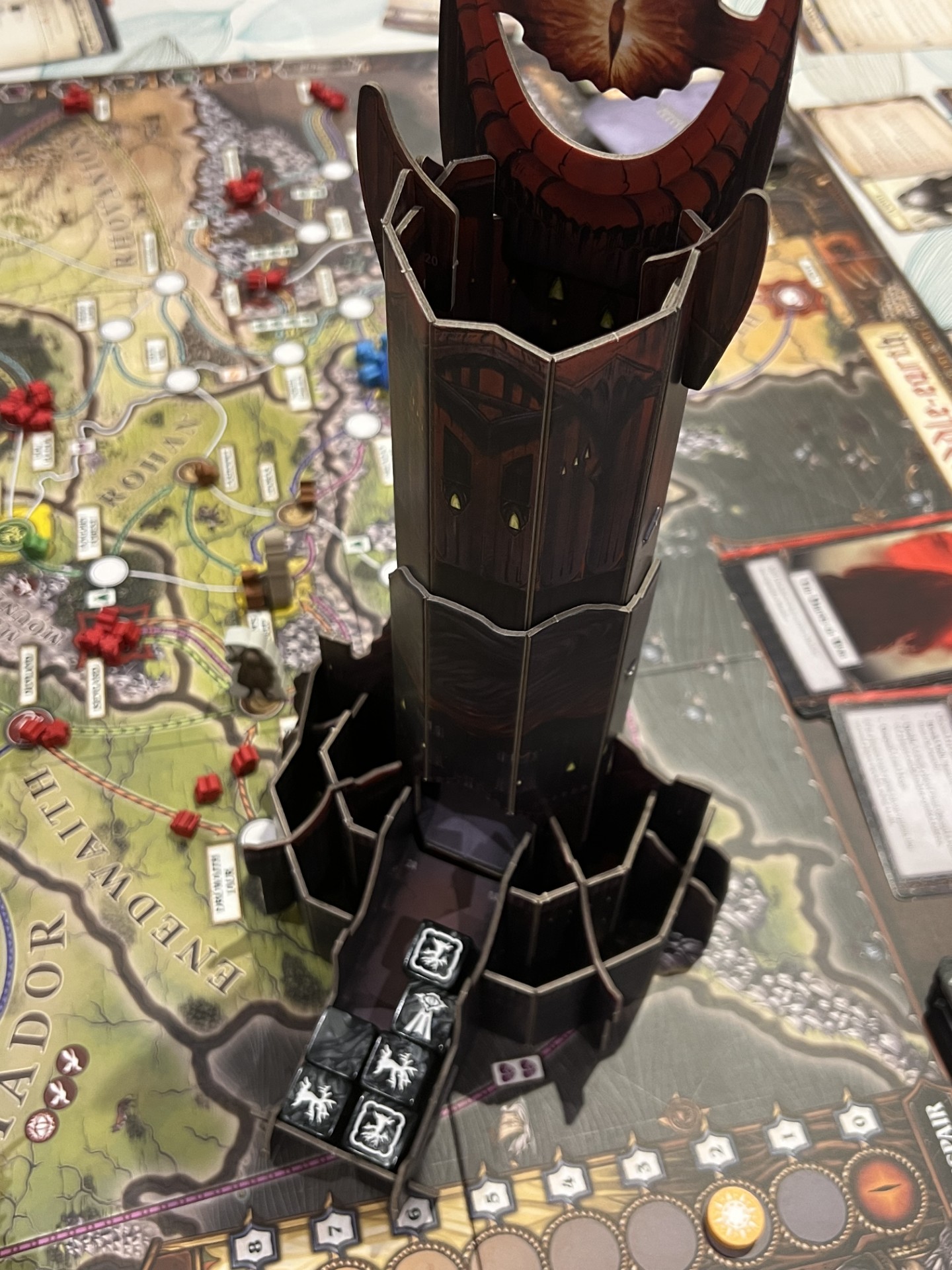
The thing is, these aren’t even the real showstopper in The Lord of the Rings: Fate of the Fellowship arsenal. That honour goes to the cardboard dice tower, which is not only a beautiful tactile and satisfying way to roll the custom dice, but also a means of adding theatrical flair to every combat. You drop the dice in, hold your breath, and hope the symbols fall your way. It’s silly, it’s dramatic, and it’s perfect for the narrative gameplay you’ll see unfold on the table.
Mechanically, The Lord of the Rings: Fate of the Fellowship is a bit of a beast when compared to the standard Pandemic, and it feels like the culmination of the system’s evolution. You’ve got troop movement and combat from Fall of Rome, thematic madness from Reign of Cthulhu, and a huge deck of dynamic objectives that I think I saw in The Clone Wars. That said, The Lord of the Rings: Fate of the Fellowship is not some Frankenstein’s monster. It’s a refined, cohesive experience that demands strategic thinking and rewards teamwork.
Each game presents a different set of objectives — drawn from 24 in total — along with a significant number of characters to choose from. That’s a lot of variety, and it means no two games feel the same. The main (and arguably only) loss condition in The Lord of the Rings: Fate of the Fellowship is the hope track dropping to zero, but objectives such as rallying the elves, crushing Isengard, bringing leadership to Gondor or even redeeming Boromir all add thematic flavour and mechanical support.
Ultimately, every game can only end successfully if the consistent fourth mission (destroy The One Ring) is achieved. The objectives are layered, branching, and often brutal. You’ll need to plan ahead, adapt on the fly, and make tough calls. I was surprised to see this dynamic inclusion in a Pandemic system game, and the number and variety of missions surprised me, as did their “stability.” Pandemic has always felt like a fragile game system to me — but it proves that it can handle almost anything.
When it comes to losing hope, the ever-watchful Eye of Sauron is always close by. It’s always watching, always advancing and always threatening to end Frodo’s journey. Mechanically simple, the Eye simply moves to Frodo’s location when either certain cards are drawn or when Frodo moves without using a concealment card or token. If the eye is already there and the same kind of card that would move the eye is drawn – hope will fall immediately.
As I mentioned above, the game is won if the group destroys the One Ring before Frodo loses all hope. That may sound simple, but it’s anything but. Frodo’s hope is a fragile resource, chipped away by Nazgûl searches, failed objectives, and unlucky dice rolls. You’ll spend half the game trying to protect him and keep the eye away from him, and the other half trying to push forward with objectives elsewhere It’s a delicate balance that creates urgency and tension, but amazingly, it also gives The Lord of the Rings: Fate of the Fellowship real scale.
Rarely have I played a game that conveyed the same sense of scale that The Lord of the Rings: Fate of the Fellowship does. Just as the books and films acknowledge that Frodo and Sam are just tiny parts of a huge, expansive world, often unaware of how they are affecting it, The Lord of the Rings: Fate of the Fellowship captures that feeling. Massive pitched battles can take place at one point of the map, whilst elsewhere Frodo and Sam — perhaps this time aided by some leftover member of the fellowship, or even (true to the original), by Gollum — sneak through shadowed paths into Mordor. It is, honestly, incredible and you simply must try it to understand what I am trying to convey.
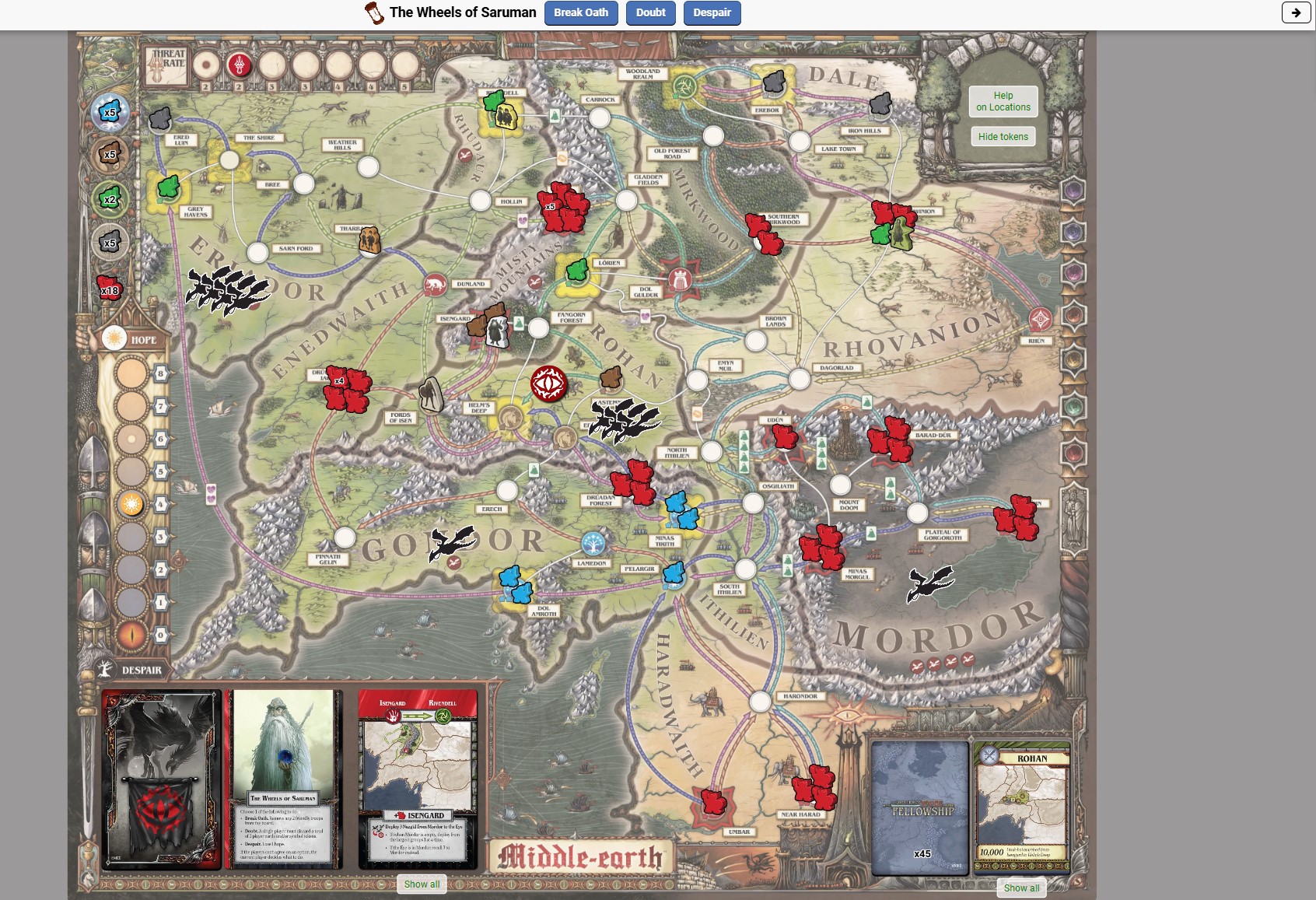
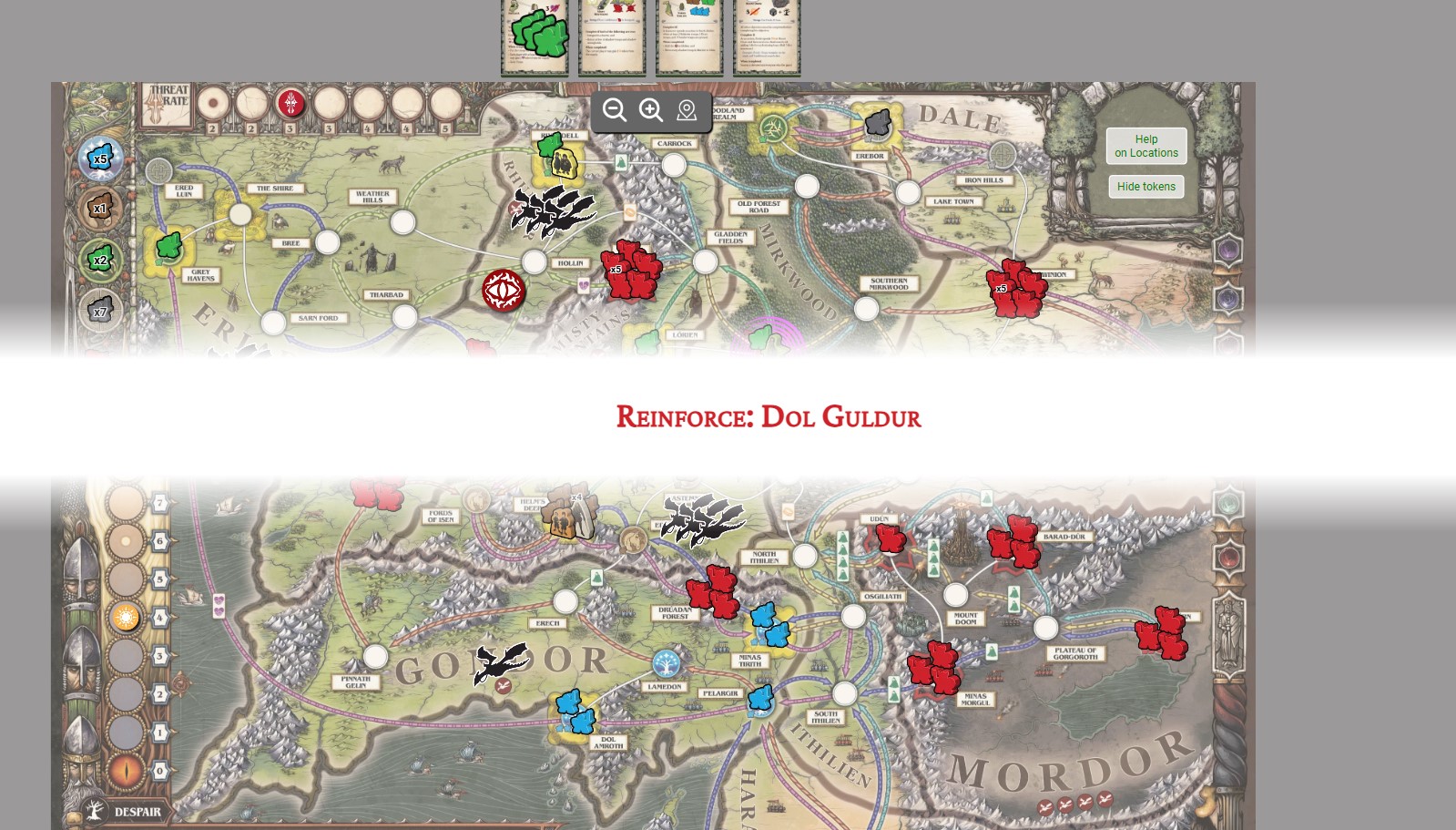
I am also delighted to report that there’s an excellent digital implementation. The Lord of the Rings: Fate of the Fellowship is available on BoardGameArena, and it’s a fantastic way to learn the rules or just to play a few solo games at your own pace. The interface is clean, the automation is smooth, and the tutorial helps you grasp the more complex interactions. For a game that has both mass appeal and quite a few intricacies, that’s invaluable.
As a possible downside, the complexity is real and The Lord of the Rings: Fate of the Fellowship isn’t a gateway game. It’s a puzzle, and it takes time to grok. You’ll need to understand troop movement patterns, character powers, event timing, and dice probabilities and there’s a lot written on character cards or player aids that can be missed. The rulebook is as solid as ever from Matt Leacock and Z-Man Games, but the first playthrough will be a learning experience. That said, once it clicks, The Lord of the Rings: Fate of the Fellowship is a dream. Turns flow quickly, decisions feel meaningful, and the tension never lets up.
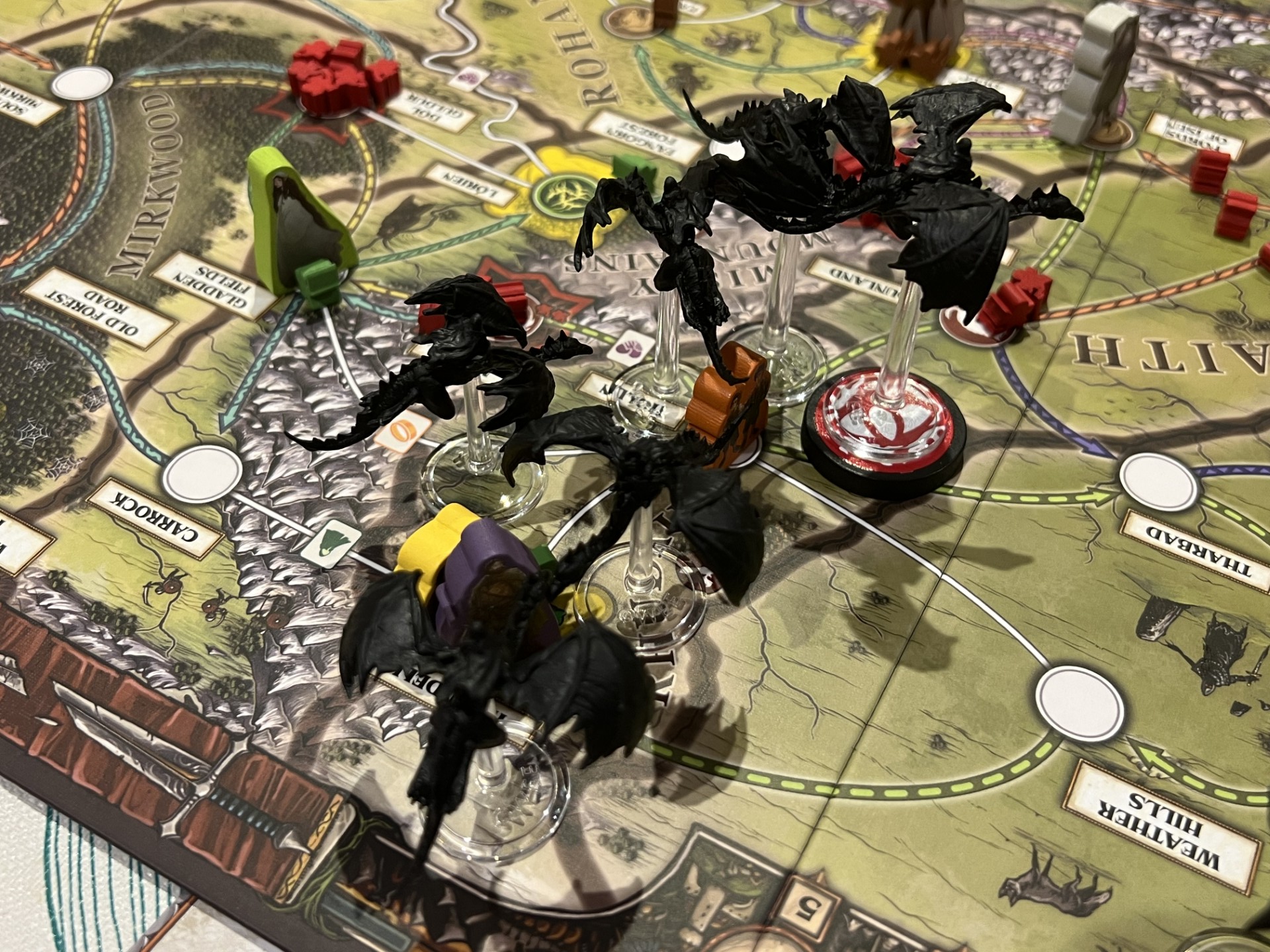
Component quality in The Lord of the Rings: Fate of the Fellowship is top-tier. The board is sturdy, the cards are well-printed, and the custom dice are chunky and satisfying. The character meeples are printed with unique art, and the Nazgûl miniatures add a touch of menace. The dice tower is a standout — it’s functional, thematic, and surprisingly durable. It’s the kind of component that elevates the whole experience.
Thematically, The Lord of the Rings: Fate of the Fellowship is a triumph. Every mechanic ties back to the story. Every character feels authentic. Every objective feels like a moment from the books. I’ve now played this game multiple times with many different objective sets and each time, I felt like I was not just playing a game — but living my own retelling of the Fellowship’s epic journey. As soon as I finished my first full game, I went to watch the movies for the hundredth time and then I played again on BoardGameArena.
That said, The Lord of the Rings: Fate of the Fellowship is not perfect. The complexity can be a barrier, especially for players new to the Pandemic system. The dual-character mechanic, while clever and satisfying, adds cognitive load, and the dice, while fun, can be cruel at times. You’ll have moments where a single bad roll derails your plans, and that can be frustrating, although in general there is perhaps more mitigation here than in most dice based games.
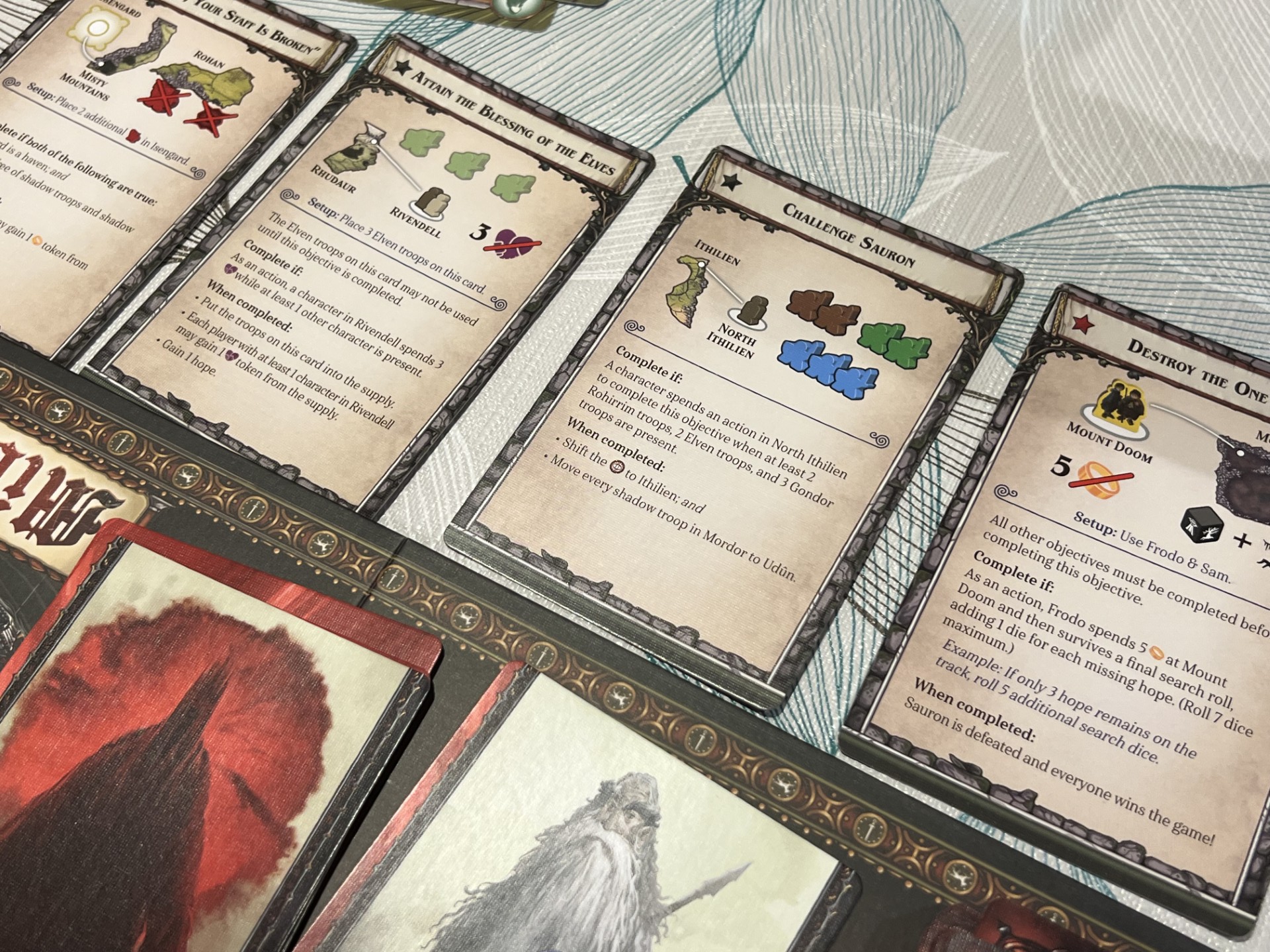
That said, the highs in The Lord of the Rings: Fate of the Fellowship outweigh the lows tenfold. When you pull off a perfect turn, when you slay a Nazgûl with Eowyn’s power, when Frodo reaches Mount Doom with hope intact ready for the final showdown — it’s magic. It’s storytelling through gameplay, and it’s unforgettable.
In fact, it’s so good that it’s really not comparable with the Pandemic system that it draws upon. I’ve long since abandoned the popular classic for more complex games, and so I came into The Lord of the Rings: Fate of the Fellowship thinking that it might be a simple reskin. If you’re thinking that, then like me, you simply could not be more wrong.
Rather, The Lord of the Rings: Fate of the Fellowship is a masterclass in thematic design. It’s complex, beautiful, and brimming with narrative tension. Whether you’re a Tolkien fan, a Pandemic veteran, or just someone who loves a good co-op challenge, The Lord of the Rings: Fate of the Fellowship is a game worth playing again and again.
The Lord of the Rings: Fate of the Fellowship is available now, from Amazon.
