

Crossover games are sometimes a simple re-skin (such as the inundation of Monopoly variants, and the many Risk reboxes) but others take the approach of cramming multiple games together through the use of Minigames. Dobble Catan is a marrying of two classics that feels very much like its own game, and is a rules-light time-respecting jaunt even for players who have never played either Dobble or Catan themselves. The only thing missing is some dice.
I’ll admit, in my shame, that I have never played Catan. I have played spin-offs and riffs on the formula (most recently the digital fantasy version Feed the Scorchpot) but I’ve never actually played Catan itself. Similarly, while my younger self was obsessed with Boggle, its similar-sounding-but-altogether-different ally Dobble has escaped my notice all these long years. Somewhere along the line I transitioned away from “party” games and into the tabletop / dungeon crawler / skirmish game rabbit hole.
Suffice to say, I was then unsure how I’d find Dobble Catan, a combination of two games I’d never played. Fortunately, Dobble Catan very much stands on its own two legs.
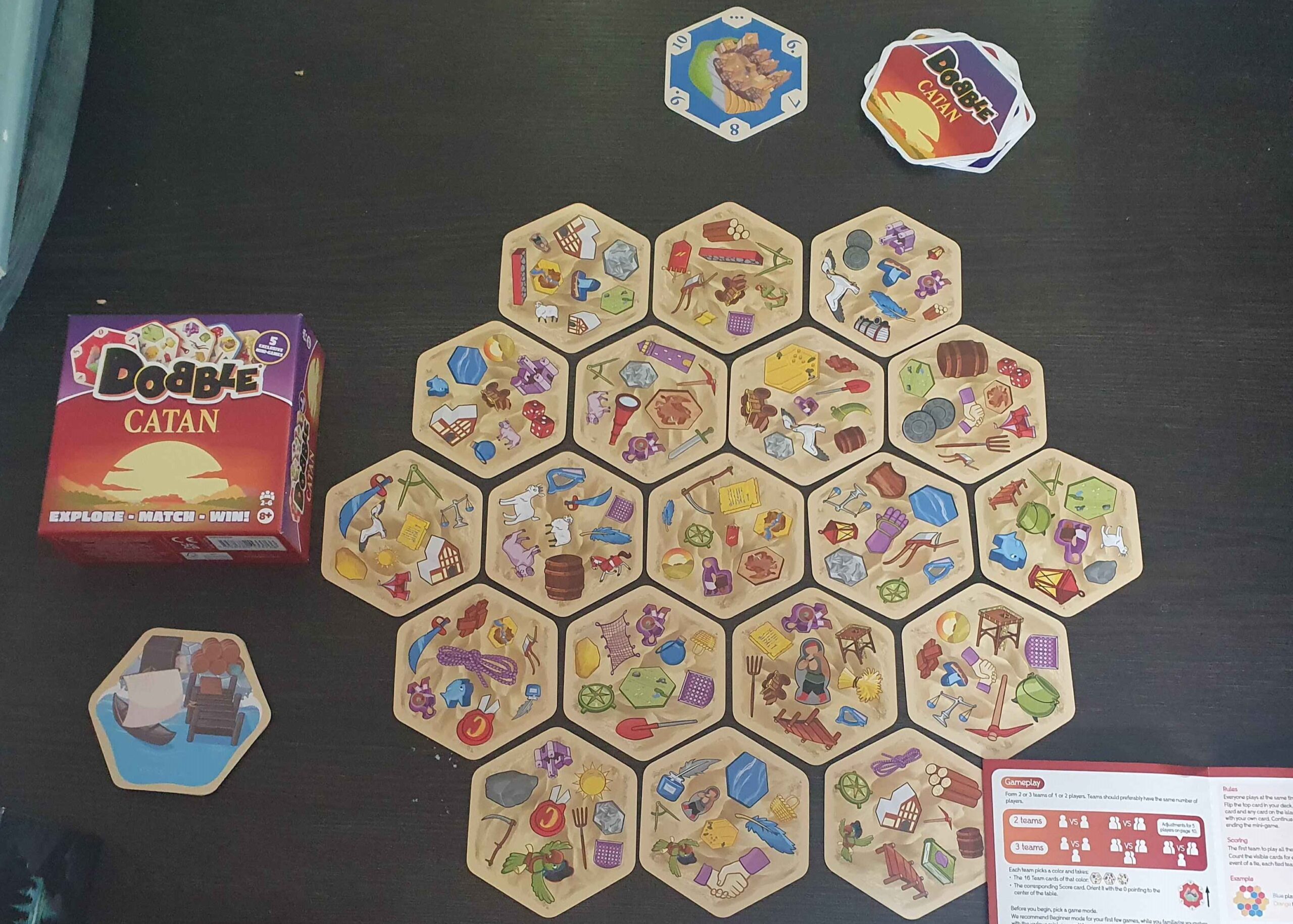
Dobble Catan makes something new with two known ingredients
The differences to either standalone Dobble or standalone Catan are evident right away. For one, there’s no dice and no marks, so the core Catan mathematics is out the window. Secondly, the tiles, filled with objects and symbols, are hexagons rather than the traditional Dobble circles, and there are decks with coloured outlines separate from the rest unlike a standard uniform Dobble pack.
There are three “team” decks of tiles and 19 “sand” ones. These 19 are arranged in typical Catan fashion to form the island of Catan, but similarities to its namesake go out the window pretty soon after that to make room for the chaos of Dobble. Once the map is set up, teams will compete in five back-to-back minigames to be the first to amass 10 points. Every minigame (except the last, which acts as a “race to the finish”) awards 1 point for getting rid of your hand of tiles first and 2 points for the bonus objective.
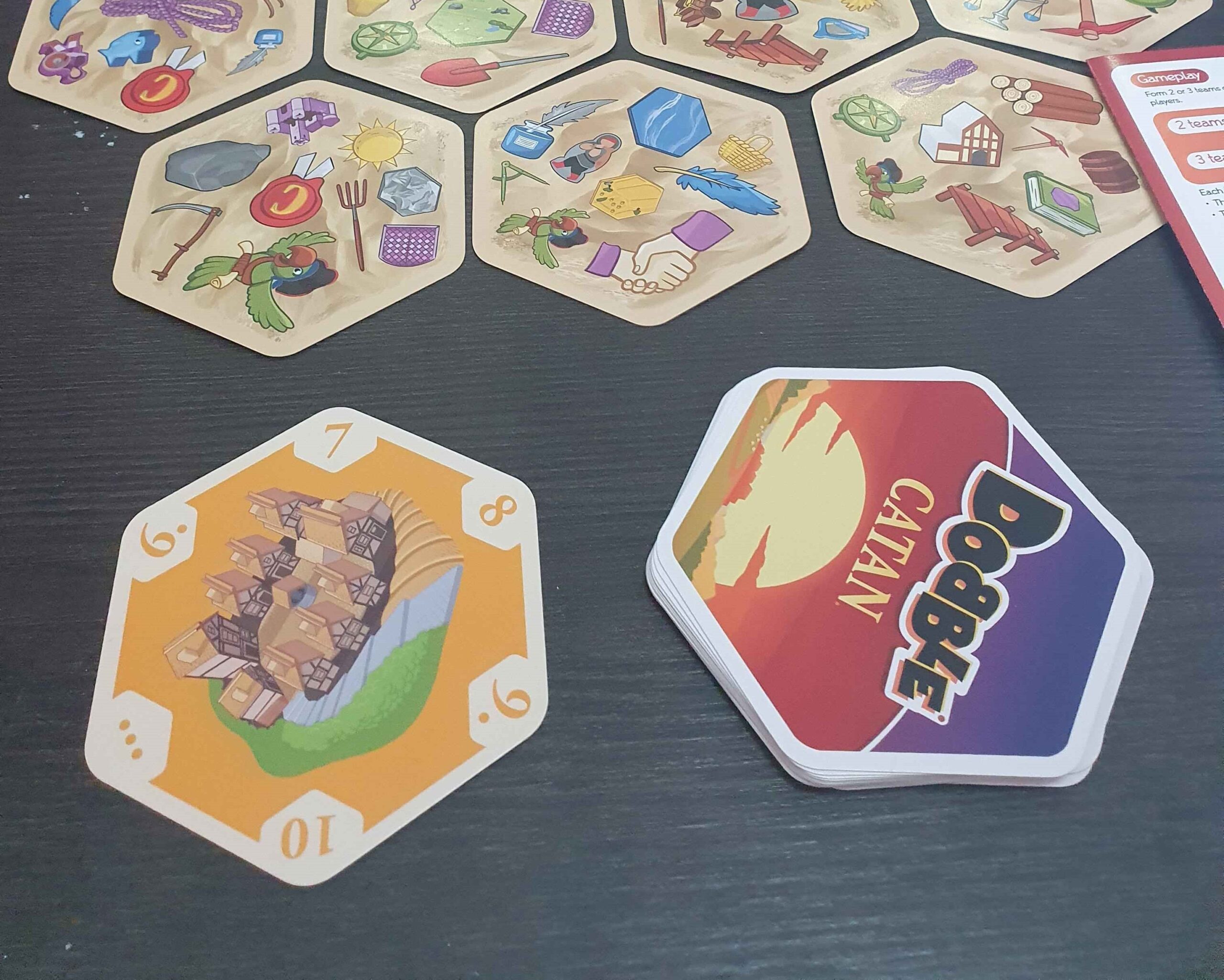
In all of these games you’re going to be drawing a tile from your team deck, comparing symbols on it to those on the island of Catan map, and slapping your colour down when you see a match (or, in Barbarians, stealing the tile from the island!). It’s a simple framework that each minigame then iterates on by providing new rules or a different bonus objective for the sought-after 2 points.
Just like Catan, placement and positioning matter, but just like Dobble your physical speed and observation skills can earn you the 1 point every round if you’re quick! Not to mention, once one team finishes placing tiles from their deck the round ends immediately. This means that the team to finish first gets the 1 point, but also snub the other teams the chance to finish placing tiles at all.
Dobble Catan’s five minigames are brilliantly paced for all player types
The real beauty in the design of this party-centric placement game is that each minigame has a hard cap on how long it can last, as players rush to place tiles and burn through their decks. This keeps things moving and enables players with more tactical processes to enjoy the game just as much as those basically just playing “Snap!”.
The minigames are played in a specific order from one to five, and that is a design decision that really makes Dobble Catan click for me. Rather than randomising the order, the pre-set list makes sure you get a fair showing of each minigame and also that the fifth minigame, “Knights” is always last. This is vital as “Knights” plays until one player wins, so rolling it second would make for a very short game.
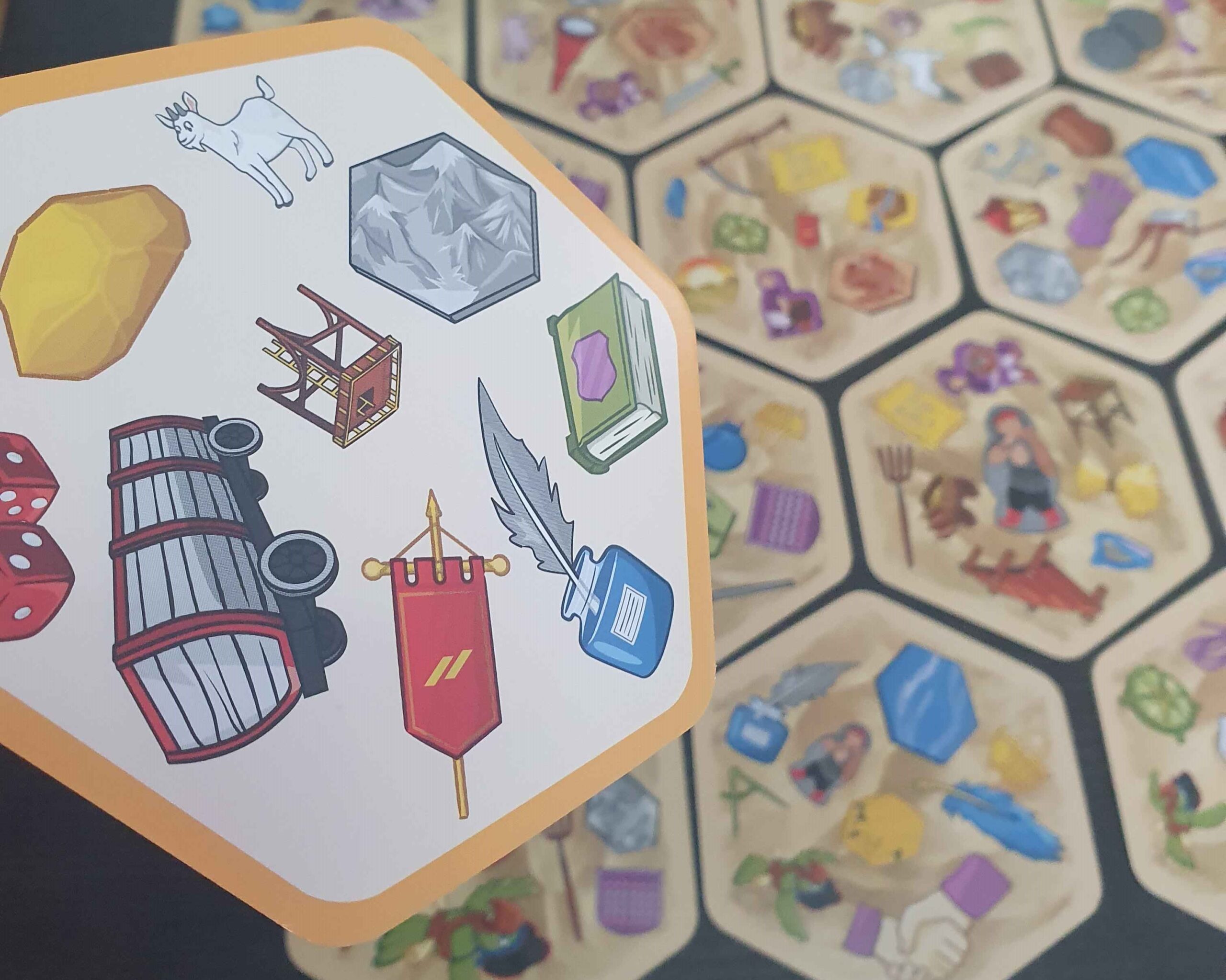
When playing the minigames there are two core rules: 1. The first to finish gets 1 point and 2. You can put your tiles on top of not only basic “sand” tiles that make the island, but also your opponent’s tiles too! Whoever’s colour is left on top of the stack of tiles when the round ends will claim that space.
The minigames are as follows:
Minigame 1 is called “Welcome to Catan” and familiarises players with how the hybrid gameplay works. You have your island of Catan in front of you and your deck of team cards. Simply draw a card, match a symbol to that on the island, and slap your tile over that one to claim that space. The first to finish gets 1 point while the team with the most tiles showing on the island gets 2.
This game works as a quick introduction to the core loop, and right away rewards faster players for their speed and tactical players for stealing spaces in equal measure.
Minigame 2 is called “Ports”. As the name implies, the island of Catan now gains Port cards around the edge. Unlike the first minigame, players only score the bonus 2 points for having Ports connected to their tiles leading to the center of the island. This means coverage isn’t as important as specific pathing, lending this minigame more to the slower, strategic thinkers.
Minigame 3 is called “Longest route” and does what it says on the tin. The minigame is much like the first but instead of counting the gross total of coloured tiles, you have to be able to string them together in a single route of adjacent tiles. Being quick helps disrupt an opponent’s plans but if you are careless then your entire route can be broken by one tile being stolen, leaving you out of the running for the 2 points.
Minigame 4 is called “Barbarians” and flips back to bring all about speed. Instead of drawing tiles and placing them on Catan, you draw a single tile per team. This tile tells you what you’re raiding Catan for, and you then snatch up any tiles from the island itself once you spot a match. This is a great palette cleanser after the more tactical Ports and Longest Route minigames, and gives younger players a chance to catch up.
Minigame 5 is called “Knights” and is a wild dash for the finish line. No matter how far from 10 points any team is, they can win here (although it will be substantially harder if you’re on 4 and your opponent is on 9, of course). Teams flip their top tile simultaneously and the first team to correctly call out the matching symbol between the teams’ tiles wins one point. This continues until a team reaches 10.
It’s a fantastically mad race for 1st place, with some flips resolving in mere moments while others you are convinced that no symbols match! But of course, it’s Dobble, so there’s always one matching symbol.
By the end of a game through all five minigames you have had a chance to be tactical, a chance to be chaotic, a chance to be physical and tactile with Barbarians and finally a chance to run on pure adrenaline in a more competitive mode. The pacing and progression of Dobble Catan is party-game genius.
Dobble Catan is quick and light, but not tied down to its predecessors
It was never going to be the single greatest game ever made, but as a crossover it serves both ideas respectfully and as a standalone game it provides a great mix of strategy, speed and chaos. About the only downside is the lack of any marks or dice, two components that are key to Catan. After playing a few games, though, you soon realise those elements would only serve to pull Dobble Catan closer to Catan and away from being its own unique entity. You don’t need to have played Dobble or Catan to enjoy Dobble Catan and that’s no bad thing, so perhaps keeping the dice for the classics is best.
Dobble Catan is available now, and can be found on Amazon.
