
Feed the Scorchpot is a surprisingly cerebral dice game
The roguelikes will continue until morale improves.

In a nice twist from “videogame genre but roguelike”, new indie darling Feed the Scorchpot is actually “board game genre but roguelike” and this subtle difference carries into every facet of the game.
Dice rolls are a key part of the mechanics and vibe but also the screen is relatively static, with the “board” in front of you in its entirety for the full run. Every building you place, every coin you spend and every dice you keep across the whole board can make or break a run, making Feed the Scorchpot the most cerebral and challenging game of this type I have played. You can still get to game-breaking levels of “flavour” (Feed the Scorchpot’s score system), but achieving those combos is incredibly difficult compared to genre favourites Balatro and CloverPit.
Feed the Scorchpot’s premise is a novel beginning to a ruthlessly mathematical puzzler. You are tasked with feeding a dragon for 20 years, but to do so you need to harvest ingredients, learn recipes and deliver it all into the titular Scorchpot. Each year you have between three and six Seasons to add Flavour to the pot. Like all good Balatro-likes, including the excellent Lucky Shot I reviewed just the other week) there’s score and multiplier. In the case of Feed the Scorchpot this is “fodder” (the raw number of ingredients you harvest) and “flavour” (a multiplier to fodder based on what buildings and recipes process the fodder).
With the basics of the genre down, what does Scorchpot do with them?
Feed the Settlers of the Catan Scorchpot
The basic run structure involves a single, wholly-visible island map. Each hex is marked with a number, which represents its activation requirement. Every season you roll three dice (or more as you build Shrines on your island) and these dice give you a number of “marks”. A mark is any number you could get by combining two of your rolled dice.
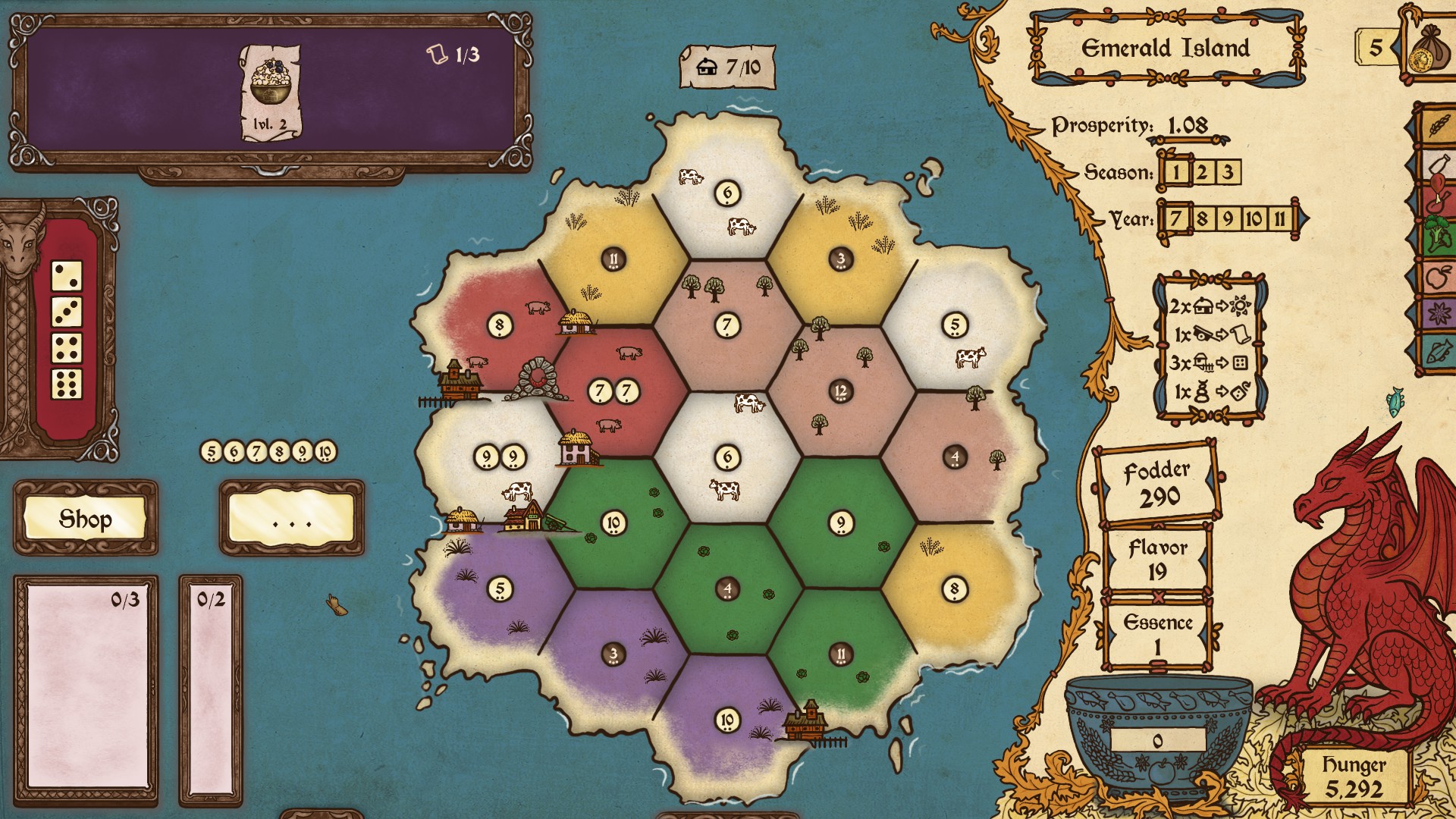
For example, if you rolled a 3, 5 and 6 then your marks are 8 (3 + 5), 9 (3 + 6) and 11 (5 + 6). The areas marked with 8, 9 and 11 on the map will activate, and any buildings such as farms, dairies, homesteads and trading posts will activate if they are in contact with these spaces. Even at its most simple, this idea already has you deciding which dice to re-roll and which to keep, and requires a working knowledge of D6 (six-sided die) probabilities.
While it sounds complicated, the tutorial run leaves you to your own devices after the first few years and I sailed through to year 20 with relative ease. It’s a bit of a false sense of security, and false hope, because those first few years of all your future runs are absolutely relentless. I lost run after run before year four because you need a perfect start to meet the hunger requirements, which was a little disheartening after seeing all the build variety and playing about with optimisations in year 35+ on my first run.
Feed the Scorchpot is brimming with flavour
The vibe of the game is on-point, with both the boardgame feel and the food-related mechanics. It really does feel like playing solo Catan at times, especially being at the mercy of your marks, but then the videogame-ness shines through when little dragons fly across the screen, or a recipe lets you make a ridiculous amount of flavour (multiplier) for your build.
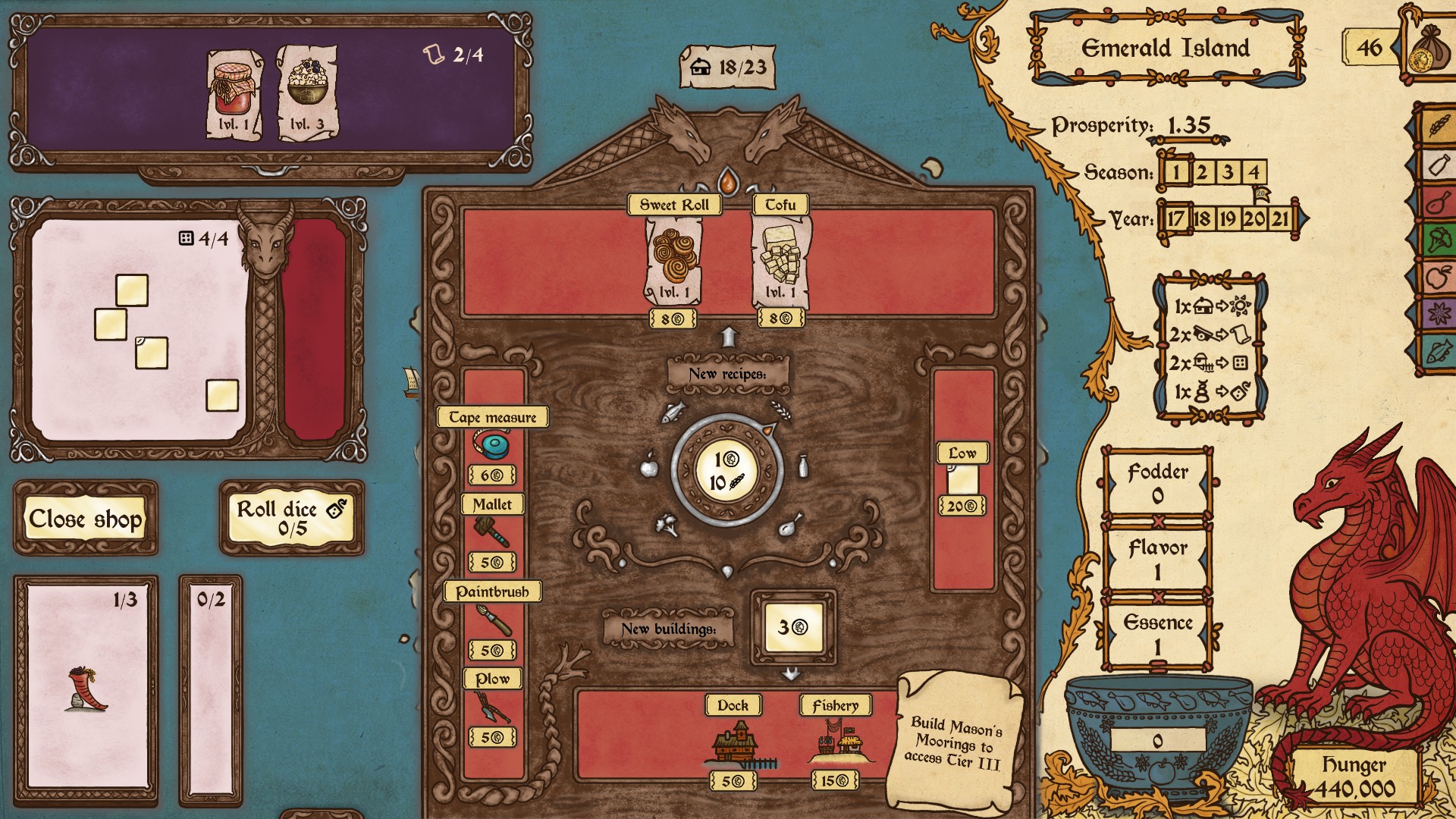
Speaking of recipes, these are conditional cards that you can select only a limited number of each season, which usually add flavour. They have an activation cost in specific resources, so if you have a recipe that needs 30 dairy then you need to make sure that your dice rolls always result in at least one mark of a space with dairy.
This slowly narrows your desired pool of dice, and that’s where the real big-brain planning comes into things. If I know I need milk, and I know my available milk farm is a mark of 10, that tells me a few things. Firstly, 10 can only be made on two D6 by rolling a 5 and 5, or a 6 and 4. These are the only two combinations, as you cannot roll a 7 on a D6. This means having any other farms, for other ingredients, with marks less than 5 is nonsensical…
Degree in statistical probability optional (recommended)
Do you see why? Because every single season I will always want either a 5 and a 5 or a 6 and a 4 (to make my 10 mark). I will never be keeping dice below a 4, which means I’ll never be adding 1, 2 or 3 to my other dice. This means that marks of 2, 3, 4 and 5 will never trigger on my run (if I plan to harvest that 10 mark milk space every turn). This is where the Warhammer 40,000 player in me really has to work overtime, and I can’t imagine the difficulty of someone with no prior probability experience learning Feed the Scorchpot’s system to the extent you need to.
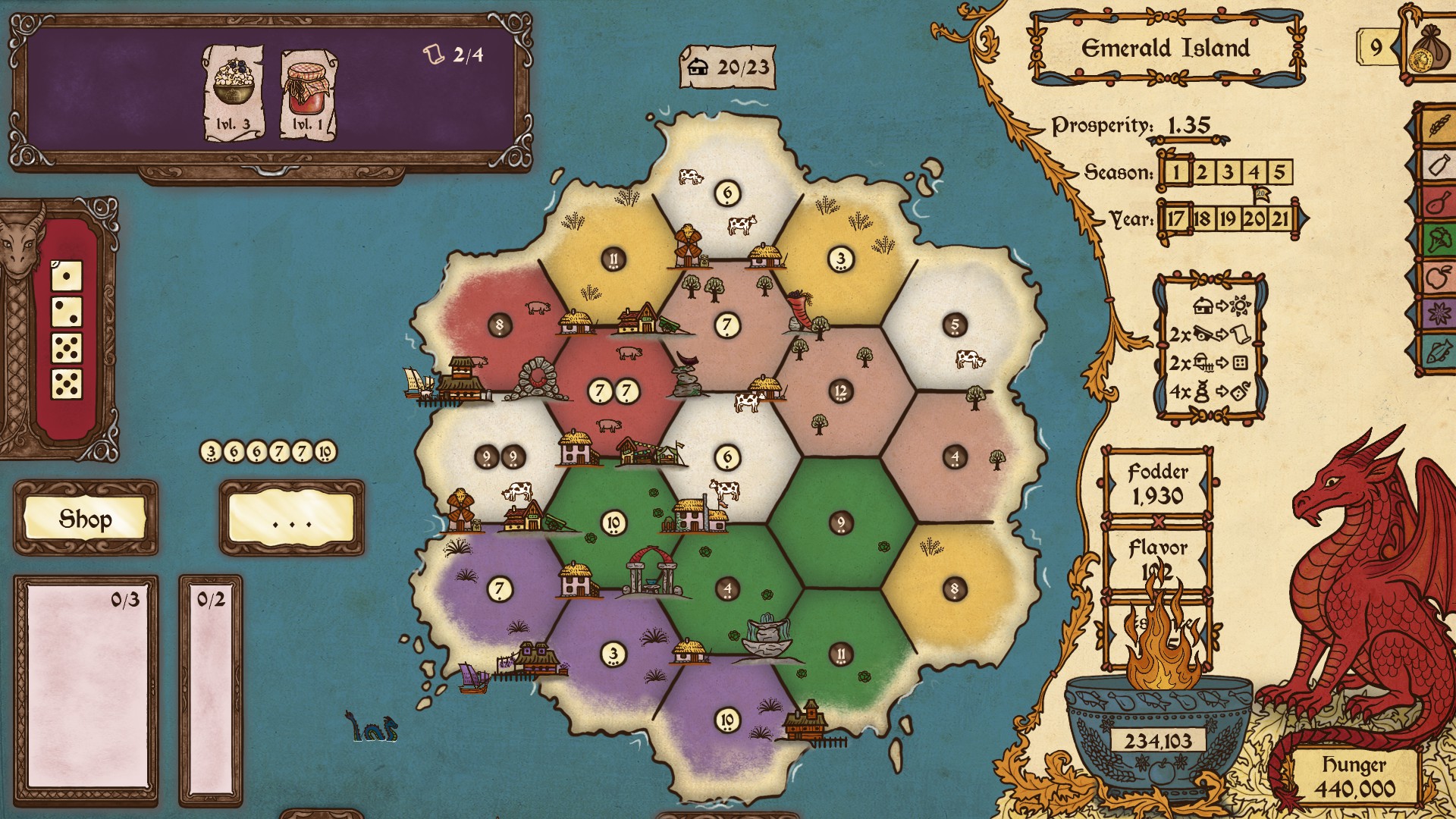
See, I’m a Deathguard player in the popular tabletop wargame Warhammer 40,000 — this means I know that 7 is the most statistically likely result of any 2 dice faces combined. Starting your island based around a 7 Mark space is a smart choice, but there’s more. Let’s say you’ve got a Mark 10 space like before, but now also a Mark 7 space you want to routinely activate. The Mark 7 can be used with any dice face, but the Mark 10 will always need a combination of 4, 5 or 6. This means that your 7 mark will need to be activated using those 4, 5 and 6 rolls you need for the 10 mark. So, you’ll need either 5, 5, 2 to make one 10 mark and two 7 marks, or you’ll need 4, 6, 3 to make one 10 mark, one 7 mark and one 9 mark. Now you know you’ll be routinely generating 9 marks when aiming for the 7 and 10 together, so you could build a farm on a 9 mark space to capitalise on that probability…
It is, frankly, a bit of a rabbit hole.
You can mathematically only get certain Marks per roll, and some Marks are mutually exclusive.
Game-changing recipes and tools try to stop the game being pure maths
The game does try to lean-off the mathematical Warhammer 40,000 brain a little, as you can add more dice into your pool, change Mark numbers and even duplicate them via tools. Being able to create a space that has three different marks (which can all trigger at once) can make balancing your probabilities a lot easier, as at least you have back-up marks if your dice aren’t being kind.
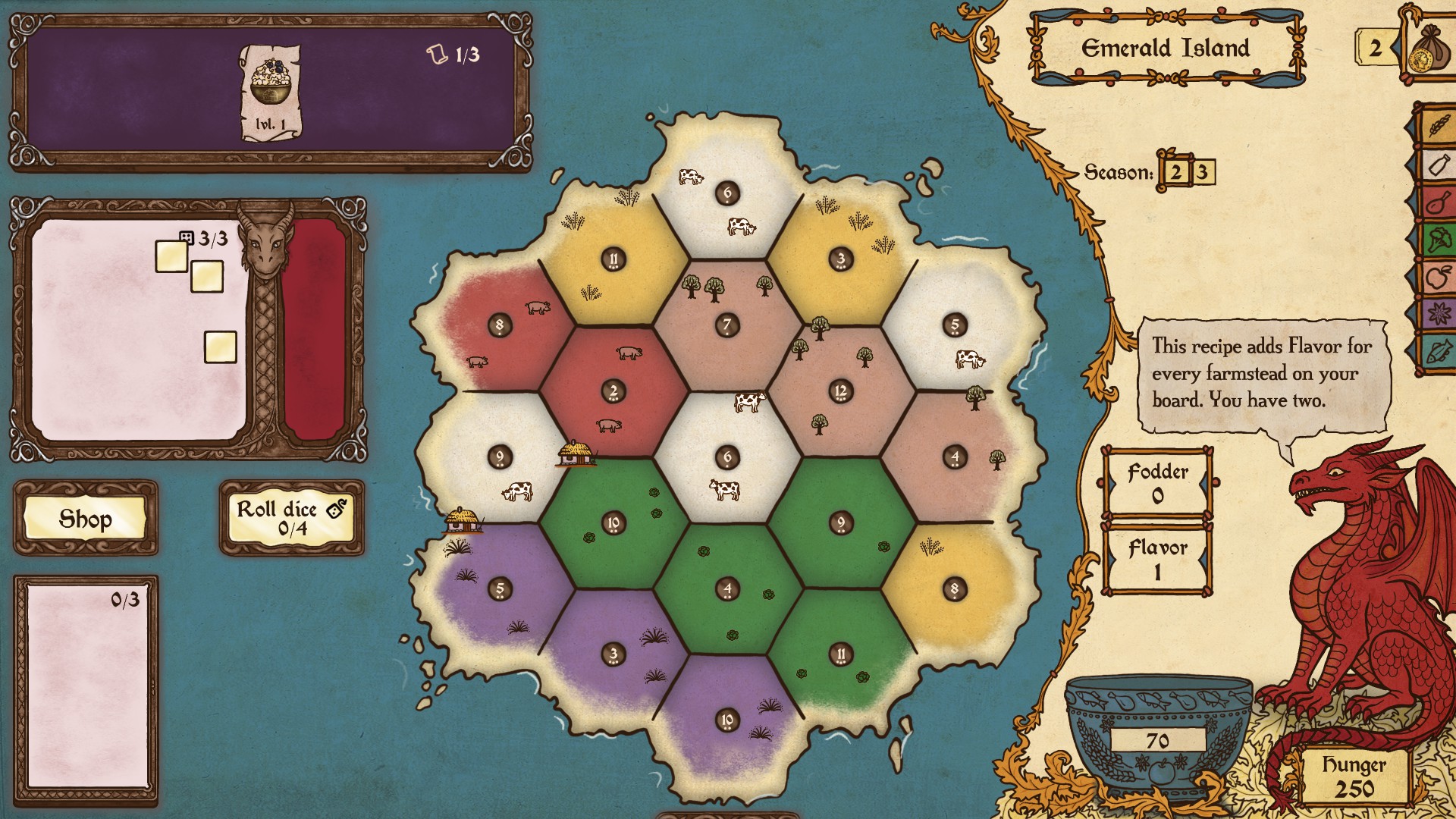
You don’t have to be a probability god to play the game, but it certainly helps get to grips with just how deep the mechanics go. This also only lasts a short while, as when you ascend the difficulty levels it does become impossible to progress without a high level of probability calculation and deep understanding of D6 rolls, which does dampen the vibe a little (especially when your calculations were correct, but the hand of fate says otherwise).
Nerdy, soulful and niche in a saturated genre
All of the nicks and knots in Feed the Scorchpot aren’t the result of bad design or a failed delivery. In fact, it’s a brave stubborn-ness to make the game the dev clearly wanted to, which I respect hugely. Feed the Scorchpot isn’t the next Balatro because everyone knows how to play Poker, but far fewer people know how to play Catan. That’s okay, though, because Feed the Scorchpot does exactly what it set out to do.
I have actually seen a lot of the development journey for this game in an indie dev group I frequent, and the developer has been nothing short of communicative, honest and authentic. If you love Catan and want to play solo with some extra videogame-y shenanigans, then this game is perfect for you. Or, maybe you just want something a little more cerebral than the genre’s saturated catalogue, with a beautiful “tapestry art” style to-boot! Feed the Scorchpot might not be for everyone, but don’t let that stop you seeing if it is for you.
Feed the Scorchpot is available now on PC via Steam
